Best Master's in Sociology Programs in Kansas
Compare 5 accredited Sociology programs in Kansas at 4 schools, with graduate earnings, cost, debt, and completion data from IPEDS and the U.S. College Scorecard.

Listed in-state tuition for a sociology master's in Kansas runs from $7,986 at Wichita State University to $11,971 at the University of Kansas, and the lower sticker price does not always mean the cheaper degree. The state has a small, focused set of options, so choosing well comes down to cost, funding, and format.
The ranking covers every eligible program, campus and online, on one page, with the first-place pick, GRE policies, assistantships, and career outcomes.
Emporia State's online format and the campus programs at Kansas and Wichita State solve different problems.
Key Points
- For 2027, University of Kansas offers funded assistantships with tuition waivers.
- In 2027, Emporia State offers fully online sociology M.A. with 7-week sessions.
- A sociology master's alone qualifies for no Kansas license in 2027.
Best Master's in Sociology Schools in Kansas: Ranked List
The University of Kansas opens the ranking, and the single factor separating it from the rest is its funded graduate pathway: sociology students can receive multi-year teaching or research assistantships with full tuition waivers and stipends while completing a 30-credit exam-only terminal MA or a 36-credit thesis route that can lead to doctoral study. Emporia State contrasts with a fully online applied format, and Wichita State offers a campus-based evidence-based practice track.
University of Kansas
#1Lawrence, KS · $12,000 – $27,000/yr (est.)
Best for: Research-oriented students planning doctoral study
KU pairs a theory and methods core with electives in inequality, political sociology, health, gender, and political economy. Students can choose a 36-credit thesis route that can lead into the PhD or a 30-credit exam-only terminal path. Graduate tuition and fees run $12,102 in state and $30,432 out of state, with an institution-wide average net price after aid of $18,059. The institution-wide graduation rate is 68.8 percent.
- 36-credit thesis route or 30-credit exam-only terminal path
- GRE required for admission
- Fall entry only with January 5 deadline
- 15 prerequisite sociology credit hours required
- Three letters of recommendation and writing sample
- Electives in gender, inequality, and political sociology
- Pathway available to continue into PhD program
Emporia State University
#2Emporia, KS · ~$9,000/yr (est.)
Best for: Working professionals needing online applied tracks
Emporia State's applied sociology department offers a fully online 30-credit master's with two career-focused tracks: Community Leadership and Criminal Justice. Courses move through accelerated seven-week sessions, and students complete a capstone or thesis with a community partner. Graduate tuition and fees run $7,106 in state and $15,419 out of state, with an institution-wide average net price after aid of $16,261. The institution-wide graduation rate is 56.1 percent.
- 30-credit fully online applied sociology degree
- Accelerated seven-week sessions, six per year
- Complete in about 12 months
- Capstone or thesis with a community partner
- Core courses in theory and qualitative research methods
- Leadership for social justice and community building
- Three references and statement of objectives required
- Criminal Justice concentration in the online applied program
- Crime causation and prevention coursework
- Criminal justice organization and community policing
- Scholarships available
Wichita State University
#3Wichita, KS · ~$8,000/yr (est.)
Best for: Applied learners focused on social services
Wichita State's campus-based MA in Sociology emphasizes sociological theory, research methods, and social justice, with both thesis and non-thesis options and a required applied learning experience. Admission requires a 3.0 GPA, college algebra, 12 social science credits, three professor references, and a 500-word statement of purpose. Graduate tuition and fees run $9,684 in state and $19,869 out of state, with an institution-wide average net price after aid of $13,194. The institution-wide graduation rate is 51.0 percent.
- 32-credit two-year program
- Thesis and non-thesis options
- Applied learning experience included
- 3.0 GPA admission requirement
- College algebra and 12 social science credits required
- Three professor references and 500-word statement
- Sociological practice internship option
Cost & outcomes by school
Federal data for the highest-earning Sociology programs, independent of the ranking above. Earnings are this field's master's graduates four years after completing, where the Scorecard reports them.
| School | Earnings | Tuition / yr | Debt | Grads/yr | Format |
|---|---|---|---|---|---|
| Emporia State University KS | — | $8,843 | — | 9 | Online |
| Wichita State University KS | — | $7,986 | — | 4 | Campus |
| Kansas State University KS | — | $12,089 | — | 5 | Campus |
| University of Kansas KS | — | $11,971 | — | 2 | Campus |
Sources: U.S. Department of Education. Tuition and graduates: IPEDS. Earnings and debt: College Scorecard, this field's master's graduates; a dash means no figure is reported.
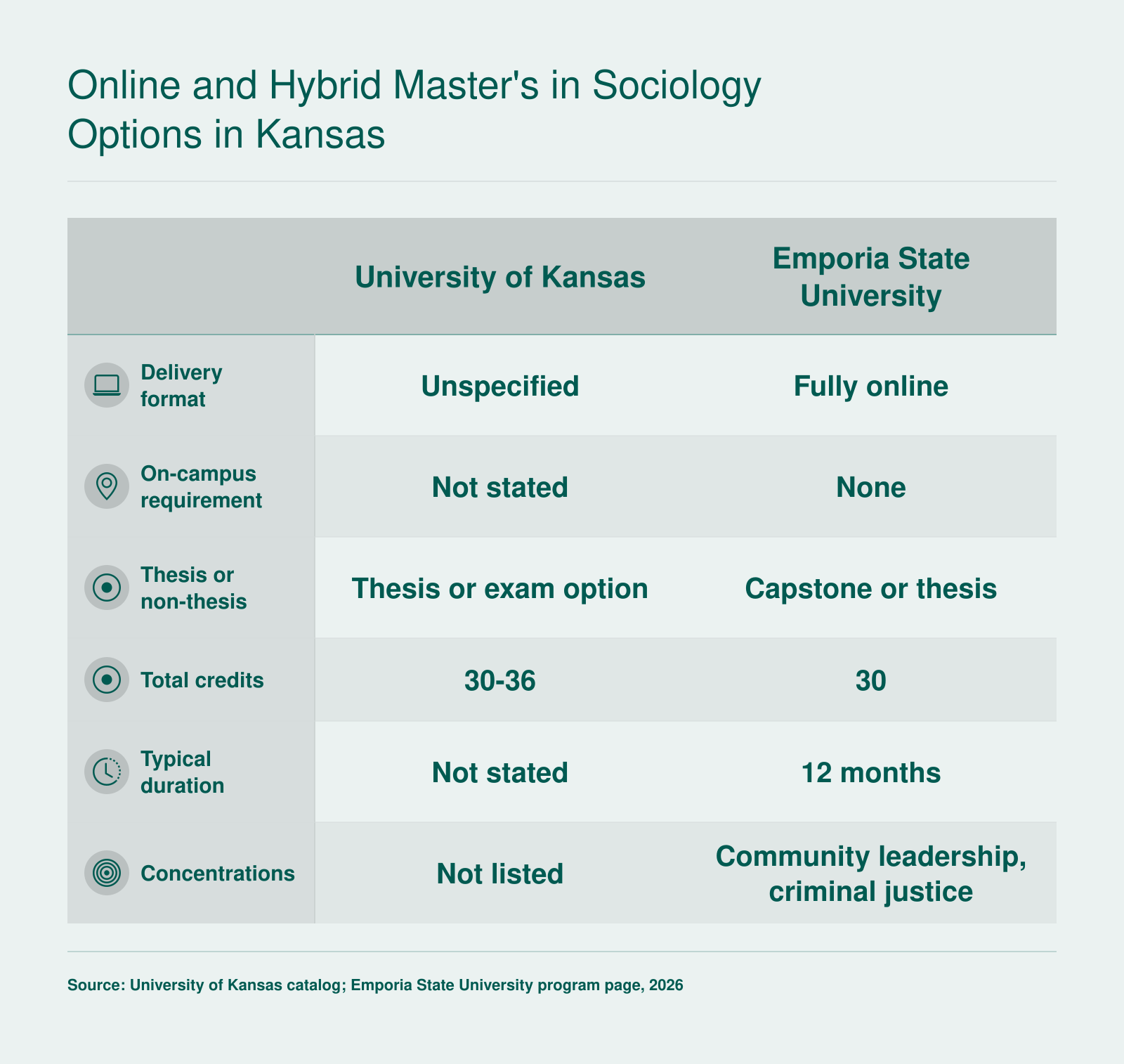
Online and Hybrid Master's in Sociology Options in Kansas
Among the schools ranked here, Emporia State University's applied sociology M.A. is the clear fully online option, with 7-week sessions and no in-person requirement. The University of Kansas does not state that its sociology M.A. can be completed fully online, so working adults should confirm current delivery before applying. Campus-based options, where offered, often bundle assistantships, a trade-off against online flexibility.
Which Kansas Sociology Master's Programs Waive or Make the GRE Optional?
GRE requirements are one of the first practical filters when comparing Master's Programs in Kansas: a required score can compress your timeline, while master's programs with no GRE required shift the weight toward your writing sample, references, and academic record.
University of Kansas
The sociology MA requires GRE scores for Fall 2026 applicants.1 The fall application deadline is January 5, with no late applications and no spring intake. Admission also depends on 15 sociology credit hours including theory and statistics, three academic recommendation letters, a writing sample (a senior or master's thesis is preferred), and transcripts from all colleges attended.
Emporia State University
Emporia State's MA in Applied Sociology does not require the GRE, placing it among Master's in Sociology Programs With No GRE Required. No 2026 application deadline is published, so confirm the current cycle directly with the department. Materials include a statement of objectives, three references, and transcripts: an unofficial bachelor's transcript at application, then official transcripts showing at least 60 credit hours and final grades from all colleges attended.
Apply by the priority or funding deadline even if an admissions page lists a later general date; assistantship decisions are often tied to the earlier date.
Related Articles
Cost, Assistantships, and Kansas Licensure or Certification
Sticker price and real cost can point in opposite directions here. A cheaper online program, even among the Best Online Master's in Sociology Programs, may still leave you paying more out of pocket than a campus program that comes with a paid assistantship.
Tuition compared
Federal program-level figures put Wichita State lowest at $7,986 in-state and $16,873 out-of-state. Emporia State follows at $8,843 and $19,154, and the University of Kansas is highest at $11,971 and $27,146. These figures date from 2022, so use them to compare schools rather than to budget.
Current 2026-27 per-credit rates were not confirmed, so a firm total-degree estimate would be a guess. Credit requirements are 32 at Wichita State, 30 at Emporia State, and roughly 30 to 36 at KU (the thesis option takes 36). Multiply each bursar's current rate by those hours for your own number.
Assistantships and waivers
KU is the clearest on funding. Its 2026-27 graduate teaching assistantships pay $20,084 and include a full tuition waiver, with KU covering 75% of the health insurance premium.
Emporia State says assistantships may carry waivers, generally tied to a 20-hour-per-week appointment and prorated for split appointments. It does not state a stipend or waiver amount, so confirm both with Graduate Studies and the hiring department. Wichita State's assistantship terms were not confirmed, so ask the department directly.
A funded KU position can turn the highest sticker price into the lowest actual cost. Program-level debt figures are not reported for these programs, so compare written funding offers across sociology master's programs with assistantships instead. Licensure is covered in the next section.
Kansas Licensure or Certification for Sociology Master's Graduates
What Can You Do With a Master's in Sociology in Kansas?
What jobs does a master's in sociology actually lead to in Kansas? The degree trains you in research design, data analysis, and social theory, and graduates generally follow one of a few paths.
- Research analyst: Methods and statistics coursework prepares you to analyze survey and administrative data for agencies, health organizations, and private employers.
- Program evaluator: Applied training, such as the grant proposal writing and community-partner capstone in Emporia State University's Applied Sociology program, maps directly onto assessing whether social programs work.
- Community college instructor: A master's is commonly the credential these teaching roles ask for. Wichita State University lists teaching career preparation among its program goals.
- Nonprofit or state agency policy work: Wichita State also points to nonprofit and social services careers, and Emporia State's Community Leadership concentration targets the same space, which overlaps with MPA programs in Kansas.
Continuing to a PhD
The University of Kansas offers a terminal MA, but it also provides a pathway into its PhD program for students who want an academic career. Wichita State likewise describes its thesis track as preparation for doctoral study.
If you plan to stop at the master's, the applied options at Emporia State and the non-thesis route at Wichita State fit that goal. If a doctorate is the plan, the thesis track is the stronger choice.
How We Rank Kansas Sociology Master's Programs
Prestige-based rankings reward a university's name, while outcome-based rankings reward what students actually pay and earn after graduating. This list takes the second approach. Each program is compared on graduate tuition, average net price after grants and aid, institution-wide graduation rate, program-level earnings and debt reported by the College Scorecard, and whether the degree is offered on campus, online, or in a hybrid format; the same measures underlie our ranking of the most affordable master's in sociology programs.
Accreditation is the baseline check. The University of Kansas and Emporia State University are institutionally accredited by the Higher Learning Commission1, which the U.S. Department of Education recognizes. Sociology has no specialized programmatic accreditor1, so institutional accreditation is the credential that matters. A degree page calling a sociology MA "accredited by the Higher Learning Commission" refers to the university's accreditation, not a sociology-specific one. Confirm any school's current status in the HLC directory before applying.
Two limits are worth knowing. Graduation rates cover the whole institution, not the sociology department alone. Net price is an average, so your actual cost depends on residency, assistantship funding, and aid.
Compare Sociology programs on the data that matters
Explore more Social Work & Social Sciences specializations or browse every graduate field.
All Social Work & Social Sciences programs