Best Master's in Sociology Programs in New York
Compare 25 accredited Sociology programs in New York at 11 schools, with graduate earnings, cost, debt, and completion data from IPEDS and the U.S. College Scorecard.

A master's in sociology in New York forces a hard cost question: whether a private university brand justifies the tuition premium when CUNY and SUNY programs charge a fraction of the price. Published graduate tuition among the schools ranked here spans roughly $7,300 at CUNY City College to $71,800 at Columbia University.
That spread matters because sociology graduates enter nonprofit, research, and public-sector roles where salary ceilings arrive quickly, making debt load the deciding variable. Program-level earnings remain unpublished for many of these degrees, so tuition is the clearest comparison.
Key Points
- CUNY Hunter College charges New York residents $470 per credit for 2027 graduate study.
- Hunter says the GRE is no longer required, while several ranked schools publish no policy.
- Fully online sociology master's degrees are scarce in New York, so most programs expect campus attendance.
Top 10 Master's in Sociology Programs in New York, Ranked
These ten New York programs are listed in ranking order, with campus, hybrid, and international-partnership formats side by side. Graduation rates mentioned below describe each university as a whole, not its sociology program. Program-level earnings are not yet published for any of these programs, so we leave earnings out rather than estimate them. Where our research did not confirm a fall application deadline, we say so and suggest checking the department page.
Columbia University in the City of New York
#1New York, NY · ~$58,000/yr (est.)
Best for: Aspiring urban ethnographers
Columbia's M.A. in Sociology is a free-standing, one-year degree that pairs academic training with independent research. It specializes in ethnographic methods applied to urban environments, while also accommodating quantitative, international, education, and historical projects. The university's institution-wide graduation rate is about 96%, though that figure does not describe the sociology program itself. A fall application deadline is not confirmed in our research, so check the department's admissions page.
- One-year intensive, free-standing master's degree
- Combines academic training with an independent research component
- Ethnographic methods specialization with an urban environment focus
- Accommodates quantitative, international, education, and historical projects
- Based in Knox Hall on the New York City campus
- Dedicated program officers provide guidance
New York University
#2New York, NY · ~$43,000/yr (est.)
Best for: Internationally minded students open to Shanghai study
NYU's master's in sociology is offered through NYU Shanghai in collaboration with ECNU's School of Social Development, with coursework completed at ECNU over a standard three years. Faculty research covers urban sociology, social stratification and mobility, social demography, health inequality, population aging, and sociology of education. Choose it if you want study in Shanghai rather than Manhattan, and confirm program-specific tuition before applying. The university's institution-wide graduation rate is about 88%, and no fall deadline is confirmed in our research.
- Three-year standard duration
- Run in collaboration with ECNU's School of Social Development
- Coursework completed at ECNU
- Research areas include urban sociology and social stratification
- Faculty also work in health inequality and population aging
- Doctoral study in sociology also offered
Binghamton University
#3Vestal, NY · $10,000 – $15,000/yr (est.)
Best for: Undergraduates wanting an accelerated BA+MA route
Binghamton's sociology department offers an M.A. alongside its Ph.D., with a critical focus on labor, migration and capitalism, carceral and surveillance studies, and the politics of resistance. Master's students are generally self-funded, though funding opportunities may arise, and prospective applicants are encouraged to contact the chair first. The university's institution-wide graduation rate is about 82%. A fall deadline is not confirmed in our research.
- Critical focus: labor, migration, capitalism, carceral and surveillance studies
- Transdisciplinary environment with faculty doing ethnography and historical research
- Master's students generally self-funded
- Assistantships with medical benefits go mainly to PhD students
- Contact the department chair before applying
- Accelerated 4+1 pathway: BA and MA in five years
- Graduate courses taken in senior year
- 3.3+ GPA, two professor references, and a writing sample required
- Apply by spring of junior year
- No graduate financial aid offered through this pathway
Stony Brook University
#4Stony Brook, NY · ~$14,000/yr (est.)
Stony Brook's M.A. in Sociology is a terminal, 30-credit degree built around six core courses in theory, statistics and methods, and global sociology, plus four electives. Every student completes a theoretical or empirical paper evaluated by two faculty. Admission is for fall only, with a January 1 application deadline. The university's institution-wide graduation rate is about 76%.
- Terminal master's degree, 30 credits, completed within three years
- Six core courses: two theory, three statistics and methods, one global sociology
- Four electives plus a mandatory research paper reviewed by two faculty
- Listed concentrations include global phenomena, inequalities, gender, health, and racism
- Also listed: quantitative and qualitative methods, theory and statistics
- Fall admission only; application deadline January 1
- 3.0 undergraduate GPA and three recommendations required
Syracuse University
#5Syracuse, NY · $45,000 – $50,000/yr (est.)
Syracuse offers its Sociology M.A. through the Maxwell School of Citizenship and Public Affairs, with a research-heavy core in theory, methods, and statistics. A master's thesis option substitutes for six credit hours, and the program is positioned as preparation for doctoral study or research and analysis careers. The university's institution-wide graduation rate is about 84%. A fall deadline is not confirmed in our research.
- 30 credits total
- 12 credits in theory, methods, and statistics
- 6 credits of advanced sociology seminars
- 12 additional graduate credits
- Master's thesis option substitutes for six credit hours
- Offered through the Maxwell School
- Listed tracks: Theory and Methods, and Statistics
CUNY Hunter College
#6New York, NY · ~$11,000/yr (est.)
Hunter's two-year M.S. in Applied Digital Sociology is a career-oriented, campus-based program that trains students in digital research methods for research, policy, and data analysis roles. It is fall admission only, with deadlines of March 15 and April 15, and does not require the GRE. Listed concentrations include media research and analysis, marketing research and consumer behavior, and international development. The university's institution-wide graduation rate is about 57%.
- Two-year, 30-credit program; full-time or part-time
- Required courses in statistics, qualitative and quantitative digital methods
- Internship or research assistantship required
- Digital portfolio or thesis and a conference presentation required
- Concentrations: media research, marketing research, international development
- Fall admission only; deadlines March 15 and April 15
- Writing sample, two recommendations, and personal statement required
- Accelerated BA/MS pathway requires 130 credits and a 3.25 GPA
CUNY City College
#7New York, NY · ~$11,000/yr (est.)
City College's M.A. in Sociology builds a foundation in sociological concepts and emphasizes the link between research design and sociological questions. Students complete a capstone project in the final semester, which may draw on secondary research or internship experience, or choose a thesis for an academic path. Faculty offer one-on-one guidance, and students come from varied undergraduate backgrounds. The university's institution-wide graduation rate is about 57%, and no fall deadline is confirmed in our research.
- Capstone project completed in the final semester
- Capstone may use secondary research or internship experience
- Thesis option for students heading toward academic careers
- Emphasis on research design tied to sociological questions
- One-on-one faculty guidance throughout the program
University at Albany
#8Albany, NY · ~$14,000/yr (est.)
Albany's M.A. in Sociology is a campus-based, thesis program with strengths in cultural sociology and medical sociology, plus topics such as population health, crime and deviance, and migration. The curriculum is being revised for Fall 2026, so applicants for fall 2027 should expect the new structure, which requires a minimum of 30 credits. The fall deadline is January 15, and the university's institution-wide graduation rate is about 61%.
- Updated structure from Fall 2026: minimum 30 credits
- Choice among methods options, theory options, and statistics or R-based data analysis
- Master's thesis required, with faculty mentoring
- At least nine credits of resident study in one semester
- Concentrations listed: cultural sociology and medical sociology
- Fall deadline January 15; spring deadline December 1
- Transcripts, three recommendations, goals statement, and writing sample required
- Accelerated 4+1 option available
St. John's University-New York
#9Queens, NY · ~$36,000/yr (est.)
St. John's offers a hybrid M.A. in Sociology on its Queens campus, mixing in-person and online courses for working professionals. The 33-credit curriculum focuses on theory, methods, and social justice research, with concentrations in The Global City and Social Justice and in Confronting Inequalities. Applicants need 18 undergraduate sociology or related credits. The university's institution-wide graduation rate is about 66%, and no fall deadline is confirmed in our research.
- 33 credits: 18 core and 15 elective
- Hybrid format combining in-person and online courses
- Concentrations: The Global City and Social Justice; Confronting Inequalities
- Core includes research methods, statistics, and social theory
- Comprehensive examination required
- 3.0 GPA and 18 undergraduate sociology credits expected
- Competitive graduate assistantships available
- Criminology electives allowed
The New School
#10New York, NY · ~$44,000/yr (est.)
The New School for Social Research offers an on-campus M.A. in Sociology in Manhattan, normally two years full-time, with attention to social inequalities, culture and politics, law, and global contexts. The department reports merit scholarships for many master's students. Note that the New School is pausing Ph.D. admissions for 2026 to 2027 while it reviews that program, which matters if you hoped to continue into its doctorate. The M.A. itself continues, and the university's institution-wide graduation rate is about 69%.
- Campus-based in New York City; full-time or part-time
- Normally two years full-time
- Focus on social inequalities, culture and politics, law, and global contexts
- Ethnographic and historical research emphasized
- Merit scholarships reported for many master's students
- Preparation for government, NGOs, media, consulting, or doctoral study
- Sociology Ph.D. admissions paused for 2026 to 2027
Cost & outcomes by school
Federal data for the highest-earning Sociology programs, independent of the ranking above. Earnings are this field's master's graduates four years after completing, where the Scorecard reports them.
| School | Earnings | Tuition / yr | Debt | Grads/yr | Format |
|---|---|---|---|---|---|
| Teachers College at Columbia University NY | $93,752 | $37,918 | $51,263 | 21 | Campus |
| CUNY Hunter College NY | — | $11,398 | — | 7 | Campus |
| Stony Brook University NY | — | $14,222 | — | 8 | Campus |
| CUNY City College NY | — | $11,402 | — | 1 | Campus |
| University at Albany NY | — | $13,808 | — | 3 | Campus |
| Binghamton University NY | — | $13,950 | — | 1 | Campus |
| New York University NY | — | $42,726 | — | 15 | Campus |
| St. John's University-New York NY | — | $36,227 | — | 3 | Hybrid |
| The New School NY | — | $44,423 | — | 10 | Campus |
| Columbia University in the City of New York NY | — | $57,973 | — | 18 | Campus |
| Syracuse University NY | — | $48,132 | — | 2 | Campus |
Sources: U.S. Department of Education. Tuition and graduates: IPEDS. Earnings and debt: College Scorecard, this field's master's graduates; a dash means no figure is reported.
How We Rank the Best Master's in Sociology Schools in New York
Prestige surveys tell you which names other academics recognize. They don't tell you what a degree costs or whether graduates can repay what they borrowed. Our ranking of the best master's in sociology programs relies on federal IPEDS and College Scorecard data instead: net price, completion, graduate earnings, and student debt.
Those numbers have limits. Graduation rates and net price are reported for each institution as a whole, not for its sociology department, so a strong university-wide completion rate says little about a specific master's cohort. Program-level earnings appear only where the College Scorecard publishes them. For many small sociology master's programs in our Master's Programs in New York guide, those earnings are not yet available, and when that happens we say so rather than estimate.
Accreditation works differently in sociology than in fields like counseling or social work. No programmatic accreditor exists for sociology master's degrees, so two checks matter instead: the school's regional accreditation and the program's state registration. Every school ranked here is accredited by the Middle States Commission on Higher Education.1 Each program should also appear in the New York State Education Department's Inventory of Registered Programs, and we flag any ranked program listed there as inactive.2
Online and Hybrid Master's in Sociology Programs in New York
Fully online sociology master's degrees remain scarce in New York, and the programs ranked here reflect that: most expect you on campus. If you need flexibility, focus on the hybrid and part-time options.
Hybrid and Flexible Options
- St. John's University: The Queens-based M.A. runs in a hybrid format that blends in-person and online coursework, so you spend less time commuting while still attending some live sessions. Expect 33 credits and a comprehensive exam.
- University at Albany: Its M.A. can be completed online or on campus, but Albany maintains a resident study requirement (at least 9 credits in a single semester). Confirm with the department whether online enrollment satisfies that requirement before you count on studying remotely.
Part-Time Pacing
The New School offers its on-campus M.A. full-time (about two years) or part-time, which helps if you are working while studying. Stony Brook's terminal M.A. is campus-based and allows up to three years to finish its 30 credits.
Schedules shift year to year, so verify synchronous versus asynchronous delivery and any on-campus dates directly with each program.
Which Ranked Master's in Sociology Programs Waive or Make the GRE Optional?
The GRE is fading from New York sociology admissions, and broader No-GRE master's programs are available, but only a few ranked schools say so in writing, and the rest leave applicants guessing.
- GRE not required: Hunter College says the exam is no longer required for its master's.1 Applicants submit a writing sample, two recommendation letters, and a personal statement by March 15 or April 15.
- GRE optional: Stony Brook University treats scores as optional. It requires a 3.0 GPA, three recommendations, and a personal statement, with fall admission only and a December 1 deadline.
- GRE required, waiver possible: The University at Albany lists the GRE as required and rejects scores older than five years. Applicants can start the application and then submit a GRE Waiver Request. The program page gives no criteria, but a separate graduate admissions page cites a 3.3 GPA plus A- grades in research methods and statistics, with program approval. Albany also asks for three letters, a statement of goals, and a writing sample.
- No published policy found: Columbia University, Syracuse University, Binghamton University, CUNY City College, St. John's University-New York, The New School, and Teachers College at Columbia University do not clearly state a GRE policy in the pages we reviewed. New York University's published GRE rule applies to its PhD, not a master's.
For these schools, email the program office before you pay for a test.
Related Articles
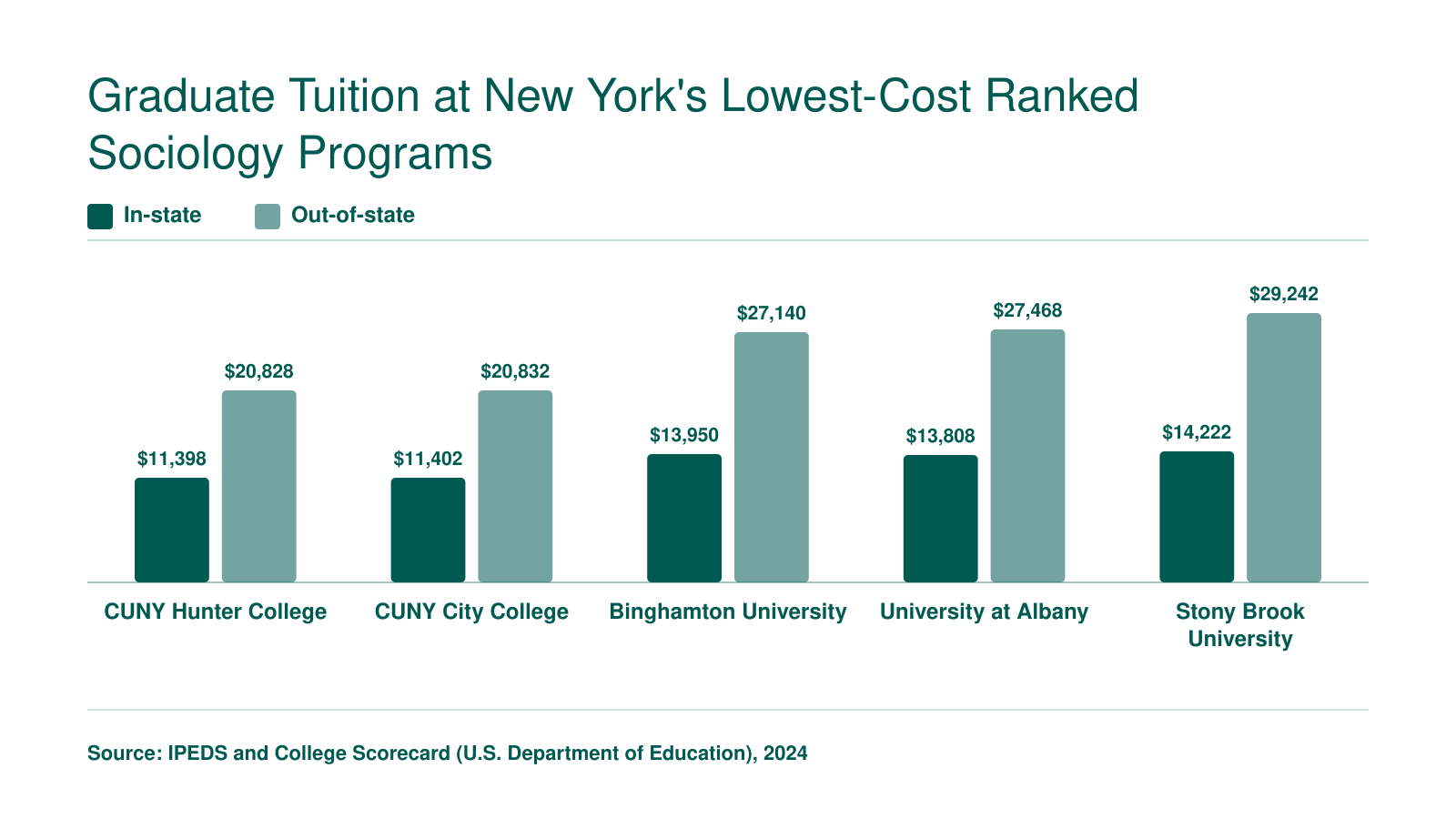
Graduate Tuition at New York's Lowest-Cost Ranked Sociology Programs
The most affordable master's in sociology options here are the public CUNY and SUNY campuses, which charge New York residents less than out-of-state students. Private schools on this list charge one rate to everyone. These are published tuition and fees before any aid, assistantships, or scholarships.
Master's in Sociology Cost, Funding, and Certification in New York
Tuition
According to the CUNY Graduate Programs 2026-2027 Guide, CUNY graduate tuition for 2026-27 is $470 per credit for New York residents and $855 for nonresidents. That applies to CUNY Hunter College and CUNY City College, with mandatory fees added each semester. Hunter's program requires 30 credits, so tuition alone runs roughly $14,100 for residents and $25,650 for nonresidents.
University at Albany posts graduate rates for "all other" master's programs, not sociology specifically: $3,522.98 for six credits and $6,379.63 for eleven in Fall 2026 and Spring 2027. Confirm whether residency changes that figure. Columbia, NYU, Syracuse, St. John's, and The New School charge private-school rates, and the per-credit or flat amounts differ by school, so check each bursar page. Institution-wide net price figures mostly reflect undergraduates and should not be read as a program's price.
Funding
Binghamton offers teaching assistantships, but they go mainly to doctoral students. Its master's students are generally self-funded. St. John's lists competitive graduate assistantships, and The New School advertises merit scholarships. Hunter requires an internship or research assistantship as part of its degree, though that is a program component, not a tuition award. Master's-level funding at the other ranked schools could not be confirmed, so ask each department directly.
Certification
Sociologists need no state license in New York. Programs are registered with the New York State Education Department (NYSED), which confirms the degree is authorized. If you are considering teaching or social work, you will need a separate credential path, such as teacher certification through a Master of Arts in Teaching (MAT) in New York or a social work degree and licensure.
Frequently Asked Questions About Master's in Sociology Programs in New York
Are there funded sociology master's programs in New York?
How selective are New York sociology master's programs?
When are application deadlines for New York sociology master's programs?
Can a master's in sociology lead to a PhD or applied research job in New York?
Compare Sociology programs on the data that matters
Explore more Social Work & Social Sciences specializations or browse every graduate field.
All Social Work & Social Sciences programs