Best Master's in Sociology Programs in Massachusetts
Compare 7 accredited Sociology programs in Massachusetts at 6 schools, with graduate earnings, cost, debt, and completion data from IPEDS and the U.S. College Scorecard.
Massachusetts has dozens of sociology graduate listings on paper, but only a handful are dedicated sociology master's programs. Directories routinely blur them with social work degrees and PhD tracks that award an MA only in passing.
Tuition among the programs here runs from $17,410 at UMass Amherst to $67,626 at Boston University, nearly a fourfold spread.
Structure matters as much as price. Northeastern's catalog, for instance, offers its MA only to doctoral students, so a stand-alone terminal degree there is not an option.
Key Points
- In-state tuition runs $17,410 at UMass Amherst and $20,456 at UMass Boston.
- Private tuition ranges from $29,174 at Northeastern to $67,626 at Boston University.
- No dedicated fully online sociology master's was confirmed in Massachusetts as of 2026.
Top-Ranked Sociology Master's Programs in Massachusetts for 2027
Massachusetts has a small set of sociology master's programs, and they differ more than their names suggest. Some are stand-alone terminal degrees. Others are earned mainly on the way to a Ph.D. We list the terminal options first, then the programs that are tied to doctoral study, and we flag where the published sources disagree.
Boston College
#1Chestnut Hill, MA · ~$38,000/yr (est.)
Best for: Aspiring researchers eyeing doctoral study
Boston College's Master's Program in Sociology and Social Research is a campus-based degree in Chestnut Hill built around methods, theory, and statistics, and it is aimed at students heading to social research careers or Ph.D. study. The university graduates about 91% of its students. The financial assistance the program describes, including tuition waivers and stipends, is for Ph.D. students, so master's applicants should confirm their own funding picture.
- 30 credit hours required
- Coursework in methods, theory, and statistics
- Master's thesis or paper option
- Empirical research course and writing seminar
- Requires transcripts, references, statement of purpose, and writing sample
- GREs strongly recommended
- Campus-based delivery
Boston University
#2Boston, MA · $65,000 – $70,000/yr (est.)
Best for: Career-minded students wanting an optional thesis
Boston University's M.A. in Sociology is a nine-course degree that trains students for either academic or applied social science work, including government, research departments, and community programs. The thesis is optional and needs advisor approval, which suits students who want flexibility. The department says students specialize across subfields, but the master's page lists no fixed concentrations. The university graduates about 89% of its students.
- Nine graduate courses, 36 units
- Five required core courses plus four electives
- Qualitative and quantitative methods training
- Optional thesis with advisor approval
- Any bachelor's degree accepted, sociology preferred
- No foreign language requirement
- No fixed concentration tracks published
Brandeis University
#3Waltham, MA · $60,000 – $65,000/yr (est.)
Best for: Students pairing sociology with gender studies
Brandeis University in Waltham offers two on-campus master's options. The standard M.A. in Sociology needs eight courses and ends in either a master's project or a take-home exam. The joint M.A. in Sociology and Women's, Gender, and Sexuality Studies adds feminist research methods and a foundational women's studies course, and it can be a stand-alone degree or part of a Ph.D. path. The university graduates about 86% of its students.
- Eight courses, at least five in the Sociology Department
- Year of SOC 300a plus two graduate seminars
- One research methods course and one social theory course
- Master's project or 72-hour take-home exam
- Deadlines listed as November 1, March 1, and June 22
- Joint M.A. with a gender studies focus
- Eight courses, with a foundational women's studies course
- Feminist research methods course required
- 25 to 40 page research paper read by two faculty
- Stand-alone or Ph.D. pathway; one-year completion listed
University of Massachusetts-Boston
#4Boston, MA · ~$20,000/yr (est.)
UMass Boston's Applied Sociology M.A. stands out for its practice orientation, with a curriculum built on research methods, statistics, and evaluation, and fieldwork or internship options. Students choose their own specialization rather than a fixed track. Sources describe both a terminal M.A. and an M.A. earned on the way to the Ph.D. The university graduates about 49% of its students, a lower figure than its private neighbors, though its tuition is the more modest.
- 37 credits with theory, methods, and capstone research seminar
- Qualitative, quantitative, and survey methods strengths
- Fieldwork or internship options
- Master's paper required
- Admission needs 3.0 GPA and 18+ sociology credits
- Graduate assistantships and tuition remission possible
- March 1 priority deadline, April 1 final deadline
Northeastern University
#5Boston, MA · ~$29,000/yr (est.)
Northeastern's Sociology M.A. in Boston is awarded only to students already enrolled in its doctoral program, and direct admission to the master's is not available. Students choose an academic track or an applied track that adds advanced methods such as social network analysis and program evaluation. It fits committed researchers, not people looking for a terminal professional master's. The university graduates about 91% of its students.
- Open only to enrolled Ph.D. students, no direct admission
- 30 semester hours with a 3.00 GPA minimum
- Academic track or applied track
- B or better expected in foundations courses
- Applied track adds network analysis and program evaluation
University of Massachusetts-Amherst
#6Amherst, MA · $15,000 – $20,000/yr (est.)
UMass Amherst's department has a generalist profile with an emphasis on social inequality, and its public graduate listing shows a campus-based 30-credit M.A. through either a thesis or two comprehensive exams. Treat this one cautiously, because the current admissions page says there is no terminal master's to apply to and that students earn the M.A. during the Ph.D. The university graduates about 83% of its students, and in-state tuition is notably lower than at the area's private schools.
- 30 credits with theory, statistics, and methods courses
- Thesis route or two comprehensive exams
- Up to six independent study credits allowed
- 3.0 GPA requirement
- Department says the M.A. is earned during the Ph.D., not a separate admit
- Departmental emphasis on social inequality
Cost & outcomes by school
Federal data for the highest-earning Sociology programs, independent of the ranking above. Earnings are this field's master's graduates four years after completing, where the Scorecard reports them.
| School | Earnings | Tuition / yr | Debt | Grads/yr | Format |
|---|---|---|---|---|---|
| University of Massachusetts-Amherst MA | — | $17,410 | — | 5 | Campus |
| University of Massachusetts-Boston MA | — | $20,456 | — | 7 | Campus |
| Northeastern University MA | — | $29,174 | — | 6 | Campus |
| Boston College MA | — | $37,520 | — | 5 | Campus |
| Brandeis University MA | — | $60,153 | — | 3 | Campus |
| Boston University MA | — | $67,626 | — | 3 | Campus |
Sources: U.S. Department of Education. Tuition and graduates: IPEDS. Earnings and debt: College Scorecard, this field's master's graduates; a dash means no figure is reported.
Online and Hybrid Master's in Sociology Options in Massachusetts
Is there a fully online or hybrid master's in sociology in Massachusetts? No dedicated fully online or hybrid sociology MA/MS appears on official program pages for master's programs in Massachusetts as of 2026. The practical alternative for in-state learners is part-time campus study, not online sociology master's programs.
UMass Boston's Applied Sociology MA can be completed part time within five years, but it requires time in residence and lists no online or remote courses. UMass Amherst's MA in Sociology is on-campus and in-person. Boston College and Boston University describe their sociology master's programs as full-time and on-campus, and Northeastern's Sociology MA is also campus-based.
If you need flexible scheduling, contact departments directly. Boston-area programs may offer evening or part-time arrangements for working adults, but official pages do not consistently confirm evening delivery, so treat hybrid or online claims cautiously.
Which Massachusetts Sociology Master's Programs Waive or Make the GRE Optional
GRE policies below come from each department's published admissions information as last checked in October 2026. Where a school's admissions page does not address the GRE, the table says "No published policy" rather than guessing. Graduate programs in general have been moving toward GRE-optional admissions, but requirements change from cycle to cycle, so confirm the current policy with the department before you apply.
| School | Program | GRE Policy | Notes |
|---|---|---|---|
| Boston College | Master's Program in Sociology and Social Research | Optional | GRE scores are strongly recommended even though they are not required. |
| University of Massachusetts-Amherst | Sociology graduate program | Optional | No terminal master's program for applicants who want only a master's degree. Scores may be submitted, but the admissions committee will not consider them. |
| University of Massachusetts-Boston | Master's program details not confirmed | No published policy | Admissions information consulted did not state a GRE requirement. |
| Boston University | Master's program details not confirmed | No published policy | Admissions information consulted did not state a GRE requirement. |
| Northeastern University | Master's program details not confirmed | No published policy | Admissions information consulted did not state a GRE requirement. |
| Brandeis University | Master's program details not confirmed | No published policy | Admissions information consulted did not state a GRE requirement. |
Related Articles
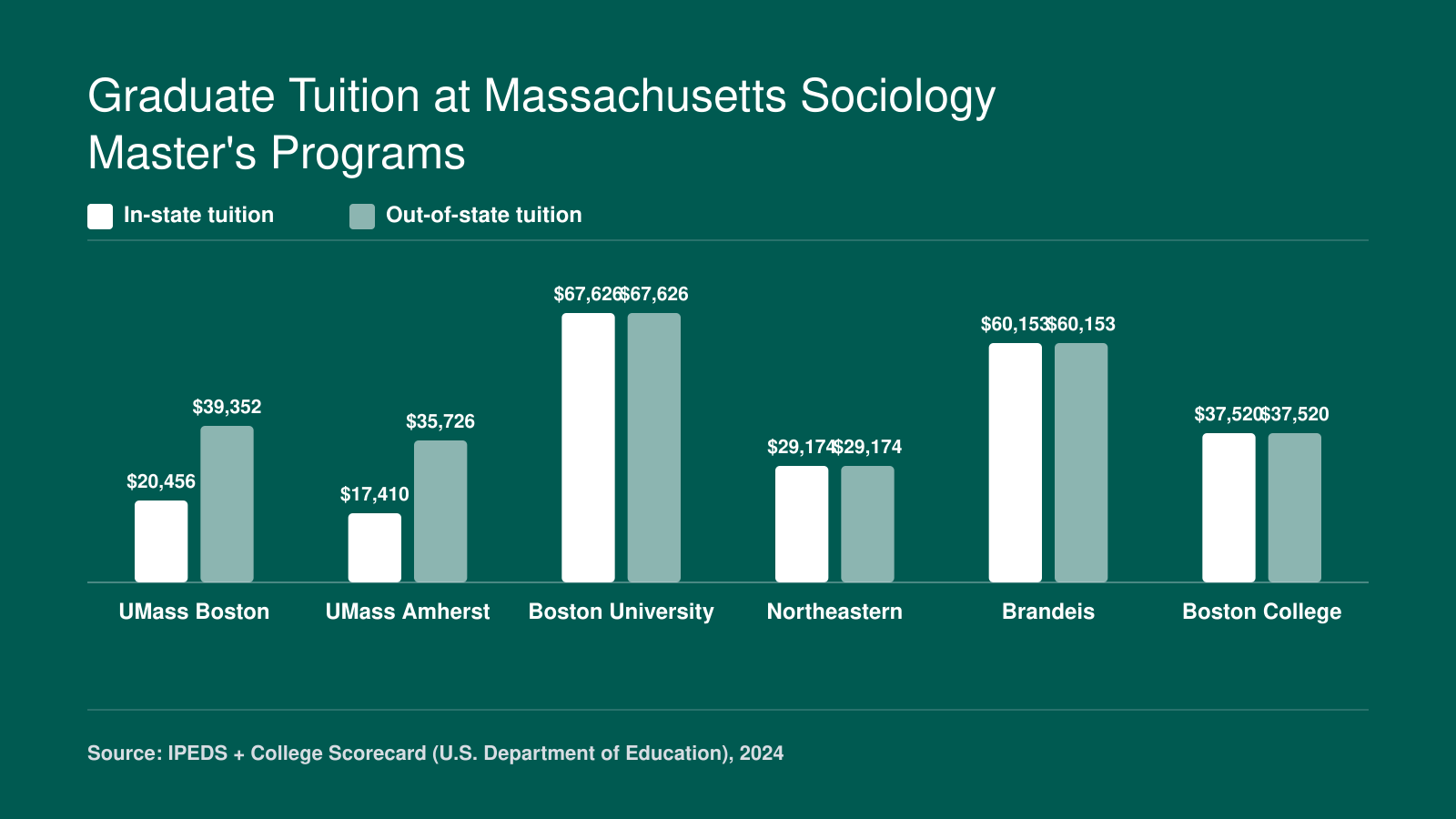
Graduate Tuition at Massachusetts Sociology Master's Programs
Public and private tuition sit far apart here. In-state students at the UMass campuses pay $17,410 to $20,456, while the private schools run from $29,174 at Northeastern to $67,626 at Boston University. Sticker tuition is not what most funded students pay, since assistantships and tuition waivers, where a program offers them, can cut the bill sharply.
Cost, Assistantships, and Licensure for a Master's in Sociology in Massachusetts
Public vs. Private Tuition
The real cost question is less about sticker price than about who ends up paying it. At the public campuses, graduate tuition runs $17,410 in-state at UMass Amherst and $20,456 at UMass Boston, rising to $35,726 and $39,352 for out-of-state students. Private Boston-area tuition ranges from $29,174 at Northeastern to $67,626 at Boston University, with Boston College at $37,520 and Brandeis at $60,153. Average net price figures (roughly $17,700 to $41,700) are institution-wide estimates that largely reflect undergraduate aid, so treat them as a rough guide, not your bill.
Who Funds Master's Students
UMass Boston's Applied Sociology M.A. offers a limited number of assistantships that pair a stipend with tuition remission. Indicate your interest when you apply. Boston College advertises tuition waivers, living stipends, and teaching and research assistantships, but frames that support around Ph.D. study. UMass Amherst's funding descriptions likewise center on doctoral students, and Northeastern does not admit students directly to its M.A. Elsewhere, plan to self-fund unless a department confirms master's support in writing.
Licensure
Massachusetts does not license sociologists. That sets this degree apart from LICSW social work licensure, which requires a master's or doctorate in social work from a Council on Social Work Education-accredited program, and from LMHC counseling licensure, which requires the NCMHCE exam. A sociology M.A. does not qualify you for either.
Admissions Requirements and Application Deadlines
Verified requirements come from the two UMass programs below. For Boston College, Northeastern, Boston University, and Brandeis, check each graduate admissions page directly, since we have not confirmed their current terms.
- Degree and GPAA bachelor's degree is the baseline. UUMass Boston's Applied Sociology MA sets a 3.0 minimum GPA. UMass Amherst's application page does not establish a minimum.
- Statement of purposeUMass Amherst requires one. UMass Boston asks for 1,200 words on your academic and career interests and desired specialization.
- Writing sampleUMass Amherst asks for 25 to 30 pages. UMass Boston's program finder lists 10 to 30 pages of original sociology or related coursework, though its department resources page gives different guidance, so confirm before submitting.
- RecommendationsBoth UMass programs call for three letters. Amherst's letter and statement details appear on a page labeled for PhD admissions, so confirm they apply to the master's.
- PrerequisitesUMass Boston expects applicants without a sociology BA to have 18 semester credits in sociology or a related social science, with theory, methods, and statistics preferred. UMass Amherst states no prerequisite coursework.
- DeadlinesUMass Boston's Fall 2026 cycle had a March 1 priority deadline and an April 1 final deadline. UMass Amherst's deadline is December 31, 2026 for Fall 2027, with no priority date and no late applications accepted.
What You Can Do With a Master's in Sociology in Massachusetts
A sociology master's in Massachusetts is less a narrow credential and more a bet on transferable research, data, and organizational skills. The degree tends to pay off in roles that reward evidence and clear writing more than a single occupational license.
Graduates commonly move into research analyst positions, policy and nonprofit program roles, public health and city agency work, higher education administration, and PhD preparation. The strongest short-term path is usually an applied research or evaluation job in Boston's nonprofit, healthcare administration, or government sector, where a master's can qualify you for titles that a bachelor's alone often cannot. For students weighing cost, the question is whether a two-year investment in methods and theory will convert into one of those roles in a metro area that has unusually high demand for analytical staff. Some programs prepare students more directly for doctoral study, while others emphasize applied, community-facing work, so match the program's strengths to the career track you want.
Compare Sociology programs on the data that matters
Explore more Social Work & Social Sciences specializations or browse every graduate field.
All Social Work & Social Sciences programs