Best Master's in Higher Education Programs in Massachusetts
Compare 9 accredited Higher Education programs in Massachusetts, with graduate earnings, cost, debt, and completion data from IPEDS and the U.S. College Scorecard.

Massachusetts packs enough colleges into one small state that higher education is itself a major local employer. Boston University, Northeastern, and Suffolk share one city, while Amherst, Lowell, North Andover, Bridgewater, and Salem each host a program of their own.
Campus and online master's in higher education programs appear together here. Tuition is the sharpest divide: public and private options sit at opposite ends of the price scale while competing for the same adviser, admissions, and residence life jobs.
Key Points
- Salem State and Bridgewater State carry the lowest in-state graduate tuition; Boston University costs far more.
- Massachusetts does not license higher education administrators, so no state credential gates student affairs jobs.
- Ask every program about assistantships, since residence life or advising roles can offset tuition.
Top Master's in Higher Education Programs in Massachusetts, Ranked
Every program below earned its spot on federal outcomes data (IPEDS and College Scorecard), not on brochure claims. Graduation rates cited are institution-wide figures for the whole school, not completion rates for a single program. Read each card for who the program fits, then compare cost and format against your own situation.
Boston University
#1Boston, MA · $65,000 – $70,000/yr (est.)
Best for: Working adults wanting flexible start dates
Boston University graduates about 89% of its students institution-wide, and its Wheelock EdM in Higher Education Administration covers student affairs, admissions, financial aid, and counseling foundations. Students can choose in-person or online study, full-time or part-time. It fits readers who want a Boston network and a graduate assistantship or internship option, and who can weigh a higher sticker price against available merit aid.
- 36 credit hours; concentration in Higher Education Administration
- Offered in person and fully online
- In-person students finish in one year; online in about 18 months
- Three start dates per year: fall, spring, summer
- Graduate assistantship or internship option
- Merit scholarships reach over 65% of new students
- Core courses cover history, legal issues, and research methods
University of Massachusetts-Amherst
#2Amherst, MA · $15,000 – $20,000/yr (est.)
Best for: UMass undergraduates wanting an accelerated 4+1 route
UMass Amherst graduates about 83% of its students institution-wide and is the flagship of the public system. Its Higher Education M.Ed. draws on sociology, psychology, history, and economics and ends with a capstone case study. It suits readers seeking public-university value, especially current UMass undergraduates who can use the 4+1 track or those who want to pair policy study with a dual degree.
- Capstone integrative seminar with a defended case study project
- Dual degree option with the Master's in Public Policy Administration
- 4+1 accelerated track for current UMass undergraduates
- Interdisciplinary coursework in sociology, psychology, history, economics
- Assessment and research projects on student experiences
- Prepares for student affairs, advising, admissions, institutional research
University of Massachusetts-Lowell
#3Lowell, MA · ~$16,000/yr (est.)
Best for: Cost-conscious fully online learners
UMass Lowell graduates about 65% of its students institution-wide. Its M.Ed. in Education Administration with a Higher Education concentration is delivered entirely online and is test optional. The two-semester practicum covers settings like admissions and residence life, which suits working professionals who want hands-on experience at a low per-credit price.
- 30 credit hours; concentration in Higher Education
- Available entirely online, synchronous and asynchronous options
- $470 per credit listed by the program
- Test optional; two letters of recommendation minimum
- Two-semester practicum included
- Full-time and part-time options
Merrimack College
#4North Andover, MA · ~$37,000/yr (est.)
Merrimack College graduates about 70% of its students institution-wide. Its M.Ed. in Higher Education is campus-based and organized around social justice and equity. Two 12-credit concentrations let students lean toward student affairs or toward leadership, policy, and organizational development. A fellowship or assistantship can offset cost, so it fits readers who want a small-college cohort and paid experience.
- 36 credit hours; full-time and part-time schedules
- Concentration: Student Affairs (12 credits)
- Concentration: Leadership, Policy, and Organizational Development (12 credits)
- 3.0 GPA minimum; capstone required
- Fellowship option at about 25 hours per week
- Assistantship option at 10 to 12 hours per week
Bridgewater State University
#5Bridgewater, MA · ~$9,000/yr (est.)
Bridgewater State University graduates about 53% of its students institution-wide and prices its master's well below Boston's private schools. The fully online Higher Education Administration M.Ed. targets mid- and upper-level roles such as enrollment management, financial aid, and student affairs. It fits working adults who prefer small classes and one course at a time.
- Fully online; study one course at a time
- Complete in as few as two years
- Classes limited to 15 students
- Hands-on practicum experience
- Covers crisis management, finance, law, policy, and social justice
- Assistantships and fellowships available
Salem State University
#6Salem, MA · $5,000 – $10,000/yr (est.)
Salem State University graduates about 50% of its students institution-wide. Its campus-based M.Ed. in Higher Education in Student Affairs centers on on-campus graduate assistantships that bring tuition remission and stipended hours. It fits aspiring advisors, residence life staff, and career services professionals who want a student affairs focus at a public price.
- Student affairs focus for advising, residence life, career services roles
- On-campus graduate assistantships with stipended work hours
- Tuition remission up to nine credits
- Fall start; priority deadline December 15, then rolling admissions
- Two letters of recommendation minimum; $50 application fee
- Welcomes international students in F or J status
Northeastern University
#7Boston, MA · ~$29,000/yr (est.)
Northeastern University graduates about 91% of its students institution-wide. Its Master of Education in Higher Education Administration is 100% online and built for working professionals, with a practitioner-reviewed capstone and an optional Boston residency. It fits remote students who want multiple start terms and a defined total program tuition.
- 100% online; optional in-person networking residency in Boston
- $37,400 total program tuition listed by the program
- Complete in as little as two years; full-time and part-time
- Four start dates per year with rolling admissions
- Capstone with practitioner feedback and a mock interview
- Coursework includes DEI content on HBCUs and Tribal Colleges
- ePortfolio built for employers
Suffolk University
#8Boston, MA · ~$38,000/yr (est.)
Suffolk University graduates about 61% of its students institution-wide and sits in the middle of Boston's higher education landscape. Its campus-based M.Ed. in Administration of Higher Education pairs a legal and financial core with a supervised practicum at a local institution. It fits students who want in-person administrative experience in the city.
- 36 credit hours across 12 courses
- Practicum at a local college or university, about 10 hours per week
- Core includes legal and financial aspects of higher education
- Courses in leadership theory, diversity, and student development theory
- Electives in disability services
- Research in higher education course
Cost & outcomes by school
Federal data for the highest-earning Higher Education programs, independent of the ranking above. Earnings are this field's master's graduates four years after completing, where the Scorecard reports them.
| School | Earnings | Tuition / yr | Debt | Grads/yr | Format |
|---|---|---|---|---|---|
| University of Massachusetts-Lowell MA | $82,921 | $16,434 | — | 20 | Online |
| Boston University MA | $74,836 | $67,626 | $29,762 | 84 | Online |
| Suffolk University MA | $69,052 | $38,448 | — | 1 | Campus |
| Merrimack College MA | $64,371 | $36,800 | $20,500 | 14 | Campus |
| Salem State University MA | $62,341 | $9,360 | $20,658 | 7 | Campus |
| Bridgewater State University MA | — | $9,297 | — | 28 | Online |
| University of Massachusetts-Amherst MA | — | $17,410 | — | 25 | Online |
| Northeastern University MA | — | $26,020 | — | 36 | Online |
| Northeastern University MA | — | $29,174 | — | — | Online |
Sources: U.S. Department of Education. Tuition and graduates: IPEDS. Earnings and debt: College Scorecard, this field's master's graduates; a dash means no figure is reported.
Cost, debt & payoff
Median earnings of this field's master's graduates (4 yrs after completing) vs. their median federal loan debt · U.S. College Scorecard
Across these programs the median graduate earns about $69,052 and finishes with roughly $20,658 in debt — a ratio that clears a common rule of thumb (keep debt below first-year salary). Tuition and debt vary widely school to school, so check the per-school figures in the table above before you shortlist.
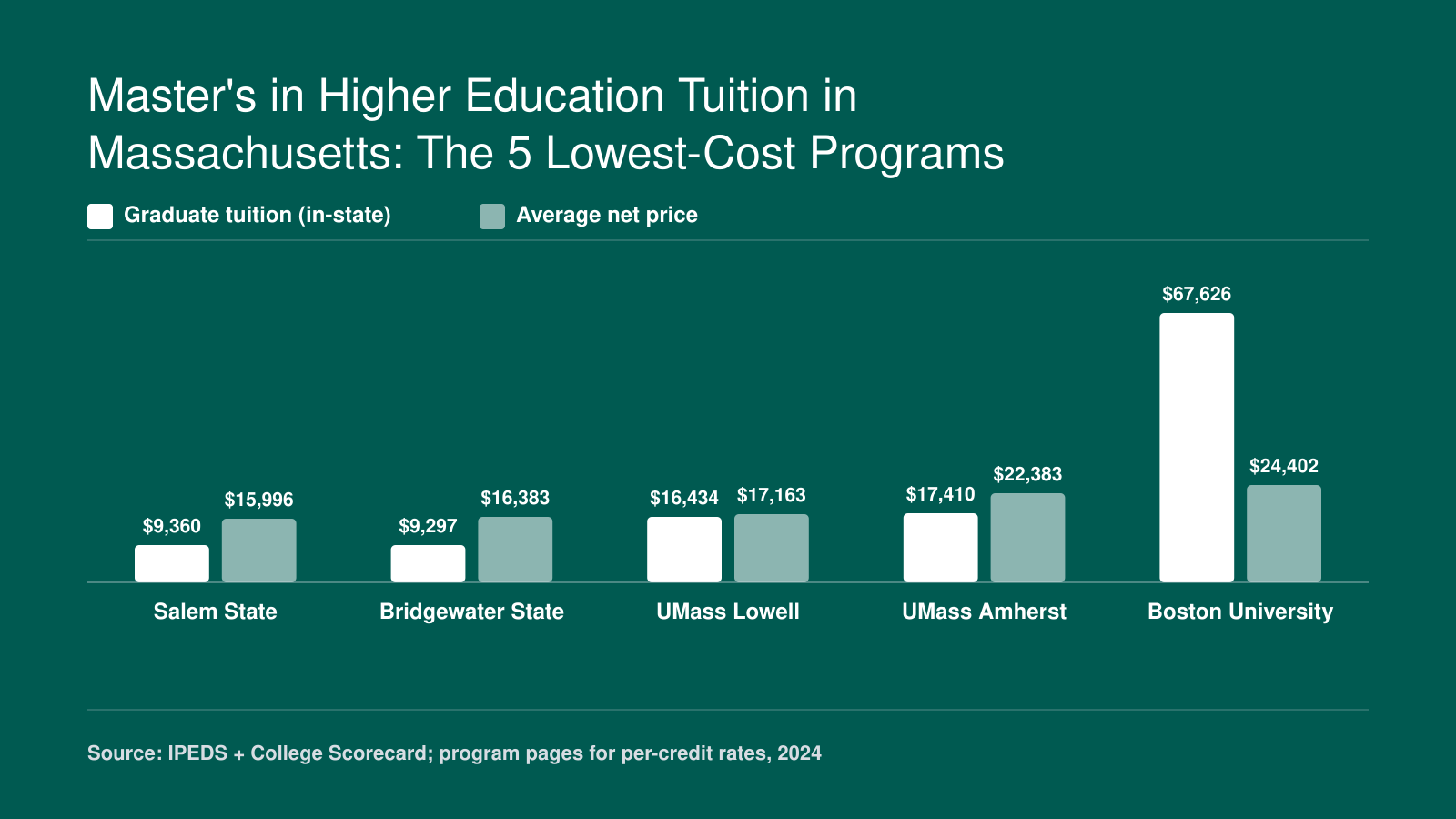
Master's in Higher Education Tuition in Massachusetts: The 5 Lowest-Cost Programs
Salem State University and Bridgewater State University carry the lowest published in-state graduate tuition here, with UMass Lowell and UMass Amherst next and Boston University far higher as the only private school. Net price is an institution-wide approximation from federal data, not a quote for a master's in higher education, so use it to compare schools, not to budget. For a closer estimate, UMass Lowell publishes $470 per credit across 30 credits, about $14,100 before fees. Boston University lists 36 credits, so confirm its per-credit rate with the bursar.
Online and Hybrid Master's in Higher Education Options in Massachusetts
Online and campus-based pathways lead to the same master's in higher education but suit different schedules and lifestyles. Among Master's Programs in Massachusetts, Boston University, UMass Amherst, UMass Lowell, Bridgewater State, and Northeastern all offer online formats; Boston University runs its EdM both in person and fully online. Merrimack, Salem State, and Suffolk are campus programs.
Delivery style varies by school. UMass Lowell offers both synchronous and asynchronous options, so you can mix live sessions with self-paced work. Bridgewater State builds class interaction through Zoom and Flipgrid. Northeastern's program is 100% online, with a Boston networking residency that is available but not listed as a graduation requirement. UMass Amherst aims its online MEd at busy professionals, many of whom already work in higher education.
For staff already employed on a campus, part-time pacing usually matters most. Boston University, UMass Lowell, Northeastern, and Merrimack all list both full-time and part-time enrollment.
One caveat: online coursework rarely means zero fieldwork. UMass Lowell includes a two-semester practicum, Bridgewater State builds in hands-on practicum experience, and Suffolk requires 300 clinical hours at a local college or university. If student affairs is your goal, confirm where your practicum can take place and whether your current position can count toward it.
Related Articles
Which Massachusetts Higher Education Master's Programs Waive the GRE?
Many applicants first check whether the GRE is required, and higher education administration has largely shifted to test-optional, creating more master's programs with no GRE required. Most programs nationally now treat the GRE as optional or drop it entirely, so the real question is what you submit in its place.
Among the schools here, published policies are uneven, and you should confirm the rule for your exact entry term before deciding whether to test:
- GRE not required: Boston College's higher education master's does not require the GRE; scores may be submitted voluntarily (its score code is 3218). Boston College lists the same no-GRE policy for both the M.A. and the dual M.A./M.B.A. pathway.
- No policy published: Several programs on this list, including options at UMass campuses and the private schools ranked here, do not state a GRE requirement, waiver, or test-optional policy on the admissions pages reviewed. Treat that as a gap to confirm directly, not as evidence the test is required.
If a program is optional or silent, lead with what you control: a focused statement of purpose, strong recommendation letters, and documented work in student affairs or campus roles.
Cost, Accreditation, and Certification for Higher Ed Careers in Massachusetts
Massachusetts does not license higher education administrators. There is no state credential for a residence life coordinator, academic adviser, admissions officer, or dean of students, and the educator licenses issued by the Department of Elementary and Secondary Education apply to K-12 positions, not college jobs. Employers set their own bar through degree requirements, experience, and background checks.
What does matter is institutional accreditation. The New England Commission of Higher Education accredits the universities behind these programs, which keeps students eligible for federal loans and keeps the degree recognizable to hiring committees on other campuses.12 Note that NECHE accredits the institution, not the individual higher education curriculum.
Beyond that, credentialing is voluntary. CAS standards guide how student affairs units are built and assessed, and professional associations such as NASPA and ACPA publish competency frameworks that shape curricula and offer conference training. If you are considering a counseling-oriented track, such as clinical mental health counseling master's programs in Massachusetts, with an eye toward Massachusetts LMHC licensure, confirm the specific degree, clinical hours, and exam requirements with the program and the state board before enrolling.
The practical upshot: credentials add little to your bill. Tuition, residency status, and assistantship funding determine what this degree actually costs you.
What Massachusetts Higher Education Master's Graduates Earn
The table shows median graduate earnings for each program, with the time window stated, using IPEDS and College Scorecard data (2024). Windows differ by school because of what the federal data reports, so compare rows with care. Debt and the 10-year monthly payment appear where published. Graduates typically move into academic advising, residence life, admissions, career services, and institutional research roles at Massachusetts colleges.
| School | Program | Median earnings | Earnings window | Median program debt | 10-year monthly payment |
|---|---|---|---|---|---|
| University of Massachusetts-Lowell | Master of Education in Education Administration (Higher Education) | $91,947 | Five years after finishing | N/A | N/A |
| Boston University | EdM in Educational Leadership & Policy Studies: Higher Education Administration | $82,099 | Five years after finishing | $29,762 | $339 |
| Bridgewater State University | Higher Education Administration, MEd | $80,124 | One year after finishing | N/A | N/A |
| Merrimack College | M.Ed. in Higher Education | $64,371 | Four years after finishing | $20,500 | $233 |
| Suffolk University | Master of Education in Administration of Higher Education | $64,170 | Five years after finishing | N/A | N/A |
Questions Prospective Higher Ed Grad Students Ask
Deadlines and prerequisites change by program, degree track, and admission cycle, so no single summary can replace the school itself. Use the answers below as a verification method, and confirm every detail directly before you apply.
How do I confirm current application deadlines?
What prerequisites should I check at each school?
Where can I find reliable context beyond school websites?
Compare Higher Education programs on the data that matters
Explore more Education & Teaching specializations or browse every graduate field.
All Education & Teaching programs