Best Master's in Sociology Programs in West Virginia
Compare 3 accredited Sociology programs in West Virginia, with graduate earnings, cost, debt, and completion data from IPEDS and the U.S. College Scorecard.

A campus MA in Morgantown or Huntington and a fully online MA from Charles Town carry the same title but ask very different things of students. West Virginia has few graduate sociology options, so format and admission rules, including whether a Master's in Sociology With No GRE Required is available, weigh more here than in larger states.
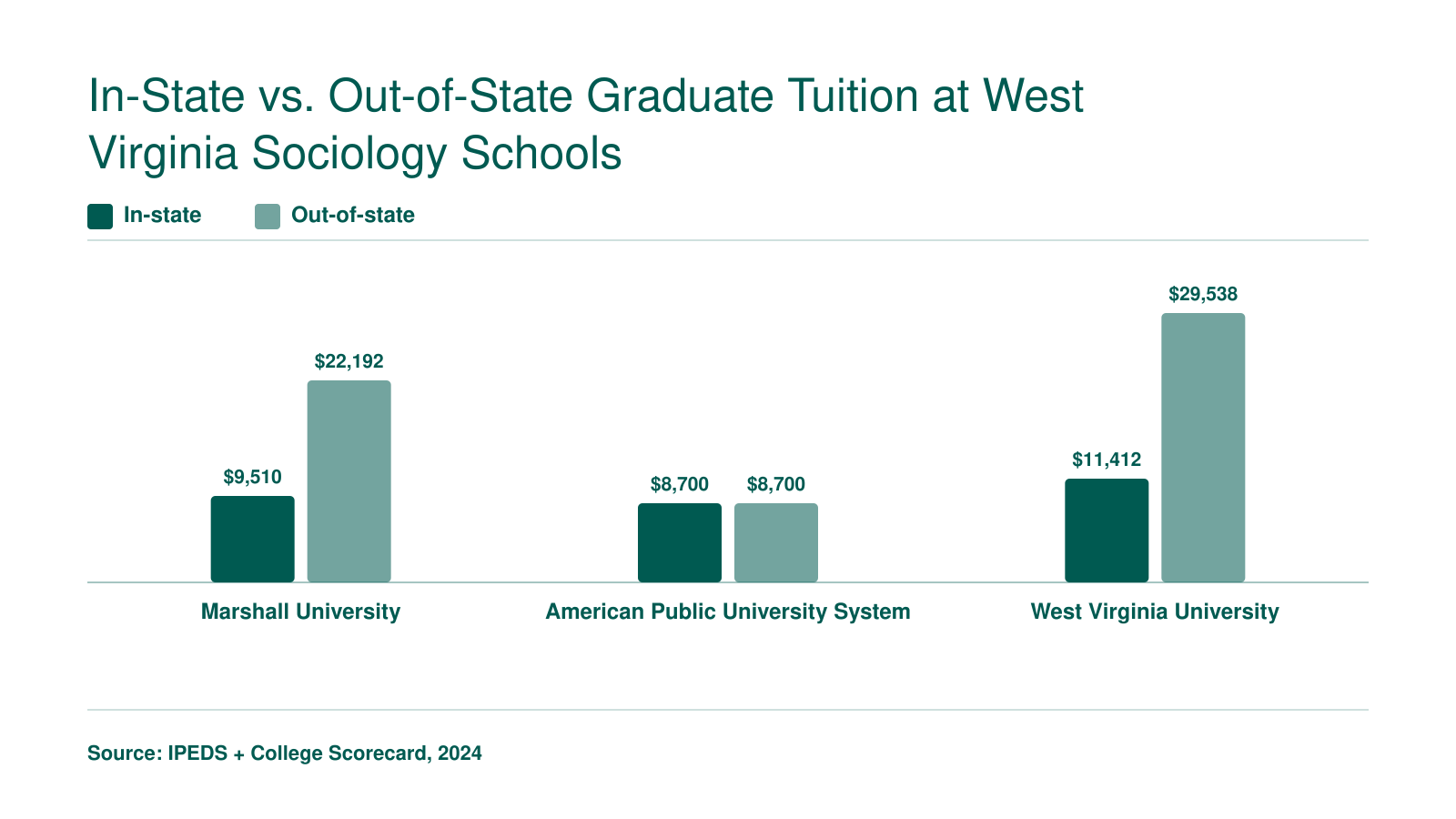
Published graduate tuition runs from $8,700 to $11,412 a year for residents, while out-of-state students on campus can pay up to $29,538.
One constraint applies everywhere: a sociology master's does not qualify graduates for West Virginia social work licensure, which is a separate credential path built around MSW programs in West Virginia.
Key Points
- Marshall's 2026-2027 resident graduate rate is $548.50 per credit hour.
- West Virginia University assistantships pay at least $15,000 over nine months.
- A sociology master's does not meet West Virginia social work licensure requirements.
Best Master's in Sociology Programs in West Virginia, Ranked
Three West Virginia options made this year's list. Each card's net price is an approximate institution-wide average, not a program-specific quote. Graduation rates below are also institution-wide, reflecting each school overall rather than the sociology program.
American Public University System
#1Charles Town, WV · $5,000 – $10,000/yr (est.)
Best for: Online learners balancing work and study
American Public University System's Master of Arts in Sociology is built around a 30-credit curriculum in social theory, research methods, and data analysis. The program includes a capstone research project, service learning, and one-on-one faculty mentoring, with interest areas in education, healthcare, and social services. The institution reports an institution-wide graduation rate of about 57 percent.
- 30 total credit hours
- No entrance exam required
- $470 per credit
- 12 start dates per year
- Capstone research project required
- Service-learning and one-on-one faculty mentoring
- Interest areas: education, healthcare, social services
- Transfer up to 15 prior credits possible
West Virginia University
#2Morgantown, WV · ~$11,000/yr (est.)
Best for: PhD-bound students pursuing research training
West Virginia University reports a Master of Arts in Sociology, but the current graduate policy does not admit students to a standalone sociology MA. Students are dually enrolled in the MA and PhD path and may receive the MA as part of doctoral progress or as a terminal award if they leave after completing the 31-credit requirement. The degree includes 16 core, 12 elective, and 3 research credit hours with a 3.00 minimum GPA and a second-year research paper option. The institution reports an institution-wide graduation rate of about 65 percent.
- 31 credit hours total
- 16 core, 12 elective, 3 research hours
- Minimum 3.00 GPA required
- Second-year research paper or extra elective
- No standalone MA admission currently
- Separate MA completion timeline not published
Marshall University
#3Huntington, WV · $5,000 – $10,000/yr (est.)
Best for: Students choosing between thesis and non-thesis
Marshall University's standalone Master of Arts in Sociology is open to full-time and part-time students, with preferred fall entry. The thesis track totals 33 credit hours and the non-thesis track totals 36 credit hours, both built on a 15-credit core; students must maintain at least a 3.0 GPA in sociology and anthropology courses. Applicants should have 12 undergraduate sociology credit hours, a personal statement, a writing sample, and two letters of recommendation. The current catalog does not specify a typical number of semesters to finish. The institution reports an institution-wide graduation rate of about 51 percent.
- Thesis track: 33 total credit hours
- Non-thesis track: 36 total credit hours
- 15 credit-hour required core
- Minimum 3.0 GPA in sociology classes
- 12 undergraduate sociology credits required
- Full-time or part-time study
- Preferred fall entry
- GRE not required but encouraged
Cost & outcomes by school
Federal data for the highest-earning Sociology programs, independent of the ranking above. Earnings are this field's master's graduates four years after completing, where the Scorecard reports them.
| School | Earnings | Tuition / yr | Debt | Grads/yr | Format |
|---|---|---|---|---|---|
| American Public University System WV | — | $8,700 | — | 29 | Online |
| West Virginia University WV | — | $11,412 | — | 3 | Campus |
| Marshall University WV | — | $9,510 | — | — | Campus |
Sources: U.S. Department of Education. Tuition and graduates: IPEDS. Earnings and debt: College Scorecard, this field's master's graduates; a dash means no figure is reported.
Online and Hybrid Sociology Master's Options in West Virginia
Fully online master's in sociology programs remain rare, which shapes the choices for West Virginia students who need to keep working while they study.
What Each Program Offers
Delivery format varies across the schools here:
- American Public University System: Its Master of Arts in Sociology runs fully online, with twelve start dates a year and courses that span eight to sixteen weeks, a structure built for distance learners.
- West Virginia University: The Sociology, M.A. in Morgantown is campus-based.
- Marshall University: The Master of Arts in Sociology in Huntington is offered on campus, with full-time or part-time study available. Marshall prefers a fall entrance; its program sets a priority deadline of April 15 for fall and November 15 for spring, with later university deadlines of August 1 and December 1.
A Note for Working Adults
If you cannot commit to a full course load, Marshall's part-time option lets you spread the degree over more terms while keeping a job. West Virginia residents weighing a remote path often compare out-of-state online programs too, so confirm format directly with each admissions office before you apply.
Which West Virginia Sociology Master's Programs Waive or Require the GRE?
GRE policies vary by program, and both Marshall University and West Virginia University offer flexible options for sociology applicants. The table below summarizes what each school publishes about GRE requirements, minimum GPA, and core application materials. Because admissions policies can change between catalog years, confirm the current policy with the graduate coordinator before applying.
| School | GRE Policy | Minimum GPA | Other Application Materials |
|---|---|---|---|
| Marshall University | Not required; strongly encouraged | Not published | Personal statement; writing sample of 10-25 pages, preferably in sociology or anthropology; two letters of recommendation; evidence of at least 12 undergraduate sociology credit hours; overall and sociology undergraduate GPA; English proficiency for international applicants (e.g. TOEFL) |
| West Virginia University | Optional | 3.0 on a 4.0 scale for regular admission | Requires a bachelor's degree from an accredited college or university with no deficiencies to make up. The available handbook excerpt does not list every required document. |
Related Articles
How Much Does a Master's in Sociology Cost in West Virginia?
Marshall University publishes a 2026-2027 resident graduate rate of $463.00 per credit hour in tuition plus $85.50 per credit hour in mandatory university fees, or $548.50 per credit hour all in. A full-time semester comes to $4,932.00 ($4,165.00 tuition and $767.00 fees). Nonresident graduate tuition and fees are listed at $11,084 per full-time semester, though Marshall notes that most colleges and programs carry additional charges on top.
Program and delivery charges
State records for 2026-2027 list a college or program fee attached to Marshall's MA in Sociology: $154 for residents and $175 for nonresidents.1 Marshall's published materials do not make clear whether that amount sits inside the per-credit totals above or is added to them, so treat it as a question for the bursar. Sections designated fully online also carry a $50.00 per credit hour e-delivery fee.
Regional rates and estimating your total
Marshall offers a graduate Metro Rate to residents of 50 neighboring counties, reaching more than 160 counties across Indiana, Kentucky, North Carolina, Ohio, Pennsylvania, Tennessee and Virginia. The published rate table does not break out a Metro per-credit figure, and nothing confirms a sociology-specific discount. The cleanest estimate, across a broader sociology master's programs tuition comparison, is to multiply your per-credit rate by the credits your program requires, then add program and delivery fees.
In-State vs. Out-of-State Graduate Tuition at West Virginia Sociology Schools
At Marshall and West Virginia University, out-of-state students face a sizable tuition premium. American Public University System charges the same graduate rate regardless of location because its sociology MA is online. All figures are annual published rates before any aid or assistantship adjustments.
Sociology Master's Funding and Assistantships in West Virginia
Stipend floors have become the clearest funding signal applicants to sociology master's programs can check before they apply, and West Virginia University publishes its own. A regular assistantship there runs 20 hours per week over nine months and pays at least $15,000 ($7,500 per semester); a half-time appointment at 10 hours per week pays at least $7,500. Full 12-week summer work at 20 hours per week carries a $5,000 minimum.
The waiver matters as much as the stipend. Regular assistantships waive full-time University tuition at nine or more credits; partial appointments waive five credits per semester, with up to four additional merit credits possible from the college or program. Waivers apply to University tuition, not college tuition or fees. Eligibility requires admission to a qualifying degree program, a 2.75 GPA, and good standing, and master's students may hold waivers for up to three years.
WVU's sociology M.A. curriculum includes funded teaching assistantships, and the department describes typical packages as stipend, full tuition waiver, and student health insurance. Ask the department directly how many appointments are open in your entry year.
West Virginia Licensure: Sociology vs. Social Work
Frequently Asked Questions About Sociology Master's Programs in West Virginia
These answers address common questions about sociology master's options in West Virginia, including delivery format and how the degree compares with social work.
Does WVU offer a standalone master's in sociology?
Is Marshall University's sociology master's program online?
What is the difference between a sociology master's and a social work master's?
Can I teach at a community college with a sociology master's in West Virginia?
Compare Sociology programs on the data that matters
Explore more Social Work & Social Sciences specializations or browse every graduate field.
All Social Work & Social Sciences programs