Best Master's in Sociology Programs in Oklahoma
Compare 8 accredited Sociology programs in Oklahoma at 3 schools, with graduate earnings, cost, debt, and completion data from IPEDS and the U.S. College Scorecard.

Oklahoma's sociology master's options split between a thesis-heavy research degree and an applied, career-oriented one. Public tuition at the state universities runs well below the private option, but only if you qualify as a resident or land an assistantship.
With so few ranked choices, comparing a long list matters less than three decisions: which campus to attend, thesis or non-thesis track, and how much of the cost funding will cover. All three schools are ranked together here.
In practice, those three choices, more than any program's name, will determine what the degree costs and where it leads.
Key Points
- Every sociology master's program here is campus-based, not online.
- University of Oklahoma still requires GRE scores for sociology applicants.
- Residents pay about $9,000 at OU and Oklahoma State; assistantships cut costs.
Best Master's in Sociology Programs in Oklahoma: 2027 Ranking
Prospective sociology graduate students in Oklahoma can choose among public research programs with assistantship funding and a private dual-degree route into nonprofit leadership. The programs below vary in tuition, format, and specialization, so the right fit depends on your career goals and budget.
University of Oklahoma – Hudson College of Public Health
#1Norman, OK · ~$9,000/yr (est.)
Best for: Research-focused students seeking funded assistantships
The University of Oklahoma's master's in sociology emphasizes rigorous theory, methods, and statistics while funding most students through graduate assistantships that include stipends, tuition waivers, and health insurance. Students can concentrate in criminology/deviance, inequality/stratification, global/environmental sociology, or social research methods, and an accelerated BA/MA track is available. In-state graduate tuition and fees are about $9,797 per year and out-of-state $27,377, with an institution-wide graduation rate near 75%. The university is accredited by the Higher Learning Commission.
- Complete in about two years
- 34 credit hours required
- Graduate assistantships include stipends and tuition waivers
- December 15 application deadline
- Sociological theory, methods, and statistics sequence
- Master's thesis research required
- Concentrations in criminology/deviance, inequality/stratification, and global/environmental sociology
- Statement of purpose, CV, three recommendations, writing sample, transcripts, and GRE scores required
- Summer research fellowships and conference travel grants available
- Prepares for PhD programs or non-academic research careers
- Applications due December 15
- Criminology concentration available
- 34 credit hours with thesis research
- GRE scores required for admission
- Assistantship funding includes monthly stipend and tuition waiver
- Traditional campus delivery
- Social Research Methods concentration
- 34 credit hours required
- Master's thesis included
- Admissions due December 15
- Graduate assistantships provide stipend, tuition waiver, and health insurance
- Complete bachelor's and master's degrees in five years
- 34 credit hours required
- 3.5 GPA and junior-year application required
- Double-count up to 19 credit hours
- Fall deadline October 1; spring deadline April 1
- Master's thesis required
Oklahoma State University
#2Stillwater, OK · ~$9,000/yr (est.)
Best for: Students comparing crime, environment, and inequality tracks
Oklahoma State University's Master of Science in Sociology offers campus-based concentrations in crime and deviance, environmental sociology, and social inequality, with no GRE requirement for admission. The program emphasizes sociological theory, methods, and statistics through graduate seminars and close faculty-student relationships. In-state graduate tuition and fees are about $10,234 per year and out-of-state $25,754, and the institution-wide graduation rate is near 68%. Oklahoma State University is accredited by the Higher Learning Commission.
- Crime and Deviance concentration
- No GRE scores required
- Fall admission with funding deadline February 1
- Spring admission deadline September 15
- Funding opportunities available
- Graduate seminars and close faculty-student relationships
- Sociological theory, methods, and statistics focus
- Environmental Sociology concentration
- No GRE required for admission
- Fall with funding deadline February 1
- Fall without funding deadline April 1
- Spring deadline September 15
- Small graduate seminars
- 360-degree Critical Skills program
- Social Inequality concentration
- No GRE scores required
- Fall and spring admission deadlines
- Funding opportunities available
- Five specialty areas for focused study
- Graduate seminars and faculty-student relationships
Oklahoma City University
#3Oklahoma City, OK · ~$14,000/yr (est.)
Best for: Future attorneys pursuing nonprofit careers
Oklahoma City University offers a campus-based dual J.D./M.A. in Applied Sociology with a Nonprofit Leadership concentration through the School of Law and Petree College of Arts and Sciences. The program saves 12 credit hours compared with earning each degree separately and includes a nonprofit law externship. Graduate tuition and fees are about $35,648 for both residents and nonresidents, and the institution-wide graduation rate is near 65%.
- Dual J.D./M.A. program with law school and Petree College
- 30 credit hours in applied sociology
- Save 12 credit hours compared with separate degrees
- Nonprofit law externship required
- Exempt from Nonprofit Law and Capstone
- M.A. coursework starts after fourth semester for full-time law students
Cost & outcomes by school
Federal data for the highest-earning Sociology programs, independent of the ranking above. Earnings are this field's master's graduates four years after completing, where the Scorecard reports them.
| School | Earnings | Tuition / yr | Debt | Grads/yr | Format |
|---|---|---|---|---|---|
| University of Oklahoma OK | — | $9,353 | — | 5 | Campus |
| Oklahoma City University OK | — | $13,590 | — | 10 | Campus |
| Oklahoma State University OK | — | $9,092 | — | 2 | Campus |
Sources: U.S. Department of Education. Tuition and graduates: IPEDS. Earnings and debt: College Scorecard, this field's master's graduates; a dash means no figure is reported.
Online and Hybrid Master's in Sociology Options in Oklahoma
Remote delivery has reshaped graduate education nationally, but the Best Master's in Sociology Programs in Oklahoma have largely stayed on campus. Every program here is listed as campus-based: the University of Oklahoma's M.A. in Norman, Oklahoma State University's M.S. in Stillwater, and Oklahoma City University's M.A. in Applied Sociology with a Nonprofit Leadership focus. None is marked Online or Both, so readers searching for "online sociology masters oklahoma" will not find a fully remote ranked option on this page.
For working adults comparing online master's programs in Oklahoma, that means planning around daytime or on-site requirements, so confirm scheduling directly with each department.
The trade-off is real, though. Campus programs tend to offer assistantship access and closer faculty mentoring for thesis work. OU lists assistantship funding, a stipend, and a tuition waiver, and OSU points to funding opportunities and close faculty-student relationships.
Which Oklahoma Sociology Master's Programs Waive or Make the GRE Optional
Oklahoma's sociology master's programs do not share a single testing policy, so plan each application separately and compare master's in sociology programs with no GRE required before assuming any program is test-optional.
- University of Oklahoma: The sociology department's graduate admissions page states a current GRE General Test score is required of applicants to both the MA and the PhD, and that the department cannot waive it. An older departmental packet shows the GRE was waived for the 2023 cycle, which is a useful reminder that this policy has moved before and may move again.
- Oklahoma State University: The sociology graduate manual routes applicants through the Graduate College2 but does not publish a GRE requirement, waiver, or set of waiver conditions.1 Treat the policy as unstated rather than assuming it is on a list of master's programs with no GRE required.
- Oklahoma City University: No sociology-specific GRE policy is published for prospective graduate applicants.
Before you pay a registration fee, email the graduate coordinator in writing and ask whether a score is required for your intended entry term. Written confirmation beats a cached web page.
Related Articles
Thesis or Non-Thesis: Which Oklahoma Sociology Master's Track Fits You?
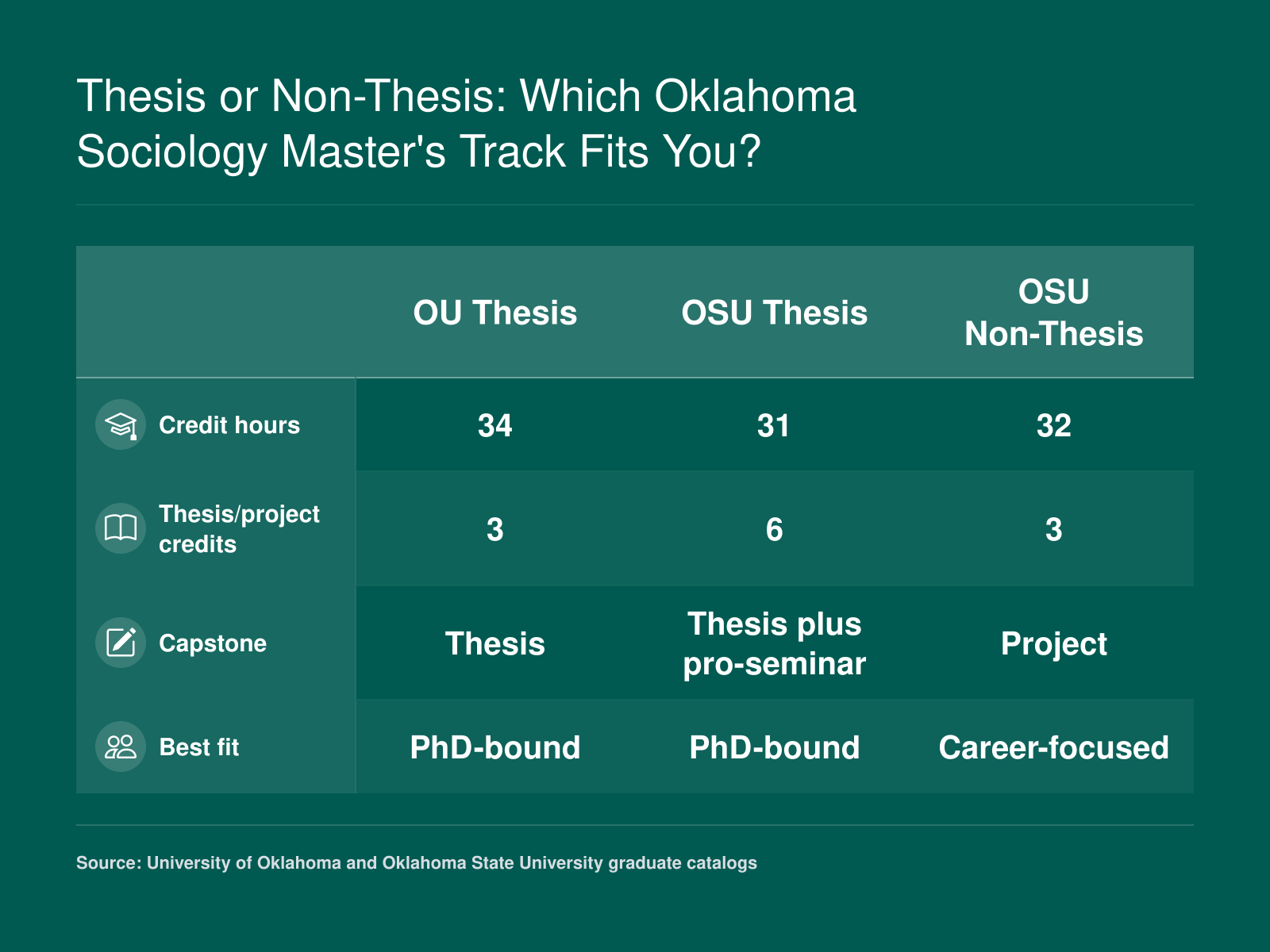
At the University of Oklahoma, the standard master's is a thesis track of 34 credits. Oklahoma State University offers a 31-credit thesis option and a 32-credit non-thesis option. If doctoral study is your goal, choose the thesis route; if you want applied or workforce-ready skills, the non-thesis project is the better fit.
What a Master's in Sociology Costs in Oklahoma, Plus Licensure and Certification Notes
Public sociology master's programs in Oklahoma cost residents far less than nonresidents. Federal data puts graduate tuition at $4,840.50 a year for Oklahoma residents and $12,969 for nonresidents at Oklahoma State University, and at $4,058 for residents and $11,463 for nonresidents at the University of Oklahoma. Oklahoma City University, a private school, lists $13,590 for everyone. These are approximate institution-wide averages, not the price of a sociology degree.
Per-credit rates for 2026-27
- University of Oklahoma: Residents pay $413.20 per credit ($405.75 tuition plus $7.45 in fees). Nonresidents pay $1,153.70. Online courses add $41.20 per credit. At the 34 credit hours the program requires, that is about $14,050 for residents and $39,225 for nonresidents before extra fees.
- Oklahoma State University: Tuition is $233.80 per credit for residents and $879.75 for nonresidents.1 The 100% online nonresident rate is $364.00.1 Apply that rate to your degree plan's credit hours, then add fees.
OU's graduate assistantships come with a tuition waiver, which can change these totals considerably.
Licensure
Oklahoma has no state license for sociologists. The degree leads to research, nonprofit, policy and doctoral paths without a credentialing exam.
Graduate Assistantships and Funding for Sociology Master's Students in Oklahoma
Funding, not sticker price, increasingly separates a manageable master's from an expensive one. At the University of Oklahoma, the sociology department's graduate packet lists 5 to 7 teaching assistantships a year for incoming students, at 20 hours a week. The master's stipend is $17,500 over nine months, with a full tuition waiver and student health insurance. The packet does not say how those positions split between master's and doctoral students, so ask the department directly.
According to the Oklahoma State University sociology Sociology Graduate Program Manual, teaching and research awards carry a Graduate College waiver covering required credits only, not fees or extra courses. Eligibility requires at least 0.50 FTE (about 20 hours a week), six enrolled credits, good standing, and an online waiver form before the semester. The department publishes no current stipend figure for master's students.
A waiver can be worth thousands per semester, so an assistantship often beats a lower posted tuition rate.
Career Outcomes and ROI for Sociology Master's Graduates in Oklahoma
A sociology master's in Oklahoma is a choice between a research apprenticeship and an applied credential, and the better return depends on the role you want next. The programs here point in different directions.
University of Oklahoma's master's stresses theory, methods, and a thesis, with graduate assistantship funding that can cover tuition and provide a stipend; its materials describe preparation for PhD programs and non-academic research. Oklahoma State University's Master of Science in Sociology emphasizes graduate seminars, a criminology and deviance concentration, and close faculty-student relationships for research and professional development. Oklahoma City University's applied sociology program is built around nonprofit leadership, with an externship in a nonprofit setting.
Common next steps for graduates include research analyst positions, nonprofit and public-sector program roles, community college teaching, and doctoral study; students drawn to public-sector management often compare MPA programs in Oklahoma. For these programs, ROI is best read through the immediate structure of each degree: a funded assistantship at OU, a specialized OSU track, or an OCU nonprofit credential that can support a public-sector career.
Admissions Requirements and Deadlines for Oklahoma Sociology Master's Programs
- Bachelor’s degreeBoth the University of Oklahoma and Oklahoma State University expect a completed bachelor’s degree from an accredited institution.
- Minimum GPAConfirm the current GPA expectation with the graduate coordinator; OSU’s 3.0 GPA figures are graduation requirements, not stated admission minimums.
- Prerequisite courseworkAsk about preparation in statistics, theory, or methods; current admissions pages do not list specific prerequisite courses for admission.
- Writing sampleOU requires a writing sample. OSU’s manual does not explicitly list one, so confirm before applying.
- Statement of purposeOU requires a statement of purpose; OSU asks for a roughly 2–3 page essay.
- Recommendation lettersBoth programs require three recommendation letters.
- DeadlinesOU lists December 15 for graduate applications. OSU gives February 1 as the Fall priority funding deadline, April 15 as the final Fall deadline, and October 1 for Spring; Spring applicants usually have fewer funding opportunities.
- Required exam / doctoral pathwayOU requires the GRE General Test for all Ph.D. and M.A. applicants and will not waive it. OSU’s manual does not mention a GRE requirement, so check the application for program-specific test policies.
Compare Sociology programs on the data that matters
Explore more Social Work & Social Sciences specializations or browse every graduate field.
All Social Work & Social Sciences programs