Health Psychology Master's Programs With No GRE Required
Compare 10 accredited no-gre Health Psychology programs, with graduate earnings, cost, debt, and completion data from IPEDS and the U.S. College Scorecard.

Test-optional admission has spread from undergraduate offices into graduate psychology, yet a health psychology master's still sits at an awkward crossing: the degree rarely leads to licensure on its own, and the price varies widely by program.
A "no GRE" label can mean waived, optional, or waived only above a GPA cutoff, and it can change by term. Verify each policy on the department's own page. This is a guide, not a ranking.
The larger question is what the degree will do for your career, not whether you can skip one exam.
Key Points
- Verify no-GRE wording on the department's own page, not third-party lists.
- Tuition, not the $249 GRE fee, drives what you actually pay.
- A health psychology master's alone does not qualify for psychologist licensure.
Health Psychology Master's Programs With No GRE Required
-
#1
Touro University Worldwide
Master of Arts in Psychology
$89,314median earnings $9,000grad tuition / yr $27,075median federal debt 115grads / yrNo GRE required12 monthsVisit program site →84score -
#2
National University
Master of Science in Health Psychology
$78,497median earnings $16,416grad tuition / yr $28,854median federal debt 1,098grads / yrNo GRE required30 credits16 monthsVisit program site →69score -
#3
University of Michigan-Dearborn
Clinical Health Psychology, MS
$17,126grad tuition / yr 15grads / yrNo GRE required48 credits2 yearsVisit program site →33score -
#4
Northcentral University
Master of Science in Health Psychology (MSHP)
$52,083median earnings $17,998grad tuition / yr $30,160median federal debt 153grads / yrNo GRE required30 credits16 monthsVisit program site →21score
How we rank. Each program is scored on graduate figures only: the field's master's earnings and debt, graduate tuition and the number of master's graduates, normalized across all programs in this field. Data comes from the U.S. Department of Education's IPEDS and College Scorecard; no school pays for placement.
Compare the top programs
| Rank | School | Earnings | Tuition / yr | Debt | Grads/yr | Format |
|---|---|---|---|---|---|---|
| 1 | Touro University Worldwide CA | $89,314 | $9,000 | $27,075 | 115 | Online |
| 2 | National University CA | $78,497 | $16,416 | $28,854 | 1,098 | Online |
| 3 | University of Michigan-Dearborn MI | — | $17,126 | — | 15 | Online |
| 4 | Northcentral University CA | $52,083 | $17,998 | $30,160 | 153 | Online |
Sources: U.S. Department of Education. Tuition and graduates: IPEDS. Earnings and debt: College Scorecard, this field's master's graduates; a dash means no figure is reported.
Cost, debt & payoff
Median earnings of this field's master's graduates (4 yrs after completing) vs. their median federal loan debt · U.S. College Scorecard
Across these programs the median graduate earns about $63,983 and finishes with roughly $35,580 in debt — a ratio that clears a common rule of thumb (keep debt below first-year salary). Tuition and debt vary widely school to school, so sort the ranking by "Most affordable" or "Lowest debt" to weigh cost against outcomes.
Why Health Psychology Programs Are Dropping the GRE and What 'No GRE' Really Means
Holistic review has replaced the GRE as the default gatekeeper in many health psychology admissions offices, but the phrase "no GRE" covers several different policies among master's programs with no GRE required. Admissions committees now lean harder on undergraduate GPA, the statement of purpose, letters of recommendation, and applied or research experience. When a program page says "GRE not required," the exam is usually not considered. "GRE optional" means a score may strengthen an otherwise borderline file, while a waiver above a GPA threshold applies only to students who clear that cutoff. Temporary waivers tied to recent admissions cycles may have expired, so confirm the current policy. A university-wide test-optional statement does not always bind every department; the page for health psychology master's programs is the authority. Dropping the GRE rarely lowers the bar. Expect closer review of transcripts and prerequisite psychology or statistics coursework.
How to Verify a No-GRE Policy Before You Apply
Admissions language changes, so verify the policy on the department's own page, and keep written confirmation.
- Use the program-specific pageRead the program's 'Requirements' page, not the graduate school homepage, and check whether the GRE is required, optional, or waived.
- Confirm the application termMake sure the no-GRE policy covers your intended start term, not a past cycle's temporary waiver or a limited test-optional window.
- Check for GPA conditionsSome waivers apply only above a minimum GPA, such as 3.0, and policy may differ between clinical and nonclinical tracks.
- Email the admissions officeAsk about GPA minimums, prerequisite courses, essay prompts, recommendation letters, and whether international applicants need TOEFL or IELTS.
- Keep written proofSave the admissions email or a dated screenshot of the policy in case the page changes mid-cycle.
Examples of Health Psychology Master's Programs That State a No-GRE Policy
A program counts as no-GRE for our purposes only when its own university page says the GRE is not required or is optional. Marketing summaries and third-party lists do not count. Held to that standard, the examples here are few, and none should be read as a complete list or a ranking.
Avila University (Online MS in Psychology, Mental Health Concentration)
Avila's program page states "No GRE required."1 This is a Master's in Psychology with a mental health concentration, so it is adjacent to an online health psychology master's rather than a degree titled Health Psychology. Consider it a model of what a clear waiver looks like, and confirm the curriculum fits your goals.
The waiver comes with GPA conditions:
- Unconditional admission: 2.75 cumulative undergraduate GPA.
- Conditional admission: 2.5 GPA.
- Provisional admits: must reach a 3.0 over their first nine credits.
- Prerequisites: an undergraduate psychology degree is not required, but leveling courses in developmental, cognitive, abnormal, and social psychology may be.
Read the Fine Print Elsewhere
Some universities list GRE scores as one route into a health psychology emphasis alongside a GPA threshold. That is not the same as a waiver unless the page says so. Policies also change between admission cycles, so re-check the official admissions page for your intended start term before you apply.
Related Articles
Accreditation: How to Confirm a No-GRE Program Is Legitimate
How do I know an online health psychology master's without a GRE requirement is regionally accredited? Start with institutional accreditation. Confirm that the university holds recognition from one of the seven U.S. institutional accreditors: ACCJC, HLC, MSCHE, NECHE, NWCCU, SACSCOC, or WSCUC.1 This status matters for federal financial aid eligibility and credit transfer.
Then separate program-level accreditation. APA accreditation applies to doctoral programs and to specific master's-level practice areas such as clinical, counseling, or school psychology3, see, for instance, Master's in Clinical Psychology With No GRE Required, but health psychology is not a stand-alone APA category.2 A health psychology master's will not typically carry APA programmatic accreditation. MPCAC accredits counseling and psychology master's programs at regionally accredited institutions, see Master's in Counseling Psychology With No GRE Required for no-GRE options, and has been recognized by CHEA since May 2021,4 so verify whether a specific health psychology program is listed.
Confirm status yourself with the U.S. Department of Education's DAPIP database5 or CHEA's directories.1 Search by the institution's current legal name, campus, and state, then confirm the agency, status, and covered campus. An online no-GRE program at an accredited university carries the same accreditation as the on-campus version.
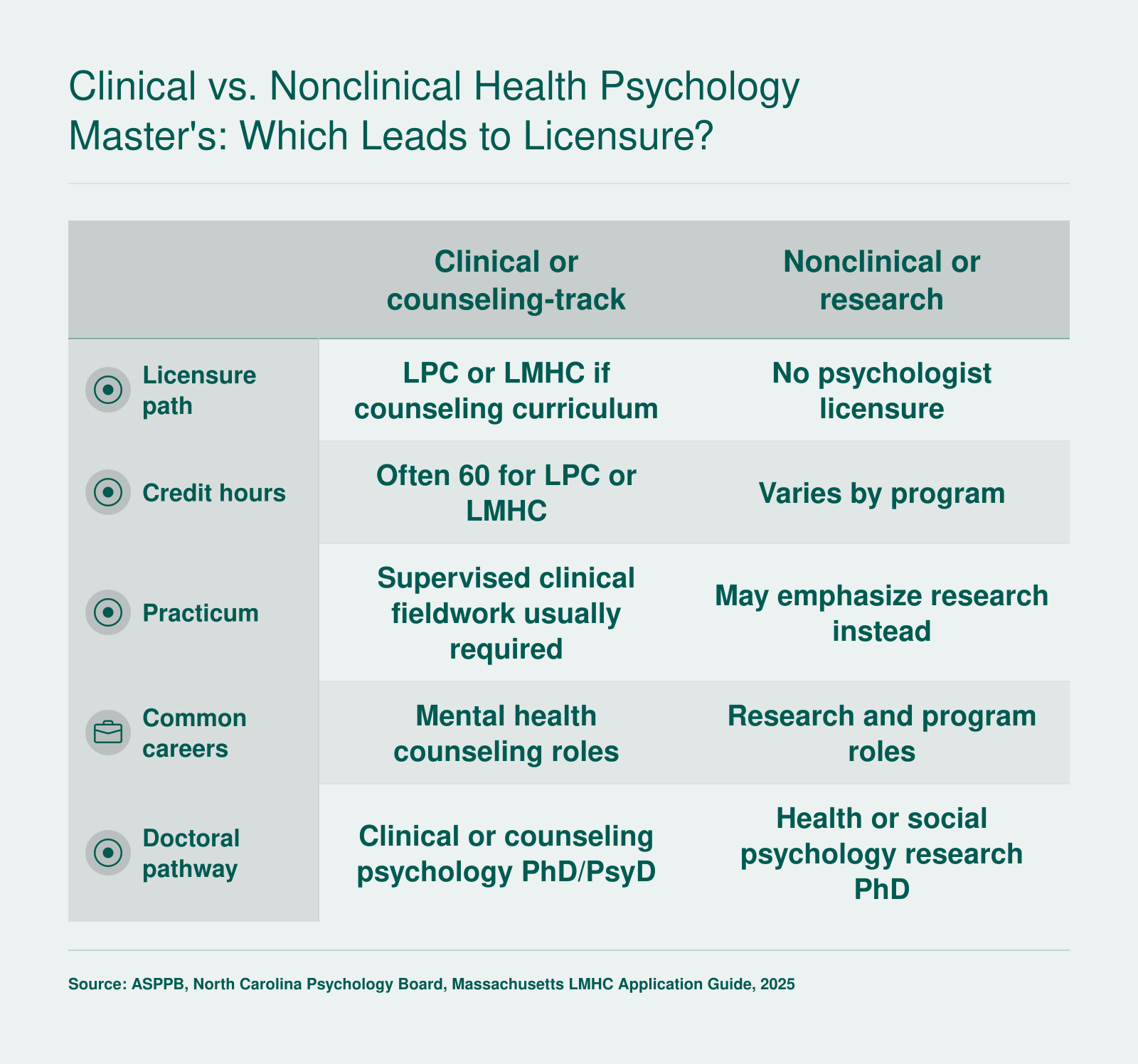
Clinical vs. Nonclinical Health Psychology Master's: Which Leads to Licensure?
A health psychology master's alone generally does not qualify you for psychologist licensure, which requires a doctorate. Clinical or counseling-track programs may meet state LPC or LMHC requirements if the curriculum includes the required counseling courses and supervised fieldwork. Confirm your licensure intent with the program before applying.
What a No-GRE Health Psychology Master's Costs
Skipping the GRE saves a small, fixed cost. Tuition and fees are the variable that drives health psychology master's programs cost. ETS lists the GRE General Test at $249 as of August 1, 2026 (including score reports to four programs), or $100 with a fee reduction voucher. Confirm current pricing on ETS General Test fees and each program's admissions page.
Build Your Own Cost Sheet
- Tuition: Find the per-credit rate on the school's tuition and fees page, then multiply by total credit hours from the graduate catalog.
- Fees: Online programs often add distance-education or technology fees, so check the tuition calculator and program handbook.
- In writing: Ask the financial aid office for an itemized cost of attendance, plus details on assistantships, scholarships, and employer tuition benefits.
Check Your Borrowing Ceiling
Graduate students can't receive Direct Subsidized Loans.1 Direct Unsubsidized Loans cap at $20,500 a year.1 Starting July 1, 2026, students never enrolled in a professional program face a $100,000 aggregate limit.2 Grad PLUS is generally closed to new graduate borrowers after that date, with a narrow exception for students already enrolled and borrowing.1 Confirm your figures on StudentAid.gov. Use BLS data, APA Division 38, and state psychology boards for career context; do not use them to estimate tuition.
Pay Snapshot for a Common Health Psychology Career Path
For nonclinical health psychology master's graduates, one common role is health education specialist.
Online, Hybrid, and On-Campus Formats Without the GRE
Flexibility and hands-on access pull against each other, and the format you pick decides which one you get. Derby and National University deliver fully online, while Daemen is online with an optional campus component.45 Manchester blends asynchronous work with online or in-person live sessions, and Keele and Stirling are campus-based.312 Online suits working professionals, and campus or blended routes suit career changers who want direct contact with supervisors.
Timelines follow the same split. Keele, Stirling, and Manchester run 12 months full-time and 24 part-time, though Manchester limits part-time study to home students.123 Derby's part-time route takes 36 months, with a 24-month accelerated option.4 National University lists 30 credits but no standard completion time.
Most of these programs end in a 60-credit research project.134 Others offer choices: National University allows an optional internship, and Daemen offers a thesis or field practicum.5 Where placements exist, online students usually arrange them near home.6 Before applying, ask whether the program finds placements or leaves that to you.
Health Psychology programs by state
Questions About No-GRE Health Psychology Master's Programs
Policies vary by program and admission cycle, so confirm details on the official page.
Do any health psychology master's programs not require the GRE for admission?
Will skipping the GRE hurt me if I apply to a PhD later?
What should I submit instead of GRE scores to strengthen my application?
Can I switch from a nonclinical to a licensure-track program later?
Compare Health Psychology programs on the data that matters
Explore more Psychology specializations or browse every graduate field.
All Psychology programs