Master's in Clinical Psychology Programs With No GRE Required
Compare 150+ accredited no-gre Clinical Psychology programs at 130+ schools, with graduate earnings, cost, debt, and completion data from IPEDS and the U.S. College Scorecard.
Licensure after a clinical psychology master's typically requires 2,000 to 4,000 supervised post-degree hours. A program's GRE policy does not shorten that timeline.
"No GRE" can mean scores are never requested, that they are optional, or that a 3.0 GPA waives them. Before you shortlist the best clinical psychology master's programs with no GRE required, check the actual policy.
A no-GRE admission is not a weaker clinical path; it simply removes one standardized filter while leaving state licensure rules unchanged.
Key Points
- For 2027 applications, fall deadlines run December through February.
- No-GRE can mean waived, optional, or unconditional admission based on GPA.
- APA accredits only a few master's programs, including Capella and Eastern Michigan.
Top No-GRE Clinical Psychology Master's Schools for 2027
The programs below are built around a shared admission reality: the GRE is either waived, optional, or granted by GPA, rather than treated as a fixed requirement. They are ordered by a blend of institutional retention, completion, and quality signals, not by any single admission criterion. Each listing names the verified GRE policy so you can quickly separate true no-GRE programs from conditional waivers.
Northwestern University
#1Evanston, IL · ~$55,000/yr (est.)
Best for: Illinois licensure seekers wanting funded clinical training
Northwestern's clinical psychology MA is a terminal, licensure-focused master's housed in Psychiatry and Behavioral Sciences. The program is explicitly no-GRE: scores are not accepted, and every admitted student receives a 45% tuition scholarship across eight quarters. Students complete 24 months of full-time study with at least 700 on-site clinical hours, including 280 direct patient-contact hours. It prepares graduates for Illinois counselor licensure and is pursuing APA accreditation.
- GRE scores are not accepted or considered
- 24-month, full-time, in-person program
- At least 700 on-site clinical hours
- 280 direct patient-contact hours
- 3.2 GPA and three recommendation letters required
- All students receive a 45% tuition scholarship
- Prepares for Illinois counselor licensure
- Seeking APA accreditation
Pepperdine University
#2Malibu, CA · $40,000 – $45,000/yr (est.)
Best for: Working professionals needing online and campus flexibility
Pepperdine's MA in Clinical Psychology is a terminal degree built for California LMFT and LPCC pathways, with no GRE or standardized test requirement. Students can choose daytime, evening, or online formats across multiple Southern California campuses. The curriculum covers individual, couple, family, and group therapy, with hands-on clinical training and a concentration option focused on Latinx communities.
- No GRE or standardized test required
- Daytime, evening, or online formats available
- Prepares for LMFT or LPCC licensure in California
- Curriculum spans individual, couple, family, and group therapy
- Multiple Southern California campus locations
- Concentration focused on Latinx communities
- $1,655 per credit
- Complete in 2.5 to 3 years
- Part-time and evening classes available
- Fall start only
University of Houston-Clear Lake
#3Houston, TX · $5,000 – $10,000/yr (est.)
Best for: Texas licensure candidates wanting applied practicum
The University of Houston-Clear Lake offers a no-GRE, campus-based clinical psychology MA with an unusually applied structure. Students train in an onsite Psychological Services Clinic for a two-semester internal practicum before completing a 500-hour internship at more than 60 Houston-area sites. The 63-credit program advertises a 100% graduation and licensure rate among its clinical psychology cohort.
- No GRE required
- 63 total credit hours
- Two-semester internal practicum at onsite clinic
- 500-hour internship at 60+ Houston-area sites
- Starts summer or fall
- Reports a 100% graduation and licensure rate
- Three recommendation letters and $35 application fee
Ball State University
#4Muncie, IN · $10,000 – $15,000/yr (est.)
Ball State's MA in Clinical Psychology is a research-focused, two-year degree that is test-optional, not a no-GRE guarantee. It is designed for students who plan to continue to a PhD or PsyD or work in research roles rather than earn a master's-level counseling license. Small cohorts of 10 to 12 students support close faculty mentorship, and graduate assistantships can cover tuition plus a stipend.
- No entrance exam required; test optional
- 36 credit hours, two-year program
- Starts fall; priority deadline February 1
- 3.0 GPA and psychology prerequisites required
- Cohorts of 10 to 12 students
- Assistantships can cover tuition plus stipend
- Research-focused; does not lead to master's licensure
- Accelerated master's option for Ball State undergraduates
Abilene Christian University
#5Abilene, TX · $25,000 – $30,000/yr (est.)
Abilene Christian's MS in Clinical Psychology is a campus-based, 48-credit degree in which the GRE is not considered. Students complete 450 clinical hours in ACU's on-campus psychology clinic, and coursework covers individual and group counseling, clinical interviewing, psychological testing, ethics, and research design. Admission requires a 3.5 GPA for unconditional entry, with 3.0 to 3.49 admitted on probation.
- No GRE considered; test optional
- $1,293 per credit
- 48 total credit hours
- 450 clinical hours in on-campus clinic
- 3.5 GPA for unconditional admission
- Priority deadline February 1; regular May 1
- Assistantships pay $1,650 per semester
Clayton State University
#6Morrow, GA · $5,000 – $10,000/yr (est.)
Clayton State's MS in Clinical/Counseling Psychology has a conditional GRE policy, not a blanket waiver. Applicants with a 3.0 GPA or higher may submit GRE scores optionally, while applicants with a 2.75 to 2.99 GPA must submit the GRE General Test. New students enter only in fall, and the application deadline is March 15.
- GRE optional for applicants with 3.0 GPA or higher
- GRE required for 2.75 to 2.99 GPA
- Fall admission only; March 15 deadline
- Five foundational psychology prerequisites
- Two recommendation letters and statement required
- On-campus interview required
Lamar University
#7Beaumont, TX · ~$9,000/yr (est.)
Lamar's MS in Applied Psychology, clinical psychology concentration, does not require GRE scores. The 60-credit, campus program includes nine hours of practicum plus a thesis and candidacy examination, with training in therapy techniques, intellectual and personality assessment, and community consultation. Fall enrollment only, with an April 15 deadline. The program prepares graduates for mental health agencies, hospitals, and private practice.
- No GRE required; test optional
- 60 credit hours including nine practicum hours
- Clinical psychology concentration
- Thesis and candidacy examination required
- Fall start; April 15 deadline
- 3.0 GPA and three recommendation letters
- Prepares for assessment and therapeutic practice
Fort Hays State University
#8Hays, KS · ~$5,000/yr (est.)
Fort Hays State's MS in Psychology (Clinical) is an on-campus, test-optional program with a strong Kansas licensure focus. Students complete an on-campus practicum at the university's counseling center and a 600-hour supervised off-campus internship. The program offers two tracks: a scholarship track for doctoral preparation and a professional development track for immediate clinical practice. Graduates are prepared for licensure as master's-level psychologists in Kansas.
- No entrance exam required; test optional
- 61 credit hours, two-year full-time program
- Two tracks: scholarship or professional development
- 600-hour supervised internship
- On-campus practicum at Health & Wellness Services
- Starts fall or spring
- Prepares for Kansas master's-level psychology licensure
Washburn University
#9Topeka, KS · ~$11,000/yr (est.)
Washburn's MA in Psychology, clinical skills emphasis, is explicitly no-GRE and no application fee, though scores may be submitted if available. Students begin client contact as early as the second semester in the university's training clinic, and the program guarantees internship placement. Graduates are immediately eligible for Temporary Licensed Master's Level Psychologist (TLMLP) status in Kansas. The program reports 100% of recent graduates employed in the field or pursuing doctoral degrees.
- No GRE requirement; scores optional
- No application fee
- Client interaction begins second semester
- Guaranteed internship placement
- Immediate TLMLP licensure eligibility in Kansas
- 60 credit hours; starts fall or spring
- 100% job placement or doctoral pursuit reported
- Teaching assistantship with $3,500 annual stipend
Cost & outcomes by school
Federal data for the highest-earning Clinical Psychology programs, independent of the ranking above. Earnings are this field's master's graduates four years after completing, where the Scorecard reports them.
| School | Earnings | Tuition / yr | Debt | Grads/yr | Format |
|---|---|---|---|---|---|
| Notre Dame de Namur University CA | $85,048 | $15,300 | $81,798 | 20 | Online or campus |
| Assumption University MA | $66,917 | $15,470 | $43,569 | 33 | Campus |
| Lamar University TX | $66,540 | $8,642 | $29,355 | 490 | Campus |
| Capella University MN | $66,014 | $15,092 | $41,000 | 1,611 | Online |
| Fort Hays State University KS | — | $4,949 | — | — | Campus |
| Augusta University GA | — | $6,992 | — | — | Campus |
| North Carolina Central University NC | — | $7,638 | — | — | Campus |
| Washburn University KS | — | $10,787 | — | — | Campus |
| East Tennessee State University TN | — | $11,366 | — | — | Campus |
| Clayton State University GA | — | $6,493 | — | 15 | Campus |
Sources: U.S. Department of Education. Tuition and graduates: IPEDS. Earnings and debt: College Scorecard, this field's master's graduates; a dash means no figure is reported.
Cost, debt & payoff
Median earnings of this field's master's graduates (4 yrs after completing) vs. their median federal loan debt · U.S. College Scorecard
Across these programs the median graduate earns about $66,014 and finishes with roughly $47,793 in debt — a ratio that clears a common rule of thumb (keep debt below first-year salary). Tuition and debt vary widely school to school, so check the per-school figures in the table above before you shortlist.
No GRE, GRE-Optional, or Waiver-Based: Know Which Policy You're Facing
For many No-GRE master's programs, “No GRE required” and “GRE optional” sound interchangeable in marketing copy, but the difference decides whether you spend a summer studying. Three distinct policies hide behind the same phrase.
- Unconditional no-GRE: Scores are never requested, and some programs will not look at them at all. Northwestern's master's in clinical psychology does not accept scores and instructs applicants not to send them; San Francisco State's master's dropped the requirement outright.
- GRE-optional: Scores are welcome and reviewed if submitted. Washington State's clinical program lists the general and Psychology GRE as optional for fall 2027, and Penn State's clinical area does not require scores but still encourages them.
- Waiver-based: The exam disappears only if you clear a bar. Florida State's doctoral program grants a merit waiver to applicants meeting both a research criterion, such as four months of substantive lab experience, and an academic one, such as a 3.2 undergraduate or 3.5 graduate GPA.
Optional can also carry a price. Penn State Behrend's master's does not require the GRE for admission, but scores may be needed for most assistantships and scholarships. Confirm the policy in writing for your exact entry term, since programs revise these rules yearly.
Accreditation Checks Before You Apply: Regional, MPCAC, and CACREP
Does an APA-accredited online master's in clinical psychology exist? Yes, but they are uncommon. APA's Commission on Accreditation now accredits a small group of master's programs in health service psychology, including Capella's M.S. in Clinical Psychology and Eastern Michigan's M.S. in Clinical Psychology. Most terminal master's programs rely on other accreditors instead.
- Institutional accreditation: Regional accreditation is the baseline. It determines federal aid eligibility and whether licensing boards accept your credits.
- MPCAC: Augusta University, Brenau, Clayton State, Arizona State, and the University of Western States hold it for clinical or counseling psychology master's programs.
- CACREP: Hofstra, UNC Chapel Hill, the University of Minnesota, and the University of Arizona hold it for clinical mental health counseling. Some state LPC boards require or strongly prefer a CACREP degree, so check counseling psychology master's licensure requirements by state before you apply.
- Verify status: Northwestern's M.A. in Clinical Psychology was not accredited by APA, CACREP, or MPCAC as of October 23, 20261, though the school plans to seek APA accreditation. Confirm every program on each accreditor's current listing.
Related Articles
State Licensure Paths for No-GRE Graduates: LPC, LMFT, and Clinical Hours
Yes, a no-GRE clinical psychology master's can lead to a license to practice therapy. The credential is just not "psychologist." In every state, that title requires a doctorate. What a master's qualifies you for is counselor licensure (LPC or LPCC, depending on the state) or marriage and family therapist licensure (LMFT), and many MFT programs no GRE required lead to that LMFT route; each credential has its own credit-hour floor, supervised hour requirement, and national exam.
How the requirements stack up
- California LMFT: 3,000 supervised hours and the California LMFT Clinical Exam, administered through the Board of Behavioral Sciences.
- Texas LPC: 3,000 supervised hours, plus the NCE or NCMHCE and a Texas jurisprudence exam. The Texas LMFT route requires a 60-semester-hour degree.
- Illinois LPC: moving to a 60-semester-hour requirement effective July 1, 2026, with the NCE or CRCE; the entry-level LPC does not require post-degree supervised experience, though the clinical LCPC does, according to the Illinois LPC qualifications.
Watch the credit count
That 60-hour threshold is the trap. Many clinical psychology master's degrees run 36 to 48 credits, which can leave you short, or missing counseling-specific coursework your board expects. Confirm the rules with your state board before you enroll, not after you graduate.
Most Affordable No-GRE Clinical Psychology Master's Options
These lowest-cost options are drawn from the most recent IPEDS and College Scorecard data shown in the ranking. Average net price is an institution-wide figure, not a personal quote, so your own cost will vary by dependency status and aid package. Several programs publish per-credit rates to estimate full-degree cost: Saint Mary's lists $670 per credit across 60 credits, and Brescia lists $685 per credit across 45 credits, though rates may not be current or directly comparable. Fort Hays State highlights graduate teaching assistantships, and Saint Mary's offers an application-based scholarship of $2,500 per year.
| School | In-state tuition and fees | Out-of-state tuition and fees | Average net price (institution-wide) |
|---|---|---|---|
| Clayton State University | $5,180 | $16,532 | $8,365 |
| Lamar University | $8,905 | $18,745 | $9,366 |
| Fort Hays State University | $5,923 | $17,741 | $12,569 |
Online, Hybrid, or Campus: Where Your Practicum Hours Happen
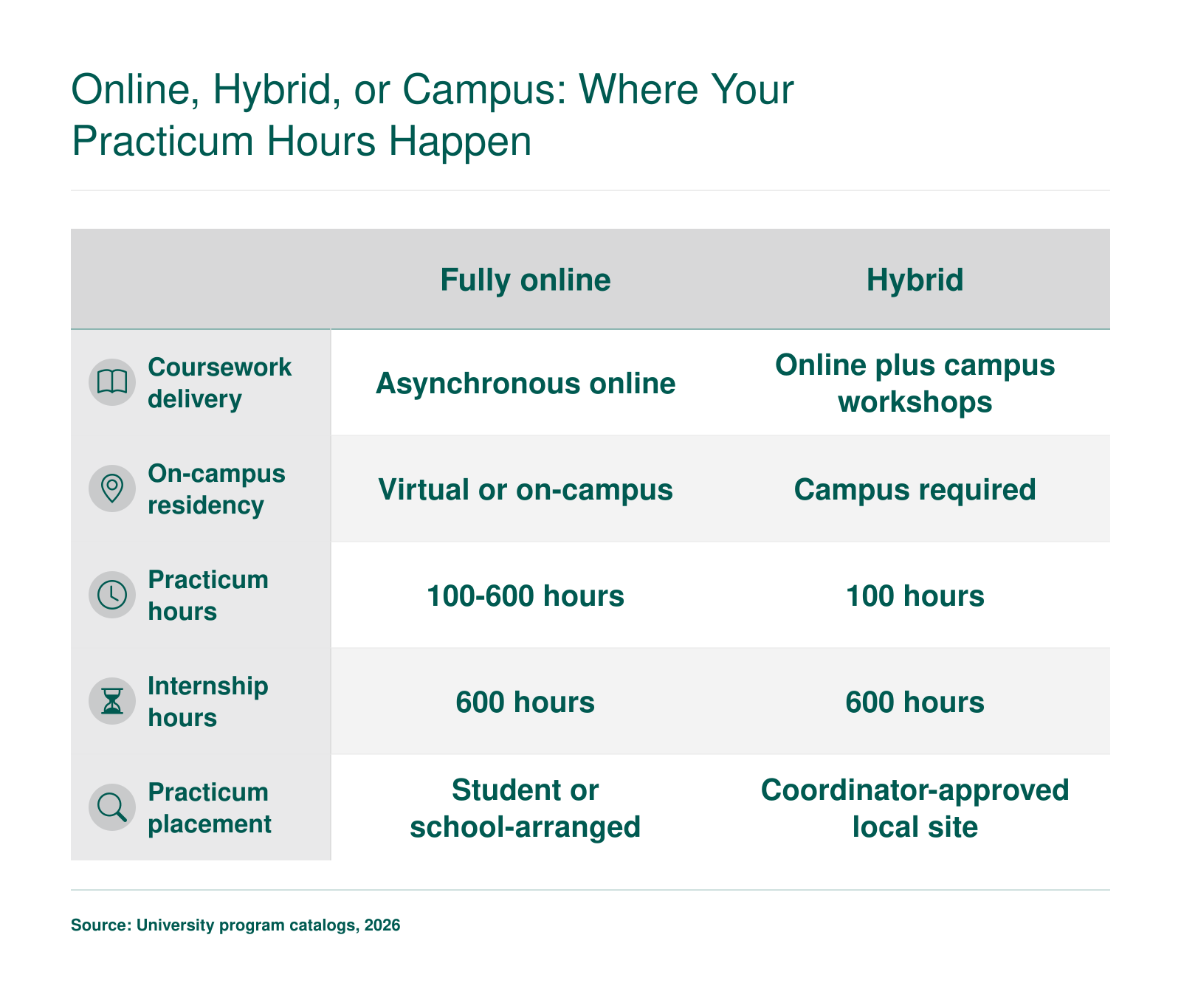
Coursework can be completed online in several programs here, but clinical fieldwork is always done in person at an approved site. Hybrid programs add brief campus workshops or residencies on top of online classes. Practicum totals range from 100 to 600 hours depending on the school, while internship requirements typically sit at 600 hours.
What Admissions Committees Ask for Instead of GRE Scores
Fall deadlines commonly run December 1 through February 1; many online options use rolling admission.
- Bachelor's degree from an accredited schoolAny major may be accepted with psychology/statistics prerequisites before or during enrollment.
- Minimum GPAPublished minimums often range 2.5–3.0; some programs weigh the last 60 credits and a few review the full record holistically.
- Prerequisite courseworkStatistics, research methods, and abnormal psychology are frequent prerequisites; some require B-or-better grades or additional psychology credits.
- Personal statementExplain your clinical interests, relevant background, and why you fit the program's training model.
- Letters of recommendationTwo or three, ideally from professors or supervisors who can speak to academic and clinical potential.
- Resume or relevant experienceVolunteer, research, or human-services experience strengthens an application, especially for clinical-track programs.
- InterviewMany programs invite finalists for an interview before admission decisions.
Clinical Psychology programs by state
Compare Clinical Psychology programs on the data that matters
Explore more Psychology specializations or browse every graduate field.
All Psychology programs