Best Health Psychology Master's Programs
Compare 10 accredited Health Psychology programs, with graduate earnings, cost, debt, and completion data from IPEDS and the U.S. College Scorecard.

Does a master's in health psychology qualify you to practice as a psychologist? In nearly every state, no. Independent licensure as a psychologist requires a doctorate, so the master's is either a stepping stone to a PhD or PsyD or a terminal degree for research and program roles.
Programs differ sharply. Credit loads run from 30 at National University to 48 at UM-Dearborn, and Touro University Worldwide advertises a 12-month online format. UM-Dearborn's clinical track prepares students for Michigan's limited license, a state-specific pathway.
Cost, format, and licensure fit rarely line up in a single program.
Key Points
- APA does not accredit master's programs in health psychology, so verify regional accreditation and licensure fit.
- Tuition is only part of the bill: per-credit online fees and campus charges add up.
- A master's alone does not qualify you as a psychologist; licensure requires a doctorate.
Best Health Psychology Master's Programs for 2027, Ranked
The programs below stand out for combining health psychology coursework with practical training in clinical, medical, and community settings. Each card highlights concentration details, key curriculum points, and where available, early-career earnings. Use the list to compare programs by focus, schedule, and cost.
University of Michigan-Dearborn
#1Dearborn, MI · ~$17,000/yr (est.)
Best for: Online learners wanting clinical health training
The clinical health psychology master's blends cognitive behavioral therapy, acceptance and commitment therapy, and motivational interviewing training with two terms of practicum in community clinics and hospitals. Students build skills in psychological assessment, neuropsychology, statistics, and research methods, and graduates meet course requirements for Michigan's Limited License.
- 48 credit hours over two years
- No entrance exam required
- Minimum 3.2 GPA and three recommendation letters
- Practicum in community clinics and hospitals
- Prepares for Michigan Limited License coursework
- Fall start with March 15 application deadline
- Thesis or elective capstone option
Central Connecticut State University
#2New Britain, CT · ~$15,000/yr (est.)
Best for: Evening students balancing work and graduate study
This master's in psychology offers a health psychology specialization centered on the mind-body connection. The curriculum develops skills in research, clinical assessment, and prevention, with coursework in biofeedback, behavioral interventions, and health promotion. Evening courses and part-time or full-time enrollment make it accessible for working professionals.
- Health psychology specialization focused on mind-body connection
- Full-time and part-time enrollment options
- Evening classes offered
- Research, clinical assessment, and prevention curriculum
- Assistantships and scholarships available
- Median earnings $54,398 one year after finishing
University of Wisconsin-Milwaukee
#3Milwaukee, WI · $13,000 – $26,000/yr (est.)
Best for: Research-oriented students planning doctoral study
The master's in psychology with a health psychology specialization trains students in research methods and the application of psychological theory to physical health. The curriculum covers statistics, experimental design, psychophysiology, and behavioral neuroscience, with an optional field placement in health settings. Students benefit from partnerships with the Medical College of Wisconsin and teaching or research assistantships.
- 36 credit hours
- Full-time and part-time options
- Optional field placement in health psychology
- Research in laboratory and clinical settings
- Interdisciplinary training with Medical College of Wisconsin
- Teaching and research assistantships with salary and tuition remission
- Median earnings $54,074 one year after finishing
National University
#4San Diego, CA · ~$16,000/yr (est.)
The health psychology master's explores stress, coping, behavioral nutrition, and chronic conditions through electives in substance abuse, collaborative care, and community health. The program emphasizes practical applications such as coaching and wellness interventions and offers an accelerated pathway to a PhD. Graduates pursue roles in health education, community health, and wellness program coordination.
- 30 credit hours and 10 courses
- 16-month completion path
- 8-week course terms
- Rolling start dates
- No entrance exam required
- Optional internship at program's end
- FastForward pathway to PhD
- Median earnings $57,834 one year after finishing
Touro University Worldwide
#5Los Alamitos, CA · ~$9,000/yr (est.)
The master's in psychology with a health psychology concentration examines smoking cessation, nutrition, eating disorders, and the psychological aspects of healthy aging. Students learn from scholar-practitioners and can apply health psychology theories in consulting, hospitals, corporations, and government agencies. The program prepares graduates for health education, wellness coaching, and community outreach roles, though it does not lead to licensure.
- 12-month completion possible
- 8-week course sessions
- Six start dates per year
- No GRE required
- No residency required
- Curriculum covers smoking cessation, nutrition, eating disorders, and healthy aging
- Scholar-practitioner faculty
- Median earnings $61,331 one year after finishing
Cost & outcomes by school
Federal data for the highest-earning Health Psychology programs, independent of the ranking above. Earnings are this field's master's graduates four years after completing, where the Scorecard reports them.
| School | Earnings | Tuition / yr | Debt | Grads/yr | Format |
|---|---|---|---|---|---|
| Touro University Worldwide CA | $89,314 | $9,000 | $27,075 | 115 | Online |
| National University CA | $78,497 | $16,416 | $28,854 | 1,098 | Online |
| University of Wisconsin-Milwaukee WI | $66,931 | $12,728 | $41,000 | 52 | Campus |
| Central Connecticut State University CT | $61,035 | $14,562 | $53,260 | — | Campus |
| Walden University MN | $56,934 | $10,885 | $41,000 | 270 | Online |
| Northcentral University CA | $52,083 | $17,998 | $30,160 | 153 | Online |
| Grand Canyon University AZ | — | $10,015 | — | — | Online or campus |
| North Carolina A & T State University NC | — | $8,368 | — | 12 | Campus |
| Carroll University WI | — | $14,424 | — | — | Campus |
| University of Michigan-Dearborn MI | — | $17,126 | — | 15 | Online |
Sources: U.S. Department of Education. Tuition and graduates: IPEDS. Earnings and debt: College Scorecard, this field's master's graduates; a dash means no figure is reported.
Cost, debt & payoff
Median earnings of this field's master's graduates (4 yrs after completing) vs. their median federal loan debt · U.S. College Scorecard
Across these programs the median graduate earns about $63,983 and finishes with roughly $35,580 in debt — a ratio that clears a common rule of thumb (keep debt below first-year salary). Tuition and debt vary widely school to school, so check the per-school figures in the table above before you shortlist.
Behind the List: The Cost, Completion, and Earnings Data We Weighed
A low sticker price matters little if few students finish or graduates cannot repay what they borrowed; the schools on this list earned their places on numbers a student can verify. Four inputs matter most:
- Tuition and fees: The graduate price for the specific program, before any aid.
- Net price: The average amount students pay after grants and scholarships, which often differs sharply from the published rate.
- Graduation rate: The share of students who complete a degree at the institution.
- Earnings and debt: Median pay and borrowing for graduates of the program itself, from the College Scorecard, where the federal government publishes them.
What These Numbers Can't Tell You
The graduation rate and net price measure the whole institution, not the health psychology master's alone. Both blend undergraduates with graduate students, so treat them as signals rather than guarantees for this degree.
Program-level earnings are the biggest gap. For the health psychology programs here, the federal government has not yet published program-level earnings or debt figures, and we won't estimate them. Where a number is missing, we say so rather than fill it in.
Institutional figures come from the 2024 College Scorecard snapshot, the most recent release available as of October 2026. Confirm current tuition and deadlines directly with each program before you apply.
Health Psychology Master's Program Cost: Tuition Plus the Fees Nobody Advertises
The table below lists the most affordable options in the ranking, with published graduate tuition and average net price. Net price is an institution-wide average after grants and scholarships, not a personal quote, so your own cost may differ. Typical add-ons from bursar pages include a $72 per semester psychology program fee at UCCS, a $25 per credit online course fee at UConn, technology fees from $32 to $135 per term at Loyola University Chicago, a $750 per year books and materials budget at Purdue, and practicum costs such as background checks and student liability insurance.
| Program | In-State Graduate Tuition | Out-of-State Graduate Tuition | Average Net Price |
|---|---|---|---|
| University of Michigan-Dearborn | 15640 | 32896 | 9492 |
| University of Wisconsin-Milwaukee | 10398 | 22398 | 15014 |
| Central Connecticut State University | 13050 | 16550 | 16857 |
Health Psychology vs. Clinical Psychology at the Master's Level
A health psychology master's is not a shortcut to becoming a therapist, and confusing it with clinical psychology master's programs is one of the costliest mistakes applicants make.
The Core Difference
Health psychology examines how behavior, stress, and social conditions shape illness, recovery, and wellness. Think smoking cessation, chronic pain coping, medication adherence, and the effects of caregiving strain. Clinical psychology centers on assessing, diagnosing, and treating mental disorders such as depression, anxiety, and psychosis.
What Master's Programs Actually Train
Most health psychology master's programs are either research-focused or applied but nonclinical. Graduates learn program design, behavior-change methods, data analysis, and health communication. Training in direct clinical care, often labeled "clinical health psychology," typically happens at the doctoral level, where students complete extended supervised internships before they can practice independently.
The Practical Consequence
If your goal is to provide psychotherapy with a master's degree, a health psychology program will usually leave you short. A Clinical Mental Health Counseling or marriage and family therapy degree built around a licensure track is the more direct route, because it includes the supervised clinical hours that state boards require. Health psychology fits better if you want to work in public health, wellness programming, research, or behavioral health support, or if you plan to continue to a doctorate.
Rule of thumb: when a program page promises coursework in behavior change and research methods but never mentions supervised clinical hours or a licensure track, it is training you for nonclinical work.
Related Articles
Campus, Online, or Both? Comparing Formats and Practicum Requirements
Credit Load and Pace
No single national standard governs programs titled health psychology, so structures vary. Total credits generally run from about 30 to 61. National University's online MS sits at the low end: 30 credits, roughly 16 months. Clinically oriented campus programs climb higher, such as East Texas A&M's 60-credit Clinical Psychology MS.
Practicum and Internship Hours
Hours depend on whether the degree is clinical. Counseling psychology programs such as Liberty University's and Capella University's commonly require 700 hours (100 practicum plus 600 internship). Do not assume that figure applies to a nonclinical health psychology degree. Some online programs require no clinical internship at all, and others offer an optional internship in place of a capstone. If licensure is your goal, confirm which hours your state board will count, since some count only direct client contact.
Thesis or Non-Thesis
Thesis tracks generally add about six credits and several months of supervised research. Non-thesis tracks substitute coursework, a comprehensive exam, or a capstone. East Texas A&M offers both. Research lab access is strongest on campus, so if you are eyeing a doctorate, that matters.
Who Each Format Fits
- Online: Best for working professionals who need flexible scheduling. Online psychology master's degrees typically do not shrink fieldwork requirements when the program is clinical.
- Campus: Offers faces-to-faces with faculty, labs, and sometimes a university training clinic, but fixed schedules are harder to pair with a full-time job.
- Hybrid: Combines mostly remote coursework with occasional in-person sessions. Check the residency dates before you commit.
Who Finds Your Placement
Online students usually complete placements at approved sites near home, and responsibility varies. Adler University arranges placements, with field work of about 8 to 10 hours a week. At Walden University, students arrange their own. Ask admissions who secures sites, and how hard that has been for recent students in your region, before you enroll.
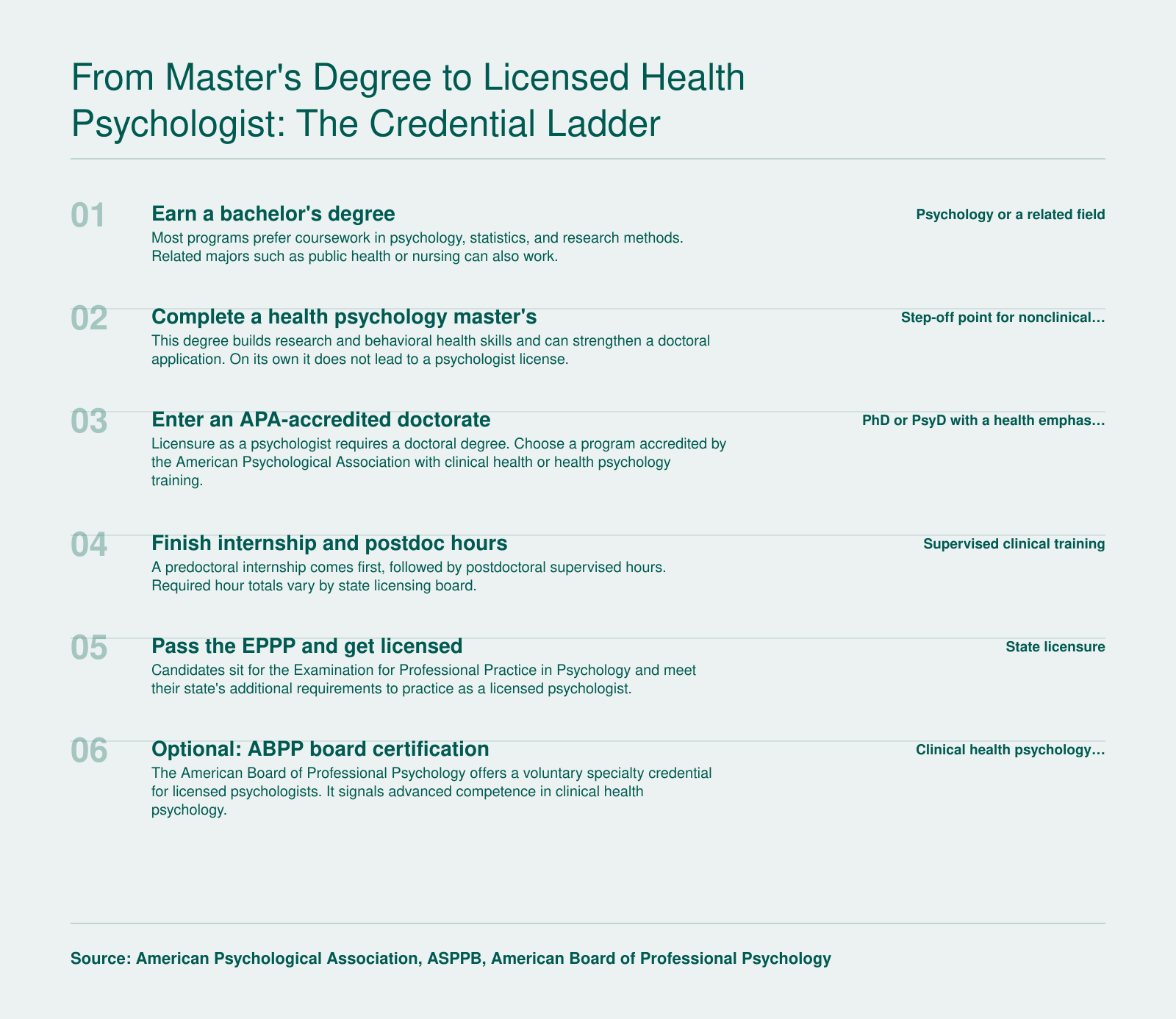
From Master's Degree to Licensed Health Psychologist: The Credential Ladder
Licensure as a psychologist requires a doctorate, so a health psychology master's is either a stepping stone or a destination. Graduates who do not plan to practice clinically can step off after the master's degree into research, program coordination, public health, and corporate wellness roles that do not require a license.
What Health Psychology Master's Applications Typically Require
Requirements vary by school, so confirm details on each program's admissions page before you apply.
- Accredited bachelor's degreeMost programs want a bachelor's from an accredited institution, and many accept non-psychology majors, sometimes with prerequisites.
- Minimum GPAA 3.0 is a common stated minimum (Daemen), though Avila lists 2.75 and Tulane's listed minimum is 3.4.
- Prerequisite courseworkStatistics and research methods are nearly universal; Saint Mary's asks for 3 undergraduate psychology credits, and Tulane requires psychology statistics and psychopathology at a B or higher.
- GRE policyMany programs, including UW–Milwaukee, Avila, Saint Mary's, and Tulane, do not require the GRE, but policies can differ by track.
- Letters of recommendationExpect to submit recommendation letters, ideally from faculty or supervisors who can speak to your academic or professional work.
- Statement of purposeMost applications include a personal or purpose statement explaining your interest in health psychology and your career goals.
- Fall-entry deadlinesListed dates range from March 1 at UW–Milwaukee to June 1 at Saint Mary's, June 15 at Tulane, and August 21 at Avila's online program.
- Rolling admissionNational University's online program reviews applications as they arrive, so apply early because places can fill before any posted date.
Where Health Psychology Master's Graduates Actually Work
What jobs can you actually get with a health psychology master's, given that the degree does not qualify you for clinical licensure on its own?1 The answer is a broad band of applied and research roles that sit alongside, but not inside, the clinical practice that requires a doctorate.
Applied and Program Roles
Most graduates land in nonclinical positions where health behavior and research literacy matter more than a license, often in health education roles. Common titles include:
- Health educator: designing and delivering behavior-change programming for patients and communities.
- Wellness program manager: running corporate or institutional wellness and health-promotion initiatives.
- Behavioral health coordinator: supporting multidisciplinary teams, though duties and eligibility depend on the position and jurisdiction.
- Public health analyst: applying quantitative training to population health work.
These roles turn up in hospitals and outpatient clinics, public health departments, corporate wellness programs, research universities, and community or nonprofit health organizations. A newer track runs through eHealth and digital health, where graduates work as digital intervention designers, UX researchers, or behavioral scientists building technology-based interventions.2
Research Jobs and Doctoral Preparation
If you are aiming at a PhD in clinical or health psychology, the master's often works as a launchpad rather than a destination. Research-focused programs commonly require an empirical thesis,3 and graduates frequently take roles as clinical research coordinators, project coordinators, or research assistants that build methodology and independent-research experience.2
That combination (thesis work, quantitative coursework in research and behavioral medicine, faculty mentorship, and hands-on research) is what strengthens doctoral applications.3 It does not guarantee admission or credit transfer. Some programs do recognize prior graduate work: Virginia State University, for example, states that entrants holding a master's may complete the on-campus portion of its Clinical Health Psychology PhD in three years, contingent on credit transfer, before a one-year off-site internship.4 Preparation and payoff still vary by program.
Health Psychology programs by state
Health Psychology Master's Questions, Answered
These answers condense the cost, career, and credential points covered above and add detail on doctoral admissions and accreditation. Accreditation rules for master's programs are changing, so confirm current details with each program and your state licensing board.
Do health psychologists need a license?
How do health psychology and clinical psychology programs differ?
Is a master's in health psychology worth it?
How much does a health psychology master's program cost?
Can I study health psychology fully online?
What jobs can I get with a health psychology master's?
Does a health psychology master's prepare me for a PhD or PsyD?
Does a health psychology master's need MPCAC or APA accreditation?
Compare Health Psychology programs on the data that matters
Explore more Psychology specializations or browse every graduate field.
All Psychology programs