Master's in Educational Technology Programs With No GRE Required
Compare 160+ accredited no-gre Educational Technology programs at 140+ schools, with graduate earnings, cost, debt, and completion data from IPEDS and the U.S. College Scorecard.

Months of GRE prep or a waiver based on your transcript: for a working teacher, corporate trainer, or career changer pursuing an educational technology or instructional design master's, the second path is usually the practical one. Every school ranked here was selected with a no-GRE filter, but policies change and some waivers carry conditions such as a 3.0 GPA, so confirm the current test requirement on each admissions page.
Across the most affordable master's in educational technology programs, tuition runs from $8,037 at UNC Charlotte to $26,034 at Penn State, a gap of nearly $18,000 that the degree title alone does not explain.
Key Points
- Every ranked program has no GRE requirement.
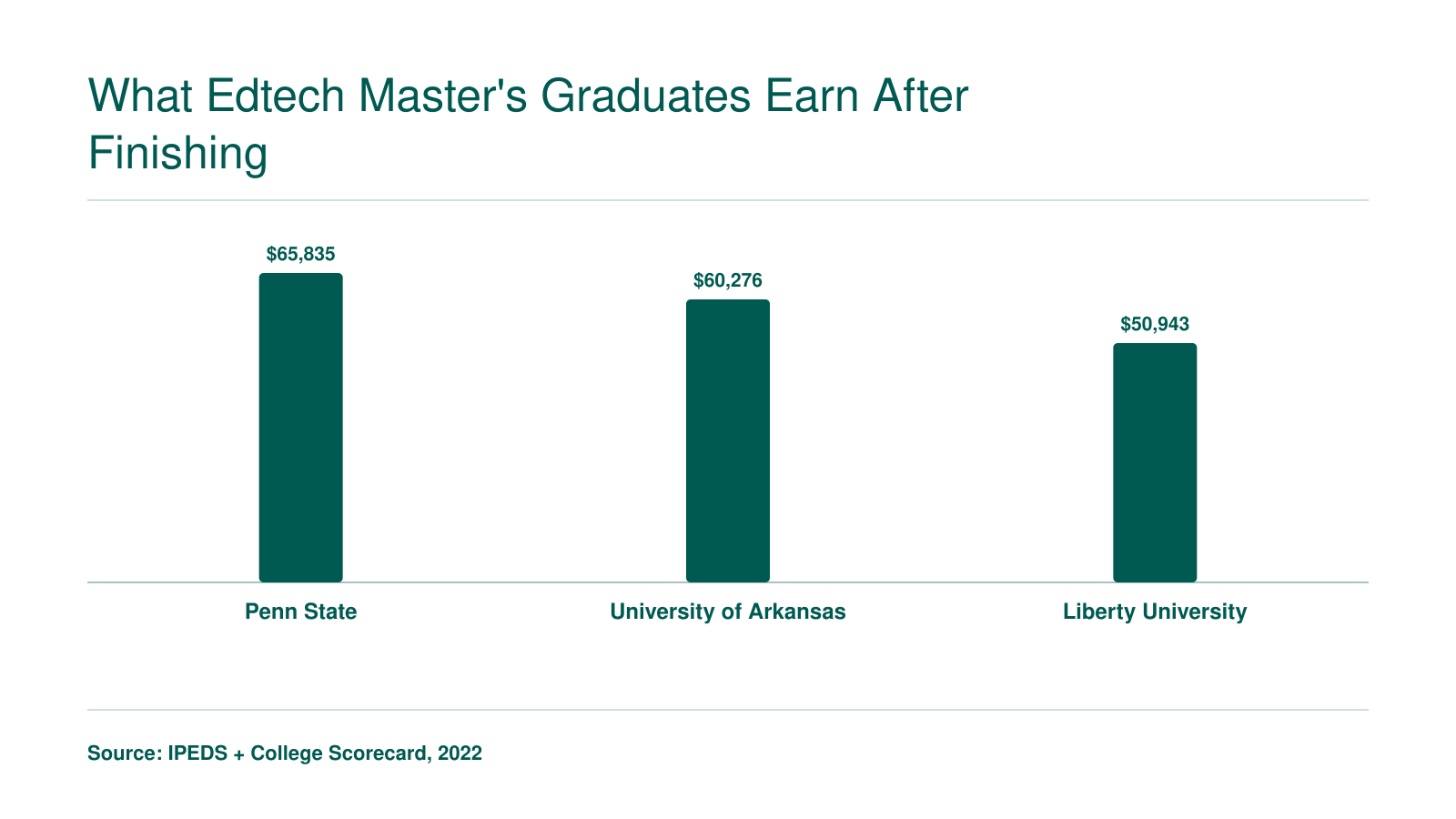
- Penn State and Arkansas graduates earn $60,276 to $65,835 after one year.
- Liberty University reports $50,943 median earnings and $34,166 median debt.
Top Accredited No-GRE Educational Technology Master's Programs
These accredited educational technology and instructional design master's programs are ordered here by a composite of test-waiver eligibility, retention, completion, and moderate cost and earnings factors, with no single metric driving the order. Each program either waives the GRE or does not require it for admission; where a policy is not confirmed, applicants should check the current GRE policy directly.
Indiana University-Bloomington
#1Bloomington, IN · $12,000 – $33,000/yr (est.)
Best for: K-12 educators targeting technology coaching roles
Indiana University Bloomington's M.S.Ed. in Educational Technology for Learning is a 36-credit online program built around hands-on evaluation and application of digital tools. It prepares graduates for technology coaching, instructional coaching, and curriculum development roles in K-12 settings. The program offers three annual start dates and does not require the GRE for applicants with a U.S. degree. Fellowships, assistantships, and employer tuition reimbursement may be available.
- 36 total credit hours
- Three start dates per year: fall, spring, summer
- 3.0 GPA minimum and two recommendations
- No GRE required for applicants with a U.S. degree
- Reduced application fee of $35
- Military benefits and employer reimbursement accepted
University of North Carolina at Charlotte
#2Charlotte, NC · $5,000 – $10,000/yr (est.)
Best for: Instructional designers choosing from three concentrations
UNC Charlotte's M.Ed. in Learning, Design, and Technology is a 30-credit program with three concentrations: School Specialist, Training and Development, and Online Learning and Teaching. All students complete a capstone project for a client and present to faculty. GRE or GMAT scores are optional, and the School Specialist concentration leads to the NC 077 Instructional Technology Specialist license. Applicants need a 3.0 GPA, three recommendations, and a 750-word statement.
- Three concentrations: School Specialist, Training and Development, Online Learning and Teaching
- GRE and GMAT optional; no entrance exam required
- 30 credit hours with capstone project for a client
- 3.0 GPA, three recommendations, and 750-word statement
- School Specialist concentration leads to NC 077 license and requires teaching experience
Pennsylvania State University
#3University Park, PA · ~$26,000/yr (est.)
Best for: Working professionals stacking two certificates
Penn State World Campus offers a fully online Master of Education in Learning, Design, and Technology. The 30-credit program charges $1,048 per credit and includes a noncredit capstone portfolio. GRE and MAT scores are not required. Students can earn certificates in Educational Technology Integration and E-Learning Design along the way, and the program is Act 48-approved for Pennsylvania educators.
- $1,048 per credit; 30 credit hours total
- Fully online with spring, summer, and fall starts
- No GRE or MAT scores required
- Noncredit capstone portfolio reviewed by adviser
- Embedded certificates in Educational Technology Integration and E-Learning Design
- Act 48-approved for Pennsylvania educators
- Does not lead to teacher certification
University of Arkansas
#4Fayetteville, AR · ~$12,000/yr (est.)
The University of Arkansas's Master of Education in Educational Technology is a fully online, non-thesis program focused on instructional design and web-based instruction. It requires 31 credits and allows completion in 1.5 to 6 years with spring, summer, and fall enrollment. No GRE is required for applicants with a 3.0 GPA or higher. Graduates pursue roles such as instructional designers, e-learning developers, and training coordinators.
- 31 credit hours, fully online
- Non-thesis degree with practical application focus
- No GRE required with a 3.0 GPA or higher
- Flexible completion from 1.5 to 6 years
- Spring, summer, and fall enrollment options
- Prepares for instructional design and e-learning roles in multiple sectors
The University of Texas at Arlington
#5Arlington, TX · ~$11,000/yr (est.)
UT Arlington's Master of Education in Instructional and Learning Design Technology is a 100% online, 30-credit program designed for working professionals. It covers instructional design foundations, online learning design, and assessment, with electives in multimedia, gamification, UX, or leadership. No GRE is required, and students complete either a research project or workplace capstone, finishing with a professional ePortfolio. A 2.8 GPA and two recommendations are typical admission requirements.
- 30 credit hours, 100% online
- No GRE required; 2.8 GPA minimum
- Two recommendation letters required
- Choice of thesis or workplace capstone
- Professional ePortfolio required
- Electives include gamification, UX, and leadership
University of Florida
#6Gainesville, FL · ~$13,000/yr (est.)
University of Florida's online M.Ed. in Curriculum and Instruction with an emphasis in Educational Technology prepares students for instructional design and digital learning roles. It can be completed in as few as two years, with full-time or part-time options and start dates each semester. No GRE is required, and students may earn a graduate certificate concurrently. The curriculum includes instructional design, media environments, learning analytics, and a culminating project.
- 2-year typical completion, full-time or part-time
- Starts fall, spring, and summer
- 3.0 GPA minimum
- No GRE required for admission
- Capstone project with asynchronous presentation
- Concurrent graduate certificate option
University of Maine
#7Orono, ME · ~$11,000/yr (est.)
The University of Maine's online M.Ed. in Instructional Technology is a 33-credit program offered collaboratively across three UMaine campuses. It features rolling admissions and does not require the GRE or GMAT. Graduates can earn the Maine Department of Education 680 endorsement, and career paths include technology integrator and instructional designer.
- 33 credit hours, $584 per credit ($19,272 total)
- 100% online with rolling admissions
- No GRE or GMAT required
- 3.0 GPA minimum
- Maine Department of Education 680 endorsement eligible
- Collaborative program across three UMaine campuses
Southern Illinois University Edwardsville
#8Edwardsville, IL · $10,000 – $15,000/yr (est.)
Southern Illinois University Edwardsville offers an accelerated online MSEd in Instructional Technology with an Educational Technology specialization. The 30-credit program can be completed in 10 months and carries a flat tuition of $14,973 with all fees included. Neither the GMAT nor GRE is required. It prepares students for the Technology Specialist Certification exam and includes a capstone addressing a real K-12 technology issue.
- $14,973 total tuition with all fees included
- 30 credit hours, 10 courses, accelerated 10-month format
- Six start dates per year
- No GMAT or GRE required
- 3.0 GPA minimum
- Prepares for Technology Specialist Certification exam
- Capstone solves a real K-12 technology issue
Liberty University
#9Lynchburg, VA · ~$9,000/yr (est.)
Liberty University's online M.Ed. in Curriculum and Instruction with a concentration in Educational Technology and Online Instruction is a 36-credit program delivered in asynchronous 8-week courses. It emphasizes technology integration for diverse learners and leadership in Christian, public, and private schools. No standardized testing is required for admission, and military tuition discounts are available. Graduates pursue roles like school technology specialist or online learning coordinator.
- 36 credit hours, $450 per credit
- Asynchronous 8-week online courses
- Eight start dates per year
- 2.5 GPA minimum; $50 application fee
- Transfer in up to 50% of degree
- Military tuition discounts available
- Emphasizes technology integration for diverse learners
Cost & outcomes by school
Federal data for the highest-earning Educational Technology programs, independent of the ranking above. Earnings are this field's master's graduates four years after completing, where the Scorecard reports them.
| School | Earnings | Tuition / yr | Debt | Grads/yr | Format |
|---|---|---|---|---|---|
| National University CA | $93,547 | $16,416 | $23,284 | 21 | Online |
| Southeastern Oklahoma State University OK | — | $5,220 | — | — | Online |
| Eastern New Mexico University NM | — | $5,706 | — | — | Online |
| University of Louisiana at Monroe LA | — | $9,399 | — | — | Online |
| University of Florida FL | — | $12,737 | — | — | Online |
| Louisiana State University and Agricultural & Mechanical College LA | — | $13,027 | — | — | Online |
| Dakota State University SD | — | $6,731 | — | 3 | Online |
| University of North Carolina at Charlotte NC | — | $8,037 | — | 34 | Campus |
| Concordia University-Saint Paul MN | — | $8,550 | — | 23 | Online |
Sources: U.S. Department of Education. Tuition and graduates: IPEDS. Earnings and debt: College Scorecard, this field's master's graduates; a dash means no figure is reported.
Cost, debt & payoff
Median earnings of this field's master's graduates (4 yrs after completing) vs. their median federal loan debt · U.S. College Scorecard
Across these programs the median graduate earns about $70,758 and finishes with roughly $23,284 in debt — a ratio that clears a common rule of thumb (keep debt below first-year salary). Tuition and debt vary widely school to school, so check the per-school figures in the table above before you shortlist.
Lowest Net Price Options Among No-GRE Edtech Programs
Net price below is an institution-wide average after all aid and is approximate, not a quote for graduate students. Aid that can lower out-of-pocket cost for EdTech master's students includes departmental graduate assistantships, education-college scholarships, TEACH Grant eligibility (up to $4,000 per year, with a four-year service commitment), employer or school-district tuition partnerships, and flat-rate online tuition. The table lists the cheapest options here by net price, but actual cost will vary by aid and enrollment.
| School | Format | In-State Graduate Tuition | Out-of-State Graduate Tuition | Net Price (Institution Average After Aid) |
|---|---|---|---|---|
| University of Florida | Online | $12,737 | $30,130 | $6,541 |
| The University of Texas at Arlington | Online | $11,249 | $26,073 | $13,951 |
| Southern Illinois University Edwardsville | Online | $10,488 | $10,488 | $14,889 |
Published tuition is only a starting point. The number that matters is net price, what you actually pay out of pocket, and it can differ sharply from the sticker price.
What Edtech Master's Graduates Earn After Finishing
Among programs with published graduate earnings, Penn State and University of Arkansas report one-year median earnings of $65,835 and $60,276, respectively. Liberty University's five-year median is $50,943, with median debt of $34,166 and a 10-year monthly payment of $389. Graduates commonly move into roles such as instructional designer, instructional technology coordinator, eLearning developer, and corporate trainer.
Related Articles
Asynchronous, Synchronous, or Residency: How These Programs Are Delivered
Delivery format decides whether a no-GRE master's program fits a working adult's life, and the programs here split into clear groups.
Fully asynchronous
Liberty University runs asynchronous courses with no required login times and no campus visits. Texas State University is also described as asynchronous and online. These suit anyone whose week changes without warning.
Scheduled live sessions
UNC Greensboro leans on synchronous, discussion-based classes. Commonwealth University of Pennsylvania mixes formats, with live meetings once or twice a week during spring and fall terms. The University of Delaware is mostly self-paced, but a few courses require occasional evening videoconferences. For teachers, evening sessions can collide with grading and school events. For corporate trainers, they can collide with client delivery or travel.
Campus visits and residencies
The sources reviewed do not establish a required on-campus residency for any of these online programs, so travel costs look unlikely to be a factor. Confirm this with an advisor before you apply.
Field-based requirements
Several programs still require work in a real setting. Delaware asks for a 50-hour clinical field experience plus an ePortfolio or thesis. UNC Greensboro requires a field-based capstone. Commonwealth's internship needs a signed affiliation agreement before it starts. UT Arlington offers a workplace capstone, and Cincinnati's capstone is a professional portfolio.
Rule of thumb: if your schedule is unpredictable, filter for 100% asynchronous online master's in educational technology programs with no residency, then check how the capstone will be completed at your workplace.
Admissions Without the GRE: What These Programs Ask for Instead
Without a GRE, these programs lean on the academic record, a focused statement, and references. The typical floor is a bachelor's degree from a regionally accredited institution and a GPA between 2.75 and 3.00.
- Bachelor's degreeUniversity of Minnesota, Adelphi, LSU and the University of Nevada, Reno each start with a bachelor's degree from a regionally accredited institution.
- Minimum GPAMinimums generally run 2.75 to 3.00. Nevada and Texas A&M International set 2.75; Minnesota asks 2.80; Adelphi and LSU list 3.00. LSU reviews applicants between 2.75 and 3.00 for probationary admission, and Adelphi considers strong candidates below 3.0.
- Application documentsA statement of purpose, résumé, and two recommendation letters are typical. Minnesota and LSU require a personal statement plus résumé; Nevada requires two letters and a 500-word statement; Adelphi asks a statement, two recommendations, and a résumé/CV.
- Teaching background and prerequisitesA teaching license is not required, and no profile presents these as a K-12 licensure-only pathway. Adelphi welcomes corporate trainers, career changers and recent graduates with no classroom or technical experience; Nevada names corporate trainers and distance-education professionals; Texas A&M International spans corporate and curriculum-design roles. Formal technology prerequisites are uncommon, Adelphi and Kean require no prior technology experience, and portfolios or interviews are not specified.
Educational Technology programs by state
Frequently Asked Questions About No-GRE Edtech Master's Programs
When are application deadlines for no-GRE educational technology master's programs?
Do I need a teaching license for an educational technology master's degree?
Is an online master's in educational technology worth it?
What can I do with a master's in educational technology?
Compare Educational Technology programs on the data that matters
Explore more Education & Teaching specializations or browse every graduate field.
All Education & Teaching programs