Best Master's in Educational Technology Programs in Alabama
Compare 7 accredited Educational Technology programs in Alabama, with graduate earnings, cost, debt, and completion data from IPEDS and the U.S. College Scorecard.

Can a working Alabama teacher use a master's in educational technology to move into instructional design, technology coaching, or district tech leadership? Yes, and many can finish while still teaching. Campus and online programs in Alabama let you build the credential without leaving the classroom, but format, GRE policy, cost, licensure fit, and graduate earnings vary enough to change the return on the degree.
The rankings below compare those differences directly.
Key Points
- In-state graduate tuition ranges from $6,868 a year at West Alabama to $21,797 at Samford.
- Jacksonville State sets MS in Instructional Technology deadlines of July 1, November 1, and April 1.
- Your Alabama teaching certificate, not a GRE score, usually drives admission to these master's programs.
Top-Ranked Master's in Educational Technology Programs in Alabama
Each program below earned its spot on value signals a working educator cares about: what it costs, how it's delivered, and how its graduates fare. Graduation rates are institution-wide, so they describe the school, not the master's program itself. Confirm current SACSCOC institutional accreditation and the educator preparation unit's CAEP or AAQEP status with each school before you apply.
Jacksonville State University
#1Jacksonville, AL · $10,000 – $15,000/yr (est.)
Best for: Educators wanting campus or online flexibility
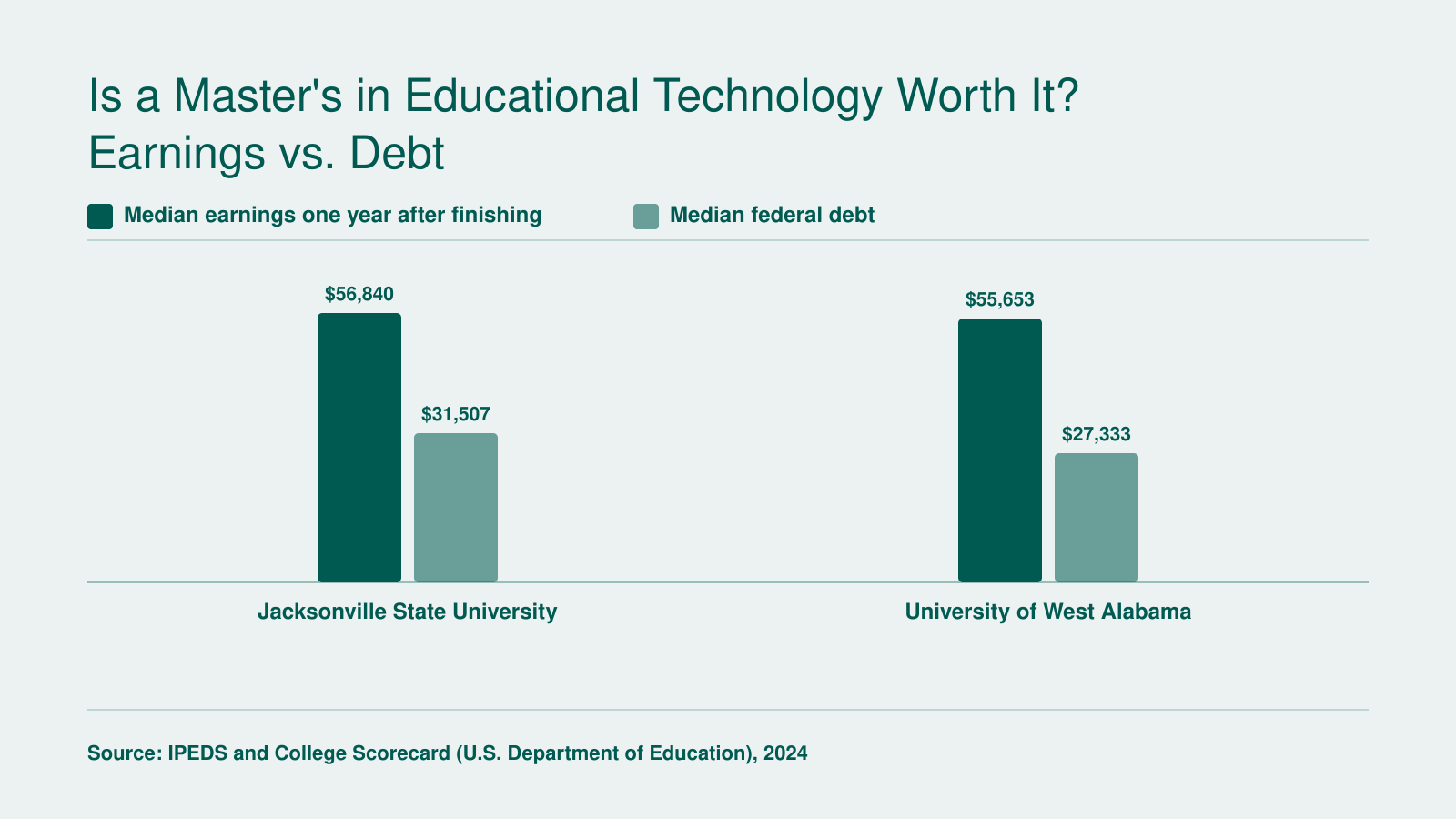
Jacksonville State University offers a Master of Science in Education in Instructional Technology in a hybrid format, with a fully online option for students who can't attend on campus. The school graduates about 55% of its students. Scorecard figures for this field show median earnings of roughly $56,840 one year after completion and $60,576 four years out, with median graduate debt near $31,507. Those figures come from a small cohort of 11 completers, so treat them as a rough signal.
- Hybrid delivery with a fully online option
- Faculty review admission, not automatic acceptance
- 3.0 graduate GPA required
- $35 application fee, three reference forms, résumé or CV
- Current educators submit a copy of their Alabama Professional Educator Certificate
- Deadlines: July 1 fall, November 1 spring, April 1 summer
University of Mobile
#2Mobile, AL · ~$14,000/yr (est.)
Best for: Career changers moving beyond K-12 classrooms
The University of Mobile offers a fully online, non-certification Master of Education in Instructional Design and Technology in its School of Education. Any bachelor's field qualifies, which opens the door to career changers heading into corporate training, e-learning design, consulting, or higher education. The school graduates about 57% of its students. Alabama teachers with a valid certificate can also earn a master's-level salary increase with the degree.
- Fully online, non-certification degree
- Open to any bachelor's degree field
- Core courses include ISD 508, ISD 563, and a practicum in ISD 575
- Includes TE 520 Evaluation and Research in Education
- Careers: technology consultant, e-learning designer, corporate trainer
- Master's-level salary increase for Alabama teachers with a valid certificate
Auburn University at Montgomery
#3Montgomery, AL · $5,000 – $10,000/yr (est.)
Best for: Working teachers needing rolling start dates
Auburn University at Montgomery runs an online Master of Education in Instructional Technology aimed at K-12 teachers, higher education staff, and corporate trainers. The curriculum follows CAEP and ISTE standards, and AUM's College of Education is CAEP accredited at the initial and advanced levels. A hands-on practicum and four electives let students tailor the degree. The school graduates about 33% of its students, a figure worth weighing alongside the program's low entry barriers.
- Fully online, 30 credit hours in 10 courses
- Completion in about 1.5 years
- No GRE or entrance exam required
- Rolling admissions with summer, fall, and spring starts
- 3.0 GPA minimum and $25 application fee
- Practicum for field experience
- Four electives, including instructional design and information resource management
- Aligned with ISTE standards; military benefits accepted
University of West Alabama
#4Livingston, AL · $7,000 – $14,000/yr (est.)
The University of West Alabama in Livingston offers an online Master of Education in Learning, Design, and Technology with an International concentration. Coursework covers interactive e-learning, educational games and simulations, assistive technology, and online course design, finishing with an e-portfolio capstone. The school graduates about 35% of its students. Scorecard data for this field show median earnings near $55,653 one year after completion and $60,086 four years out, with median graduate debt around $27,333 across 45 completers.
- Fully online, 36 total credit hours
- International concentration adds conversational English and Southern US culture courses
- Comprehensive e-portfolio capstone required
- Courses on interactive e-learning design and educational games
- Covers digital citizenship and the law, plus assistive technology
- Online teaching and course design coursework
Samford University
#5Birmingham, AL · $20,000 – $25,000/yr (est.)
Samford University in Birmingham offers a 30-hour M.S.E. in Instructional Design & Technology on campus, with project-based work applied to business, education, healthcare, and military settings. The program is a design-focused degree and does not lead to Class A Certification. The school graduates about 77% of its students, the strongest rate in this group, but published graduate tuition is also the highest here, so compare cost carefully.
- 30 total credit hours, campus-based
- Does not earn Class A Certification
- Covers instructional analysis, design, development, implementation, and evaluation
- Includes multimedia, web-based instruction, and distance education
- Project-based learning in business, education, healthcare, and military contexts
- Focus on integrating technology into curricula and instructional systems
Cost & outcomes by school
Federal data for the highest-earning Educational Technology programs, independent of the ranking above. Earnings are this field's master's graduates four years after completing, where the Scorecard reports them.
| School | Earnings | Tuition / yr | Debt | Grads/yr | Format |
|---|---|---|---|---|---|
| Jacksonville State University AL | $60,576 | $11,488 | $31,507 | 15 | Hybrid |
| University of West Alabama AL | $60,086 | $6,868 | $27,333 | 57 | Online |
| Strayer University-Alabama AL | — | $15,135 | — | — | Online |
| Columbia Southern University AL | — | $3,936 | — | 1 | Online |
| Auburn University at Montgomery AL | — | $9,136 | — | 1 | Online |
| University of Mobile AL | — | $14,410 | — | 1 | Online |
| Samford University AL | — | $21,797 | — | — | Campus |
Sources: U.S. Department of Education. Tuition and graduates: IPEDS. Earnings and debt: College Scorecard, this field's master's graduates; a dash means no figure is reported.
What You Can Do With a Master's in Educational Technology
The choice often comes down to leaving the classroom or using the degree to earn more inside it. Both paths are open with this credential across Master's Programs in Alabama.
Graduates commonly move into roles like instructional technology specialist or coach, instructional designer (in K-12, higher education, or corporate training), online learning coordinator, and district technology integration lead. These jobs sit at the intersection of teaching and design, which is why the best educational technology master's programs often blend education technology with instructional design coursework. The two fields share the same core: building effective learning experiences across digital tools and platforms.
Not everyone wants to leave teaching, and you don't have to. Many classroom teachers pursue the degree to advance on the state salary schedule and deepen their tech integration skills while staying with students. The cost and certification section covers how the degree affects pay and credentials.
Online and Hybrid Master's in Educational Technology Options in Alabama
Format varies more than the degree titles suggest. Auburn University at Montgomery, the University of Mobile, and the University of West Alabama all deliver their instructional technology and instructional design master's fully online. Jacksonville State runs a hybrid Master of Science in Education in Instructional Technology with a fully online option. Samford's Instructional Design & Technology M.S.E. is campus-based in Birmingham.
AUM's program is built for working educators: 30 credit hours, about 18 months, with a practicum for field experience. UWA's online master's in educational technology track runs 30 credits and ends in a comprehensive e-portfolio capstone. None of these schools publishes a clear breakdown of which courses meet live versus on your own schedule, or whether exams are proctored, so ask the program coordinator directly before you enroll.
For a teacher working a full school day, the fully online options carry the least schedule risk. Jacksonville State's hybrid is workable if you live within driving distance of campus.
Out-of-state students comparing most affordable master's in educational technology programs should confirm the rate that applies. AUM lists $552 per credit for non-Alabama residents online, plus online course, technology, and administrative fees.1
Which Alabama Edtech Master's Programs Skip the GRE?
In Alabama, your teaching certificate shapes your admission far more than a GRE score does, and many master's in educational technology programs with no GRE required in the state handle entrance exams in one of three ways:
- No exam listed: Admission rests on a bachelor's degree, transcripts, recommendations, a statement, and a minimum GPA, often 3.0 overall or 3.0 across your last 60 hours.1
- GRE or MAT with a GPA alternative: A 3.0 GPA can stand in for test scores when you seek unconditional admission.2
- Exam required, no waiver stated: Some tracks ask for a satisfactory MAT, GRE, or Praxis II score regardless of GPA.
Minimum GPAs on these programs generally run from 2.75 to 3.0.13
Do you need a teaching license to enroll? That depends on the track. Class A certification tracks expect a valid Class B certificate and a clear background check, and some also require documented classroom experience.2 Non-certification instructional technology and design tracks usually require neither a certificate nor teaching experience.
Before you apply to Jacksonville State University, the University of Mobile, Auburn University at Montgomery, the University of West Alabama, or Samford University, compare them in Best M.Ed. Programs in Alabama and check three things on the admissions page: the test policy, how GPA is calculated, and whether a certificate is required. If a school posts no test policy, ask admissions to confirm it in writing.
Related Articles
Master's in Educational Technology Cost and Alabama Certification Fit
In-state graduate tuition runs from $6,868 a year at the University of West Alabama, the lowest here, to $21,797 a year at Samford University, the highest. Net price is an institution-wide average after aid, not a quote for any one master's program, so treat it as a rough guide. On licensure, a few of these degrees are explicitly non-certification, which matters because Alabama's Class A certificate in Instructional Technology is what ties a teacher's pay to the master's-level salary schedule. Confirm with your district before you enroll.
| School | Program | Credits | In-state graduate tuition (annual) | Per-credit rate and fees | Net price (institution-wide) | Class A certification fit |
|---|---|---|---|---|---|---|
| University of West Alabama | M.Ed. in Learning, Design & Technology | 30 (36 for the International concentration) | $6,868 | $429 per credit, $12,870 tuition for 30 credits, plus a $120 technology fee each semester | $12,684 | Non-certification degree |
| Auburn University at Montgomery | M.Ed. in Instructional Technology (online) | 30 | $9,136 | $483 in-state, $531 out-of-state, plus $70 per credit in fees and a $35 service fee each semester; $16,590 in-state tuition and per-credit fees | $13,224 | Not confirmed here; ask the program |
| Jacksonville State University | M.S. in Education in Instructional Technology | N/A | $11,488 | N/A | $14,279 | Not confirmed here; ask the program |
| University of Mobile | M.Ed. in Instructional Design and Technology (Non-Certification) | N/A | $14,410 | N/A | $22,382 | Non-certification degree |
| Samford University | M.S.E. in Instructional Design & Technology | 30 | $21,797 | N/A | $32,622 | Does not earn Class A certification |
Alabama Instructional Technology Certification
Is a Master's in Educational Technology Worth It? Earnings vs. Debt
Program-level earnings are measured one year after finishing, shown beside median federal loan debt. Jacksonville State University and the University of West Alabama are the schools here with both figures. Verdict: typical monthly payments of $358 and $311 equal about 7.6% and 6.7% of first-year earnings, a manageable load.
Deadlines, Start Terms, and Transfer Credit for Alabama Edtech Master's Programs
When does the next cohort actually start, and how late can you apply? Jacksonville State sets term-specific cutoffs for its MS in Instructional Technology: July 1 for fall, November 1 for spring, and April 1 for summer, with anything later requiring approval from the graduate program chair.1 Auburn University at Montgomery reviews applications on a rolling basis for its 30-hour MEd in Instructional Technology; the next listed cohort closes January 7, 2027 and begins January 11, 2027.
Transfer credit varies more than deadlines do. AUM accepts up to 12 graduate hours toward the degree, a sizable chunk of a 30-hour program. JSU accepts transfer work as well, but it cannot be used to raise your average to the 3.0 admission minimum.1 Where a cap isn't posted, ask the department for it in writing.
Before you submit anything, email the program advisor and confirm two things: the certification track you intend to pursue, and the deadline attached to it.
Compare Educational Technology programs on the data that matters
Explore more Education & Teaching specializations or browse every graduate field.
All Education & Teaching programs