Most Affordable Master's in Educational Technology Programs
Compare 160+ accredited most affordable Educational Technology programs at 140+ schools, with graduate earnings, cost, debt, and completion data from IPEDS and the U.S. College Scorecard.

How much does a master's in educational technology actually cost? In-state tuition in this ranking runs from $6,157 at Texas A&M University-Kingsville to $9,612 at California State University-San Bernardino.
Most of the programs are online, which suits working teachers and career changers who can't relocate or leave a classroom.
Those figures cover tuition only. Fees, residency rules, and out-of-state rates can change the real bill, and the lowest sticker price is not always the cheapest degree.
Key Points
- Texas State's online M.Ed. totals $15,060 before fees.
- At SIUE, online M.Ed. tuition is $499.10 per credit.
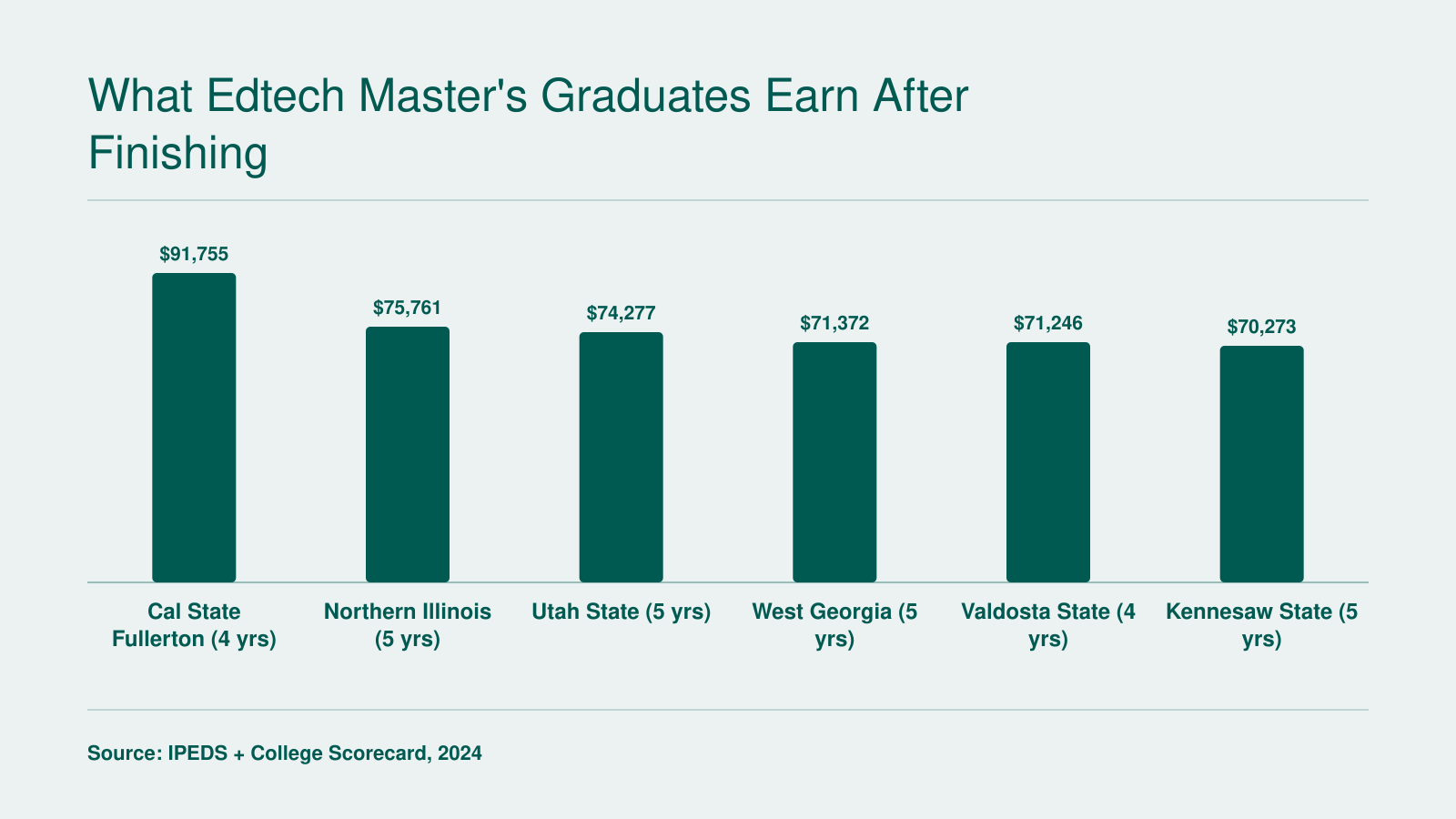
- Reported median earnings run from about $70,000 to $92,000.
Top 10 Most Affordable Master's in Educational Technology Programs
The programs below combine relatively low graduate tuition with clear pathways into instructional design, e-learning, and technology leadership. Several keep online rates the same for in-state and out-of-state students. Each entry is chosen for how well its cost and program structure fit working educators and career changers.
The University of Texas Rio Grande Valley
#1Edinburg, TX · $5,000 – $10,000/yr (est.)
Best for: Working K-12 educators seeking stackable certificates
UTRGV's M.Ed. in Educational Technology is fully online and project-based, built on AECT standards and designed to be finished in as little as 10 months. The 30-credit program lets students stack graduate certificates in E-Learning, Online Instructional Design, or Technology Leadership at no extra tuition charge. An ePortfolio final project gives graduates a work sample for instructional design and technology leadership roles.
- Fully online and project-based
- 30-credit program can be completed in as little as 10 months
- Aligned with AECT professional standards
- Concentration options: E-Learning, Technology Leadership, Online Instructional Design
- Add graduate certificates at no extra cost
- ePortfolio final assessment replaces comprehensive exam
- Designed for K-12, higher education, corporate, healthcare, government, and military settings
- Covers AI and e-learning trends
California State University-Fullerton
#2Fullerton, CA · $9,000 – $19,000/yr (est.)
Best for: Educators wanting cohort-based online learning
Cal State Fullerton's fully online MS in Educational Technology uses a cohort model and equity-driven practices, preparing educators to become instructional designers, technology coaches, or curriculum leaders. The program emphasizes applied research and meaningful technology integration in schools and workplaces.
- Fully online program
- Cohort-based structure
- Emphasizes equity-driven practices
- Designed for educators
- Prepares for instructional designer, technology coach, and curriculum leader roles
California State University-San Bernardino
#3San Bernardino, CA · ~$10,000/yr (est.)
Best for: Professionals exploring research and design emphases
Cal State San Bernardino's MA in Education with an Instructional Technology and Design option gives students two emphases: research and design/development. The program covers technology integration, instructional materials design, and digital leadership, preparing graduates for roles from instructional designer to corporate trainer. It sits in a WASC-accredited department and serves teachers, corporate trainers, and career changers.
- Two emphases: research and design/development
- WASC-accredited department
- Covers technology integration and digital initiatives
- Prepares for roles like instructional designer and corporate trainer
- Serves teachers, corporate trainers, and career changers
Florida Atlantic University
#4Boca Raton, FL · $7,000 – $18,000/yr (est.)
FAU's online M.Ed. in Instructional Technology is a 36-credit program with concentrations in Instructional Design and Instructional Technology Leader. Students take core coursework, research and statistics, and electives, with fall, spring, and summer start dates; full-time study can finish in about 24 months. Admission requires a 3.0 GPA, personal statement, resume, and two letters of recommendation.
- 36 total credit hours
- Concentrations: Instructional Design and Instructional Technology Leader
- Fall, spring, and summer start dates
- Full-time students can finish in about 24 months
- 3.0 GPA and two letters of recommendation required
- Includes research and statistics core
University of West Florida
#5Pensacola, FL · $5,000 – $10,000/yr (est.)
UWF's M.Ed. in Instructional Design and Performance Technology is a 36-credit fully online program that lets students earn three graduate certificates at the same time: Human Performance Improvement, Online Teaching and Learning, and Current and Emerging Instructional Technology. The curriculum applies business and pedagogical principles across K-12, higher education, healthcare, military, and corporate settings. UWF estimates completion in about 24 months, with 16-week courses and a January start date.
- 36 total credit hours
- Fully online
- Earn three certificates alongside the degree
- Certificate areas: Human Performance Improvement, Online Teaching and Learning, Current and Emerging Instructional Technology
- 16-week course length
- Next start date January 6
- Applies to K-12, healthcare, military, and corporate settings
- Estimated 24 months to finish
Texas A&M University-Victoria
#6Victoria, TX · $5,000 – $10,000/yr (est.)
A&M-Victoria's M.Ed. in Educational Technology is a 30-credit, fully online program covering instructional design, multimedia development, and technology management. Students can choose a Curriculum & Instruction specialization, and the program prepares graduates for roles like instructional coordinator, eLearning developer, and chief learning officer. Financial aid is available.
- 30 total credit hours
- Fully online program
- Specialization in Curriculum & Instruction
- Prepares for technology leadership roles
- Financial aid available
- 30 total credit hours
- Business management coursework
- Internship in curriculum integration
- Master comprehensive exam required
- Statement of purpose and two letters of recommendation required
- 30 total credit hours
- Internship in curriculum and technology
- Focus on adult higher education
- Social media infused learning and multimedia design skills
- Master comprehensive exam required
- Statement of purpose and two letters of recommendation required
Texas A&M University-Kingsville
#7Kingsville, TX · ~$6,000/yr (est.)
Texas A&M-Kingsville's M.S. in Education with an Instructional Technology concentration is a 30-credit program with a 12-credit core and 18-credit technology concentration. Coursework covers digital learning society, multimedia design, instructional design principles, and instructional technology leadership. The program sits in the Department of Teacher and Bilingual Education and appears in the 2026-2027 graduate catalog.
- 30 total credit hours
- 12-credit core curriculum
- 18-credit instructional technology concentration
- Covers multimedia design, digital learning society, and instructional technology leadership
- Catalog year 2026-2027
Sul Ross State University
#8Alpine, TX · $5,000 – $10,000/yr (est.)
Sul Ross State University's M.Ed. in Educational Instructional Technology is built for working professionals, with five courses taught in eight-week terms. The curriculum covers instructional design, inquiry-based research, foundations of educational technology, and critical issues, emphasizing hands-on application. Graduates prepare for roles such as K-12 technology coordinator, online educator, instructional designer, or corporate and military training specialist.
- Five total courses
- Eight-week course terms
- Flexible for working professionals
- Careers: instructional designer, tech coordinator, corporate/military training
- Multiple start dates available
Utah State University
#9Logan, UT · $8,000 – $25,000/yr (est.)
Utah State University's M.Ed. in Instructional Technology and Learning Sciences blends theory and practice in online learning, digital tools, and instructional design. The program is available online and on campus, and culminates in a creative project or internship with a portfolio. It prepares graduates for roles like educational technology specialist, instructional coordinator, or district technology leader.
- 37 total credit hours
- 3.0 GPA minimum
- Capstone or creative project required
- Available online and on campus
- State of Utah SLMA endorsement
- Build a professional portfolio
- Designed for current educators and administrators
- One-credit online orientation course
East Texas A&M University
#10Commerce, TX · ~$7,000/yr (est.)
East Texas A&M offers both M.Ed. and M.S. in Educational Technology, fully online with a 30-credit curriculum covering digital learning design and critical thinking. The program includes accelerated courses, full- or part-time pacing, no thesis, and a hands-on capstone with a professional portfolio. A Quick Start Grant for new students adds to the value.
- 30-credit, 100% online program
- Full-time and part-time pacing available
- Capstone project required
- No thesis requirement
- 3.0 GPA and two letters of recommendation
- Quick Start Grant available
- Master of Science degree option
- 30-credit, fully online curriculum
- Accelerated course format
- Build a professional portfolio
- Scholarships available
- Graduate assistantships available
Cost & outcomes by school
Federal data for the highest-earning Educational Technology programs, independent of the ranking above. Earnings are this field's master's graduates four years after completing, where the Scorecard reports them.
| School | Earnings | Tuition / yr | Debt | Grads/yr | Format |
|---|---|---|---|---|---|
| Harvard University MA | $127,546 | $57,248 | $20,500 | 143 | Campus |
| Touro University NY | $94,743 | $14,979 | — | 26 | Online |
| National University CA | $93,547 | $16,416 | $23,284 | 21 | Online |
| California State University-Fullerton CA | $91,755 | $8,994 | $20,300 | 129 | Online |
| Utah State University UT | $86,107 | $7,828 | $23,965 | 42 | Hybrid |
| University of West Georgia GA | $74,243 | $6,046 | $21,320 | 361 | Online |
| Western Governors University UT | $71,469 | $9,320 | $7,989 | 1,655 | Online |
| Southeastern Oklahoma State University OK | — | $5,220 | — | — | Online |
| Eastern New Mexico University NM | — | $5,706 | — | — | Online |
| Texas A&M University-Kingsville TX | — | $6,157 | — | 3 | Online |
| Marian University WI | — | $6,282 | — | — | Online |
| Martin Luther College MN | — | $6,300 | — | — | Online |
Sources: U.S. Department of Education. Tuition and graduates: IPEDS. Earnings and debt: College Scorecard, this field's master's graduates; a dash means no figure is reported.
Cost, debt & payoff
Median earnings of this field's master's graduates (4 yrs after completing) vs. their median federal loan debt · U.S. College Scorecard
Across these programs the median graduate earns about $70,758 and finishes with roughly $23,284 in debt — a ratio that clears a common rule of thumb (keep debt below first-year salary). Tuition and debt vary widely school to school, so check the per-school figures in the table above before you shortlist.
What an Edtech Master's Really Costs: Fees, Residency, and Flat Online Rates
Texas State University lists its online master's in educational technology at $502 per credit, and the 30-credit program totals $15,060 before any separate technology or graduation fees. Southern Illinois University Edwardsville (SIUE) lists $499.10 per credit, $1,497.30 for a three-credit course, and $14,973 total, and it states the same in- and out-of-state rate with all fees included.1 Western Governors University uses a different pricing model: $6,500 per year for 30 competency units, not conventional credits.
Fees That Sticker Prices Hide
A per-credit total is not the final bill. Educational technology master's programs may add technology, online course, portfolio, and graduation fees, and published per-credit rates vary: Texas State lists $502, while the University of Florida lists $549.34. Always ask for a fee schedule.
Flat Online Rates vs. Out-of-State Premiums
SIUE is the clearest example of a flat online rate, charging the same per-credit amount regardless of residency. In the programs below, compare in-state and out-of-state tuition: California State University-San Bernardino lists $9,612 in-state versus $19,692 out-of-state; University of West Florida lists $9,062 versus $24,894. That gap is common where residency still matters.
Net Price Is Not a Quote
The net price shown for a school is an institution-wide average after aid, not a guaranteed individual cost. Use it to compare affordability, then request a personal estimate from financial aid.
Related Articles
Online Formats and How Fast You Can Finish
Fast completion only saves money if the delivery format fits your work schedule. Asynchronous courses let you watch lectures and submit work whenever you choose. Synchronous courses require you to log in at set times. A teacher with a late dismissal bell should ask each program which model it uses, because that detail is easy to miss in program listings.
Formats and Start Dates
East Texas A&M is 100% online and appears among accelerated educational technology master's programs, with a one-year path through 30 credits. UT Rio Grande Valley lists a 10-month format, and Sul Ross runs 8-week terms across five courses. Cal State Fullerton is fully online but cohort-based, with a fall start on August 22, 2026, so you must plan around that date. Utah State and Cal State San Bernardino include hybrid or on-campus elements, so ask about visits before applying. Florida Atlantic offers three start dates a year, which helps if you miss a deadline.
Pace and Cost
Part-time students commonly finish in 18 to 24 months, and Florida Atlantic and West Florida both list 24-month tracks. Texas State can be completed in as few as 12 to 14 months.
Fewer terms can trim fees, but per-credit tuition stays the same. Texas State's 30 credits at $502 each come to $15,060 whether you finish quickly or take longer, so the real savings come from lower semester fees and an earlier return to full earning.
Accreditation Checks Before You Enroll
Before you pay a deposit, confirm two separate accreditation layers. Institutional accreditation recognized by the U.S. Department of Education is non-negotiable: it provides access to federal aid, makes graduate credits eligible for district salary-schedule advancement, and protects credit transfer if you change programs.
CAEP accreditation applies to educator-preparation units, not every graduate program. It matters mainly for licensure-track degrees or state instructional technology endorsements. Many educational technology and instructional design master's are not licensure-track, so absence of CAEP is not automatically a red flag for corporate or higher-ed roles. The Top 50 Values: Online Master's in Educational Technology ranking used here does not publish each school's institutional accreditor or CAEP status, so verify both before enrolling.
Quick tip: search the school in the U.S. Department of Education's DAPIP database or on the Council for Higher Education Accreditation (CHEA) directory. If a program claims to lead to a state technology endorsement, ask the coordinator which state approvals are current.
What Edtech Master's Graduates Earn After Finishing
Reported median earnings for these schools run from about $70,000 to $92,000, though the measurement window differs by school. Cal State Fullerton graduates earned a median of $91,755 four years after finishing, while Northern Illinois and Utah State graduates earned $75,761 and $74,277, respectively, five years out. Common destinations include instructional design, K-12 technology coordination, and corporate training, and median program debt ranged from $20,300 at Cal State Fullerton to $33,950 at Kennesaw State.
Educational Technology programs by state
Affordable Edtech Master's FAQs
What is the cheapest online master's in educational technology?
Are there accredited online educational technology master's programs with no out-of-state tuition?
Can a master's in educational technology raise a teacher's salary?
What can you do with a master's in educational technology besides teach?
Compare Educational Technology programs on the data that matters
Explore more Education & Teaching specializations or browse every graduate field.
All Education & Teaching programs