Best Master's in Educational Technology Programs in California
Compare 3 accredited Educational Technology programs in California, with graduate earnings, cost, debt, and completion data from IPEDS and the U.S. College Scorecard.

A California teacher chasing a classroom tech role and a corporate trainer moving into learning design often land in the same master's program, but they need very different things from it. The master's programs ranked here mix campus cohorts, hybrid study, and fully online formats, so a working educator can weigh both against tuition and schedule in one place.
One constraint shapes the decision more than any other: in California, an educational technology master's is a degree, not a credential. Only CTC-approved programs authorize public K-12 teaching.
Key Points
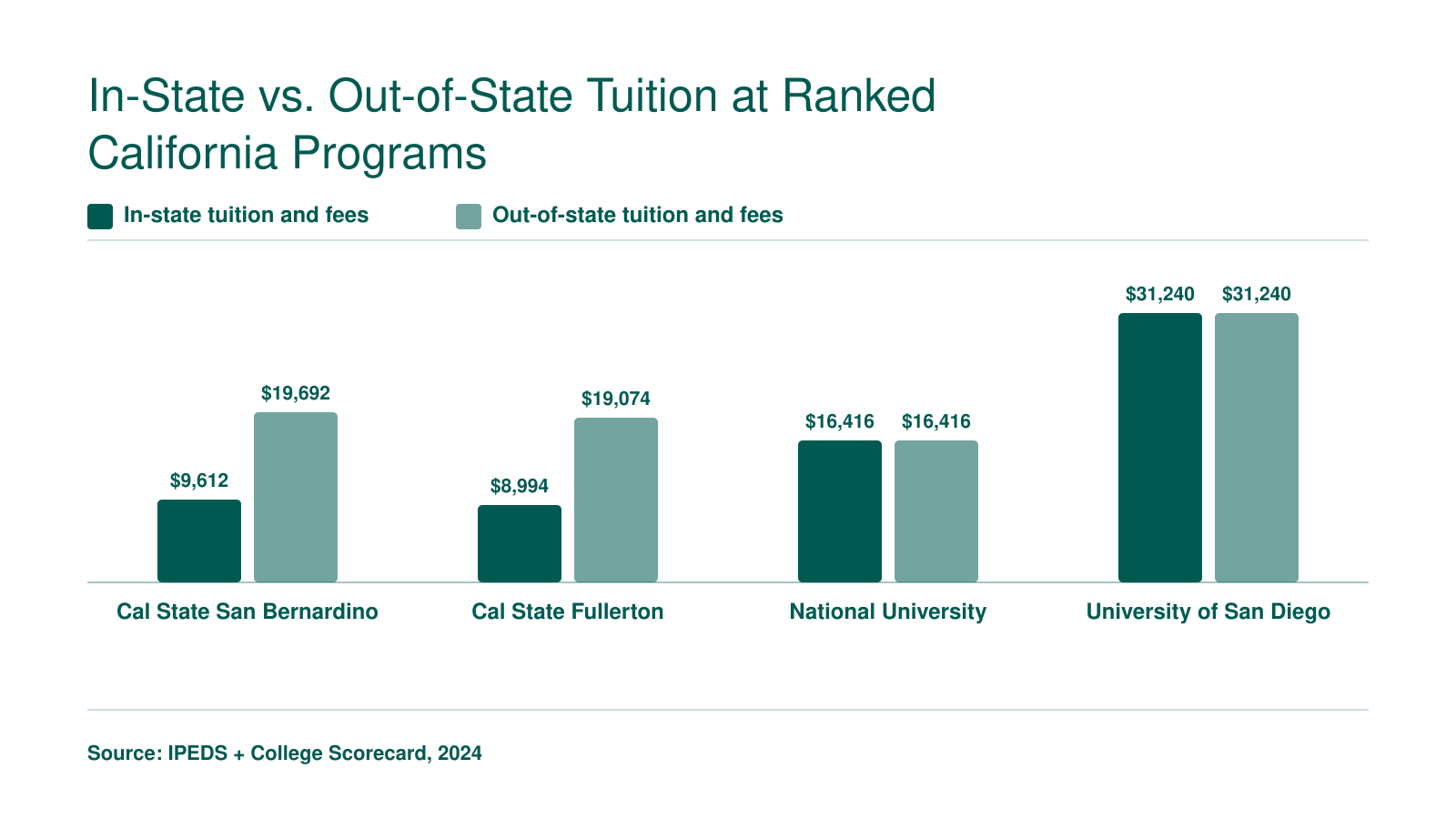
- Cal State San Bernardino and Cal State Fullerton charge out-of-state students $10,080 more than residents.
- A master's in educational technology alone does not authorize teaching in California K-12 schools.
- Cal State Fullerton offers fully online, asynchronous master's degrees in both educational technology and instructional design.
The Best Master's in Educational Technology Schools in California
These four California programs cover campus, hybrid, and fully online study, from a public cohort program to a private specialization track. Program-level earnings are not yet published for any of them, so the comparison leans on the school's graduation rate, tuition, and approximate institution-wide net price. Confirm current tuition and requirements on each program page before you apply.
University of San Diego
#1San Diego, CA · ~$31,000/yr (est.)
Best for: PK-12 teachers wanting specialization tracks
The University of San Diego is a private university in San Diego. Its online Master of Education: Technology and Innovation is built for working PK-12 educators who want to lead technology use in schools and districts. The school's graduation rate is about 84%. Graduate tuition is listed around $58,420 for in-state and out-of-state students alike, and approximate institution-wide net price is near $30,400, so it is the priciest option here.
- Fully online, 100% remote delivery
- 30 credit hours across 10 courses
- Five 14-week semesters, about 20 months
- Four EdTech specialization courses plus one elective
- Elective tracks include School Leadership or STEAM
- Cohort-based, designed for working PK-12 professionals
- Covers assistive technology, digital learning, curriculum innovation
California State University-Fullerton
#2Fullerton, CA · $9,000 – $19,000/yr (est.)
Best for: Credentialed teachers wanting low public tuition
Cal State Fullerton is a public university offering a fully online Master of Science in Educational Technology. It has the lowest graduate tuition among the schools with a published figure, roughly $7,608 in-state and $17,688 out-of-state before fees, with approximate institution-wide net price near $6,600. The school's graduation rate is about 70%. It also holds the top spot in a 2026 ed-tech ranking, though that ranking is one third-party view.
- Fully online, cohort-based program for educators
- Catalog lists the degree at 30 units
- Emphasizes equity-driven practices and research-supported strategies
- Fall start; the 2026 application deadline was June 15
- Typically asks for a 3.0 GPA and a California credential or equivalent experience
- GRE, statement of purpose, and recommendation letters not required
California State University-San Bernardino
#3San Bernardino, CA · ~$10,000/yr (est.)
Best for: Career changers eyeing corporate training roles
Cal State San Bernardino offers a Master of Arts in Education with an option in Instructional Technology and Design, delivered in a hybrid format. It suits teachers and also corporate trainers and career changers, since coursework serves both school and business settings. The school's graduation rate is about 55%. Graduate tuition is roughly $7,608 in-state and $17,688 out-of-state before fees, and approximate institution-wide net price is near $4,600.
- Hybrid delivery
- Two emphases: research, or design and development
- Prepares instructional designers, e-learning specialists, and ed tech coordinators
- Admission generally needs a 3.0 GPA in the last 60 semester units
- Conditional admission possible with a 2.5 to 2.99 GPA
- Program FAQ lists three recommendation letters
- Fall 2026 application deadline was July 31
National University
#4San Diego, CA · ~$16,000/yr (est.)
National University is a private nonprofit in San Diego with an online Master of Science in Learning Experience Design and Educational Technology. It is the fastest and most flexible entry point here, with rolling admissions and no entrance exam. The school's graduation rate is about 43%, the lowest of the four, so weigh that carefully. Graduate tuition is listed near $16,416, and approximate institution-wide net price is near $22,900.
- Online, 30 semester credit hours across 10 core courses
- Averages about 11 months to finish
- January and July start dates
- No entrance exam, no essays, $0 application fee
- Covers instructional design, multimedia learning objects, and AI for learning
- Capstone EID690 (3 credits) with a thesis-level report in an online showcase
- Up to 3 semester credit hours can transfer
Cost & outcomes by school
Federal data for the highest-earning Educational Technology programs, independent of the ranking above. Earnings are this field's master's graduates four years after completing, where the Scorecard reports them.
| School | Earnings | Tuition / yr | Debt | Grads/yr | Format |
|---|---|---|---|---|---|
| National University CA | $93,547 | $16,416 | $23,284 | 21 | Online |
| California State University-Fullerton CA | $91,755 | $8,994 | $20,300 | 129 | Online |
| University of San Diego CA | — | $31,240 | — | 24 | Online |
Sources: U.S. Department of Education. Tuition and graduates: IPEDS. Earnings and debt: College Scorecard, this field's master's graduates; a dash means no figure is reported.
How We Rank California's Master's in Educational Technology Programs
Every school on this list of California master's programs had to earn its spot with public federal data, not marketing copy. We compared graduate tuition, the average net price students pay after financial aid, and the institution-wide graduation rate, then noted whether each program is online, hybrid, or on campus. Where the College Scorecard publishes program-level earnings and debt for educational technology master's programs, we weighed those too. For several programs those figures are not yet available, and we note the gap rather than estimate.
Two caveats matter. Graduation rate describes the whole university, not the ed tech program itself. Net price is an approximate average across students, not a quote, so your own cost will differ.
The ranked list is limited to schools with public federal data.
Online and Hybrid Master's in Educational Technology Options in California
Several of the ranked California programs lean fully online for working teachers, but the live requirements differ sharply. Cal State Fullerton's MS in Educational Technology is fully online and asynchronous with no required campus visits; its MS in Instructional Design and Technology is fully online and asynchronous but requires two full-day Saturday meetings in person. Cal State Long Beach's Educational Technology & Media Leadership program keeps core courses online but synchronous, with evening and Saturday sessions, while electives may run online, hybrid, or face-to-face depending on availability. University of San Francisco offers in-person, online, and hybrid options; its asynchronous online format works for self-paced students, while in-person and hybrid sections meet on teaching weekends about twice a month. For CSU Monterey Bay, the fully online MS in Instructional Science and Technology requires no campus time, but the hybrid track requires five weekend seminars on campus.1 CSU East Bay's program page sends mixed signals, listing a Hayward/Concord hybrid schedule and a fully online shift since 2020, so its current format is unclear.
Related Articles
In-State vs. Out-of-State Tuition at Ranked California Programs
The resident discount matters most at the two Cal State campuses, where out-of-state graduate tuition and fees run $10,080 higher than the in-state figure at both Cal State San Bernardino and Cal State Fullerton. National University and the University of San Diego charge a flat rate regardless of residency, at $16,416 and $31,240.
California Credentialing at a Glance
Educational Technology vs. Instructional Design Master's in California
The two degrees overlap heavily, and California programs often blur the line: Cal State Fullerton lists instructional designer among the roles its educational technology graduates pursue. Employer research on instructional design and learning technology roles groups related degrees together, so job titles matter more than degree names. The differences below are general patterns, not guarantees.
| Factor | Master's in Educational Technology | Master's in Instructional Design |
|---|---|---|
| Typical students | Teachers, school and district staff, and others who plan to work in schools | Career changers, corporate trainers, and course developers from higher education or industry |
| Core focus | Applying technology to teaching, including classroom integration, digital tools, and program leadership | Designing learning experiences using models such as ADDIE, plus e-learning development and authoring tools |
| Typical job titles | Educational technology specialist, technology integration coach, technology coach, curriculum developer, district technology leader | Instructional designer, online course developer, instructional materials developer, corporate trainer, digital media developer |
| Work settings | K-12 schools and districts, with some higher education and training roles | Corporate learning and development, colleges and universities, and e-learning companies |
| Credential relevance | Often a better fit for school-based roles and district leadership, though a master's alone is not a California teaching credential | Employers tend to value a portfolio and design skills; in one study of job postings, 43.1% preferred a master's degree |
Quick Answers for California Ed Tech Master's Applicants
These answers draw on program pages and accreditor listings, and some details vary by school. Confirm current requirements directly with each admissions office before you apply.
Do I need a teaching credential to apply to educational technology master's programs in California?
What accreditation should a California educational technology master's program hold?
Can a full-time teacher realistically finish an ed tech master's while working?
Compare Educational Technology programs on the data that matters
Explore more Education & Teaching specializations or browse every graduate field.
All Education & Teaching programs