Best Master's in Educational Technology Programs in Connecticut
Compare 5 accredited Educational Technology programs in Connecticut at 4 schools, with graduate earnings, cost, debt, and completion data from IPEDS and the U.S. College Scorecard.

Connecticut offers only a few educational technology master's programs, and they differ sharply in format, price, and entry requirements. The best master's in educational technology programs in Connecticut include fully online options at Eastern Connecticut State University and the University of Connecticut, hybrid at the University of Saint Joseph, and Fairfield University's online M.A. at the top of the price range.
Each program uses a 30-credit structure, yet total cost and admissions rules vary widely. Teachers weighing a raise against tuition should compare those differences before applying.
Key Points
- Eastern Connecticut State's EdTech M.S. runs fully online, asynchronous.
- Eastern's EdTech M.S. is $714 per credit, about $21,420 before fees.
- Fairfield's EdTech M.A. admits students without a GRE score.
Top-Ranked Master's in Educational Technology Programs in Connecticut
A master's in educational technology in Connecticut should show you, not just tell you, how learning tools work in real classrooms and online settings. The programs below pair coursework in instructional design, multimedia, and technology integration with transparent price and graduation data, so you can compare what you would likely pay with how students tend to finish.
Fairfield University
#1Fairfield, CT · ~$21,000/yr (est.)
Best for: Technology coaches seeking ISTE certification
Fairfield University's School of Education and Human Development offers a 30-credit Master of Arts in Educational Technology aimed at educators who want to lead technology use across schools, agencies, and professional development. Students can earn the ISTE Educator Certificate while enrolled, a useful credential for K-12 technology coaches. The flexible elective choices make it a strong fit for working teachers.
- 30 credit hours
- Capstone experience required
- ISTE Educator Certificate available while enrolled
- Trains teachers, co-teachers, and consultants
- Four electives chosen with an advisor
- Foundations cover intro to educational technology, technology and transformational culture
- Core includes designing for online instruction and creating digital content
University of Saint Joseph
#2West Hartford, CT · ~$18,000/yr (est.)
Best for: Practicing educators needing hybrid classroom access
The University of Saint Joseph's MA in Education with a concentration in Educational Technology is designed for practicing educators who can bring classroom access to their coursework. It emphasizes technology for learning, computers in the classroom, and integrating technology with literacy, and it ends with a comprehensive exam. Admission requires a 2.5 GPA and two recommendations, and the university offers tuition discounts for alumni and a scholarship for eligible new students.
- 30 credit hours
- 2.5 minimum undergraduate GPA
- Two letters of recommendation
- Comprehensive exam required
- Concentration includes technology for learning, computers in the classroom, and literacy
- Partnership with K-12 Teachers Alliance
- Tailored for practicing educators with classroom access
- Alumni may qualify for 20% tuition discount
Eastern Connecticut State University
#3Willimantic, CT · ~$16,000/yr (est.)
Best for: Online learners wanting fully asynchronous coursework
Eastern Connecticut State University's fully online M.S. in Educational Technology is built for educators who need asynchronous flexibility, with three start dates and no application deadline. The curriculum covers assistive technology, global connections, and research methods, and students can choose electives in early childhood tech, bilingual education, special education, and STEM. A culminating research project or readings plus an ePortfolio brings the degree together.
- 30 credit hours
- Rolling admissions, three start dates per year
- No application deadline
- Thesis or capstone option
- ePortfolio culminating experience
- Electives in early childhood tech, bilingual education, special education, and STEM
- Requires teaching certificate or experience
- Military benefits and employer reimbursement supported
University of Connecticut
#4Storrs, CT · ~$23,000/yr (est.)
UConn's MA in Educational Psychology offers an Educational Technology concentration with a fully online two-summer cohort option and a campus-based path. Students can choose a thesis track with 21 credits of coursework plus nine thesis credits or a non-thesis plan ending in a comprehensive exam, and the program emphasizes instructional design, multimedia, and learning cognition. The capstone includes e-portfolio preparation, which is a strong fit for educators building job-ready artifacts.
- 30 total credit hours
- Cohort-based structure
- Thesis and non-thesis tracks
- 21 coursework credits plus 9 thesis credits
- Comprehensive exam for non-thesis track
- Capstone includes e-portfolio preparation
- Covers instructional design, multimedia, and learning cognition
- Sixth-Year Certificate available for master's holders
Cost & outcomes by school
Federal data for the highest-earning Educational Technology programs, independent of the ranking above. Earnings are this field's master's graduates four years after completing, where the Scorecard reports them.
| School | Earnings | Tuition / yr | Debt | Grads/yr | Format |
|---|---|---|---|---|---|
| Post University CT | — | $7,955 | — | — | Online |
| Eastern Connecticut State University CT | — | $15,646 | — | 6 | Online |
| Fairfield University CT | — | $21,448 | — | 4 | Hybrid |
| University of Connecticut CT | — | $22,872 | — | 13 | Hybrid |
Sources: U.S. Department of Education. Tuition and graduates: IPEDS. Earnings and debt: College Scorecard, this field's master's graduates; a dash means no figure is reported.
Online and Hybrid Master's in Educational Technology Options in Connecticut
Fully online
Eastern Connecticut State University's M.S. in Educational Technology is the clearest online case among online master's programs in Connecticut. Coursework is 100% online and asynchronous, with three start dates a year and an expected 12 to 16 hours of work per week, which suits teachers on a school schedule. Fairfield University's M.A. in Educational Technology is also listed as online among educational technology master's programs, but its pages do not say whether classes are asynchronous or meet live.
Hybrid and flexible formats
University of Saint Joseph lists its educational technology concentration as hybrid, though its teacher-focused pages describe programs as online unless noted. UConn's M.A. is fully online and branded "Two Summers Online."1 Neither school's available pages settle whether sessions are scheduled or self-paced, so ask admissions before enrolling.
Residencies and rates
None of these pages shows a required on-campus residency, but UConn's summer-based model is worth confirming. Eastern expects applicants to hold a teaching certificate or have teaching experience.
UConn publishes separate in-state and out-of-state tuition figures1; Eastern lists one per-credit rate for all students. Ask whether the online rate follows that split, since the other two schools do not make this clear.
Which Connecticut Edtech Master's Programs Waive or Skip the GRE?
Standardized tests have been fading from education master's admissions, though schools more often leave the GRE off their checklists than announce a formal waiver. That pattern holds in Connecticut, as it does among Master's in Educational Technology Programs With No GRE Required.
- Fairfield University: The M.A. in Educational Technology admits on a rolling basis, with a fall priority deadline of July 15. Late applicants may be considered if space permits. Admissions materials don't clearly say whether the GRE is required, and the program director may request an interview. Test scores (Praxis Core, SAT, ACT, GRE or equivalent) apply to state certification pathways.
- University of Connecticut: The Graduate School says programs may require the GRE, so confirm with your intended program. Where required, scores stay valid for five years. Deadlines vary by program. Apply several months ahead, and expect to be admitted and accept at least one month before classes begin.
- University of Saint Joseph and Eastern Connecticut State University: Neither publishes a GRE policy; Eastern has no application deadline and three annual start dates, while Saint Joseph's deadline and start terms are not published, so ask admissions directly.
Without a test score, reviewers typically weigh undergraduate GPA, a statement of purpose, recommendation letters and, for some tracks, a teaching certificate.
Related Articles
What an Edtech Master's Costs and How It Fits Connecticut Certification
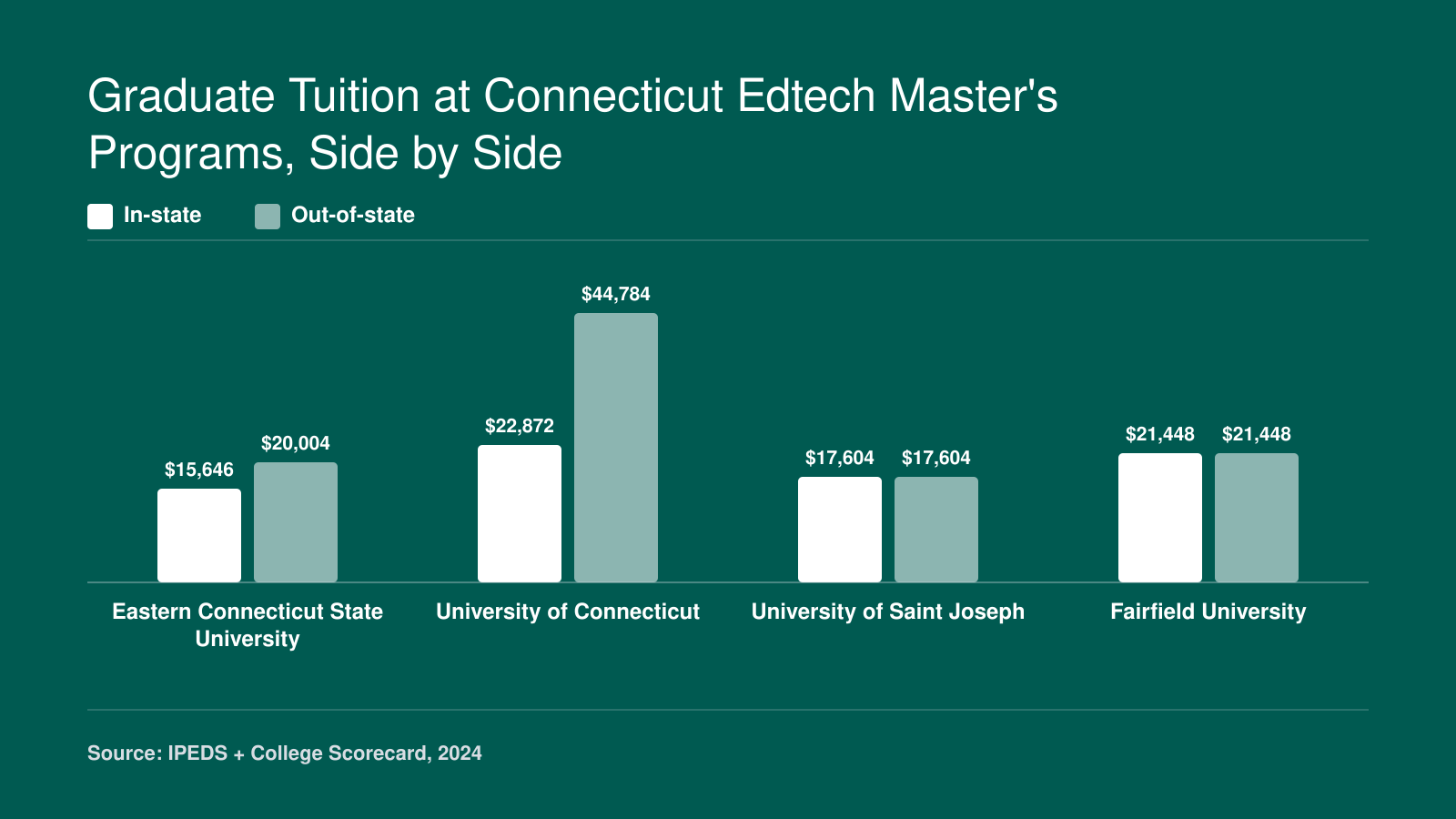
Eastern Connecticut State University lists its M.S. in Educational Technology at $714 per credit, which works out to $21,420 for the 30 required credits before a $60 per-semester fee. Each program on this page also uses a 30-credit structure, but the materials reviewed show a clear per-credit rate only for Eastern. Federal graduate tuition estimates differ: roughly $15,600 in-state at Eastern, $17,604 at University of Saint Joseph, $21,448 at Fairfield University, and $22,872 in-state or $44,784 out-of-state at University of Connecticut. Use these as planning figures, not final bills, because fees, residency rules, and cohort pricing vary.
Certification and endorsement reality
A master's in educational technology does not by itself lead to a first Connecticut teaching certificate, and it is not a substitute for accelerated teacher certification programs in CT. The degree may support master's-level advancement for educators who already hold a credential, including candidates in Best M.Ed. Programs in Connecticut. Connecticut does not list a standalone educational technology endorsement. The closest state pathway is the School Library Media Specialist endorsement (062). CSDE guidance indicates up to 21 graduate credits from an edtech program may count toward the 30 semester hours for that endorsement, with 9 credits of school-based work still needed. The 062 route also expects a bachelor's degree and, under Option A, 24 semester hours and 10 school months of teaching experience.
Confirm before you enroll
Endorsement alignment is not automatic. Ask the program coordinator and CSDE to review your planned courses against the 062 worksheet or any other endorsement you are pursuing before you commit, because state guidance and program structures can change.
Graduate Tuition at Connecticut Edtech Master's Programs, Side by Side
In-state and out-of-state graduate tuition for the ranked educational technology master's programs in Connecticut. These are annual figures, not total program cost.
Connecticut Edtech Master's: Your Questions Answered
How long does it take to complete a master's in educational technology in Connecticut?
Can I transfer graduate credits into a Connecticut educational technology master's program?
Does a master's in educational technology lead to Connecticut teacher certification?
Is an instructional design master's different from an educational technology master's?
Can non-teachers apply to Connecticut educational technology master's programs?
Do Connecticut online edtech programs charge out-of-state students more?
Compare Educational Technology programs on the data that matters
Explore more Education & Teaching specializations or browse every graduate field.
All Education & Teaching programs