Best Online Master's in Educational Technology Programs
Compare 150+ accredited online Educational Technology programs, with graduate earnings, cost, debt, and completion data from IPEDS and the U.S. College Scorecard.

The schools here advertise graduate tuition from about $9,000 to nearly $65,000, and the degrees lead to the same instructional designer, technology coach, and training roles.
For a working teacher, trainer, or designer who can't relocate or visit campus, the filter for an online master's in educational technology is 100% online. Hybrid programs are excluded, and the order reflects a mixed quality composite from our internal rankings data.
A higher price rarely buys a different credential. Employers and districts mostly screen for accreditation and demonstrated portfolio work.
Key Points
- These programs are ranked on graduate earnings and net price.
- Asynchronous courses let working educators complete assignments on their own schedule.
- For 2027, verify state authorization and accreditation before applying.
Top 10 Best Fully Online Master's in Educational Technology Programs
These ten programs are fully online and built for working educators, instructional designers, and technology leaders who want a clear path from coursework to career impact.
University of Georgia
#1Athens, GA · ~$11,000/yr (est.)
Best for: Working educators building instructional design portfolios
The University of Georgia offers two online M.Ed. paths in Learning, Design, and Technology. The Instructional Design and Development track is a 100% online cohort that pairs design thinking with portfolio building, while the Instructional Technology track blends live and asynchronous work and aligns with Georgia PSC standards. The university graduates about 90% of students.
- $23,220 total program tuition
- 36 credit hours
- 100% online cohort structure
- Ranked #3 by U.S. News
- Cohort starts fall, spring, and summer
- Can be completed in two years
- Portfolio of design artifacts
- SACSCOC accredited
- $14,091 total program tuition
- 33 credit hours
- Approved by Georgia PSC for certification
- Synchronous and asynchronous options
- Aligns with ISTE educator standards
- Capstone required
- Field experience in P-12 classroom
Johns Hopkins University
#2Baltimore, MD · ~$65,000/yr (est.)
Best for: Design professionals seeking flexible pacing
Johns Hopkins University offers a fully online Master of Education in Learning Design and Technology with a Learning Experience Design concentration. The 30-credit program can be completed in one to two years and covers learning sciences, multimedia design, and data analytics. The university graduates about 94% of students.
- 30 credit hours
- Complete in 1 to 2 years
- Fully online option available
- Full-time and part-time options
- Covers multimedia design and data analytics
- Prototyping and user research
- Careers in education, business, government, nonprofits
Texas A&M University-College Station
#3College Station, TX · ~$12,000/yr (est.)
Best for: Self-directed learners avoiding campus visits
Texas A&M University offers a 36-credit online Master of Education in Learning Design and Technology. The asynchronous program requires no thesis, internship, or campus residency, making it flexible for working professionals. The university graduates about 84% of students.
- 36 total credit hours
- Asynchronous online classes
- No thesis, internship, or practicum required
- No campus residency needed
- Prepares instructional designers and technology leaders
Lehigh University
#4Bethlehem, PA · ~$29,000/yr (est.)
Lehigh University's online Master of Science in Instructional Technology is a 30-credit program with live evening virtual sessions and self-paced work. Students choose between Artificial Intelligence and Learning Analytics or Game-Based Learning and Learning Design tracks, and no GRE is required. The university graduates about 88% of students.
- 30 credit hours
- Complete in 1.5 to 2.5 years
- Fully online option available
- Synchronous and asynchronous options
- Two tracks: AI and Learning Analytics or Game-Based Learning
- No GRE or GMAT required
- Evening live virtual sessions
North Carolina State University at Raleigh
#5Raleigh, NC · $12,000 – $33,000/yr (est.)
North Carolina State University offers several online learning design and technology paths, including an M.Ed. that can lead to North Carolina 077 or 079 endorsements. Students complete a capstone portfolio and internship or project, and delivery is 100% online with part-time scheduling. The university graduates about 85% of students.
- 30 credit hours
- 100% online delivery
- Leads to NC 077 or 079 endorsements
- Capstone portfolio plus project
- Part-time scheduling
- Current K-12 teachers
- M.Ed. is 30 credits, M.S. is 36 credits
- M.S. focuses on instructional design
- M.Ed. focuses on K-12 technology
- Fully online option available
- Prepares for PK-12, corporate, and military roles
- 30 credit hours
- STEM education focus
- 100% online delivery
- No thesis or capstone required
- Full-time and part-time options
California State University-Fullerton
#6Fullerton, CA · $9,000 – $19,000/yr (est.)
California State University-Fullerton's fully online Master of Science in Educational Technology uses a cohort model and equity-driven approach to prepare educators for technology leadership. The curriculum blends theory, applied research, and instructional methods. The university graduates about 70% of students.
- Fully online program
- Cohort-based structure
- Designed for educators
- Emphasizes equity-driven practices
- Nationally ranked program
Indiana University-Bloomington
#7Bloomington, IN · $12,000 – $33,000/yr (est.)
Indiana University-Bloomington offers an online M.S.Ed. in Educational Technology for Learning aimed at K-12 technology leaders. The 36-credit program offers fall, spring, and summer starts and does not require the GRE for applicants with a U.S. degree. The university graduates about 80% of students.
- 36 credit hours
- Fall, spring, and summer starts
- No GRE required for U.S. graduates
- Prepares for K-12 technology leadership roles
- Scholarships and employer reimbursement available
- Reduced application fee of $35
University of San Diego
#8San Diego, CA · ~$31,000/yr (est.)
University of San Diego offers a fully online Master of Education in Technology and Innovation that can be completed in 20 months. The 30-credit program includes a specialization track and prepares PK-12 educators for instructional technology specialist roles. The university graduates about 84% of students.
- 30 credit hours
- 20-month program
- 100% online delivery
- 10 total courses
- Elective from four specialization tracks
- Designed for PK-12 technology leaders
University of Delaware
#9Newark, DE · $20,000 – $25,000/yr (est.)
University of Delaware's 33-credit M.Ed. in Educational Technology is open to educators and professionals from business, government, and higher education. The program includes 50 clinical hours, a capstone ePortfolio, and electives in AI, VR, eLearning, and mobile web design. The university graduates about 81% of students.
- 33 credit hours
- No GRE required
- Online or in-person formats available
- 50 clinical hours
- Electives cover VR, AI, eLearning, mobile web design
- Top 30 U.S. News online education program
- Up to 9 transfer credits accepted
George Washington University
#10Washington, DC · ~$36,000/yr (est.)
George Washington University offers a fully online Educational Technology Leadership master's with 30 credits and three annual start terms. Coursework covers instructional design, project management, AI literacy, and digital citizenship, and the university graduates about 84% of students.
- 30 credit hours
- $1,300 per credit hour
- Fully online delivery
- Spring, summer, and fall starts
- No application fee
- One letter of recommendation required
- Accredited by Middle States Commission
- U.S. News ranked #13 online program
Cost & outcomes by school
Federal data for the highest-earning Educational Technology programs, independent of the ranking above. Earnings are this field's master's graduates four years after completing, where the Scorecard reports them.
| School | Earnings | Tuition / yr | Debt | Grads/yr | Format |
|---|---|---|---|---|---|
| Touro University NY | $94,743 | $14,979 | — | 26 | Online |
| National University CA | $93,547 | $16,416 | $23,284 | 21 | Online |
| California State University-Fullerton CA | $91,755 | $8,994 | $20,300 | 129 | Online |
| Utah State University UT | $86,107 | $7,828 | $23,965 | 42 | Hybrid |
| University of West Georgia GA | $74,243 | $6,046 | $21,320 | 361 | Online |
| Western Governors University UT | $71,469 | $9,320 | $7,989 | 1,655 | Online |
| Southeastern Oklahoma State University OK | — | $5,220 | — | — | Online |
| Eastern New Mexico University NM | — | $5,706 | — | — | Online |
| Martin Luther College MN | — | $6,300 | — | — | Online |
| The University of Texas at El Paso TX | — | $7,166 | — | — | Hybrid |
| Southwest Baptist University MO | — | $7,956 | — | — | Hybrid |
| Nicholls State University LA | — | $8,236 | — | — | Online |
Sources: U.S. Department of Education. Tuition and graduates: IPEDS. Earnings and debt: College Scorecard, this field's master's graduates; a dash means no figure is reported.
Cost, debt & payoff
Median earnings of this field's master's graduates (4 yrs after completing) vs. their median federal loan debt · U.S. College Scorecard
Across these programs the median graduate earns about $70,758 and finishes with roughly $23,284 in debt — a ratio that clears a common rule of thumb (keep debt below first-year salary). Tuition and debt vary widely school to school, so check the per-school figures in the table above before you shortlist.
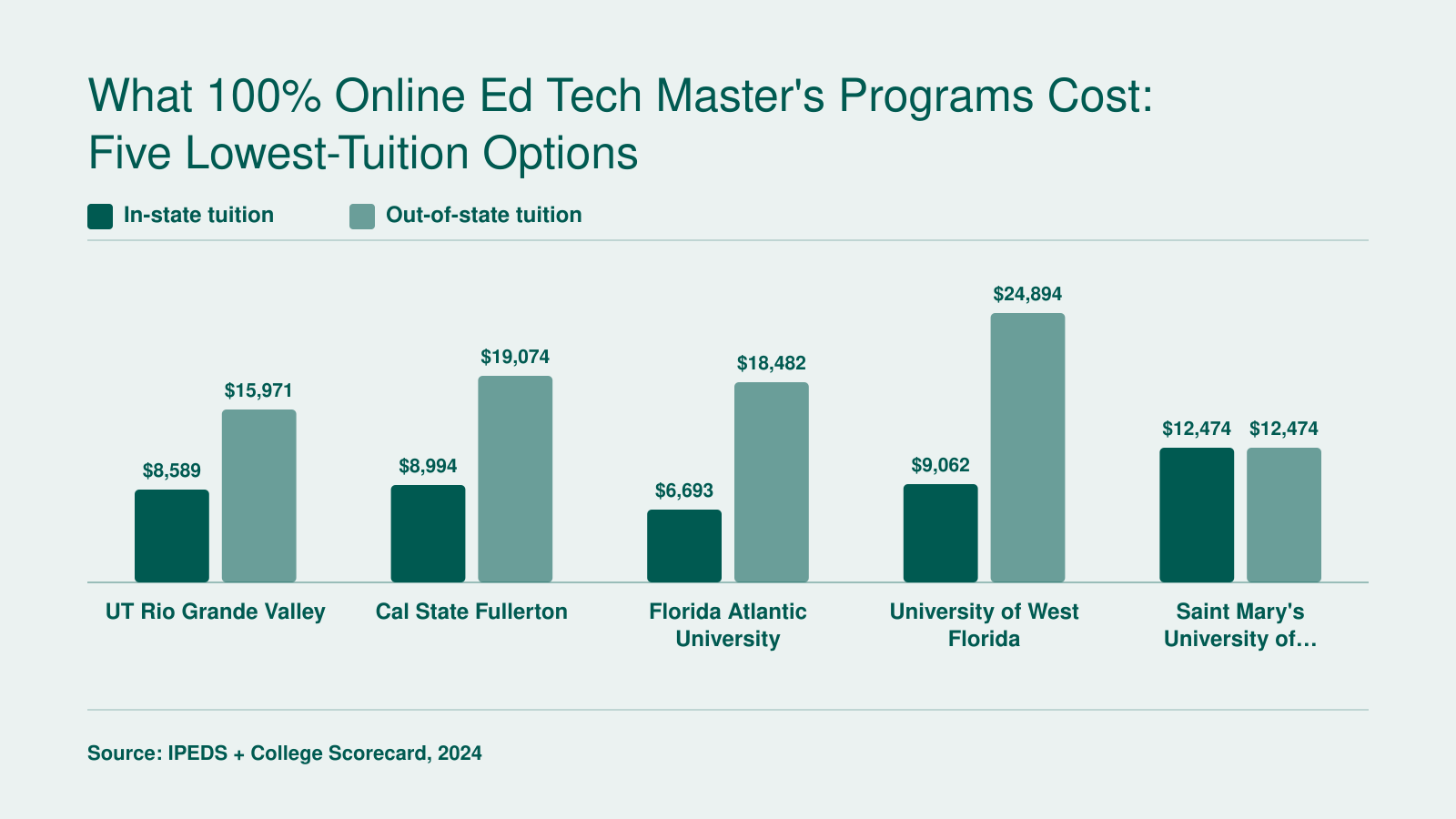
What 100% Online Ed Tech Master's Programs Cost: Five Lowest-Tuition Options
Graduate tuition varies by residency, but several fully online programs charge the same rate for everyone. The chart compares advertised in-state and out-of-state tuition for the most affordable options in the ranking. Net price is an institution-wide average after aid, not a quote. Saint Mary's University of Minnesota charges one flat rate regardless of residency. Program-level median debt is $19,000 at UT Rio Grande Valley, $20,300 at Cal State Fullerton, and $20,500 at Saint Mary's, with monthly payments of $216, $231, and $233 respectively.
Live Sessions or Fully Asynchronous? How Ranked Programs Deliver Courses
How do online ed tech master's programs actually deliver courses, and will you need to be online at specific times? The practical difference matters most for working teachers: asynchronous programs let you complete coursework whenever your schedule allows, while synchronous courses require scheduled live sessions.
Western Governors University's M.Ed. in Education Technology and Instructional Design is fully asynchronous and competency-based.1 You work through 12 courses at your own pace inside six-month terms, with monthly start dates and no required login times, assignment deadlines, or class attendance.1
Boise State's Master of Educational Technology is 100% online2, and the university's online master's degree page lists roughly four to five live Zoom sessions per semester3, so that frequency comes from the school itself rather than a secondary listing.
If you're considering an Accelerated Master's in Educational Technology, also check term structure and any required capstone or practicum at your workplace, since those shape when you can finish. If you teach during the day, ask admissions directly about live attendance policies before applying.
Related Articles
Admissions Requirements for Online Ed Tech Master's Programs
- Bachelor's degreeAn accredited bachelor's is required; GPA minimums commonly fall between 2.75 and 3.00, and LSU may give 2.75–3.00 applicants probationary review.
- Teaching license and classroom experienceMost programs below do not require a license or classroom background; LSU's Education Technology Leader track is the exception, requiring certification and three years.
- GRE/GMATNot required at Texas State, LSU, SIUE, Boise State, and Adelphi; Rowan does not list a GRE requirement.
- Statement of purpose and resumeA statement of career goals and a current resume or CV are common; Rowan requests both.
- Recommendation letters and transcriptsRowan requires two recommendation letters; official transcripts from every postsecondary institution are standard, with application fees ranging from none at Rowan to $40 at SIUE.
Educational Technology vs. Instructional Design: Which Master's Fits Your Goals?
Does an online ed tech master's actually teach AI, learning analytics, or AR/VR? It depends on the program, and offerings change often, so verify the current curriculum yourself rather than relying on a static list.
Where to Look
Start with the official curriculum pages and course catalogs, including Boise State Online Technology Degrees and Certificates and Arizona State University Online Master of Arts in Education, then also check Purdue and the University of Florida. Search for terms like artificial intelligence, learning analytics, immersive technology, and educational data. Then ask admissions or a faculty contact for sample syllabi, a recent course list, and elective options. A topic missing from a course title does not mean it goes untaught, since it may be embedded in other classes.
Questions to Ask
- Dedicated courses: Does the program offer separate AI, analytics, or AR/VR courses?
- Core or elective: Are those courses required or optional?
- Syllabi: Can I see recent ones?
- Tools: Which platforms and software do students use?
- Capstone: What capstone or practicum options exist?
Match the Degree to the Role
The Bureau of Labor Statistics Occupational Outlook Handbook describes roles such as instructional coordinators and training and development specialists. ISTE, AECT, EDUCAUSE, and ATD publish competencies, trend reports, and job titles. Use them to judge whether instructional design master's programs or educational technology programs fit the role you want.
Accreditation, State Authorization, and Endorsement Portability
Institutional and Programmatic Accreditation
Institutional accreditation from a recognized regional or national accreditor, such as the Higher Learning Commission or Middle States Commission on Higher Education, is the baseline. It governs federal aid eligibility, employer recognition, and whether districts grant salary-lane credit. Confirm the status on the school's own accreditation page.
No single programmatic accreditor covers ed tech. CAEP or AAQEP accreditation of a college of education (Southeastern Oklahoma State and UMGC are examples) signals sound educator preparation, but it does not mean every concentration leads to licensure or that your state will accept it.
State Authorization and Portability
NC-SARA is a reciprocity agreement, not an accreditor. It lets an authorized home-state school enroll students in other participating states, though field placements can trigger separate rules. That is why some programs restrict enrollment by state.
Most ed tech master's degrees do not lead to licensure. Some states offer a technology endorsement added to an existing license, such as Utah, New Mexico, and Ohio (through Akron's 18-hour online option). Requirements vary: Dominican University's Illinois endorsement path calls for a Professional Educator License and Test 178. Check with your state education agency before enrolling.
Educational Technology programs by state
Frequently Asked Questions About Online Ed Tech Master's Programs
Most of these online master's programs are built for working educators, but the right choice depends on cost, pace, and transfer flexibility. The answers below focus on what published program data and earnings outcomes show.
Is a master's in educational technology worth it?
How long does it take to complete an online master's in educational technology?
Can transfer credits or prior learning shorten an online ed tech master's?
Compare Educational Technology programs on the data that matters
Explore more Education & Teaching specializations or browse every graduate field.
All Education & Teaching programs