Best Master's in Educational Technology Programs in South Carolina
Compare 3 accredited Educational Technology programs in South Carolina, with graduate earnings, cost, debt, and completion data from IPEDS and the U.S. College Scorecard.

South Carolina districts increasingly expect instructional technologists and digital learning coaches to hold graduate credentials, not just classroom skill. For teachers and trainers moving into those roles, the in-state options are concentrated: a handful of universities offer a master's in educational technology.
That makes a side-by-side look at format, cost, GRE policies, licensure implications, and graduate outcomes worthwhile. Salary-lane movement in South Carolina often turns on district policy as much as degree title.
Key Points
- Coastal Carolina University's in-state tuition is $11,640, the lowest here.
- In 2027, most programs below are online and GRE optional.
- These programs raise salary-lane status, not initial teaching certification.
Ranked: South Carolina's Best Master's in Educational Technology Programs
A master's in educational technology can position South Carolina educators for instructional design, technology coaching, and salary-lane advancement. These ranked programs vary in delivery format, cost, and admissions flexibility, so the right choice depends on whether you need fully online coursework, a K-12 endorsement path, or a budget-friendly public option.
University of South Carolina
#1Columbia, SC · ~$14,000/yr (est.)
Best for: Online learners in corporate instructional design
A fully online 30-credit M.Ed. built around eight-week terms and two courses per semester, including summer. South Carolina certified teachers pay a reduced tuition rate, and admitted out-of-state students pay the resident rate. The university holds SACSCOC institutional accreditation and CAEP educator-preparation accreditation through 2032.
- No entrance exam required
- $18,874 total program tuition
- $515 per credit for SC certified teachers
- 30 credit hours, typically two years
- Fully online with eight-week terms
- No teaching licensure or prior education degree required
- Out-of-state students pay resident tuition
- Careers: instructional designer, eLearning developer
Winthrop University
#2Rock Hill, SC · ~$16,000/yr (est.)
Best for: Working adults needing flexible seven week terms
A 30-credit online Master of Education in Learning Design and Technology with seven-week courses taken one at a time. Synchronous and asynchronous delivery supports working adults, and graduate assistantships are available. Alumni work at Meta, Clemson University, and K-12 districts.
- 100% online with synchronous and asynchronous options
- 30 credit hours, 7-week courses
- Rolling admissions for fall start
- 3.0 GPA minimum
- Graduate assistantships available
- Designed for working adults
- Alumni at Meta, Clemson, and K-12 districts
- Careers in instructional design
Coastal Carolina University
#3Conway, SC · $10,000 – $15,000/yr (est.)
Best for: K-12 educators pursuing technology leadership
A 30-credit Master of Education in Instructional Technology grounded in NETS-T standards and built for K-12 educators and educational professionals. Students complete a capstone, and applicants below a 3.0 undergraduate GPA may substitute GRE or MAT scores. The program is CAEP-accredited.
- CAEP-accredited program
- 30 credit hours with capstone
- Grounded in NETS-T standards
- 3.0 GPA minimum
- Two recommendations required
- GRE or MAT may substitute for low GPA
- Designed for K-12 educators
- Careers: technology coach, instructional designer
Cost & outcomes by school
Federal data for the highest-earning Educational Technology programs, independent of the ranking above. Earnings are this field's master's graduates four years after completing, where the Scorecard reports them.
| School | Earnings | Tuition / yr | Debt | Grads/yr | Format |
|---|---|---|---|---|---|
| Coastal Carolina University SC | $55,622 | $10,764 | $27,717 | 31 | Campus |
| University of South Carolina SC | — | $14,134 | — | 19 | Online |
| Winthrop University SC | — | $16,306 | — | 12 | Online |
Sources: U.S. Department of Education. Tuition and graduates: IPEDS. Earnings and debt: College Scorecard, this field's master's graduates; a dash means no figure is reported.
Online and Hybrid Master's in Educational Technology Options in South Carolina
Campus study gives you face-to-face contact with faculty, but the schools ranked here among online master's programs in South Carolina lean toward web-based delivery, which suits working teachers better. No program here is described as hybrid, and I found no campus-only track among them.
The University of South Carolina offers its 30-credit M.Ed. in Learning Design and Technologies, a master's in instructional design and technology, 100% online, with all courses web-based. Coastal Carolina University's 30-credit M.Ed. in Instructional Technology is also fully online and described as cohort-based with a prescribed course sequence. Winthrop University's Master of Education in Learning Design and Technology is fully online.
Published details rarely say whether sessions are asynchronous or synchronous, or whether terms run 8 or 16 weeks. Treat those as open questions for each admissions office, not as assumptions.
A cohort matters for teachers because you move through a fixed sequence with the same peers, which builds support and keeps your plan predictable. The tradeoff is less freedom to pause or reorder courses.
For a full-time teacher, asynchronous 8-week courses usually offer the most flexibility. Neither USC nor Coastal Carolina publishes that combination, so confirm term length and live-meeting requirements before you apply.
Which South Carolina Master's Programs Waive or Make the GRE Optional?
The programs below generally emphasize undergraduate GPA and transcripts over standardized test scores. South Carolina's educational technology master's options vary by deadline, with start terms available in fall, spring, and summer.
| School | GRE Policy | Application Deadline | Start Terms |
|---|---|---|---|
| University of South Carolina | Not required. | November 1 for January 11, 2027 start; March 15 for Summer 2027 start; June 15 for August 17, 2027 start. | January 11, 2027; Summer 2027; August 17, 2027. |
| Coastal Carolina University | Optional: 3.0 GPA or GRE (minimum 286, with 146 verbal and 140 quantitative; scores no older than five years). | Fall: August 1; Spring: December 1; Summer: June 1. | Fall semester; Spring semester; Summer I session. |
Related Articles
What a Master's in Educational Technology Costs in South Carolina
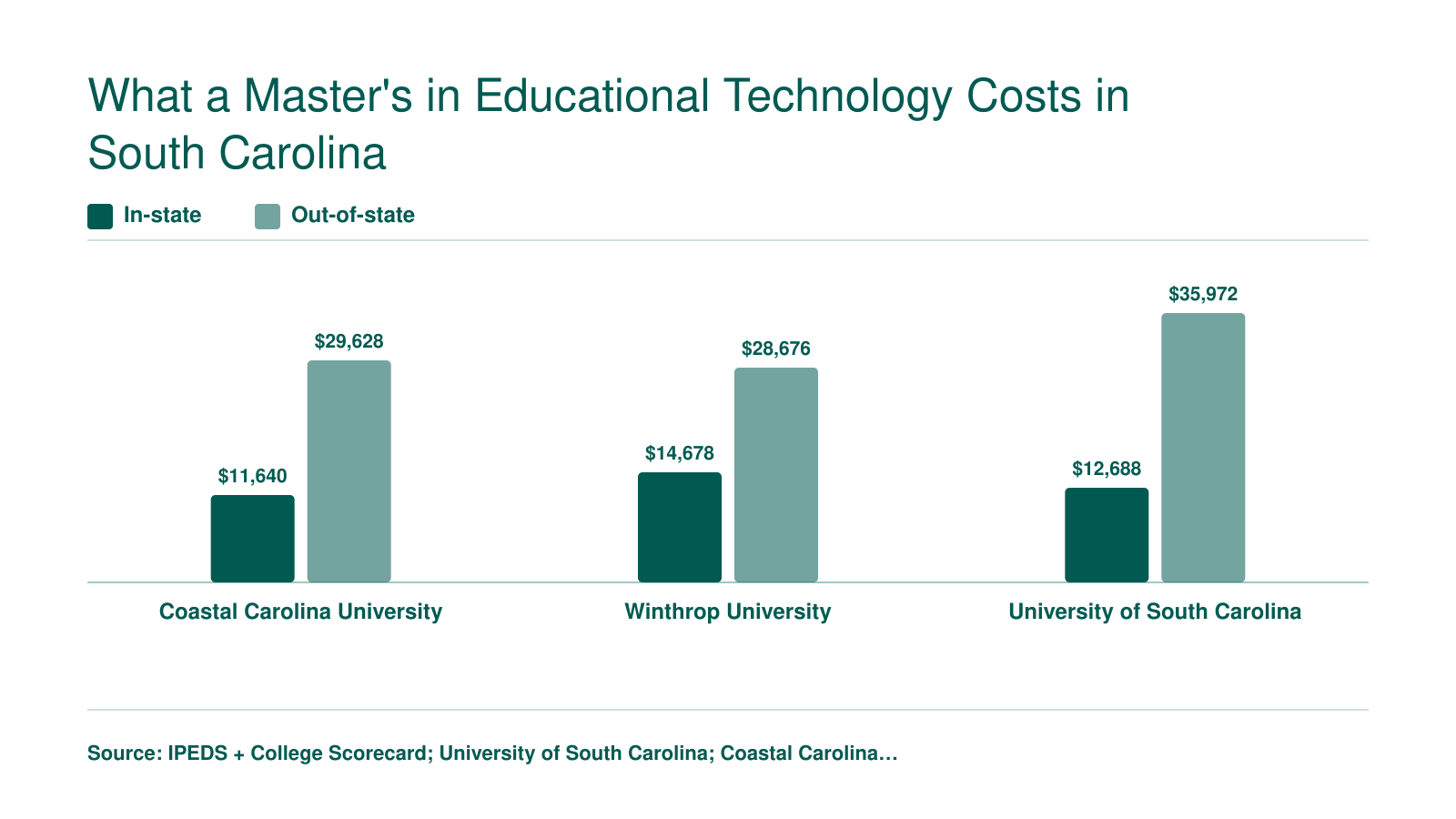
The chart below compares the most recent IPEDS graduate tuition and fees for the schools on this page. Coastal Carolina University's in-state rate of $11,640 is the lowest, while Winthrop University's out-of-state rate of $28,676 is the lowest for nonresidents. University of South Carolina's M.Ed. in Learning Design and Technologies lists $515 per credit (about $18,874 total) for South Carolina certified teachers and $572.25 per credit (about $20,763) for other applicants. Coastal's fully online 30-credit instructional technology concentration advertises a 30% tuition reduction for full-time South Carolina public school teachers, though some university materials list up to 50%. Institution-wide average net price after aid runs from about $13,966 to $22,811, so treat that as a broad average rather than a program quote.
South Carolina Licensure, Add-on Endorsements, and Salary-Lane Advancement
A master's that raises your pay and a master's that adds a credential are not the same thing in South Carolina. Most educational technology programs do the first and not the second, and none of them grants an initial teaching license. You need an existing certificate before you enroll; if you need initial licensure, the best MAT programs in South Carolina are a better place to start.
Advancement versus endorsement
The South Carolina Department of Education (SCDE) treats class advancement and endorsements separately. Moving from the bachelor's class to the master's class requires a conferred degree. Acceptable graduate degrees are education degrees or an academic field tied to a relevant certification field. Coursework must come from a regionally accredited institution, an SBE-approved South Carolina teacher-education institution, or a school whose programs a national accreditor approves under an SCDE partnership. The sources reviewed do not say whether a minimum credit count or specific specialization applies, so check your certificate record.
An endorsement is added to an existing certificate, requires coursework with a C or better, and involves no exam. A master's does not create one automatically. The closest fit here is Online Teaching, which the University of South Carolina says you can add through a four-course sequence or its online M.Ed. in Learning Design and Technologies, one of the online educational technology master's programs in South Carolina.
Salary lanes
Pay for the master's lane is set by each district's own schedule, and I could not confirm a typical dollar difference. Treat any figure you hear as district-specific.
Your next step
Before you enroll, ask your district HR office to confirm in writing that the program, its accreditation, and its credits count for your lane and endorsement.
Graduate Earnings, Debt, and Return on Investment
The question is not which master's costs least on paper. It is which one leaves you with manageable debt and a pay raise that covers it. Program-level federal data answers that for Coastal Carolina University's Master of Education in Instructional Technology.
Graduates report median earnings of $50,203 one year after finishing and $55,622 four years after finishing. Median federal debt for completers is $27,717, which works out to about $315 a month on a 10-year repayment plan.
Among M.Ed. programs in South Carolina, the University of South Carolina and Winthrop University do not have program-level earnings or debt figures in the federal data, so those entries stay without numbers here. USC does list $18,874 in total program tuition for SC certified teachers, along with reduced per-credit tuition. Those are program details worth confirming with the school, not outcome data.
The ROI takeaway
For South Carolina teachers, the strongest value case combines low borrowing with a salary-lane bump. A graduate degree that moves you up the state salary schedule, whether in instructional technology or related fields like curriculum and instruction master's programs in South Carolina, while you borrow little, or use reduced teacher tuition, pays back faster than a higher-priced program with the same credential.
Questions Prospective Ed Tech Students in South Carolina Ask
Choosing a master's in educational technology means reconciling admission requirements, pace, cost, and career goals. These answers address the questions South Carolina students ask most often before applying.
Can I get a master's in educational technology without teaching experience?
How many months does a South Carolina educational technology master's typically take?
What is the cheapest master's in educational technology in South Carolina?
What can I do with a master's in educational technology in South Carolina?
Is an educational technology specialist (Ed.S.) degree different from a master's?
Compare Educational Technology programs on the data that matters
Explore more Education & Teaching specializations or browse every graduate field.
All Education & Teaching programs