Best Master's in Educational Technology Programs in Arkansas
Compare 5 accredited Educational Technology programs in Arkansas at 3 schools, with graduate earnings, cost, debt, and completion data from IPEDS and the U.S. College Scorecard.

Arkansas educational technology master's degrees run 30 to 36 credit hours, with published in-state graduate tuition from $7,670 to $12,470 a year. Delivery leans heavily online, and Arkansas Tech states plainly that no Arkansas teaching license is required to enroll.
The real decision is narrower than it first looks: credit load drives total cost more than residency, since flat per-credit pricing is common here. What separates the options is direction, whether you want K-12 technology coordination or instructional design work outside schools, where hiring managers read the portfolio before the credential.
Key Points
- The University of Arkansas educational technology M.Ed. is fully online.
- In-state tuition ranges from $7,670 to $12,470 among these programs.
- University of Arkansas waives GRE with 3.0 GPA in last 60 hours.
Ranked: Best Master's in Educational Technology Schools in Arkansas
A working teacher or career changer comparing Arkansas educational technology master's should weigh what each program returns for the tuition dollar and the semester spent. The three schools below range from a fully online flagship path in Fayetteville to a low-cost campus option in Russellville and a dual-format choice in Little Rock.
University of Arkansas
#1Fayetteville, AR · ~$12,000/yr (est.)
Best for: Online learners across K-12 and corporate settings
The University of Arkansas in Fayetteville offers a fully online Master of Education in Educational Technology built for K-12, higher education, business, industry, and healthcare settings. The 31-credit, non-thesis program emphasizes instructional design and web-based instruction, with multiple start dates and a 1.5 to 6 year completion window. In-state graduate tuition and fees are about $10,104, out-of-state runs about $29,966, and the average net price after aid is roughly $18,209. The university graduates about 70.5% of students.
- No entrance exam required
- 31 total credit hours
- Complete in 1.5 to 6 years
- Multiple starts each spring, summer, and fall
- 100% online, non-thesis program
- No GRE required if undergraduate GPA is 3.0 or higher
- Focus on web-based instruction design
- Prepares for K-12, higher ed, business, industry, and healthcare
Arkansas Tech University
#2Russellville, AR · $5,000 – $10,000/yr (est.)
Best for: Campus learners prioritizing portfolio-based training
Arkansas Tech University in Russellville runs a campus-based Master of Education in Instructional Design and Technology with an Instructional Design and Technology concentration. The 30-hour program does not require an Arkansas teaching license, and students build a portfolio of technology-based products. In-state graduate tuition and fees are about $8,674, out-of-state is about $14,668, and the average net price after aid is near $12,970. The university graduates about 48.6% of students.
- 30 total credit hours
- No Arkansas teaching license required
- Graduate Certificate in Online Teaching available
- Conditional admission possible with Arkansas teaching license and appeal
- Requires 3.0 GPA in first 12 graduate hours
- Portfolio of technology-based products required
- Emphasizes digital instructional materials and internet resources
University of Arkansas at Little Rock
#3Little Rock, AR · ~$8,000/yr (est.)
Best for: Career changers weighing online and campus options
The University of Arkansas at Little Rock offers the Learning Systems Technology master's in both fully online and campus formats, with online concentrations including K-12 Online Teaching. The 33- to 36-credit program aligns with ISTE National Educational Technology Standards and can include an internship in the university eLearning department. In-state graduate tuition and fees are about $9,748, out-of-state is about $22,158, and the average net price after aid is near $17,248. The university graduates about 41.7% of students.
- 36 total credit hours
- 2.7 minimum undergraduate GPA
- Fully online delivery
- Capstone required
- Aligns with ISTE NETS standards
- Prepares instructional designers for multiple sectors
- K-12 Online Teaching concentration
- Comprehensive exam or portfolio option
- For educators adding online teaching skills
- 33 total credit hours
- Embedded Learning Systems Technology certificate
- 12 hours toward online teaching endorsement
- Internship in university eLearning Department
- Minimum grade of B per course
- 3.0 GPA required for good standing
- Covers learning analytics and instructional design
Cost & outcomes by school
Federal data for the highest-earning Educational Technology programs, independent of the ranking above. Earnings are this field's master's graduates four years after completing, where the Scorecard reports them.
| School | Earnings | Tuition / yr | Debt | Grads/yr | Format |
|---|---|---|---|---|---|
| Arkansas Tech University AR | $49,760 | $7,670 | $19,230 | 25 | Campus |
| University of Arkansas at Little Rock AR | — | $7,915 | — | 2 | Online |
| University of Arkansas AR | — | $12,470 | — | 15 | Online |
Sources: U.S. Department of Education. Tuition and graduates: IPEDS. Earnings and debt: College Scorecard, this field's master's graduates; a dash means no figure is reported.
Online and Hybrid Master's Options in Arkansas
Online delivery dominates educational technology master's programs in Arkansas, and the University of Arkansas offers the clearest schedule for a working teacher.
- University of Arkansas: Among online M.Ed. programs in Arkansas, its M.Ed. in Educational Technology is 100% online, with 31 credits (22 core, 9 elective) and spring, summer or fall starts. The advertised pace is 18 months, though students may take up to six years. Courses follow a fixed annual rotation, and summer carries only two of them, so a skipped class can push graduation back a full cycle. The ePortfolio comes in your final semester and replaces a comprehensive exam.
- UA Little Rock: The M.Ed. in Learning Systems Technology is fully online, requiring 36 credits and a capstone.
- Arkansas Tech University: The Instructional Design and Technology option is listed as campus-based, at 30 credits, and does not require an Arkansas teaching license.
Before applying, ask each program whether any courses meet live at set times. A required evening session is manageable, but a midday meeting is not if you teach all day. Also ask what laptop and software you need and whether full-time faculty teach the online sections.
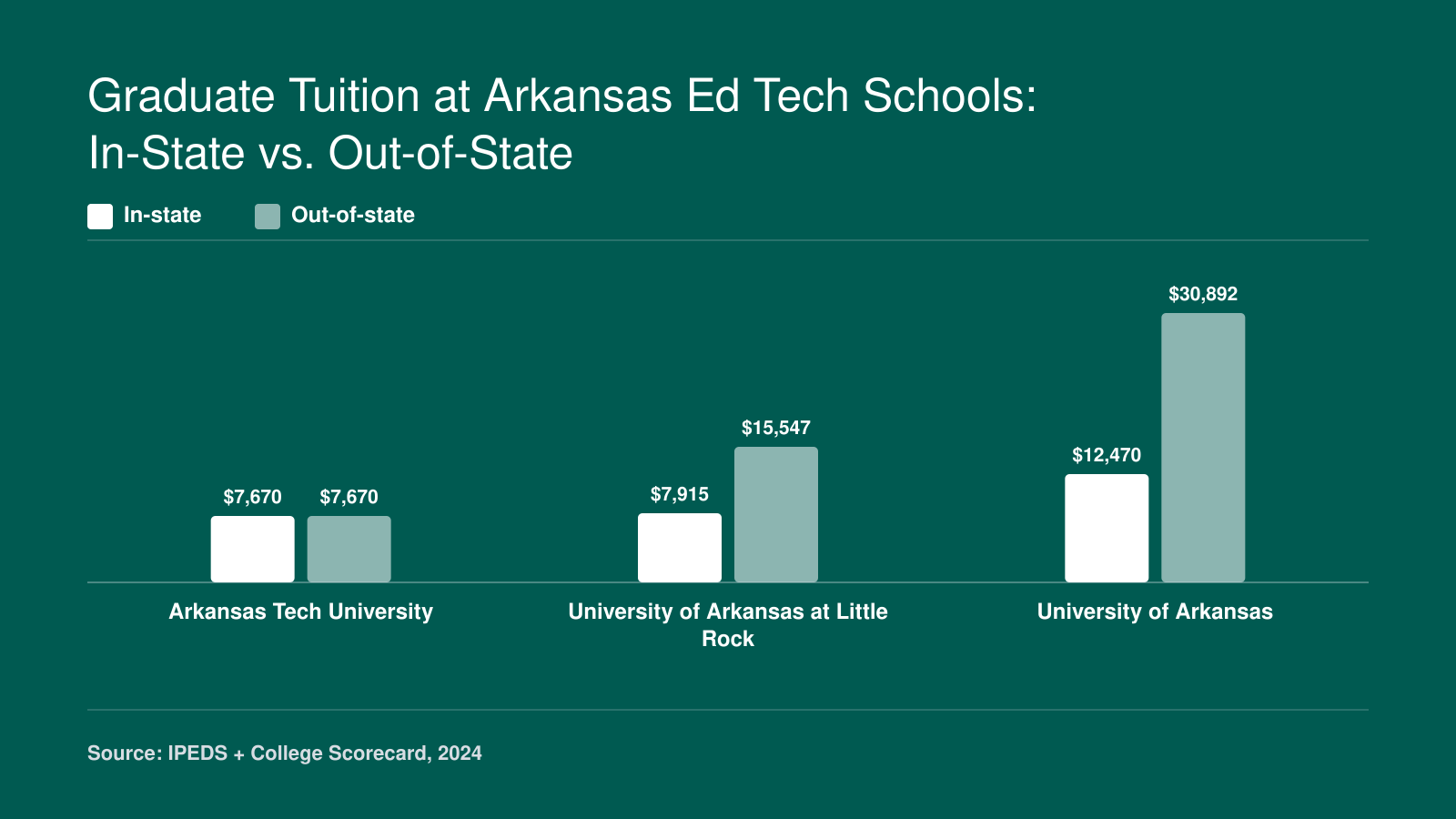
Graduate Tuition at Arkansas Ed Tech Schools: In-State vs. Out-of-State
Published annual graduate tuition and fees range from $7,670 to $12,470 for in-state students among the ranked Arkansas programs. Arkansas Tech lists the same out-of-state rate as in-state, a pattern often seen with online delivery. These figures are annual published tuition and fees, not total program cost.
Which Arkansas Master's in Ed Tech Programs Waive or Make the GRE Optional?
A 3.0 GPA over your last 60 undergraduate hours is the number that matters most at the University of Arkansas: hit it, and no entrance exam is required for the M.Ed. in Educational Technology, one of the Master's in Educational Technology Programs With No GRE Required. Applicants in the 2.7 to 2.9 range may still be considered, but the department asks for GRE or MAT scores, and the catalog notes that an already-completed graduate degree can substitute. A bachelor's degree from an accredited institution is the baseline; a teaching license is not stated as a requirement. Deadlines are inconsistent across pages for Master's Programs in Arkansas, with the department listing August 1 for fall, so confirm the date for your intended start term.
Arkansas Tech's instructional design and technology option uses conditional admission tied to a 3.0 GPA across your first 12 graduate hours rather than a test score, and no Arkansas teaching license is required. UA Little Rock's Learning Systems Technology M.Ed. lists a 2.7 GPA minimum and publishes no GRE policy.
For most working teachers, test prep is likely unnecessary. Verify with the graduate school before you pay for anything.
Related Articles
Cost, Financial Aid, and Arkansas Licensure or Certification
Flat per-credit pricing that ignores residency has become the norm for Arkansas online master's in educational technology, which makes total credit load, not state lines, the main cost variable.
What the degree actually costs
- University of Arkansas: 31 credits online at $473.47 per credit plus $55.38 in listed per-credit fees, or $528.85 per credit, works out to roughly $16,394 in tuition and those fees. Other mandatory, course-specific, and book costs sit on top.
- Arkansas Tech and UA Little Rock: both price graduate study well below Fayetteville's published rates, with Tech's instructional design and technology option at 30 credits and UA Little Rock's learning systems technology M.Ed. at 36.
Published net price figures are institution-wide averages across all students, so when comparing most affordable master's in educational technology programs, treat them as rough context rather than a quote for your program.
Paying for it
At Fayetteville, a 50 percent master's assistantship pays about $1,969 monthly (roughly $17,723 over nine months), appointments at 25 percent or more confer in-state classification, and support caps at six semesters excluding summer. Availability within educational technology is not published.
Arkansas Tech requires no teaching license and offers a Graduate Certificate in Online Teaching alongside the degree; the UA and UA Little Rock master's are non-licensure programs.
Career Paths and Return on Investment for Ed Tech Graduates
Graduates of these programs commonly move into instructional design, district technology coordination, e-learning development, or corporate training roles. The figures below are program-level median earnings from federal IPEDS and College Scorecard data, with the measurement window shown for each row, and program median debt where reported.
| School | Program | Median earnings | Measurement window | Median program debt |
|---|---|---|---|---|
| University of Arkansas | Master of Education in Educational Technology | $60,276 | One year after finishing | |
| University of Arkansas at Little Rock | Master of Education in Learning Systems Technology | $55,898 | Five years after finishing | |
| Arkansas Tech University | Instructional Technology - Instructional Design and Technology Option, Master of Education | $49,760 | Four years after finishing | $19,230 |
Arkansas Educational Technology Master's: Your Questions Answered
Arkansas ed tech master's degrees vary by delivery format, transfer policy, and career focus. These answers cover the details prospective students ask most when comparing the programs below.
Which Arkansas universities offer an online master's in educational technology?
Do I need a teaching license to earn a master's in educational technology in Arkansas?
Is the GRE required for educational technology master's programs in Arkansas?
How much does a master's in educational technology cost in Arkansas?
What is the difference between instructional technology and educational technology?
Can I transfer graduate credits into an Arkansas ed tech master's program?
What can you do with a master's in educational technology in Arkansas beyond the classroom?
Compare Educational Technology programs on the data that matters
Explore more Education & Teaching specializations or browse every graduate field.
All Education & Teaching programs