Best Master's in Educational Technology Programs in Maryland
Compare 3 accredited Educational Technology programs in Maryland, with graduate earnings, cost, debt, and completion data from IPEDS and the U.S. College Scorecard.

Maryland's educational technology master's options are few, and they differ sharply on price and delivery. Johns Hopkins charges $64,730 for its 30-credit Learning Design and Technology degree, while UMGC lists $555 per credit for Maryland residents across 33 credits and Mount St. Mary's lists $22,470 for 36 credits.
Campus and online programs share one ranking here, since all three schools offer a fully online route. For most applicants the real tradeoff is cost against brand, and whether the degree leads to a license at all, the exact tension laid out in the Most Affordable Master's in Educational Technology Programs ranking.
Maryland employers hire instructional designers on portfolios and tools fluency far more often than on a Master of Arts in Teaching (MAT) in Maryland credential.
Key Points
- UMGC's M.Ed. in Instructional Technology requires no GRE or MAT and leads to no teaching certification.
- An edtech master's alone does not grant a Maryland initial teaching license from MSDE.
- Career changers can usually apply without a teaching license, but confirm each school's 2027 admissions page.
Ranked: Maryland's Top Master's in Educational Technology Schools
These schools rose to the top on what a working educator weighs most: cost after aid, completion at the institution, and how the degree is delivered. Graduation rates below are institution-wide figures, not program completion rates, and net price is an approximate institutional average rather than a quote. Only three Maryland schools returned qualifying programs in our data, so the list stops there rather than padding.
Johns Hopkins University
#1Baltimore, MD · ~$65,000/yr (est.)
Best for: Career changers moving into learning experience design
Johns Hopkins offers an online Master of Education in Learning Design and Technology with a Learning Experience Design concentration. Coursework blends learning sciences, multimedia design and data analytics, and students prototype solutions and run user research. The school's overall graduation rate is about 94%, the strongest institution-wide figure of the three Maryland schools here. It carries the highest sticker price in this group, so weigh it against your employer's support and your target role.
- 30 credits, completed in 1 to 2 years
- Fully online option, full-time or part-time
- Fall start; next application deadline is July 15, 2027
- Three concentration options, including Learning Experience Design
- Covers learning sciences, instructional theory, multimedia design and data analytics
- Iterative design cycles with prototyping and user research
- Culminating course focuses on design leadership across an organization
- Graduates work in education, business, government and nonprofits
University of Maryland Global Campus
#2Adelphi, MD · ~$10,000/yr (est.)
Best for: Practicing P-12 teachers advancing within schools
University of Maryland Global Campus delivers its Master of Education in Instructional Technology fully online and aims it at educators with P-12 teaching experience. The program is aligned with ISTE standards and holds AAQEP accreditation through 2029. UMGC is Middle States accredited, and the school's overall graduation rate is about 33%, reflecting its large population of adult and part-time learners. The degree does not lead to teacher certification. Maryland residents pay a lower per-credit rate than out-of-state students, and Harford County Public Schools employees can get a discounted rate.
- 33 credits, completed in as little as two years
- Maryland resident rate of $555 per credit; $659 out of state
- Harford County Public Schools employees: $405 per credit, employer billed
- AAQEP accredited through June 2029; aligned with ISTE standards
- 3.0 GPA minimum; transfer up to 12 credits
- Capstone project and clinical fieldwork required
- Does not lead to teacher certification
- Military tuition rate and scholarships available
Mount St. Mary's University
#3Emmitsburg, MD · $10,000 – $15,000/yr (est.)
Best for: Working adults wanting asynchronous part-time study
Mount St. Mary's University in Emmitsburg offers an online Master of Education with an Instructional Design and Technology concentration, delivered fully asynchronously for working adults. The university is accredited by Middle States (reaffirmed in 2024) and is an AAQEP member in good standing, but confirm this master's program's own accreditation status with admissions. The school's overall graduation rate is about 65%. Rolling admissions, no application fee and employer tuition discounts keep the entry barrier low.
- 36 credits across 12 courses; $620 per credit
- $22,470 total program tuition
- Asynchronous online classes, full-time or part-time
- Includes a practicum experience
- 2.8 GPA minimum; $0 application fee; rolling admissions
- Transfer up to 9 graduate credits
- 20% tuition discount for partner employees
- Focus on accessibility, legal and ethical issues in digital learning
Cost & outcomes by school
Federal data for the highest-earning Educational Technology programs, independent of the ranking above. Earnings are this field's master's graduates four years after completing, where the Scorecard reports them.
| School | Earnings | Tuition / yr | Debt | Grads/yr | Format |
|---|---|---|---|---|---|
| University of Maryland Global Campus MD | $76,376 | $9,882 | $28,963 | 25 | Online |
| Johns Hopkins University MD | $71,213 | $64,730 | — | 21 | Online |
| Mount St. Mary's University MD | — | $14,351 | — | — | Online |
Sources: U.S. Department of Education. Tuition and graduates: IPEDS. Earnings and debt: College Scorecard, this field's master's graduates; a dash means no figure is reported.
Online and Hybrid Master's in Educational Technology Options in Maryland
Online master's in educational technology programs either schedule live sessions or let you work on your own time. The two programs with confirmed formats are both fully online; one is asynchronous and the other is mostly asynchronous.
Fully online
- UMGC: The M.Ed. in Instructional Technology (33 credits) is asynchronous, with no required live sessions. It is designed for P-12 teachers and requires clinical fieldwork. Ask the program how placements work and whether your own school can host you.
- Mount St. Mary's University: The M.Ed. in Instructional Design and Technology (36 credits) runs mostly asynchronous 8-week courses. The exception is the MEDUC 617 practicum: 90 hours, a fee, and completion on-site or remotely with a mentor. You and the practicum supervisor select the placement, and hours may fall during normal business hours.
Johns Hopkins' delivery format is not confirmed in the research behind this page, so check its program page directly. No hybrid or campus-only option is confirmed for any of the master's programs in Maryland covered here.
Out-of-state students
UMGC says location restrictions apply but does not say which jurisdictions. Confirm your state is eligible before applying. For Mount St. Mary's, no restrictions are established, but ask admissions to verify state authorization for your residence.
Which Maryland Edtech Master's Programs Waive or Skip the GRE?
The GRE is a standardized graduate admissions test, and among the best educational technology master's programs ranked here, the one with a clear answer skips it. University of Maryland Global Campus describes its M.Ed. in Instructional Technology as one of the Master's in Educational Technology Programs With No GRE Required, requiring no GRE or MAT. Admission calls for a bachelor's degree, with no minimum GPA listed. That statement comes from an admissions description. The official program page confirms the degree but does not repeat the testing language, so check it directly.
UMGC's master's in Learning Design and Technology is less certain. A 2026 third-party listing says UMGC master's programs do not require the GRE or GMAT, but we found no program-specific policy on the admissions page itself. Treat it as likely not required, not confirmed.
For Johns Hopkins University and Mount St. Mary's University, we could not confirm any published GRE policy, waiver criteria, or test-optional statement. That is not the same as "not required." Contact each school's admissions office before applying, and rely on the current admissions page over any summary here.
Related Articles
Applying Without Teaching Experience: What Maryland Programs Expect
A teaching license is not a stated requirement for the programs we could verify, so career changers can usually apply. Requirements differ by school, so confirm each program's current admissions page.
- Teaching backgroundUMGC does not state a teaching license or experience requirement for its M.S. in Learning Design and Technology or its M.Ed. in Instructional Technology.
- DegreeAn accredited bachelor's degree is the standard graduate-admission baseline.
- Minimum GPAUMGC's M.S. requires a 3.0 GPA to be maintained while enrolled. We found no separate admission threshold.
- MaterialsExpect transcripts. Statements of purpose, resumes, and recommendation letters vary by program, so check Johns Hopkins and Mount St. Mary's directly.
- Deadlines and start termsWe could not confirm 2026 deadlines or start terms for these schools. Verify them before you apply.
Master's in Educational Technology Tuition and Licensure Status by Maryland School
Published tuition is a sticker price, while the net price in the rankings is an average after grants and scholarships, so your own cost can land below either figure; the UMGC totals below are tuition only (credits times the per-credit rate), and mandatory fees are not included. Neither UMGC program leads to Maryland teacher certification, so certified teachers should ask their district whether the coursework counts toward salary advancement, while the UMGC M.S. in Learning Design and Technology fits career changers heading into corporate or higher-education instructional design. Employer or district tuition reimbursement and graduate assistantships are common aid sources, but the research does not confirm them for these programs, so ask each admissions office. Mount St. Mary's lists a total program tuition that is slightly higher than 36 credits at its per-credit rate, so confirm the final figure directly.
| School | Per-Credit Tuition (In-State / Out-of-State) | Total Credits | Estimated Program Cost | Licensure Classification |
|---|---|---|---|---|
| University of Maryland Global Campus, M.Ed. in Instructional Technology | $555 / $659 | 33 | About $18,315 in-state or $21,747 out-of-state (tuition only) | Non-licensure (no Maryland teacher certification) |
| University of Maryland Global Campus, M.S. in Learning Design and Technology | $555 / $659 | 30 | About $16,650 in-state or $19,770 out-of-state (tuition only) | Non-licensure (no Maryland teacher certification) |
| Mount St. Mary's University, M.Ed. in Instructional Design and Education Technology | $620 (in-state and out-of-state split not published) | 36 | $22,470 total program tuition | Not confirmed in available sources; verify with the program |
Maryland Certification and the Edtech Master's
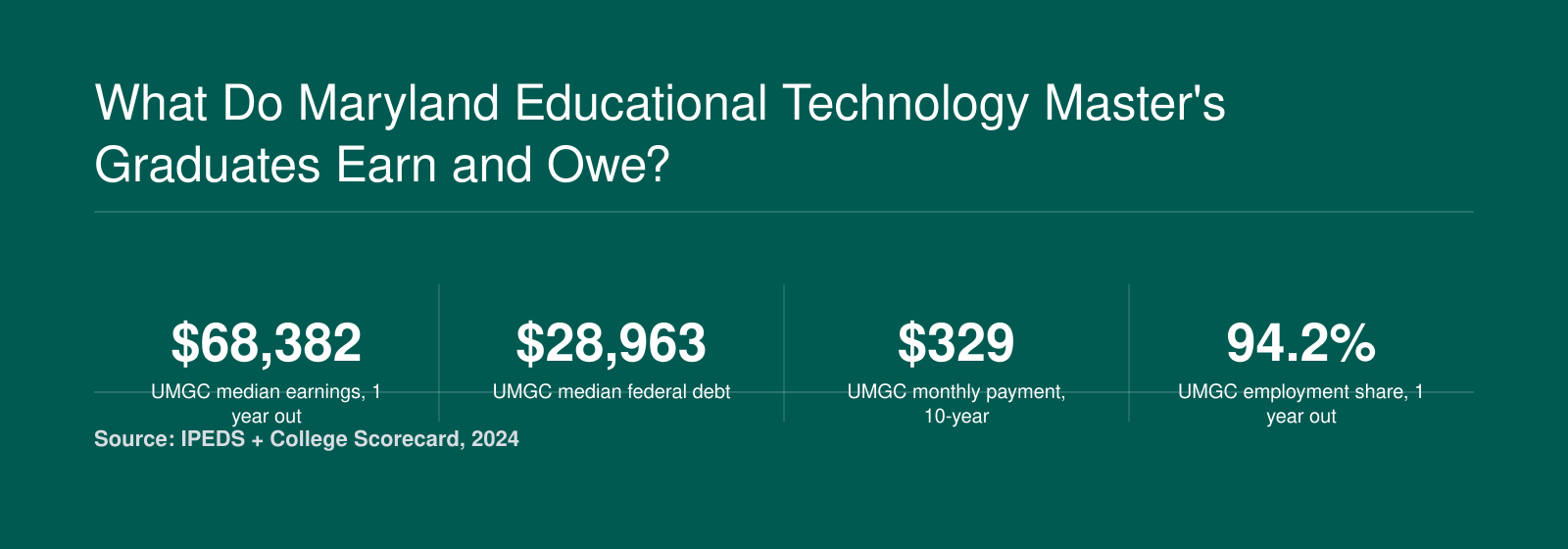
What Do Maryland Educational Technology Master's Graduates Earn and Owe?
These figures come from program-level federal data for the master's in educational technology, measured one year after completion. Typical paths include K-12 technology coach, higher-ed instructional designer, and corporate learning designer. Pay varies widely by role and employer, so treat these medians as a starting point rather than a promise.
How We Evaluated Maryland's Educational Technology Master's Schools
Our evaluation compares Maryland's educational technology master's schools using public federal data rather than reputation or advertising. Tuition, net price, and institution-wide graduation rates come from IPEDS, while program-level earnings and debt come from College Scorecard. We weighed affordability, how many students an institution graduates, how flexible the delivery is (online, hybrid, or on campus), and graduate outcomes wherever they are published.
These measures have limits. Graduation rates describe the whole institution, not one master's program. Net price is an average across students, so your own cost will differ. Some programs have no published earnings data, and we did not estimate those figures. Where outcomes are missing, the other factors carried more weight.
Tuition and GRE policies change yearly, so confirm both directly with each program before you apply. The admissions page and the bursar's office will have the current numbers.
Compare Educational Technology programs on the data that matters
Explore more Education & Teaching specializations or browse every graduate field.
All Education & Teaching programs