Master of Library and Information Science (MLIS) Programs With No GRE Required
Compare 220+ accredited no-gre Library Science programs at 90+ schools, with graduate earnings, cost, debt, and completion data from IPEDS and the U.S. College Scorecard.

An MLIS is the graduate degree most professional librarian jobs require, usually 36 to 45 credits through a program accredited by the American Library Association. Do you need the GRE to get in? At most ALA-accredited programs, no, though some keep conditional rules.
With the test gone, the harder questions are price and finishing. Listed in-state tuition here runs from $7,638 to $42,173, and several schools offer fully online tracks for working adults.
For school librarians, state certification can still demand more than the degree.
Key Points
- Kent State University reviews MLIS applications year-round for multiple start terms.
- North Carolina Central University lists the lowest in-state tuition at $7,638.
- School librarian jobs often require a state teaching license beyond the MLIS.
Ranked: MLIS Programs That Let You Skip the GRE in 2027
These ranked programs let applicants skip the GRE, though policies still vary by school. The order reflects a composite of retention, completion, institutional quality, and moderate cost and earnings factors, never a single metric. Use each card to compare ALA accreditation, delivery format, tuition, and the school's graduation rate.
University of Wisconsin-Madison
#1Madison, WI · ~$12,000/yr (est.)
Best for: Online learners wanting broad library concentrations
University of Wisconsin-Madison's Information School offers an ALA-accredited Master of Arts in Library and Information Studies with continued accreditation and its next review in 2029. The hybrid program is fully available online and is built on a 36-credit curriculum with a required 120-hour practicum. In-state graduate tuition is about $11,600 and out-of-state about $42,100; the school's graduation rate is about 90 percent. Admission does not require the GRE, though a 3.0 GPA and three recommendations are expected.
- ALA accredited; next comprehensive review in 2029
- Hybrid delivery with full online option
- 36 credits required
- Full-time: two years; part-time: three to four years
- 120-hour practicum required
- No GRE required
- 3.0 GPA minimum and three recommendation letters
- Concentrations include academic librarianship, archival studies, children's services, and more
University of Oklahoma – Hudson College of Public Health
#2Norman, OK · ~$9,000/yr (est.)
Best for: School librarianship candidates needing certification option
University of Oklahoma's ALA-accredited Master of Library and Information Studies carries continued accreditation with a 2029 review. The hybrid program can be completed fully online and emphasizes electives, archives, data science, and school librarianship. In-state graduate tuition is about $9,800 and out-of-state about $27,400; the school's graduation rate is about 75 percent. No GRE is required, and admission expects a 3.0 GPA, three recommendations, and a statement of purpose.
- ALA accredited; next comprehensive review in 2029
- Hybrid delivery with full online option
- 36 credit hours required
- No GRE scores required
- 3.0 GPA, three recommendations, statement of purpose, and resume
- Six core courses plus electives
- Concentrations include archives, data science, and school librarianship
- School librarianship certification option available
University of Iowa
#3Iowa City, IA · $13,000 – $32,000/yr (est.)
Best for: Book history and special collections scholars
University of Iowa's ALA-accredited Master of Arts in Library and Information Science is a campus-based program with continued accreditation and a 2031 review. It offers a Book Studies concentration focused on book history, preservation, and cultural heritage careers in special collections. In-state graduate tuition is about $11,300 and out-of-state about $33,400; the school's graduation rate is about 75 percent. No GRE is required for admission.
- ALA accredited; next comprehensive review in 2031
- Campus-based delivery
- Book Studies concentration
- Focus on book history, material texts, and preservation
- Prepares for careers in special collections and cultural heritage
- No GRE required
- Focus areas include academic librarianship, archival studies, and children's services
Drexel University
#4Philadelphia, PA · ~$39,000/yr (est.)
Drexel University's ALA-accredited Master's in Library and Information Science has continued accreditation with a 2032 review. The program is delivered fully online and emphasizes digital information management, archives, metadata, and user services. In-state and out-of-state graduate tuition is about $62,400; the school's graduation rate is about 78 percent. Drexel lists the program as no-GRE, though it may recommend scores for international applicants or applicants with lower undergraduate GPAs, so confirm current requirements.
- ALA accredited; next comprehensive review in 2032
- Fully online format
- 45 quarter credits required
- Average completion time: two years
- $1,000 per credit plus online program fee
- Specializations include archives, metadata, and user services
- No GRE required, but scores may be recommended for some applicants
- 3.0 GPA minimum and one recommendation letter
University of Arizona
#5Tucson, AZ · ~$15,000/yr (est.)
University of Arizona's ALA-accredited Master of Arts in Library and Information Science has continued accreditation with a 2027 review. The fully online program offers academic and public librarianship concentrations and is designed for working professionals and career changers. In-state graduate tuition is about $13,900 and out-of-state about $42,300; the school's graduation rate is about 68 percent. No GRE is required for applicants with strong academic backgrounds, and multiple start dates are available.
- ALA accredited; next comprehensive review in 2027
- Fully online delivery
- Concentrations in academic or public librarianship
- No GRE required for strong academic backgrounds
- Flexible scheduling and multiple start dates
- Focus areas include academic librarianship, archival studies, children's services, and more
- Practical skills in information organization, digital resources, and community engagement
University of Rhode Island
#6Kingston, RI · ~$18,000/yr (est.)
University of Rhode Island's ALA-accredited Master of Library and Information Studies has continued accreditation with a 2033 review. It offers two online concentrations: Digital Media and School Library Media. In-state graduate tuition is about $16,900 and out-of-state about $37,100; the school's graduation rate is about 73 percent. The program lists no GRE requirement, with waivers possible for qualified applicants, so confirm the current policy with the school.
- ALA accredited; next comprehensive review in 2033
- Online delivery
- Digital Media concentration
- Covers digital preservation, multimedia systems, and information architecture
- Hands-on project learning
- No GRE required; waiver possible for qualified applicants
- Multiple start dates
- ALA accredited; next comprehensive review in 2033
- Online delivery
- School Library Media concentration
- K-12 career preparation and state certification eligible
- Field experience component
- No GRE requirement; rolling admissions
- Cataloging skills and youth services focus
University of Southern Mississippi
#7Hattiesburg, MS · ~$10,000/yr (est.)
University of Southern Mississippi offers an ALA-accredited online Master of Library and Information Science with continued accreditation and a 2027 review. The fully online program is 40 credit hours and typically completed in one to three years. In-state graduate tuition is about $10,000 and out-of-state about $12,000; the school's graduation rate is about 49 percent. No GRE is required.
- ALA accredited; next comprehensive review in 2027
- Fully online delivery
- 40 credit hours required
- Completion time: one to three years
- No GRE required
- Synchronous online classes
- K-12 licensure coursework in Mississippi
- Scholarships available for online students
North Carolina Central University
#8Durham, NC · $5,000 – $10,000/yr (est.)
North Carolina Central University's ALA-accredited Master of Library Science has continued accreditation and a 2031 review. The campus-based program offers specializations in public, academic, digital, and school media libraries. In-state graduate tuition is about $6,700 and out-of-state about $19,700; the school's graduation rate is about 42 percent. No GRE is needed, and admission requires a 2.75 GPA, recommendation letters, a statement, and a resume.
- ALA accredited; next comprehensive review in 2031
- Campus-based delivery
- Multiple specializations: public, academic, digital, and school media
- 2.75 GPA minimum
- $50 application fee
- No GRE required
- Two recommendation letters and 700-800 word statement
- Emphasis on professional development, critical thinking, and community literacy
University of Denver
#9Denver, CO · ~$42,000/yr (est.)
University of Denver's ALA-accredited Master of Library and Information Science carries continued accreditation with a 2033 review. The online program can be completed in as few as 21 months and includes an archiving focus within the curriculum. In-state and out-of-state graduate tuition is about $61,400; the school's graduation rate is about 76 percent. No GRE is required, and the program offers four start dates per year with live online classes and faculty mentorship.
- ALA accredited; next comprehensive review in 2033
- Online delivery
- Complete in as few as 21 months
- No GRE required
- Four start dates per year
- Archiving focus available
- Live online classes and one-on-one faculty mentorship
- Capstone or internship option
University at Buffalo
#10Buffalo, NY · $10,000 – $15,000/yr (est.)
University at Buffalo offers two ALA-accredited library science master's options with continued accreditation and a 2030 review. The MS in Information and Library Science is delivered online with 36 credits and eight concentrations; the School Librarianship MS is also online and leads toward New York State certification. In-state graduate tuition is about $10,900 and out-of-state about $31,500; the school's graduation rate is about 75 percent. Neither program requires the GRE or MAT.
- ALA accredited; next comprehensive review in 2030
- Online delivery
- 36 credits required
- Complete in four full-time semesters
- No GRE or MAT required
- 3.0 GPA minimum; conditional admission possible
- Eight concentrations including information management and law librarianship
- Practicum for real-world experience
- ALA accredited; next comprehensive review in 2030
- Online delivery
- 39 credits required
- 100 field experience hours and 70 student teaching days
- New York State certification preparation
- No GRE required
- 3.0 GPA minimum; conditional admission possible
- Digital portfolio created
Cost & outcomes by school
Federal data for the highest-earning Library Science programs, independent of the ranking above. Earnings are this field's master's graduates four years after completing, where the Scorecard reports them.
| School | Earnings | Tuition / yr | Debt | Grads/yr | Format |
|---|---|---|---|---|---|
| University of Wisconsin-Whitewater WI | — | $10,543 | — | — | Hybrid |
| Middle Tennessee State University TN | — | $11,718 | — | — | Online |
Sources: U.S. Department of Education. Tuition and graduates: IPEDS. Earnings and debt: College Scorecard, this field's master's graduates; a dash means no figure is reported.
Behind the List: What Moved a School up or Down
Programs that students actually finish rose to the top of this list of best master's in library science programs, because a test-free application means little if people leave before graduating. Eligibility for a GRE waiver earned a school a bonus, and retention and completion carried the most weight after that. Cost and graduate earnings counted too, but only moderately.
Read those signals with care. Graduation and retention rates describe the whole institution, not the MLIS program alone. Net price is an average after aid, not a quote, so your own cost will depend on residency, scholarships, and credit load, even for affordable MLIS programs.
Your No-GRE Application Packet, Item by Item
Even without a GRE, a complete MLIS application usually centers on transcripts, a written statement, and references; test exceptions vary by school.
- Accredited bachelor's degreeYou'll need a bachelor's degree from an accredited institution. A minimum GPA around 3.0 is common, though cutoffs vary by program.
- Low-GPA routes and GRE exceptionsKent State sets a 2.750 minimum; applicants below submit a statement of exception. Drexel's profile indicates a GRE waiver is available, but scores may be requested when GPA is near the minimum. San José State's test page lists GRE code 4687 but does not state every MLIS applicant must submit scores.
- Statement of purposeA focused essay explaining your interest in library and information science and how the degree fits your goals.
- Letters of recommendation and résuméTypically two references and a current résumé; Kent State's required materials include a profile form, essay, and two letters.
- TranscriptsOfficial transcripts from every college or university attended.
- English proficiency for international applicantsKent State requires TOEFL 94, IELTS 7.0, PTE 65, or Duolingo 120. San José State requires TOEFL 80, IELTS 6.5, PTE 53, or Duolingo 120 and does not accept English-medium instruction as a substitute. Drexel requires proof with waivers.
Application Deadlines and Start Terms at Leading No-GRE Programs
Kent State University accepts MLIS applications year-round, reviewing files on a rolling basis for fall, spring, or summer entry. That flexibility is the exception. Most master's programs with no GRE required hold to fixed cutoffs tied to a one- or two-term calendar.
- San José State University iSchool: Fall and spring starts.4 For spring 2027, apply by Dec. 1, 2026, with documents due Dec. 20; for fall 2027, apply by May 1, 2027, with documents due May 20.4 Applications are accepted only during the posted window, not on a rolling basis.1
- University of North Texas: Fall, spring, and summer starts. Deadlines fall on June 15 for fall, Oct. 15 for spring, and April 15 for the three-week summer session.2
- Valdosta State University: Fall and spring starts, with deadlines of March 15 and Sept. 30.3
Multiple entry points at online MLIS programs like North Texas and Kent State mean you rarely wait a full year to begin. Deadlines shift each cycle, so confirm the current dates on the program's own admissions page before you plan around them.
Related Articles
Fully Online, Hybrid, or Campus: How No-GRE MLIS Formats Differ
Yes, you can earn an ALA-accredited MLIS online without taking the GRE. Several schools ranked here deliver online MLIS programs, including the University of Arizona, University of Rhode Island, University of Southern Mississippi and University of Denver. The University of Wisconsin-Madison and University of Oklahoma run hybrid programs with online completion paths. The University of Iowa and North Carolina Central University remain campus-based.
"Online" does not mean the same thing everywhere. San José State's MLIS is predominantly asynchronous. Live sessions there are rare and optional, and the program has no campus visit or residency. Southern Mississippi, by contrast, holds live weekly class meetings, and Denver builds in live online class sessions. With those two programs, some evenings are already spoken for.
If you work full time, ask two questions before applying. First, in which time zone are live classes scheduled? A 6 p.m. Central session starts at 4 p.m. Pacific. Second, how are practicum placements arranged? Wisconsin-Madison requires a 120-hour practicum, so confirm you can complete it near home.
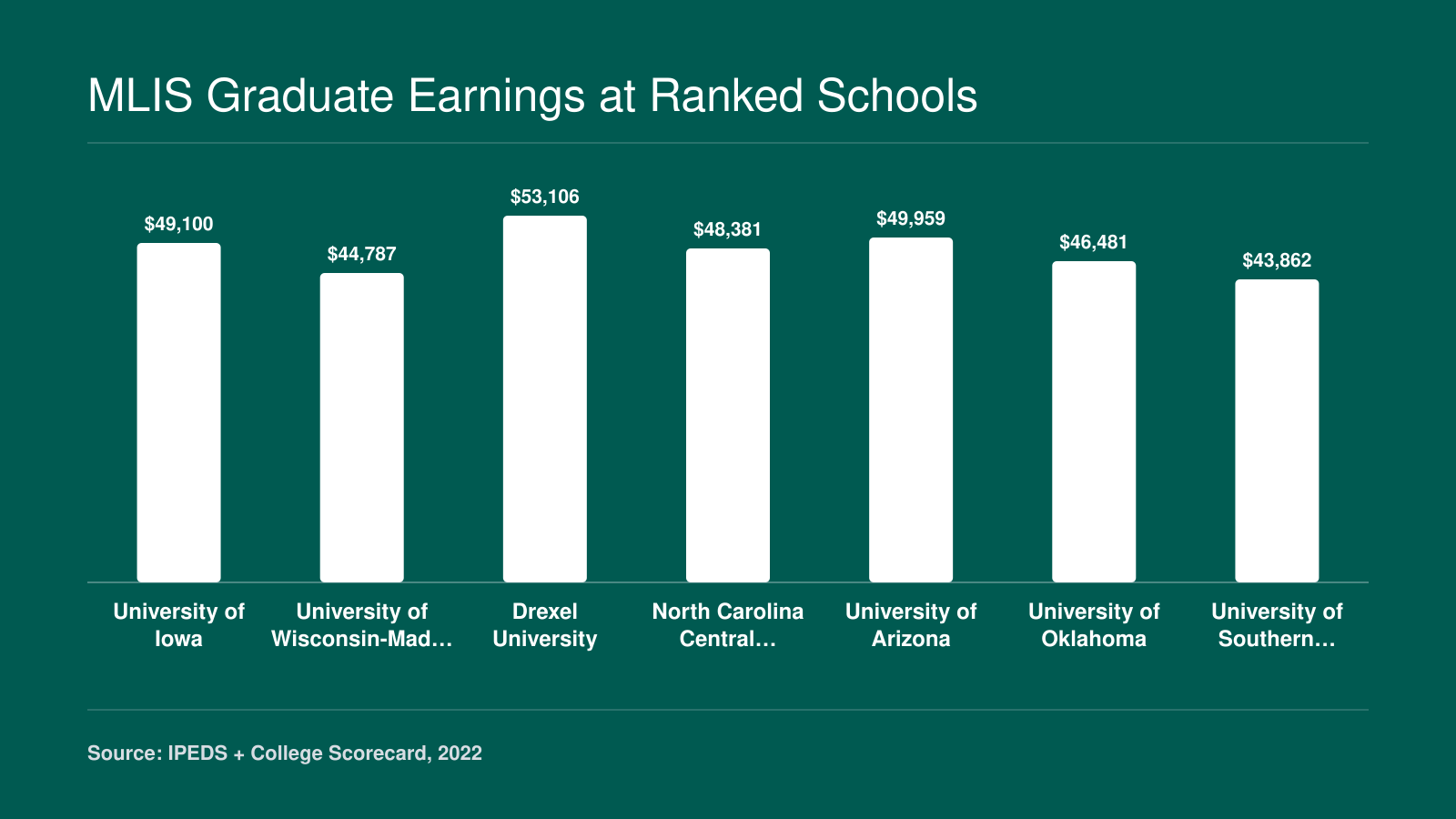
MLIS Graduate Earnings at Ranked Schools
Program-level median earnings one year after completion are shown for the ranked schools that report this figure. The differences are modest; what matters more is the type of library job you pursue, whether school, public, academic, or special.
Cheapest No-GRE MLIS Options and How to Pay Less
What is the cheapest MLIS program with no GRE requirement? On listed program tuition, North Carolina Central University is lowest for in-state students at $7,638, though it is campus-based. The University of Oklahoma follows at $9,353 in-state (out-of-state $26,142) and offers a fully online option. The University of Southern Mississippi lists $9,998 in-state and $11,998 out-of-state, and its materials say online students pay resident tuition. Private options are far higher: Drexel lists $39,261 and the University of Denver $42,173.
Sticker price is not the whole story. Median program-level debt is $22,732 at Oklahoma (about $259 a month on a 10-year plan), against $40,625 at North Carolina Central ($462 a month). Treat these as estimates.
Ways to Pay Less
- ALA Spectrum Scholarship: $5,000 for the 2025-2026 cohort of 60 scholars, for students in ALA-accredited programs taking at least two classes per semester. The 2026 deadline was March 1.
- Assistantships and state awards: Ask each department about graduate assistantships, and check ALA and state library association scholarships.
- IMLS-funded cohorts: These grants go to universities, not individuals, so ask whether a funded cohort offers tuition support.
- Employer benefits: Library systems and school districts often help with tuition.
Before you commit, ask whether e-tuition is charged at the in-state rate, and, if you live in the West, whether a public school takes part in the WICHE Western Regional Graduate Program.
Headed for a K-12 Library? Check Your State's Certification Rules First
An MLIS can qualify you for a school library job in one state and leave you short in another, because each state sets its own rules. Many require a teaching license, plus an exam or specific coursework, on top of the master's.
- Texas: A teaching certificate, a master's degree, two years of classroom experience, a state-approved preparation program, and the TExES School Librarian (150) exam.
- California: A valid teaching credential first, then the Teacher Librarian Services Credential as an added authorization. It requires a Commission-approved program with supervised fieldwork, and some pathways need 30 or more semester units beyond the MLIS.
- New York: A master's degree, generally the NYSTCE Library Media Specialist (074) exam, and the Educating All Students exam. Whether you need a prior teaching license depends on the pathway.
- Ohio: A teaching license or licensure pathway, a master's, the OAE School Library Media Specialist assessment, and the OAE Assessment of Professional Knowledge: Multi-Age (PK-12).
None of these four uses the Praxis. Other states may accept the Praxis School Librarian test (5311), so check that yours does.
Before you enroll, confirm in writing that the program's school library track is approved for your home state. This matters most for online programs based elsewhere.
Library Science programs by state
Compare Library Science programs on the data that matters
Explore more Education & Teaching specializations or browse every graduate field.
All Education & Teaching programs