Best Online Master of Library and Information Science (MLIS) Programs
Compare 180+ accredited online Library Science programs, with graduate earnings, cost, debt, and completion data from IPEDS and the U.S. College Scorecard.

Most professional librarian postings still require an ALA-accredited master's degree, yet many working adults cannot pause a salary or relocate to earn one. Every program ranked here is 100 percent online, with hybrid formats excluded.
The decision that follows is less about whether a degree is accredited than about how its remote structure fits your life. Total cost after fees, live versus self-paced classes, practicum and campus-visit rules, and school library certification paths all differ from one program to the next. An ALA-accredited credential opens the profession; the right online format is what makes it feasible.
Key Points
- Only 100% remote MLIS programs make this 2027 ranking.
- University of Kentucky's online MSLS earned renewed ALA accreditation in June 2026.
- Net price after aid reveals affordability better than published tuition.
Top 100% Online MLIS Programs for 2027
The fully online MLIS programs below are listed in rank order, with hybrid options excluded. Each selection is a 100 percent remote route to library and information science study, ordered by a mixed quality composite that emphasizes verifiable outcomes. The cards show in-state and out-of-state graduate tuition, average net price, and available concentrations.
Florida State University
#1Tallahassee, FL · ~$11,000/yr (est.)
Best for: Working librarians seeking broad library concentrations
Florida State's online Master of Science in Information offers concentrations in public, academic, and special libraries as well as school libraries. The program is designed for working professionals with flexible online coursework and covers information organization, management, and services. Admission requires a bachelor's degree and transcripts, and financial aid options are available.
- Online program with flexible scheduling for working professionals
- Public, academic, and special libraries concentration
- Covers information organization, management, and services
- Bachelor's degree and transcripts required for admission
- Financial aid options available
- Multiple application deadlines each year
- K-12 school library media preparation
- Focus on information literacy and educational technology integration
- Collection management and certification qualification
- Bachelor's degree, GPA, and recommendations required
- Multiple start terms available
Rutgers University
#2New Brunswick, NJ · ~$23,000/yr (est.)
Best for: Career changers drawn to information services leadership
Rutgers offers an online Master of Information with a Library and Information Science concentration. The curriculum blends theory and practice in collection management, information literacy, and digital reference, requiring 36 credits plus three zero-credit courses. It suits career changers and professionals seeking advancement in library and information services.
- 36 credit hours plus three zero-credit courses
- Covers collection management, information literacy, and digital reference
- Flexible interdisciplinary curriculum with elective options
- Internship option recommended for hands-on experience
- Prepares students for library and information leadership roles
University of South Florida
#3Tampa, FL · ~$10,000/yr (est.)
Best for: Aspiring school librarians pursuing Florida certification
South Florida's online Master of Arts in Library and Information Science is ALA-accredited and requires 39 credit hours. Students complete six core courses and then customize their path with electives, with an optional school librarian specialization that prepares for Florida certification. Financial aid and scholarships are available.
- ALA-accredited with next review in 2031
- 39 credit hours, fully online and asynchronous
- Six core courses plus electives
- B average required; maximum two C grades
- School librarian specialization with Florida certification preparation
- Scholarships available
University of Southern California
#4Los Angeles, CA · ~$72,000/yr (est.)
USC's online Master of Management in Library and Information Science is an ALA-accredited degree that can be completed in 12 months. The program emphasizes management strategies and information science fundamentals through live online sessions and discussions. Admission requires a bachelor's degree, resume, transcripts, two recommendations, and a statement of purpose.
- Complete in 12 months
- ALA-accredited degree with conditional accreditation status
- Focus on management strategies and information science fundamentals
- Live online sessions and online discussions
- Bachelor's degree, resume, transcripts, two recommendations, and statement of purpose required
- USC Bovard College program
University of South Carolina
#5Columbia, SC · ~$14,000/yr (est.)
South Carolina's online Master of Library and Information Science requires 36 credit hours, including 18 core hours, and is fully online except for school library practicums and internships. The program is ALA-accredited and offers S.C. school library certification eligibility. Up to 12 credit hours may transfer, and students can pursue combination degrees with English or public history.
- ALA accredited with next review in 2032
- 36 total credit hours: 18 core plus 18 tailored
- No entrance exam required
- Fully online except school library practicums and internships
- Eligible for S.C. school library certification
- Transfer up to 12 credit hours
- Starts fall, spring, and summer
- Combination degrees with English or Public History available
Louisiana State University and Agricultural & Mechanical College
#6Baton Rouge, LA · $10,000 – $15,000/yr (est.)
LSU's online Master of Library and Information Science is a 36-credit, 100 percent online program with concentrations including academic libraries, public libraries, archival studies, and more. It is ALA-accredited and currently priced at $560 per credit, totaling about $20,160. Admission requires a 3.0 GPA, a resume, and a 1,000-word statement of purpose, with no letters of recommendation.
- 36 credit hours: 18 core and 18 elective
- 100% online with asynchronous classes
- $560 per credit hour, about $20,160 total
- ALA-accredited since 1931, next review 2029
- 3.0 GPA minimum, no letters of recommendation
- 1,000-word statement of purpose required
- Four concentration options available
- No thesis or capstone required
- Academic libraries concentration
- Covers collection development and digital resource management
- Includes research support services and library administration courses
- Bachelor's degree and competitive GPA required
- Financial aid available
- Public libraries concentration
- Emphasis on community outreach and digital literacy
- Reference services and library management curriculum
- Project-based learning and professional networking opportunities
- Financial aid available
University at Buffalo
#7Buffalo, NY · $10,000 – $15,000/yr (est.)
Buffalo offers two online library science master's routes: a 39-credit School Librarianship MS and a 36-credit Information and Library Science MS. The school librarianship path includes field experience and meets New York State certification requirements. The information and library science path is ALA-accredited and offers multiple concentrations in areas such as cataloging, digital libraries, law librarianship, and music librarianship.
- 39 credits, can be completed in four full-time or eight part-time semesters
- Includes field experience and practicum
- Meets New York State certification requirements
- 3.0 GPA, three recommendation letters, and statement of goals
- No GRE required
- $50 application fee
- ALA-accredited with next review in 2030
- 36 total credit hours, full-time and part-time options
- Fully online with asynchronous delivery
- Concentrations include cataloging, digital libraries, law, music, public, academic, and special libraries
- 2-year completion option available
- $50 application fee
University of Arizona
#8Tucson, AZ · ~$15,000/yr (est.)
Arizona's online Master of Arts in Library and Information Science is ALA-accredited and requires 37 credits at $900 per credit. Students can pursue concentrations in archival studies, academic or public librarianship, digital information management and curation, and more. The program is designed for working professionals and does not require the GRE for several concentration tracks.
- 37 credit hours required
- $900 per credit
- ALA-accredited
- Online program with flexible scheduling
- Concentrations include archival studies, public librarianship, and digital information management
- Bachelor's degree required
- Archival studies concentration
- Online program format
- Prepares for careers in archiving and curation
- Academic and public librarianship concentrations
- Flexible scheduling and multiple start dates
- No GRE requirement
- Digital curation concentration
- Fully online
- Focus on information management specialization
Appalachian State University
#9Boone, NC · $9,000 – $25,000/yr (est.)
Appalachian State's online MLIS is a 36-credit, two-year program with synchronous and asynchronous delivery. It offers two concentration paths: School Libraries, which prepares for the North Carolina Media Coordinator license, and Library Science General, which leads toward public and academic library roles and Public Librarian Certification. The program holds ALA Pre-Candidacy Status and maintains a 16:1 student-instructor ratio.
- 36 total credit hours, typically completed in two years
- Fully online with synchronous and asynchronous options
- Two concentration paths: School Libraries and Library Science General
- Prepares for NC Media Coordinator licensure and Public Librarian Certification
- ALA Pre-Candidacy Status
- 16:1 student-instructor ratio
- 54-credit dual degree option available
- Focus on digital literacy and equal technology access
University of Pittsburgh-Pittsburgh
#10Pittsburgh, PA · ~$28,000/yr (est.)
Pitt's online Master of Library and Information Science offers both a general MLIS and an Archives and Information Science concentration. The general program requires 36 credits and can be completed in as little as 11 months or extended up to four years, with asynchronous weekly schedules. All online students pay in-state tuition, and the school offers a School Library Certification Program.
- Archives and Information Science concentration
- Online program delivery
- Prepares for careers in archives, records management, and digital preservation
- Covers information organization and archival practices
- ALA accredited, next review 2028
- 36 credit hours, 12 courses, $1,170 per credit
- Complete in 11 months full-time or up to 4 years part-time
- Fully online with asynchronous weekly schedules
- Three start dates per year, rolling admissions
- School Library Certification Program and PK-12 certificate available
- All online students pay in-state tuition
- No GRE or predictor test required
Cost & outcomes by school
Federal data for the highest-earning Library Science programs, independent of the ranking above. Earnings are this field's master's graduates four years after completing, where the Scorecard reports them.
| School | Earnings | Tuition / yr | Debt | Grads/yr | Format |
|---|---|---|---|---|---|
| East Central University OK | — | $6,008 | — | — | Online |
| University of West Georgia GA | — | $6,046 | — | — | Online |
| Valdosta State University GA | — | $6,316 | — | — | Online |
| University of Central Arkansas AR | — | $7,446 | — | — | Online |
| East Texas A&M University TX | — | $7,338 | — | — | Online |
| Southern Arkansas University AR | — | $7,380 | — | — | Hybrid |
| Longwood University VA | — | $7,758 | — | — | Hybrid |
| East Carolina University NC | — | $7,658 | — | — | Online |
| Valley City State University ND | — | $8,075 | — | — | Online |
| Georgia College & State University GA | — | $8,376 | — | — | Online |
| University of Virginia's College at Wise VA | — | $8,352 | — | — | Online |
| University of North Carolina at Greensboro NC | — | $8,614 | — | — | Online |
Sources: U.S. Department of Education. Tuition and graduates: IPEDS. Earnings and debt: College Scorecard, this field's master's graduates; a dash means no figure is reported.
Inside Our Scoring: What Put These Programs on the List
Only programs a student can finish without ever driving to campus made the cut; from there, a blended quality score sorted the best master's in library science programs.
What Feeds the Score
Each program is measured against the figures that actually shape your decision:
- Price: Published graduate tuition and fees, plus the institution's average net price, which reflects what students pay after grant and scholarship aid is subtracted and helps flag the most affordable MLIS programs.
- Student success: Institution-wide graduation and retention rates, a read on whether enrolled students tend to finish.
- Outcomes: Program-level graduate earnings and typical debt, pulled from federal data where those figures are published for library science.
Read the Numbers With Care
Two caveats matter. Graduation rate and net price describe the entire university, not the MLIS program by itself, so they are a backdrop rather than a precise forecast for your track. Net price is also an average across aided students, not a personal quote; your own cost depends on your aid package, residency, and pace.
Program-level earnings and debt are not published for every school here, especially smaller programs with fewer graduates in a given year. A blank in those columns means the data was too thin to report, not that graduates fared poorly. Where earnings do appear, treat them as a directional signal, then weigh them against the program's price to judge the real return.
Verifying ALA Accreditation for Each Online Program
The University of Kentucky's Master of Science in Library Science received continued accreditation on June 27, 2026, with its next comprehensive review set for 2033 and follow-up reporting due February 15, 2027. That kind of detail matters, because most public and academic library postings screen for a master's from one of the ALA-accredited MLIS programs before they read anything else on your resume.
Where these programs stand
Continued accreditation is the status you want to see. Wayne State's MLIS holds it, granted February 7, 2025, with the next review in 2031 and follow-up reporting due in 2026. Oklahoma's Master of Library and Information Studies holds continued accreditation granted June 29, 2022, meets all standards with no follow-up reporting required, and comes up for review in 2029. Drexel, the University of Wisconsin-Milwaukee, Simmons, and East Carolina each hold continued accreditation with comprehensive review visits scheduled for Spring 2032.
Two caveats. Conditional status sounds worse than it is: ALA treats conditional programs as fully accredited while they make the changes needed to comply with the standards. Pre-candidacy is different. Appalachian State's library science master's carries ALA pre-candidacy status, not accreditation, so check carefully whether a degree earned there today will satisfy employers who require the accredited credential.
Check it yourself in five minutes
The ALA Office for Accreditation maintains a searchable directory of accredited programs. Each entry lists the program name, accreditation date, and distance-education opportunities, and you can search by degree type and by distance-education option to isolate programs completable entirely online. Accreditation attaches to the program, not the format, so graduates of a masters in library science online program hold exactly the same accredited degree as someone who sat in the classroom.
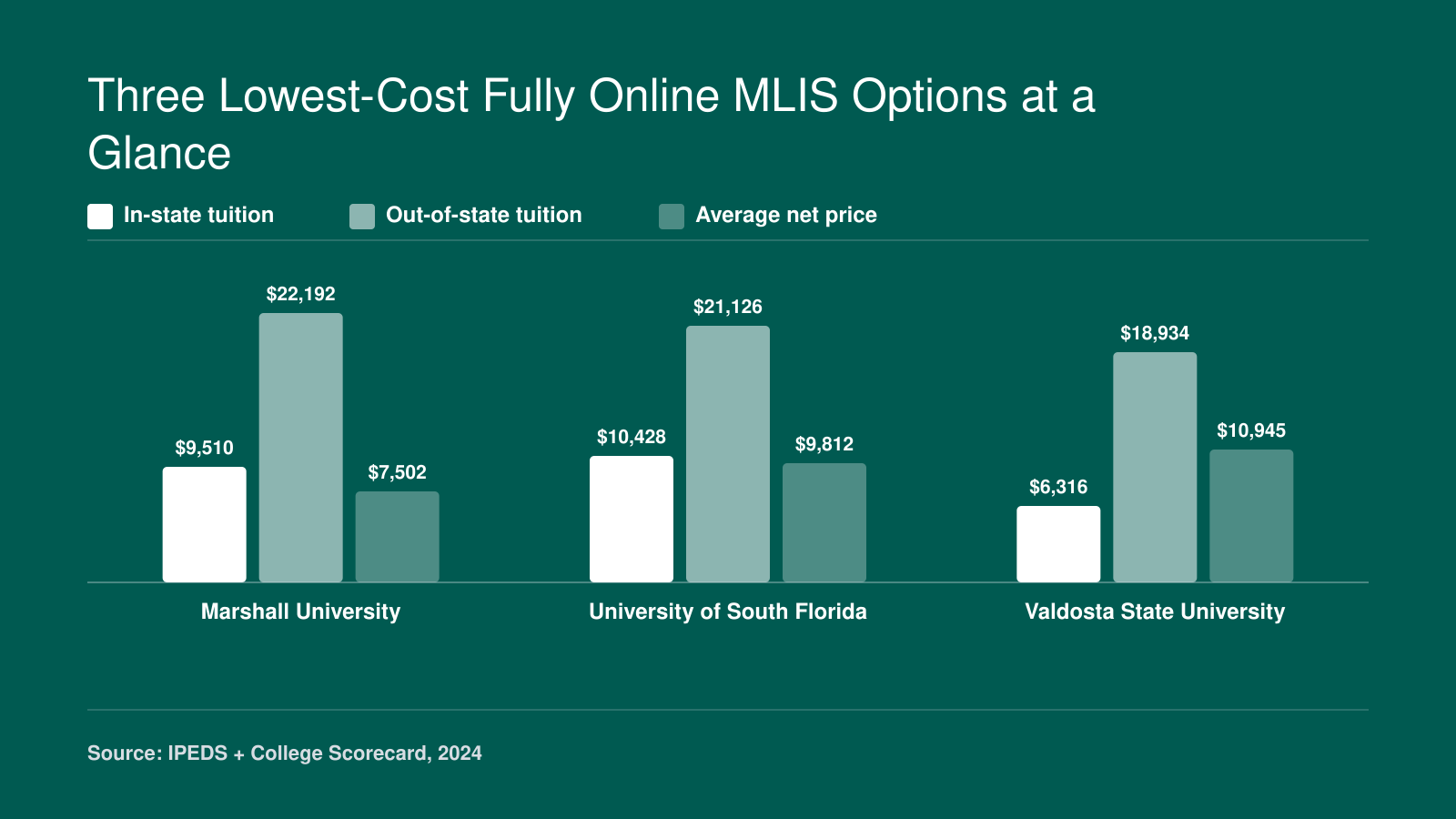
Three Lowest-Cost Fully Online MLIS Options at a Glance
This quick cost snapshot compares three fully online MLIS options using published in-state and out-of-state tuition and average net price. Net price is an institution-wide average after grant and scholarship aid, so it is a useful affordability signal rather than a program-specific sticker price.
Related Articles
A "100% online" MLIS can still require a local, in-person practicum, so confirm what you must complete on the ground before you enroll.
What Librarians Earn Nationally
This is an occupation-wide figure, not earnings from any ranked program.
Library Science programs by state
Online MLIS Questions Readers Ask Most
Does an online MLIS carry the same weight with employers as an on-campus MLIS?
Which fully online MLIS program costs the least?
Will I ever have to travel to campus to finish an online MLIS?
MLIS or MLS: does the degree title change anything for job seekers?
Can an online MLIS lead to a school librarian license?
How many semesters does a typical online MLIS take?
Can I keep working full time while earning an MLIS online?
Compare Library Science programs on the data that matters
Explore more Education & Teaching specializations or browse every graduate field.
All Education & Teaching programs