Best Master of Library and Information Science (MLIS) Programs in Missouri
Compare 4 accredited Library Science programs in Missouri at 3 schools, with graduate earnings, cost, debt, and completion data from IPEDS and the U.S. College Scorecard.

Many library job postings still screen applicants for an ALA-accredited master's, and in Missouri that requirement narrows the field fast. The University of Missouri holds the state's only ALA accreditation at this level. The University of Central Missouri is in candidacy, with AASL recognition for school librarians, and Lindenwood University pairs a master's in education with a school library certificate.
Format and cost split them further, and the Most Affordable Master of Library and Information Science Programs guide is worth consulting when price is a deciding factor. Mizzou's 39-credit online MLIS runs an estimated $23,696 in tuition, while UCM lists $18,150 total. For school library roles, state certification can matter more than ALA status.
Key Points
- Only the University of Missouri holds ALA accreditation among Missouri's master's programs in library science.
- Mizzou charges $607.60 per credit online, residents or not, across 39 credits.
- The GRE is not required for Mizzou's MLIS, and UCM lists no GRE requirement.
Ranked: Missouri's Top Master's in Library and Information Science Programs
Each program below earned its spot on value, flexibility, and how well it sets graduates up for library work in Missouri and beyond. Graduation rates cited are institution-wide figures from federal data, not program completion rates. Only Mizzou holds ALA accreditation among these listings, so check that credential against the job you want, especially for public and academic roles.
University of Missouri
#1Columbia, MO · ~$14,000/yr (est.)
Best for: Aspiring librarians wanting many specializations
The University of Missouri in Columbia offers the state's only ALA-accredited MLIS in this group, and the university has a graduation rate of 75%. The 39-credit program is fully online, with focus areas such as academic librarianship, archival studies and digital libraries, plus a PK-12 school library media specialist pathway. Online students pay the same per-credit rate whether they live in Missouri or elsewhere ($607.60 per credit hour for 2026-27, about $23,696 for the program). Mizzou also awards more than $22,000 a year in merit and need-based aid through its information school.
- ALA accredited, next accreditation review in 2030
- 39 total credit hours, 100% online
- Focus areas include academic librarianship, archival studies, digital libraries
- Minimum 3.0 GPA in last 60 undergraduate hours
- Resume and two recommendation letters required
- Fall priority deadline February 15; scholarship deadline March 1
- PK-12 school library media specialist option
University of Central Missouri
#2Warrensburg, MO · ~$10,000/yr (est.)
Best for: Cost-conscious online learners
The University of Central Missouri in Warrensburg pairs a 36-credit Master of Library Science with the lowest listed tuition of the three, about $18,150 for the whole program. The university has a graduation rate of 54%. A 24-credit core aligned to ALA competencies leads into school, public or academic librarian pathways, and future school librarians can add initial teacher certification with a student-teaching internship. The program is CAEP accredited and AASL recognized, and it lists ALA candidacy status rather than full ALA accreditation. UCM lists campus and online versions of the program: the 36-credit curriculum is the same, and both list a fully online option. Employees of participating school districts can claim a 20% tuition award.
- 36 credit hours with a 24-credit ALA-aligned core
- Three concentration options: school, public or academic
- 12 hours of electives
- $18,150 total program tuition
- As little as 24 to 36 months
- Dual degree path with Murray State
- Spring and summer starts
- Student-teaching internship for school certification
- 20% District Partnership tuition award
- 90% job placement rate reported by the program
- Research and practicum opportunities
Lindenwood University
#3Saint Charles, MO · ~$11,000/yr (est.)
Best for: Teachers adding a school library credential
Lindenwood University in Saint Charles takes a different route: a Master of Arts in Education with an integrated School Library Media and Technology Graduate Certificate, delivered online. The university has a graduation rate of 49%. It suits classroom teachers who want to lead a school library, but it is an education degree rather than a general MLIS, so it will not fit public or academic library careers as well.
- Master's in Education with a built-in library certificate
- School Library Media and Technology concentration
- Covers daily library administration and future-ready library standards
- Fully online option available
- Prepares candidates to lead from the library in any school
Cost & outcomes by school
Federal data for the highest-earning Library Science programs, independent of the ranking above. Earnings are this field's master's graduates four years after completing, where the Scorecard reports them.
| School | Earnings | Tuition / yr | Debt | Grads/yr | Format |
|---|---|---|---|---|---|
| University of Central Missouri MO | — | $10,296 | — | — | Campus |
| Lindenwood University MO | — | $11,246 | — | — | Online |
| University of Missouri MO | — | $13,681 | — | — | Online |
Sources: U.S. Department of Education. Tuition and graduates: IPEDS. Earnings and debt: College Scorecard, this field's master's graduates; a dash means no figure is reported.
Studying Online or Hybrid: How Missouri MLIS Programs Fit a Working Schedule
A fully online master's in library science, one of the Best Online Master of Library and Information Science Programs, lets you earn the degree without relocating or sitting in a classroom, but "online" covers two very different experiences: coursework you complete on your own schedule, and live sessions you log into at a set time.
University of Missouri
Mizzou's 39-credit program, one of the online master's programs in Missouri, runs 100% online with no required campus visits. It is not purely self-paced, though: some courses schedule synchronous Zoom meetings, with required times listed at registration. A full-time load is 9 credit hours per semester, while part-time students take 3 or 6. Most working students take one or two classes per term and finish in two to four years; a full-time pace typically wraps up in two.
University of Central Missouri
UCM delivers its 36-credit Master of Library Science fully online, also with no campus visits on the reviewed pages. A 2026 program review describes coursework as primarily asynchronous, with occasional live sessions generally recorded for later viewing. Full-time students taking three courses per semester finish in about two years; part-time students taking one or two typically need three to four.
Online students living outside Missouri may pay different rates; see the cost section for details.
Related Articles
GRE Policies: Which Missouri Master's in Library Science Programs Skip the Test
Do you need GRE scores to apply to a Missouri library science master's? At the University of Missouri, no. Its official catalog says the MLIS does not require the GRE, placing it among Master of Library and Information Science Programs With No GRE Required and many other No-GRE master's programs. The University of Central Missouri lists no GRE requirement on its Master of Library Science page, but it publishes no explicit policy either, so "optional" or "waived" would be a guess. Confirm with the admissions office.
- University of Missouri: 3.0 GPA (last 60 undergraduate credits), online application, résumé, essay responses, two recommendation letters, and unofficial transcripts. Fall priority deadline is Feb. 15, with a regular Fall deadline of May 1 and a Spring deadline of Oct. 15.
- University of Central Missouri: 2.75 undergraduate GPA, online application, letter of intent, and résumé. Listed deadlines are July 31 for Fall, Dec. 1 for Spring, and Apr. 15 for Summer, though the page does not say whether they are final.
Both require a bachelor's degree from an accredited institution.
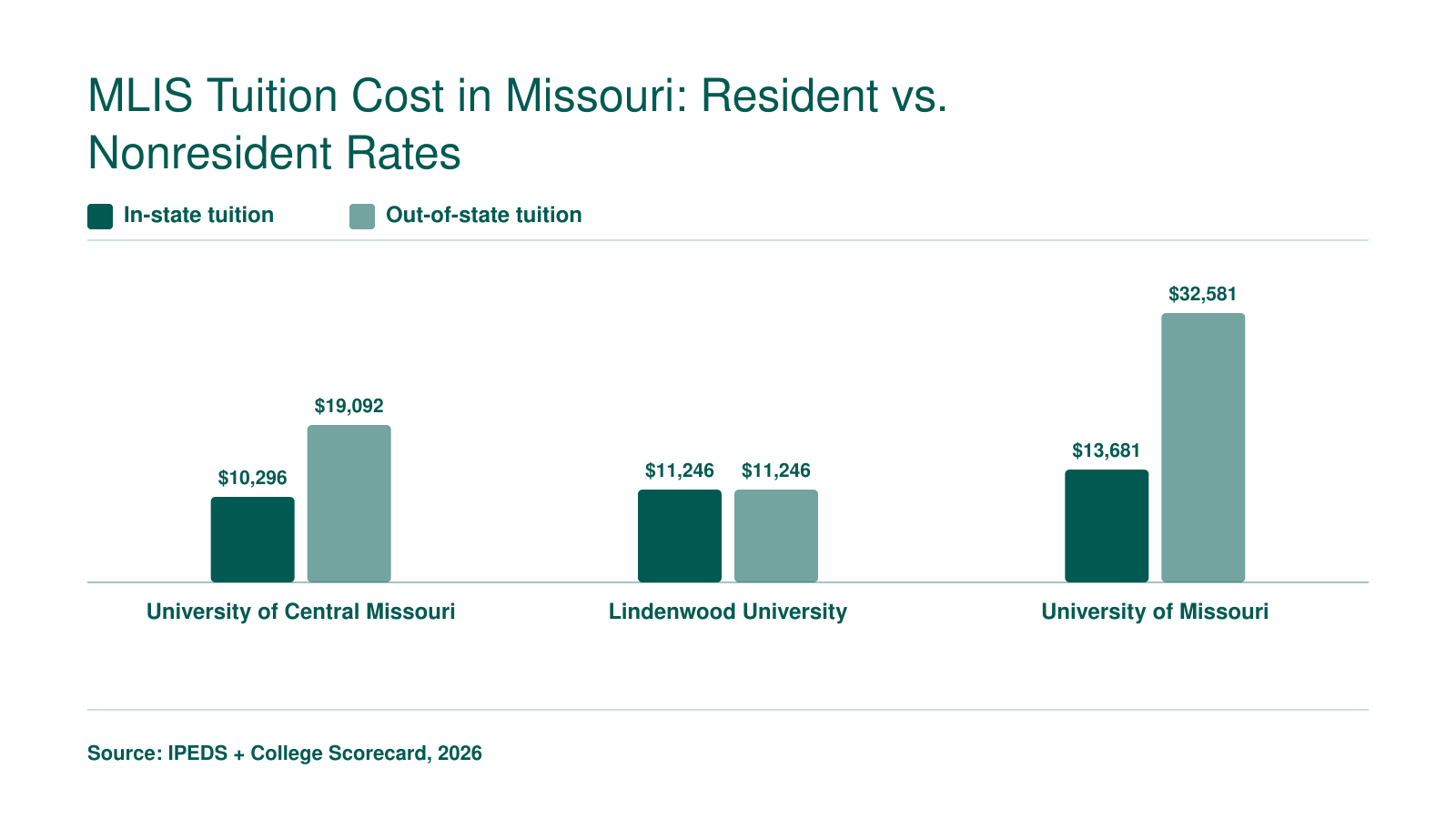
MLIS Tuition Cost in Missouri: Resident vs. Nonresident Rates
The chart shows published tuition for in-state and out-of-state students. Online MLIS students may not pay those rates. Mizzou charges one online rate of $607.60 per credit regardless of residency, and the program takes 39 credits, an estimated $23,696 in total before application fees, textbooks and course materials. UCM's MLS takes 36 credits at $430 per credit for Missouri residents, with an official estimate of $18,150. UCM does not say whether its online MLS is billed at resident or nonresident rates, and neither school itemizes mandatory fees. For the cheapest online MLIS degree, compare per-credit totals rather than the bars alone. Net price after aid averages about $14,462 at UCM, $19,638 at Lindenwood and $20,268 at Mizzou, but those are institution-wide figures, not MLIS-specific. Mizzou students can apply for the ALA Spectrum Scholarship.
What Missouri Library Science Graduates Earn
Top reported program-level earnings in Missouri
MLIS at Mizzou vs. UCM: Accreditation, Curriculum, and Career Fit
Only one of these two master's programs holds ALA accreditation today, and that difference matters most for the jobs you want.
| Feature | University of Missouri (Mizzou) | University of Central Missouri (UCM) |
|---|---|---|
| Degree name | Master of Library and Information Science (MLIS) | Master of Library Science (MLS) |
| ALA status | Accredited. Continued accreditation granted Feb. 7, 2024; next review 2030. | Candidacy since July 2024, not yet accredited. ALA lists a decision for Feb. 2027. Candidacy does not guarantee accreditation. |
| School librarian preparation | Not established in ALA sources; confirm with the program. | School Librarianship concentration. UCM states it is CAEP-accredited and AASL-recognized (granted Spring 2021), and the only such program in Missouri. |
| Emphasis areas | Confirm current options with the program. | School Librarianship is the documented specialty; confirm any others with the program. |
| Best fit | Academic and public library jobs that require an ALA-accredited degree. | Teachers already working in Missouri schools who want to become school librarians. Anyone aiming for academic or public libraries should wait for the ALA decision or choose an accredited program. |
Quick Answers for Future Missouri Librarians
These are the questions prospective students ask most about credentials and job eligibility. Each answer reflects 2026 hiring and accreditation guidance.
Will Missouri libraries expect my master's to be ALA-accredited?
Does an MLIS carry more weight than an MLS?
Can I work as a school librarian in Missouri with an MLIS?
Compare Library Science programs on the data that matters
Explore more Education & Teaching specializations or browse every graduate field.
All Education & Teaching programs