Most Affordable Master of Library and Information Science (MLIS) Programs
Compare 220+ accredited most affordable Library Science programs at 90+ schools, with graduate earnings, cost, debt, and completion data from IPEDS and the U.S. College Scorecard.
Most professional librarian jobs expect an MLIS or equivalent master’s, but median pay in public and school libraries runs from $50,500 to $55,500. That makes total cost a more reliable filter than school prestige.
Across the programs ranked here, average net price after grant aid runs from about $4,195 to $15,563. ALA accreditation, online format fit, and earnings by career track matter more than advertised per-credit rates.
Key Points
- In 2027, LSU's online MLIS requires 36 credits plus mandatory fees.
- Valdosta State's ALA-accredited MLIS has no required live weekly sessions in 2027.
- National librarian median pay is $68,270, but public library roles report $50,500.
The 10 Most Affordable MLIS Programs for 2027
Affordability here means looking past sticker price to what students actually pay after aid, and weighing that against what graduates go on to earn and owe. The ten schools below pair lower published graduate costs with online or hybrid formats and, where outcomes are reported, solid early-career earnings.
CUNY Queens College
#1Queens, NY · ~$12,000/yr (est.)
Best for: NYC-area students balancing cost and flexibility
CUNY Queens College in Queens, New York, is the rare public MLS option that combines a low average net price, about $4,195, with strong early career earnings. Published graduate tuition and fees run $7,538 for New York residents and $15,488 for nonresidents, and the program is offered in hybrid format with a fully online option. Students choose among eight concentrations, including archives, youth services, school library media, academic librarianship, and records management. Program completers reported median earnings of $75,530 one year after finishing and $89,280 five years out, with median federal loan debt of $19,100; the school's overall graduation rate is 53%.
- ALA accredited program
- Eight concentration options
- Fully online option available
- Only publicly funded ALA-accredited MLS in NYC
- Internships at Metropolitan Museum of Art
- Some courses held at CUNY sites in Manhattan
- Accepts non-matriculated students
- GRE may be required below 3.0 GPA
University of South Florida
#2Tampa, FL · ~$10,000/yr (est.)
Best for: Online learners targeting school library preparation
The University of South Florida in Tampa offers an ALA-accredited, fully online MLS designed around working adults. Published graduate tuition and fees are $6,410 for Florida residents and $17,324 for nonresidents, and the average net price is about $9,812. The 39-credit program builds around six core courses with focus areas from academic librarianship to archival studies, and the low resident tuition plus fully online delivery make it practical for Florida students. Program completers reported median earnings of $45,659 one year out and $52,729 five years after finishing, with median federal loan debt of $34,910; the school's overall graduation rate is 77%.
- ALA-accredited program
- Fully online format
- 39 credit hours required
- Asynchronous course delivery
- Six core courses foundation
- Focus areas include academic librarianship, archival studies, children's services
- School librarian specialization path
- Florida certification preparation
East Central University
#3Ada, OK · $6,000 – $12,000/yr (est.)
Best for: Working educators wanting fully online PK-12 media
East Central University in Ada, Oklahoma, serves working professionals and career changers with a fully online master's in library media. Published graduate tuition and fees are $8,032 for Oklahoma residents and $17,842 for nonresidents, with an average net price of about $8,683. The program concentrates on PK-12 school library media, emphasizing technology integration, information literacy, and collection development, making it a focused low-cost route into school library roles. One-year median earnings for program completers were $49,619, and the school's overall graduation rate is 34%.
- Fully online, flexible learning
- Meets national and state standards
- Prepares students for PK-12 roles
- Master of Education degree
- Library media concentration
- Requires teaching certification
- Educational technology focus
- Collection development skills
Florida State University
#4Tallahassee, FL · ~$11,000/yr (est.)
Florida State University in Tallahassee offers an ALA-accredited, fully online master's in information with two library-focused tracks: public, academic, and special libraries, and school libraries. Published graduate tuition and fees are $5,656 for Florida residents and $18,786 for nonresidents, with an average net price of about $11,297. The flexible format and multiple start terms fit working professionals, though the out-of-state rate narrows the value proposition for non-Florida students. Program completers reported median earnings of $60,227 one year after finishing and $57,133 five years out, with median federal loan debt of $25,060; the school's overall graduation rate is 86%.
- Online program format
- Public libraries concentration
- Academic libraries focus
- Special libraries specialization
- Flexible scheduling options
- Working professional friendly
- Leadership role preparation
- Online program format
- School libraries concentration
- Prepares for K-12 roles
- Information literacy focus
- Collection management skills
- Certification qualification
- Multiple start terms
Southern Arkansas University
#5Magnolia, AR · $5,000 – $10,000/yr (est.)
Southern Arkansas University in Magnolia offers a hybrid, 30-credit M.Ed. in library media and information specialist aimed at aspiring school librarians. Published graduate tuition and fees are $9,960 for Arkansas residents and $15,690 for nonresidents, a narrower in-state/out-of-state gap than many publics, with an average net price of about $14,027. The program includes a K-12 practicum and prepares students for Arkansas certification, with courses in management, information access, and instructional design. The school's overall graduation rate is 49%.
- Hybrid delivery format
- 30 credit hours required
- Completion time about two years
- Core courses 24 hours
- Professional education 6 hours
- Prepares for Arkansas certification
- K-12 library media practicum
- Courses include collection management and instructional design
East Texas A&M University
#6Commerce, TX · ~$7,000/yr (est.)
East Texas A&M University in Commerce offers a fully online, asynchronous master's in educational technology library science that can be completed in 1.5 to 2 years. Published graduate tuition and fees are $10,026 for Texas residents and $22,326 for nonresidents, with an average net price of about $11,841. The 36-credit program includes 8-week terms, a practicum as a school librarian, and preparation for Texas school librarian certification; applicants need a valid Texas Teacher or Principal Certificate. Program completers reported median earnings of $59,194 five years after finishing; the school's overall graduation rate is 43%.
- Fully online and asynchronous
- 36 total credit hours
- Complete in 1.5 to 2 years
- 8-week course terms
- Practicum as a school librarian
- Earn Texas school librarian certification
- EPortfolio to market your skills
- Requires valid Texas Teacher or Principal Certificate
University of Houston-Clear Lake
#7Houston, TX · $5,000 – $10,000/yr (est.)
University of Houston-Clear Lake offers a fully online master's in school library and information science focused exclusively on K-12 librarianship. Published graduate tuition and fees are $7,770 for Texas residents and $21,114 for nonresidents, with an average net price of about $15,563. The program is accredited by the Texas State Board for Educator Certification and typically requires a valid Texas teaching certificate. Program completers reported median earnings of $63,005 one year after finishing and $65,861 four years out, with median federal loan debt of $20,018; the school's overall graduation rate is 52%.
- Online program delivery
- School librarianship focus
- Accredited by Texas SBEC
- 3.0 GPA minimum
- Requires valid Texas Teaching Certificate
- 1-2 page admissions essay required
- Teacher Service Record required
- Faculty are former district library supervisors
University of West Georgia
#8Carrollton, GA · ~$6,000/yr (est.)
University of West Georgia in Carrollton offers a fully online M.Ed. in instructional technology, media, and design with a school library media concentration. Published graduate tuition and fees are $6,088 for Georgia residents and $17,800 for nonresidents, with an average net price of about $12,786. The curriculum focuses on educational technology integration, digital resource management, and media literacy instruction in K-12 settings. Program completers reported median earnings of $57,518 one year after finishing and $62,011 five years out, with median federal loan debt of $19,037; the school's overall graduation rate is 43%.
- Fully online program
- School library media concentration
- Educational technology integration
- Digital resource management
- Media literacy instruction
- Instructional design and technology tools
- Flexible format for working professionals
Marshall University
#9Huntington, WV · $5,000 – $10,000/yr (est.)
Marshall University in Huntington, West Virginia, delivers its library science master's fully online. Published graduate tuition and fees are $9,162 for West Virginia residents and $20,342 for nonresidents, with an average net price of about $7,502. The curriculum covers information organization, collection development, user services, and modern library technologies. Program completers reported median earnings of $47,465 one year after finishing and $50,743 five years out, with median federal loan debt of $26,753; the school's overall graduation rate is 51%.
- Online delivery format
- Collection development
- Information organization
- User services
- Modern library technologies
- Research methods
University of Washington-Seattle Campus
#10Seattle, WA · ~$19,000/yr (est.)
The University of Washington in Seattle offers a highly regarded MLIS in campus and hybrid formats, but it is the least affordable option in this group for most students. Published graduate tuition and fees are $12,973 for Washington residents and $43,209 for nonresidents, with an average net price of about $14,091; the MLIS itself uses the same tuition rate regardless of residency, projected at $990 per credit for 2026-27. Program completers reported median earnings of $71,315 one year after finishing and $78,633 five years out, with median federal loan debt of $28,508. The school's overall graduation rate is 85%, and a separate law librarianship track is available for students who already hold a JD.
- User-centered approach to information
- Careers include librarians and information architects
- Paths to IT management roles
- Four degree programs offered at the iSchool
- Campus and hybrid course formats
- Commitment to justice and equity
- 9-month program
- 36 total credit hours
- Requires JD from ABA-accredited law school
- Internship at Gallagher Law Library
- Residential and online delivery
- Full-time and part-time options
Cost & outcomes by school
Federal data for the highest-earning Library Science programs, independent of the ranking above. Earnings are this field's master's graduates four years after completing, where the Scorecard reports them.
| School | Earnings | Tuition / yr | Debt | Grads/yr | Format |
|---|---|---|---|---|---|
| Northeastern State University OK | — | $5,771 | — | — | Campus |
| East Central University OK | — | $6,008 | — | — | Online |
| University of West Georgia GA | — | $6,046 | — | — | Online |
| Valdosta State University GA | — | $6,316 | — | — | Online |
| East Texas A&M University TX | — | $7,338 | — | — | Online |
| Southern Arkansas University AR | — | $7,380 | — | — | Hybrid |
| University of Central Arkansas AR | — | $7,446 | — | — | Online |
| North Carolina Central University NC | — | $7,638 | — | — | Campus |
| East Carolina University NC | — | $7,658 | — | — | Online |
| Longwood University VA | — | $7,758 | — | — | Hybrid |
| Valley City State University ND | — | $8,075 | — | — | Online |
| University of Virginia's College at Wise VA | — | $8,352 | — | — | Online |
Sources: U.S. Department of Education. Tuition and graduates: IPEDS. Earnings and debt: College Scorecard, this field's master's graduates; a dash means no figure is reported.
Total Cost of an MLIS Degree: Fees, Residency Rates, and Aid
Per-credit price is the number library science master's schools advertise, but the full bill is what you repay. Multiply required credits by the per-credit rate, then add per-term fees, books, and software.
Running the Numbers
LSU's online MLIS is 36 credits at $585, or $21,060, and its rate is flat online with no out-of-state surcharge. Course-specific proctoring or book fees can add to that. UWM lists $800 per credit, so 36 credits comes to $28,800, though students who already hold a graduate degree may need only 30. Drexel charges $1,000 per credit for 2026-27 plus a $125 yearly online program fee. At 36 credits, an illustrative length, that is about $36,000 before fees. Syracuse's 36-credit program totals $75,096.
Residency and Aid
LSU is the clear case of residency parity here. Confirm the nonresident online rate in writing at any other school before you apply.
On aid, ALA and its units award more than $300,000 annually, generally to students with no more than 12 credits completed. Dominican's Illinois library-technician scholarship covers 50% of the first four courses. Also ask each school about assistantships, employer tuition benefits, and its transfer-credit cap.
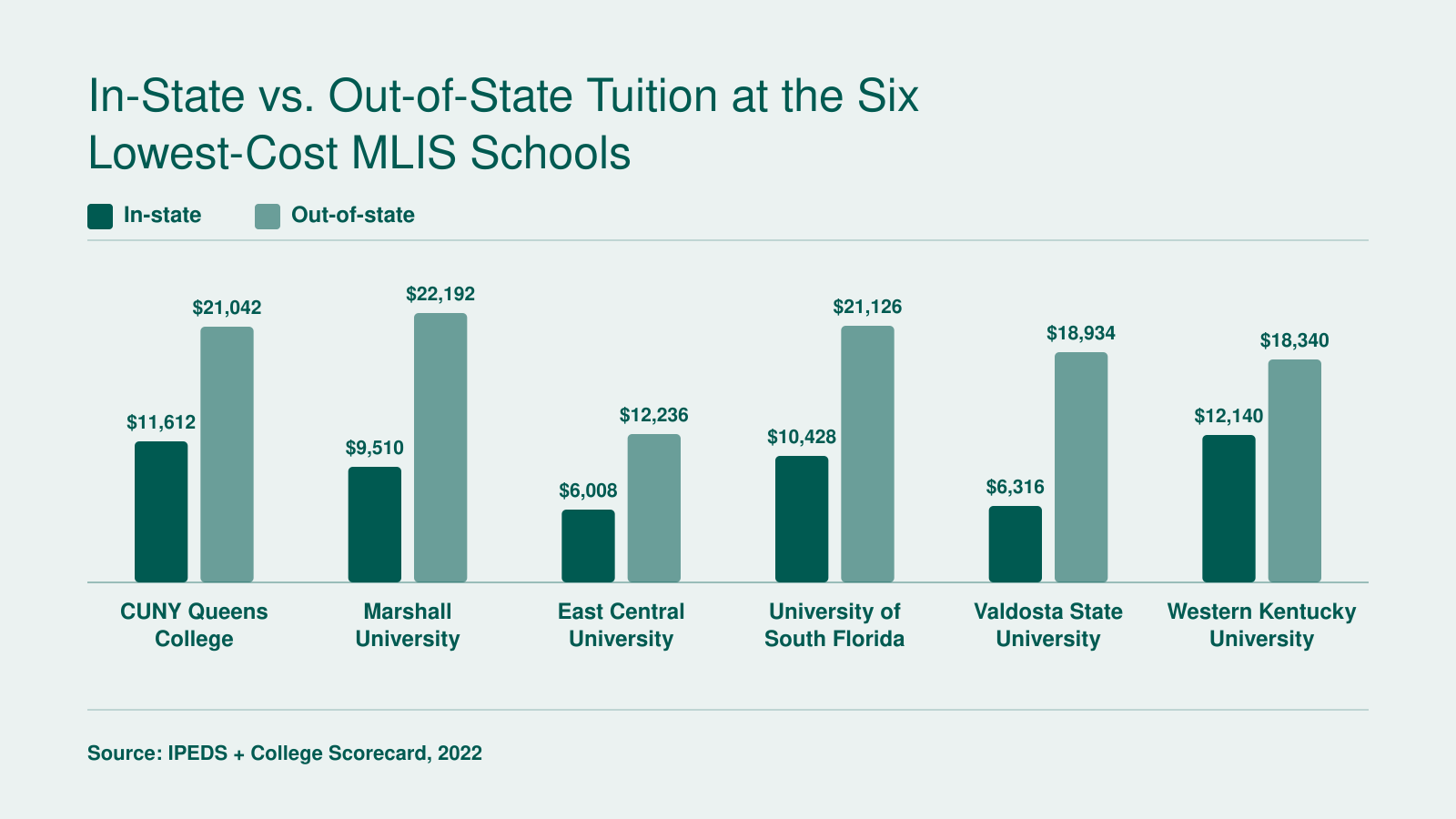
In-State vs. Out-of-State Tuition at the Six Lowest-Cost MLIS Schools
The chart below compares annual graduate tuition for in-state and out-of-state students at the most affordable MLIS programs in this ranking. Schools like East Central University and Valdosta State University keep the nonresident premium relatively modest, while Marshall University and CUNY Queens College roughly double tuition for out-of-state students. The online rate may differ from both published figures, so use this as a starting point and check the cost section for net price after aid.
Synchronous Sessions, Residencies, and Other Fine Print in Online MLIS Programs
Cheap tuition means little if the delivery format derails your work schedule or forces a costly trip to campus.
- Fully asynchronous: Valdosta State's ALA-accredited MLIS1 is among the ALA accredited MLIS programs delivered online and asynchronously, with no required live weekly sessions.2 Orientation is built into the first week of the first course.3 Campus visits are not required for 2026.4
- Mostly asynchronous with live sessions: Some programs add scheduled live classes or online lectures. If you work in a different time zone, ask what time those sessions run before enrolling.
- On-campus orientation or residency: A few online degrees still require an in-person component. Southern Miss does not require a campus visit for lectures, but other schools may, so confirm this line item in writing.
Practicum requirements vary. Valdosta State lets students arrange a field experience at an approved library, archive, or information center in their own community, and an existing workplace may be used with faculty approval.4 Finally, confirm the format per course, since some online MLIS programs still have campus-only electives.
Related Articles
What MLIS Graduates Earn in Public, Academic, School, Archives, and Corporate Roles
Salaries vary meaningfully by setting. The latest federal data show a median of $68,270 for librarians and library media specialists and $64,550 for archivists, while the Library Journal placements survey puts public library roles at $50,500, academic roles at $56,000, school roles at $55,500, and special/corporate roles at $60,000. Corporate and special library jobs tend to pay more, and public library roles tend to pay least, so borrowing less for an MLIS protects the return on a modest early-career salary.
| Career Track | Typical Employer | Median or Typical Salary | Source and Year |
|---|---|---|---|
| Librarians and Library Media Specialists | N/A | $68,270 | U.S. Bureau of Labor Statistics, May 2025 |
| Archivists | N/A | $64,550 | BLS Occupational Employment and Wage Statistics, May 2025 |
| Public library roles | Public Library | $50,500 | Library Journal Placements & Salaries Survey 2022, published 2023 |
| Academic library roles | College/University | $56,000 | Library Journal Placements & Salaries Survey 2022, published 2023 |
| School library roles | School Library | $55,500 | Library Journal Placements & Salaries Survey 2022, published 2023 |
| Special/corporate library roles | Special Library | $60,000 | Library Journal Placements & Salaries Survey 2022, published 2023 |
Top Graduate Earnings Among Affordable MLIS Schools
CUNY Queens College reports the strongest graduate earnings among the programs on this page.
Library Science programs by state
Questions Students Ask Before Choosing a Low-Cost MLIS
Cost questions drive most MLIS decisions. These answers focus on tuition, time, accreditation, and hiring realities so you can compare affordable programs without surprises.
What does an MLIS cost from start to finish once fees are included?
Do the lowest-cost MLIS programs require any trips to campus?
Which budget-friendly MLIS programs hold current ALA accreditation?
How long does it take to finish an MLIS while working full time?
What can MLIS graduates expect to earn in their first few years?
Will I pay out-of-state tuition for an online MLIS based in another state?
Can graduate assistantships or library employer tuition benefits cover MLIS costs?
Does choosing a cheaper MLIS limit my chances at academic librarian jobs?
Compare Library Science programs on the data that matters
Explore more Education & Teaching specializations or browse every graduate field.
All Education & Teaching programs