Best Master of Library and Information Science (MLIS) Programs in Tennessee
Compare 7 accredited Library Science programs in Tennessee at 4 schools, with graduate earnings, cost, debt, and completion data from IPEDS and the U.S. College Scorecard.

Only one Tennessee library science master's carries ALA accreditation, yet the state's other programs lead to real careers, including PreK-12 school librarian roles tied to endorsement 473. That distinction matters: accreditation shapes which academic and public library jobs you can hold, while an endorsement track assumes you already hold a teaching license.
Campus, hybrid, and fully online options sit side by side on this list, so you are comparing a flat-rate online degree against credit-billed public tuition. Median graduate earnings reach roughly $45,000 to $46,000 within a year at several of the schools ranked here, a figure worth weighing against what you borrow.
Key Points
- Only the University of Tennessee-Knoxville holds ALA accreditation, so check that credential before you enroll elsewhere.
- Trevecca Nazarene charges a flat $500 per credit hour, about $15,000 for 30 credits.
- Endorsement 473 requires an existing teaching license plus a qualifying Praxis School Librarian (5312) score.
Best MLIS Programs in Tennessee: Our 2027 Rankings
Tennessee's library science options look different once you follow graduates' paychecks and loan balances instead of reputation. Four schools made the list, and each card flags its concentration so you can match it to your goal, whether that is an information science career or a school library endorsement.
The University of Tennessee-Knoxville
#1Knoxville, TN · ~$16,000/yr (est.)
Best for: Aspiring academic and archival librarians
The University of Tennessee-Knoxville runs its programs through the School of Information Sciences, and the program has more than 50 years of history. Programs are offered in hybrid and campus formats, with a fully online option available. Graduate tuition is $13,720 for in-state students and $32,208 for out-of-state students, and the school's graduation rate is 73.9%. The concentration is broad information science and librarianship, with focus areas such as academic librarianship, archival studies and children's services.
- Hybrid format combining online and campus learning
- ALA accredited, next review in 2031
- Covers data analysis, UX design and digital archives
- Includes corporate taxonomy and web content analysis
- Median earnings $45,400 one year after finishing
- Median earnings $58,578 four years after finishing
- Campus-based format with a fully online option available
- Focus areas include academic librarianship, archival studies and children's services
- Prepares graduates for work in all types of libraries
- Median earnings $47,975 one year after finishing
- Median earnings $51,494 four years after finishing
University of Memphis
#2Memphis, TN · $10,000 – $15,000/yr (est.)
Best for: Licensed teachers moving into school libraries
The University of Memphis offers a campus-based School Library Information Specialist pathway for educators. Its concentration is Instruction and Curriculum Leadership, so it fits the school librarian endorsement route rather than a general information science degree. Graduate tuition is $9,954 for in-state students and $14,166 for out-of-state students, and the school's graduation rate is 50.9%. Students can start at the beginning of any semester.
- Campus-based format
- Instruction and Curriculum Leadership concentration
- Requires teaching certification
- Covers collection development and digital resources
- Builds information literacy and educational technology skills
- Up to 12 graduate credits allowed in non-degree status before admission
Middle Tennessee State University
#3Murfreesboro, TN · ~$12,000/yr (est.)
Best for: Working adults needing asynchronous classes
Middle Tennessee State University's Master of Library Science is a 36-credit program delivered 100% online and asynchronously. It covers public, academic, school and special libraries, so it suits students who want to keep career options open. Graduate tuition is $10,170 for in-state students and $28,152 for out-of-state students, and the school's graduation rate is 53.7%. No GRE or GMAT is required.
- Fully online, asynchronous format
- 36 credit hours across 12 courses
- Required field experience and ePortfolio capstone
- No entrance exam required
- Prepares librarians for PK-12 schools and other library types
- Median earnings $46,127 one year after finishing
- Median earnings $50,169 four years after finishing
Trevecca Nazarene University
#4Nashville, TN · ~$11,000/yr (est.)
Trevecca Nazarene University offers an online Master of Library and Information Science built for K-12 librarians who want to add an endorsement to a teaching license. The 30-credit cohort program takes 15 months and costs $500 per credit hour, or $15,000 total, with the same tuition for in-state and out-of-state students. The school's graduation rate is 53.2%. The concentration is school librarianship in a Christian learning environment.
- Online format with no residency requirement
- 30 credit hours completed in 15 months
- $500 per credit hour, $15,000 total tuition
- Cohort model, one class at a time
- 3.0 GPA minimum and teaching license if applicable
- 200 clinical hours and an e-portfolio required
- $250 student resource fee per course
Cost & outcomes by school
Federal data for the highest-earning Library Science programs, independent of the ranking above. Earnings are this field's master's graduates four years after completing, where the Scorecard reports them.
| School | Earnings | Tuition / yr | Debt | Grads/yr | Format |
|---|---|---|---|---|---|
| Trevecca Nazarene University TN | — | $10,537 | — | — | Online |
| University of Memphis TN | — | $11,628 | — | — | Campus |
| Middle Tennessee State University TN | — | $11,718 | — | — | Online |
| The University of Tennessee-Knoxville TN | — | $15,972 | — | — | Hybrid |
Sources: U.S. Department of Education. Tuition and graduates: IPEDS. Earnings and debt: College Scorecard, this field's master's graduates; a dash means no figure is reported.
ALA-Accredited Master's vs. School Librarian Endorsement Programs: Why the Difference Matters
When comparing Master's Programs in Tennessee, the word "library" in a degree title says less about your career options than the accreditation behind it. The University of Tennessee-Knoxville's Master of Science in Information Sciences is the only ALA-accredited library science program in the state. The American Library Association granted its current accreditation in 2024, found it meets all standards with no follow-up reporting required, and set the next review for 2031.
Most other in-state options are built for school librarianship. Middle Tennessee State University's Master of Library Science prepares students for Tennessee's Library Information Specialist endorsement, with routes that pair the degree with the endorsement, add initial teaching licensure, or offer the endorsement alone. Trevecca Nazarene University's program is likewise oriented toward the PreK-12 school librarian endorsement. The University of Memphis does not appear in the ALA directory as an accredited library science program.
That split shapes where you can work. Public, academic, and special libraries usually require an ALA-accredited degree, while endorsement programs mainly qualify you for PreK-12 school library roles.
Rule of thumb: choose the ALA-accredited route if you want options beyond K-12, and choose an endorsement track if you are a teacher moving into the school library.
Online and Hybrid Library Science Master's Options in Tennessee
Can you finish a Tennessee library science master's without setting foot on campus? For most of these programs, yes, with one consistent exception: field work.
MTSU's M.L.S. runs fully online and asynchronous across 36 credits, a format consistent with the Best Online Master of Library and Information Science Programs, so coursework fits around a working schedule, but the field experience component must be completed in person. Trevecca Nazarene delivers its K-12 focused degree online in about 15 months, one course at a time, with no residency requirement; expect a background check and field experience tied to school settings. UT Knoxville's information sciences master's mixes online and on-campus study with both synchronous and asynchronous sessions, no required campus visit, and no universal practicum, though students are encouraged to pursue one. The University of Memphis concentration is campus-based and accepts any undergraduate degree; the program can lead to K-12 school librarian certification.
If you live outside Tennessee, UT Knoxville's online enrollment is open to out-of-state and international students, so confirm your state's authorization rules before applying. Distance students arranging a local practicum site should start early, ideally a semester ahead, since placements need faculty approval and a written learning agreement.
Related Articles
Which Tennessee Library Science Master's Programs Waive or Make the GRE Optional
Endorsement tracks for school librarians often require an existing teaching license, and that is a bigger hurdle than any entrance exam. Where a school's admissions page states a testing policy, the table reports it as published. Where we found none, it says so rather than guessing, so confirm details with each program before you apply.
| Program | GRE Policy | Application Deadline | Key Prerequisites |
|---|---|---|---|
| The University of Tennessee-Knoxville (MSIS) | Not required | Fall: April 15. Spring: October 15. Summer: June 8. Apply by February 15 for fullest consideration for assistantships and scholarships. | Minimum 3.25 undergraduate GPA. All undergraduate majors welcome. |
| University of Memphis (School Library Information Specialist) | Not required | Fall: March 1. Spring: November 1. | Minimum 3.0 GPA (admitted M.S. students typically 3.30 or higher). Any undergraduate degree accepted. |
| Middle Tennessee State University | No published policy | Not confirmed | Not confirmed. Check the graduate admissions page, especially for teaching license requirements on endorsement tracks. |
| Trevecca Nazarene University | No published policy | Not confirmed | Not confirmed. Check the graduate admissions page, especially for teaching license requirements on endorsement tracks. |
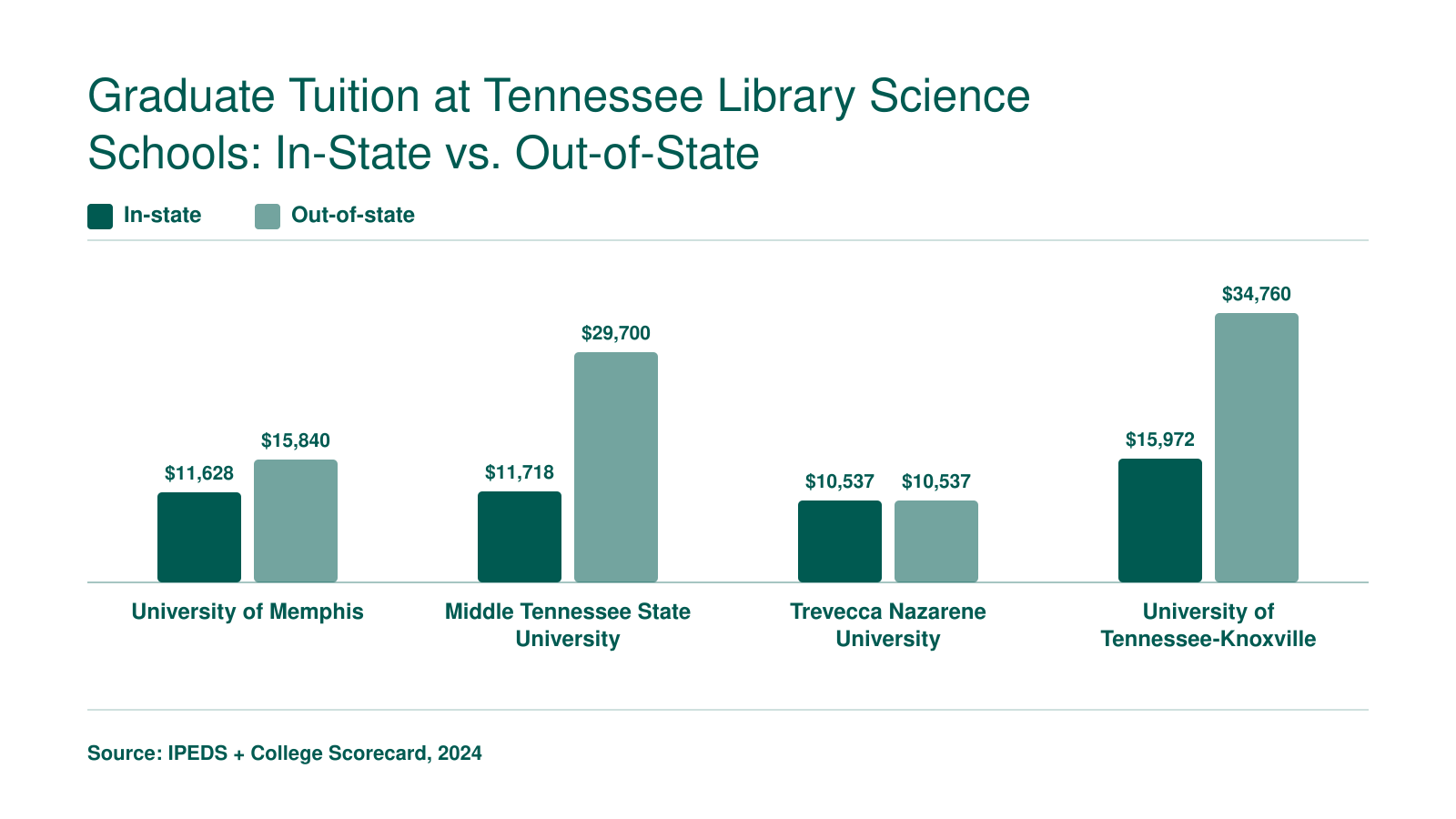
Graduate Tuition at Tennessee Library Science Schools: In-State vs. Out-of-State
The out-of-state gap is widest at The University of Tennessee-Knoxville, where nonresidents pay about $18,788 more than residents, and Middle Tennessee State University is close behind at roughly $17,982. Trevecca Nazarene University charges the same rate to everyone, and University of Memphis sits in between with a gap near $4,212. For online students outside Tennessee, that makes Trevecca the clearest case of parity, while MTSU's fully online option still carries a nonresident price.
Cost and Tennessee Licensure: What You'll Pay and How to Earn Endorsement 473
Trevecca charges a flat amount; the public universities bill by the credit, so the total depends on how many credits you take. Trevecca's 30-credit online program lists $500 per credit hour, about $15,000 in tuition, with additional fees on top. Middle Tennessee State University's M.L.S. requires 36 credit hours, so expect a larger bill if you start at a comparable rate. University of Memphis and The University of Tennessee-Knoxville are best priced from their current graduate rate sheets, which differ for in-state and out-of-state students.
The net price is a college-wide average across all students, not a quote for this program; compare these figures with the Most Affordable Master of Library and Information Science Programs list. Current averages run roughly $12,400 at Memphis, $13,400 at MTSU, $16,800 at Trevecca, and $19,000 at UT Knoxville.
Earning Endorsement 473
Endorsement 473 is the Library Information Specialist PreK-12 credential. You need a master's degree from an approved program, and the Tennessee Department of Education adds the endorsement to your license once you apply. Tennessee documents point to Praxis 5312, Library Media Specialist, with a passing score of 154. Some guides cite other scores, so confirm with ETS before you test; for programs that waive the GRE entirely, check Master of Library and Information Science Programs With No GRE Required. Memphis requires teaching certification, and Trevecca asks for a teaching license where applicable.
Moving In From Another State
A full, valid, renewable out-of-state license holder can apply for the Tennessee equivalent. Expect official transcripts, a license copy, program verification, a background check, and a nonrefundable fee. Assessment waivers are decided case by case, and you may still owe a Principles of Learning and Teaching exam. Reciprocity is not automatic, so check the destination state before assuming Tennessee's endorsement travels.
Tennessee Library Information Specialist Prek-12 Endorsement at a Glance
How We Rank: Earnings, Debt, and Completion Data
Reputation is easy to feel and hard to verify, so our ordering leans on what federal data actually reports rather than on name recognition or opinion surveys. For each library science master's, including accelerated master of library and information science programs, we look at College Scorecard program-level figures: median earnings in the years after completion, median debt carried at graduation, and how many students finish the degree each year.
Two numbers you will see on these pages describe the university, not the degree: the graduation rate and the long-horizon earnings figure for alumni a decade out. We never present either as the outcome of a specific library science program, because they pool every major on campus.
Small cohorts complicate this. When a program graduates only a handful of students a year, federal reporting suppresses earnings and debt figures, so those cards simply show fewer statistics.
One practical tip: confirm whether a program is ALA-accredited or endorsement-focused before anything else, then compare cost and outcomes among the programs that match your goal.
Quick Answers on Tennessee Library Science Master's Degrees
Do I need a teaching license to become a school librarian in Tennessee?
Will a Tennessee school-library master's qualify me for public or academic library jobs in other states?
What is the difference between an MLIS and a school library endorsement in Tennessee?
Compare Library Science programs on the data that matters
Explore more Education & Teaching specializations or browse every graduate field.
All Education & Teaching programs