Accelerated Master of Library and Information Science (MLIS) Programs
Compare 220+ accredited fastest Library Science programs at 90+ schools, with graduate earnings, cost, debt, and completion data from IPEDS and the U.S. College Scorecard.

A two-year MLIS can be compressed to roughly 12 to 16 months, but the weekly workload climbs to match: the same 36 or so credits, packed into fewer terms.
Speed is also not the credential that counts. Most librarian postings require an ALA-accredited degree, so accreditation matters more than the calendar, and every program here has been checked for it.
School library roles add a separate state certification step, which can lengthen a fast timeline even when the coursework finishes on schedule.
Key Points
- San José State and Valdosta State accept fall and spring 2027 starts.
- Valdosta State and LSU run fully asynchronous online MLIS coursework.
- Flat online rates remove out-of-state surcharges at several MLIS programs.
Best Accelerated MLIS Schools for 2027
Speed was our first filter, but value decided the order. We looked for programs that genuinely shorten the path to an MLIS or school library credential, then checked federal outcome data on graduate earnings and net price. The result is a list that favors time-saving structures with transparent costs, not brand name alone.
Syracuse University
#1Syracuse, NY · $45,000 – $50,000/yr (est.)
Best for: Career changers wanting an 18-month online MLIS
Syracuse offers an online, ALA-accredited Master of Science in Library and Information Science with a stated 18-month accelerated track and 36 total credits. The program has been continuously accredited by the American Library Association since 1928. Institution-wide, graduation rates and early-career earnings for library science graduates are strong relative to the field.
- 36 credit hours
- Fully online option available
- Complete in as little as 18 months on accelerated track
- ALA-accredited, reviewed next in 2030
- Focus areas include school librarianship
- Cost per credit $2,015
- Scholarships available, including 30% Upstate Scholarship
University of Oklahoma – Hudson College of Public Health
#2Norman, OK · ~$9,000/yr (est.)
Best for: Oklahoma residents needing in-state ALA program
Oklahoma offers a 36-credit Master of Library and Information Studies that is ALA-accredited with continued accreditation and next review in 2029. The program includes an accelerated BA/MLIS pathway for undergraduates and a fully online option. It is the only ALA-accredited library program in Oklahoma.
- 36 credit hours required
- Fully online completion option
- Accelerated BAIS/MLIS pathway available
- 8 concentration options
- No GRE required
- Part-time or full-time schedules
- Accreditation reviewed next in 2029
St. John Fisher University
#3Rochester, NY · ~$21,000/yr (est.)
Best for: Teachers needing a one-year school library credential
St. John Fisher's fully online Master of Science in Library Media is a 30-credit program that can be finished in one calendar year, with coursework and a practicum designed for New York school library certification. The program emphasizes children's and adolescent literature, information literacy, and library management.
- Complete in one calendar year
- 30 total credit hours
- Fully online option available
- 100 clinical hours required
- New York State Teacher Certification Examination in Library Media Specialist
- Portfolio required for graduation
- 3.0 GPA minimum
University of Arizona
#4Tucson, AZ · ~$15,000/yr (est.)
Arizona's accelerated MLIS program lets undergraduates in Information Science and eSociety start graduate coursework early, paying undergraduate tuition for up to 12 units. The ALA-accredited Master of Arts in Library and Information Science is available online or on campus, with accreditation next reviewed in 2027.
- Accelerated BA to MLIS pathway
- ALA-accredited program
- Online or campus options
- 12 graduate units at undergraduate tuition rate
- Admission in junior year with 3.3 GPA
- Focus areas include archival studies and public librarianship
- Eligible for undergraduate scholarships
University of Southern Mississippi
#5Hattiesburg, MS · ~$10,000/yr (est.)
Southern Miss offers a fully online, ALA-accredited Master of Library and Information Science that can be completed in 1 to 3 years, with an accelerated master's option available. The 40-credit program includes synchronous classes and meets Mississippi K-12 licensure requirements. Institution-wide, the graduation rate is 49%.
- 40 credit hours total
- Completion time 1-3 years
- Fully online program
- Synchronous online classes
- No GRE required
- Meets Mississippi K-12 licensure
- ALA-accredited, reviewed next in 2027
- Accelerated master's option available
Eastern Kentucky University
#6Richmond, KY · ~$11,000/yr (est.)
Eastern Kentucky's school librarian master's is a 33-36 credit program for certified teachers, offered online with accelerated 7-week terms and six start dates per year. Kentucky teachers pay a reduced per-credit rate, and the curriculum is EPSB-approved.
- 33-36 credit hours
- Accelerated 7-week terms
- Six start dates per year
- No campus visits required
- Three concentration options
- Kentucky teachers pay $437 per credit
- EPSB-approved curriculum
- Transfer up to 9 credit hours
University of Wisconsin-Milwaukee
#7Milwaukee, WI · $13,000 – $26,000/yr (est.)
UWM offers an ALA-accredited Master of Library and Information Science with an accelerated BSIST/MLIS pathway that lets undergraduates take six graduate credits during senior year. The MLIS is 36 credits, fully online, and accredited through 2032. Institution-wide, the graduation rate is 49%.
- 36 total credit hours
- Fully online option available
- Accelerated BSIST/MLIS pathway
- Six graduate credits during senior year
- 5 concentration options
- Wisconsin DPI school library certification
- Dual degrees save 12 credits
- Accreditation reviewed next in 2032
East Texas A&M University
#8Commerce, TX · ~$7,000/yr (est.)
East Texas A&M offers a fully online Master of Science or Master of Education in Educational Technology Library Science, a 36-credit program that can be completed in 1.5 to 2 years with 8-week terms. The asynchronous curriculum prepares students for Texas school librarian certification. Institution-wide, the graduation rate is 43%.
- 36 total credit hours
- Complete in 1.5-2 years
- Fully online, asynchronous
- 8-week course terms
- Earn Texas school librarian certification
- Practicum required
- EPortfolio to market skills
- Not open to international students
University at Albany
#9Albany, NY · ~$14,000/yr (est.)
Albany's ALA-accredited MS in Information Science offers concentrations in archives, library and information services, information management, and AI/data analytics. The program includes a 150-hour internship and a 4+1 accelerated option for undergraduates. A separate online school library track leads to initial library media specialist certification.
- 4 concentration options
- ALA-accredited, reviewed next in 2027
- STEM-designated program
- 150-hour supervised internship
- Accelerated 4+1 in five years
- Fully online option available
- Up to 36 months OPT for F-1 students
- 36 total credit hours
- Fully online option available
- School library media specialist certification
- 100 clinical hours
- 3 letters of recommendation
- Accelerated bachelor's to master's option
- Average time to degree 2.79 years
University of Maine at Augusta
#10Augusta, ME · $5,000 – $10,000/yr (est.)
UMA's fully online Information & Library Science program offers undergraduate certificates, associate, and bachelor's degrees with an accelerated pathway to Simmons University's ALA-accredited MLIS at a tuition discount. The program is designed for flexible, no-campus learning and prepares students for library support staff certification.
- Fully online program
- Offers certificate, associate, and bachelor's degrees
- Accelerated master's pathway via articulation with Simmons University
- Approximately 50% tuition discount on Simmons MLIS
- 120 credit hours for bachelor's
- Prepares for library support staff certification
- No campus visits required
None of the ranked Library Science programs match the fastest lens yet. The full ranking is at the link above.
How Long Does an Accelerated MLIS Take?
Most ALA-accredited library science programs run 36 to 42 credits, and a genuinely compressed online MLIS program finishes in roughly 12 to 18 months instead of the two years a standard full-time pace takes. Be skeptical of marketing language: a program built on 7-week terms may still require the same number of semesters, and short terms alone do not shorten the degree.
San José State publishes one of the clearest fast sequences: 43 units across four semesters, with loads of 10, 12, 9, and 12 units and a required summer term. Courses run fall, spring, and summer, and the sequence exists in both fall-start and spring-start versions.
At Valdosta State, full-time means 9 credits1, and the 36-hour degree is planned as a two-year commitment with admission only in fall and spring2. Southern Mississippi admits in fall, spring, and summer3, and seniors with a 3.5 GPA can apply up to 9 graduate credits toward both degrees4.
The practicum or capstone usually decides the finish date. Confirm when it is offered before you commit to a timeline.
Accelerated MLIS Tuition Cost: Sticker Price vs. What Students Pay
Net price is a college-wide average after grant or scholarship aid and may include living costs, so it is a comparison point rather than a personal quote. Several programs advertise a flat online rate that removes the out-of-state surcharge for distance learners. Where a program lists a per-credit rate and required credits, we show the estimated tuition total; fees and course materials are often extra and vary.
| School | Graduate Tuition In-State | Graduate Tuition Out-of-State | Net Price After Aid (Institution Average) | Per-Credit Rate | Estimated Total Program Cost | Flat Online Rate for Out-of-State? |
|---|---|---|---|---|---|---|
| University of Maine at Augusta | 8892 | 11538 | 10924 | N/A | N/A | Not stated |
| Eastern Kentucky University | 10794 | 14628 | 11040 | 437 | N/A | Not stated |
| East Texas A&M University | 7338 | 14718 | 11841 | N/A | N/A | Not stated |
| University of Wisconsin-Milwaukee | 12728 | 26159 | 15014 | 800 | N/A | Yes |
| University of Oklahoma | 9353 | 26142 | 15300 | N/A | N/A | Not stated |
| University of Arizona | 14856 | 34110 | 16674 | N/A | N/A | Not stated |
| University at Albany | 13808 | 27468 | 17167 | N/A | N/A | Not stated |
| University of Southern Mississippi | 9998 | 11998 | 21708 | 578.12 | 23124.8 | Yes |
| St. John Fisher University | 20706 | 20706 | 28945 | N/A | N/A | Not stated |
| Syracuse University | 48132 | 48132 | 38793 | 2015 | 72540 | Not stated |
Related Articles
The real speed limit is not the credit hours or the catalog promise; it's how many hours you can honestly give while working and living.
Online vs. Campus Accelerated MLIS: Live Sessions, Flexibility, and Workload
"Online" can mean very different schedules. Valdosta State and LSU run fully asynchronous MLIS programs, and LSU has no on-campus requirement. Others build in live time. Missouri's online MLIS program has no campus visits, but some courses include synchronous Zoom meetings listed at registration. UNCG's online courses require synchronous sessions. Denver mixes recorded and live material, including three live meetings in its culminating internship, per its MLIS student handbook. UW's mostly asynchronous Online MLIS requires a late-September orientation, held online or in person.
Workload is the real limit. Valdosta State estimates at least 12 to 21 hours a week per course, plus 10 to 20 hours for each major assignment.1 An accelerated load of 9 to 12 credits per term usually means 25 to 35 or more study hours a week, so many accelerated students cut back to part-time work. UNCG calls its online format suitable for full-time employment, but none of these schools publishes recommended work hours for an accelerated load.2
Before applying, confirm when live sessions meet and in which time zone. A 6 p.m. Central class starts at 4 p.m. for a West Coast worker.
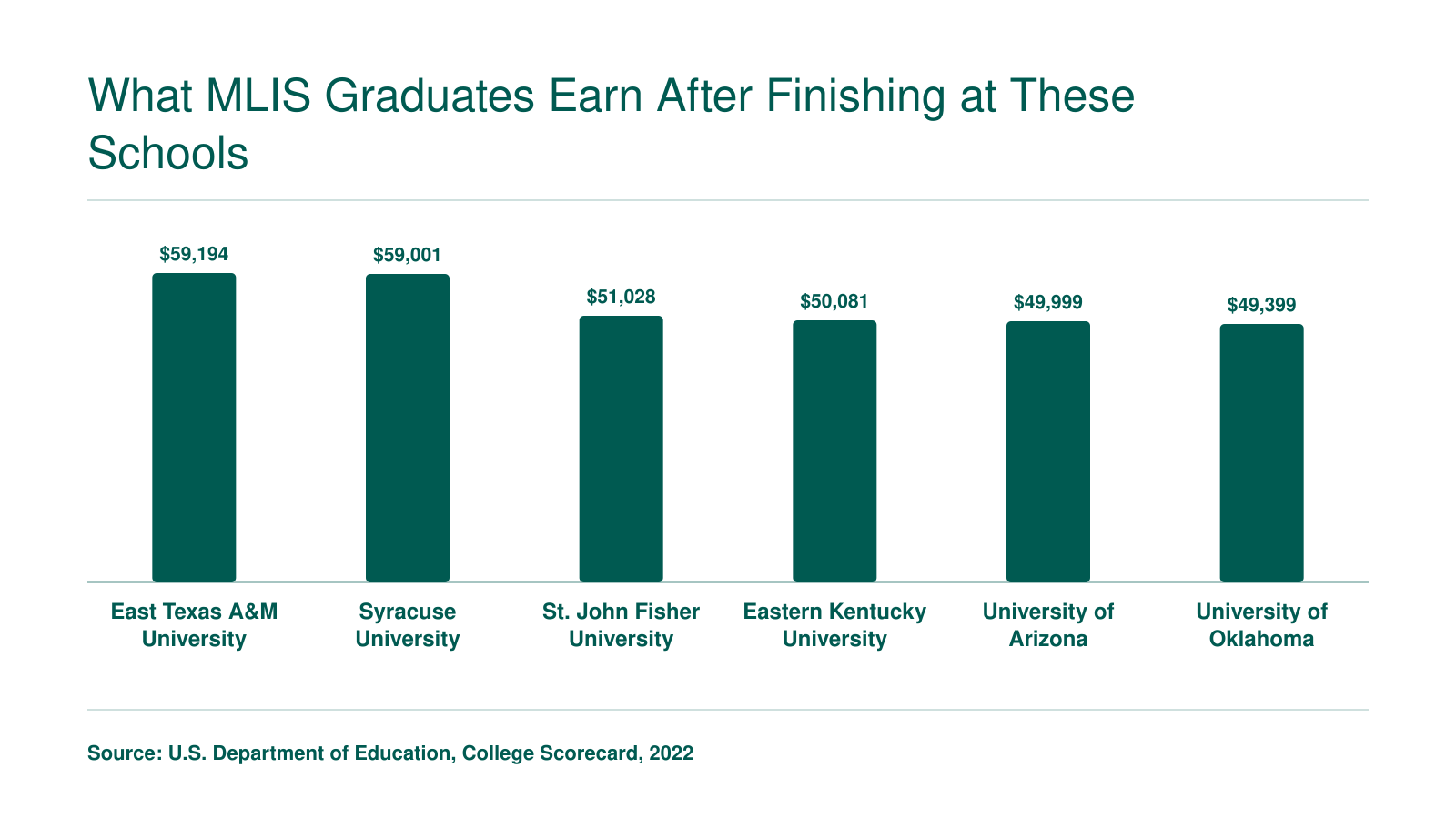
What MLIS Graduates Earn After Finishing at These Schools
Median earnings five years after finishing at the programs below are compared in College Scorecard data. Earnings can differ with concentration choices such as school librarianship or archives.
Library Science programs by state
Accelerated MLIS Questions, Answered
Accelerated MLIS paths raise practical questions about speed, cost, accreditation, and workload. The answers below reflect current deadlines and transfer policies at San José State and Valdosta State, which offer fall and spring starts.
What is the fastest accelerated MLIS program you can enroll in?
Can an accelerated MLIS be completed fully online?
What does an accelerated MLIS cost in total?
Do accelerated MLIS programs carry ALA accreditation?
Is a full-time job realistic during an accelerated MLIS?
How is an accelerated MLIS different from a standard MLIS?
When are application deadlines and start terms for accelerated MLIS programs?
Does finishing faster affect how library employers view your degree?
Compare Library Science programs on the data that matters
Explore more Education & Teaching specializations or browse every graduate field.
All Education & Teaching programs