Best Master of Library and Information Science (MLIS) Programs in Texas
Compare 12 accredited Library Science programs in Texas at 5 schools, with graduate earnings, cost, debt, and completion data from IPEDS and the U.S. College Scorecard.

School librarian certification in Texas requires a master's degree and two years of classroom teaching, while many public and academic librarian openings ask for an ALA-accredited credential. That split shapes the choice: which Texas MLIS gets you hired without overpaying.
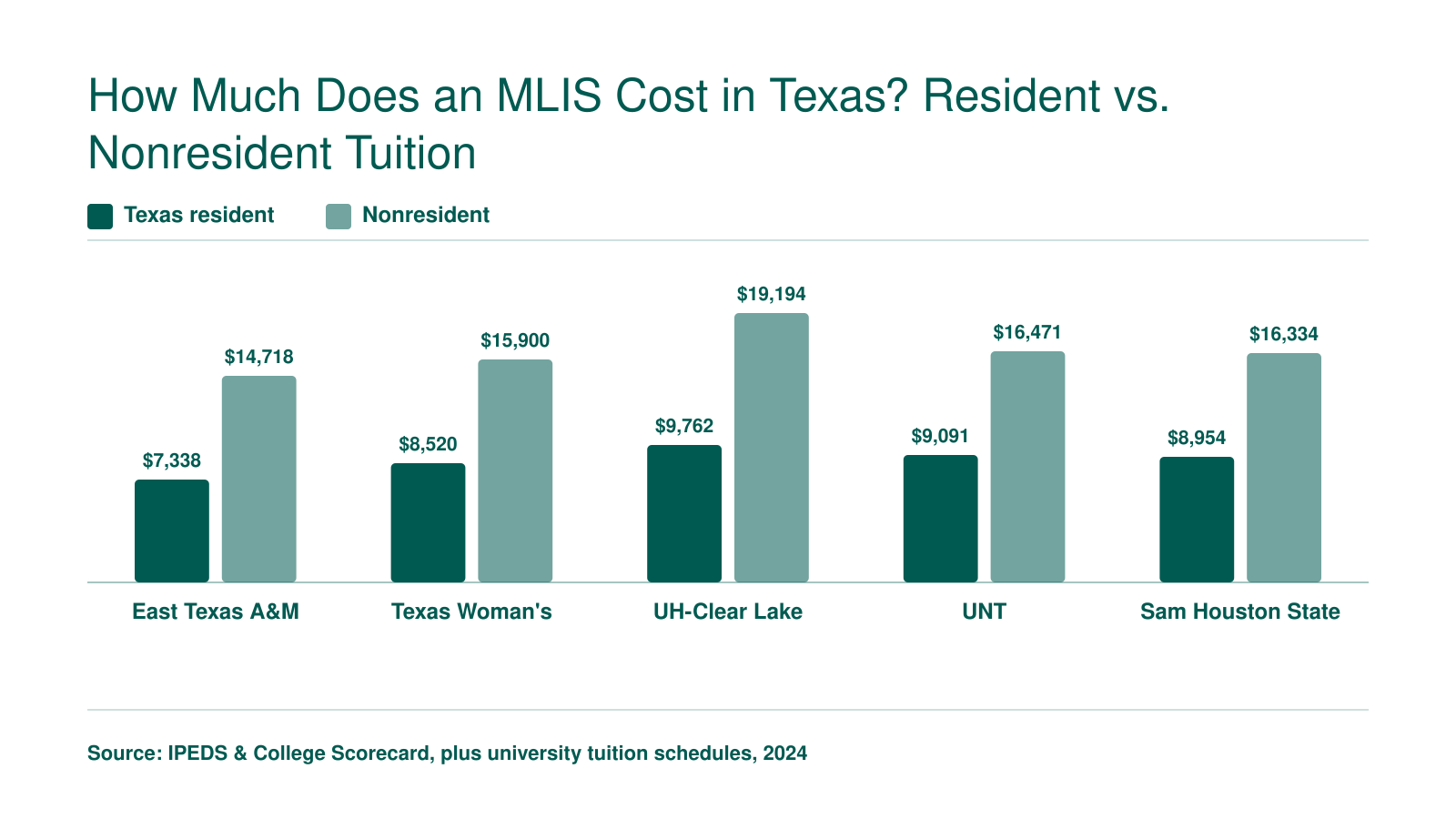
Tuition among ranked schools runs about $7,300 to $9,800 per year for residents and $14,700 to $19,200 for nonresidents. Programs here mix online, hybrid, and campus formats. They differ on GRE policy, total cost, and school librarian certification. The cheapest tuition is not always the fastest route to certification.
Key Points
- ALA accreditation in Texas covers Texas Woman's, UNT, and UT Austin.
- UNT's 36-credit degree runs about $16,500 for residents, $20,520 for nonresidents.
- Program-level earnings and debt are not yet published for Texas MLIS schools.
Best MLIS Programs in Texas: Ranked for 2027
Texas has a small set of library science master's programs, and they differ in an important way. Some hold ALA accreditation, the standard credential for most professional librarian jobs, while others are built around Texas school librarian certification. Each card below states plainly which kind of program you are looking at.
Texas Woman's University
#1Denton, TX · ~$9,000/yr (est.)
Best for: Working professionals studying fully online
Texas Woman's University in Denton offers an online Master of Library Science with a practicum and individualized study plans. The ALA directory lists continued accreditation, with the next review in 2032. Focus areas include academic librarianship, children's services and health sciences librarianship, and certificates in school librarianship and community information are available. It suits working professionals and career changers, though online students should know the published tuition still differs for residents and nonresidents.
- ALA accreditation confirmed: continued status, next review 2032
- 36 credit hours; fully online with no campus visits
- Practicum experience included
- Admission requires a bachelor's degree and a 3.0 GPA
- Individualized study plans and several subject-area tracks
- Dual degree and post-master's certificate options
- ALA accreditation confirmed: continued status, next review 2032
- Community Information concentration, online
- Coursework in information organization and digital resource management
- Training for serving diverse populations
- ALA accreditation confirmed: continued status, next review 2032
- School Librarianship concentration, online
- Designed to support Texas school librarian certification
- Bachelor's degree and transcripts required
University of North Texas
#2Denton, TX · $9,000 – $16,000/yr (est.)
Best for: Students seeking a specialized concentration
The University of North Texas in Denton offers the MS in Library Science, with five concentrations or a general program of study. Courses run on site in Denton and Houston, online, and in blended formats, and students can start in fall, spring or summer. The ALA directory lists continued accreditation, with the next review in 2028. It suits students who want a specialization such as archival studies, law librarianship or knowledge management, or who plan to continue to doctoral study.
- ALA accreditation confirmed: continued status, next review 2028
- Concentrations: Archival Studies, Children's and Young Adult Librarianship, Information Organization, Knowledge Management, Law Librarianship and Legal Informatics
- General program of study also available
- On-site courses in Denton and Houston, plus online and blended options
- Capstone required; practicum or internship for those without experience
- 3.0 GPA, two recommendations and a personal statement required
- Three start terms per year
University of Houston-Clear Lake
#3Houston, TX · $5,000 – $10,000/yr (est.)
Best for: Certified teachers becoming school librarians
The University of Houston-Clear Lake in Houston offers an online Master of Science in School Library and Information Science. It focuses entirely on school librarianship, with faculty who are former district library supervisors. This listing is not shown as ALA-accredited; it is approved through the Texas State Board for Educator Certification. It suits practicing Texas teachers who want to move into the school library and already hold a Texas teaching certificate.
- Not listed as ALA-accredited; accredited through Texas SBEC
- Fully online, study from home or office
- Requires a valid Texas teaching certificate
- 3.0 GPA minimum and a 1 to 2 page admissions essay
- Teacher service record required
- Focus on literacy, technology integration and information resources
Sam Houston State University
#4Huntsville, TX · ~$9,000/yr (est.)
Sam Houston State University in Huntsville offers a 36-credit Master of Library Science with a school librarianship focus, in both online and on-campus versions. Coursework covers literacy, technology integration, research methods and K-12 leadership. No ALA accreditation is shown for either listing, so confirm with the university that the degree fits your career path. It suits Texas educators who want a school library credential, with a choice of online or on-campus study.
- No ALA accreditation shown for this listing
- 36 credit hours, delivered online
- School librarianship focus with K-12 leadership emphasis
- Covers technology integration and research methods
- No ALA accreditation shown for this listing
- On-campus program in Huntsville
- Library science focus at the graduate level
East Texas A&M University
#5Commerce, TX · ~$7,000/yr (est.)
East Texas A&M University in Commerce offers a fully online, asynchronous Educational Technology Library Science degree, available as an MS or an MEd. Students finish 36 credit hours in 8-week terms, typically in 1.5 to 2 years, and complete a practicum as a school librarian. This listing is not shown as ALA-accredited. It suits working Texas teachers or principals who want a fast route to school librarian certification, though the program is not open to international students.
- Not listed as ALA-accredited; built for Texas school librarian certification
- 36 credit hours in 8-week terms; 1.5 to 2 years
- Fully online and asynchronous
- Practicum as a school librarian and an EPortfolio
- Requires a valid Texas Teacher or Principal Certificate
- $50 application fee; not open to international students
- Quick Start Grants of $250 or $500 offered
Cost & outcomes by school
Federal data for the highest-earning Library Science programs, independent of the ranking above. Earnings are this field's master's graduates four years after completing, where the Scorecard reports them.
| School | Earnings | Tuition / yr | Debt | Grads/yr | Format |
|---|---|---|---|---|---|
| East Texas A&M University TX | — | $7,338 | — | — | Online |
| Texas Woman's University TX | — | $8,520 | — | — | Online |
| Sam Houston State University TX | — | $8,954 | — | — | Online |
| University of North Texas TX | — | $9,091 | — | — | Hybrid |
| University of Houston-Clear Lake TX | — | $9,762 | — | — | Online |
Sources: U.S. Department of Education. Tuition and graduates: IPEDS. Earnings and debt: College Scorecard, this field's master's graduates; a dash means no figure is reported.
How This Texas MLIS Ranking Was Built
Prestige doesn't pay off a student loan, so this list weighs what a degree costs against what graduates earn. For each program, the inputs are degree-aware graduate tuition, the average net price students pay after aid, and, where College Scorecard publishes them, program-level graduate earnings and median debt. Programs missing those reported figures are simply listed without them.
Two limits are worth knowing. Graduation rates are institution-wide, not specific to the MLIS, so they describe the university as a whole. Net price is an average estimate across students, not a quote, and your own bill will depend on residency, credit load, and aid.
Campus, hybrid, and online best MLIS programs share one ranking. A school can appear more than once if it offers multiple formats or concentrations.
Online and Hybrid Master's in Library Science Options in Texas
The tradeoff in online library science study is flexibility versus live structure, and the programs here land in different places on that spectrum.
- Texas Woman's University: Primarily asynchronous on Blackboard, with some possible live sessions. No campus residency is required, and the practicum can be completed locally. Full-time students take three courses a semester and finish in about two years. Part-time students take one or two per term and should expect three or more years.
- University of North Texas: Offered fully online, as a Denton hybrid, and off-campus in Houston. The 36 credits run about 24 months, and the format suits working students. How often the hybrid meets, and whether online courses have live meetings, is not published.
- East Texas A&M University: Asynchronous online classes in 8-week terms, finishing in roughly 1.5 to 2 years, with a school librarian practicum.
- University of Houston-Clear Lake and Sam Houston State University: Both are online, and neither lists its live-meeting policy.
- UT Austin: Online and on-campus options exist, but residency and part-time details need confirming directly.
Full-time paraprofessionals and teachers will likely do best with the asynchronous, term-based formats, TWU or East Texas A&M, since those keep work hours free.
Related Articles
Texas MLIS Programs With No GRE Requirement or a GRE-Optional Policy
A GRE policy is simply whether a program wants a standardized test score alongside your transcript; schools on this page range from GRE-optional to master's programs with no GRE required. Here is where each school stands, based on its admissions pages.
- University of Texas at Austin: GRE optional. The minimum is a 3.0 on upper-division and graduate coursework, and applicants below it can apply with an explanatory letter.
- University of North Texas: GRE not required. Meet one of three GPA tests: 3.0 on the last 60 hours, 3.0 cumulative, or 3.5 on a completed master's. Scores of 2.90 to 2.99 may be admitted conditionally.
- University of Houston-Clear Lake: GRE waived at a 3.000 GPA on the last 60 hours. Between 2.750 and 3.000, you need 294 combined Quantitative and Verbal and a 3.5 in writing. One page also says no GRE, so confirm. School library applicants need a valid Texas Teaching Certificate.1
- Sam Houston State University: The only policy found is in a 1999-2001 catalog (GRE required, 800 combined; 3.0 GPA).2 It does not confirm current rules, so ask the program.
- UT Arlington: UT Arlington's admissions pages do not list a GRE policy for this degree.
- Texas Woman's University and East Texas A&M University: No GRE policy found. Texas Woman's University lists a 3.0 minimum GPA.
We rank and compare master's programs on verifiable outcomes, real graduate earnings, net price, and debt, not prestige or advertising.
How Much Does an MLIS Cost in Texas? Resident vs. Nonresident Tuition
The chart compares federally reported graduate tuition for residents and nonresidents, so use it for relative cost, not as a bill. Estimates for a 36-credit program: UNT runs about $16,500 for residents and $20,520 for nonresidents. East Texas A&M comes to roughly $15,400 resident and $30,800 nonresident from its Fall 2026 nine-credit totals, plus a $50 per credit online fee (about $1,800). TWU charges $333 resident and $761 nonresident per credit including its program fee, but its credit total is not established here. Fees vary, and no flat online rate is confirmed, so ask each bursar whether online nonresidents pay in-state or e-tuition rates. Net price is an institution-wide average, not MLIS-specific.
Texas School Librarian Certification: Where Your MLIS Fits
Graduate Earnings and Debt at Ranked Texas MLIS Schools
The U.S. Department of Education's IPEDS and College Scorecard data (2024) does not currently publish program-level median earnings or median debt for these library science programs, so those cells are left blank rather than filled with institution-wide figures. Any earnings figure added later would be stated with its time window, such as one or four years after completion. Because no program-level debt is reported, we cannot yet pair a lowest-debt program with its earnings, so compare net price and tuition before drawing a payoff conclusion.
| School | Program | Median Earnings After Completion | Median Debt at Graduation |
|---|---|---|---|
| University of Houston-Clear Lake | School Library and Information Science M.S. | Not reported | Not reported |
| University of North Texas | Library Science, MS | Not reported | Not reported |
| Texas Woman's University | Master of Library Science Degree (MLS) | Not reported | Not reported |
| Sam Houston State University | Master of Library Science | Not reported | Not reported |
| East Texas A&M University | Educational Technology Library Science (MS/MED) | Not reported | Not reported |
Quick Answers on Texas Library Science Master's Programs
These short answers cover the questions readers ask most. Confirm every date and policy on the school's own admissions page before you apply.
Which Texas MLIS program ranks first, and why?
Is every ranked Texas MLIS program ALA-accredited?
When do Texas library science master's programs accept applications?
Compare Library Science programs on the data that matters
Explore more Education & Teaching specializations or browse every graduate field.
All Education & Teaching programs