Master's in Accounting Programs With No GMAT or GRE Required
Compare 710+ accredited no-gre Accounting programs at 520+ schools, with graduate earnings, cost, debt, and completion data from IPEDS and the U.S. College Scorecard.

Most state boards require 150 semester hours for CPA licensure, and a master's in accounting is a common way to close the 30-hour gap after a bachelor's degree. Months of GMAT or GRE prep only push that timeline back.
Test policies are not uniform, though. Some programs never request a score; others waive it only for applicants above a GPA cutoff or with documented work experience.
A conditional waiver you narrowly miss still means sitting the exam.
Key Points
- For 2027, Purdue and Iowa waive the GMAT and GRE.
- UMass-Lowell accounting master's graduates earned median $78,034 after one year.
- Most state boards require 150 semester hours total for CPA licensure.
Top 10 Master's in Accounting Programs With No GMAT or GRE Required
These ten accounting master's programs make the GMAT or GRE optional, waived, or not required, spanning on-campus, online, and accelerated options. Each profile below highlights the verified test policy, delivery format, tuition, and institutional graduation rate so you can compare practical costs and CPA pathways at a glance.
University of Wisconsin-Madison
#1Madison, WI · ~$12,000/yr (est.)
Best for: Campus-based future CPAs
The University of Wisconsin-Madison offers an intensive one-year, campus-based MS in Accounting and Business Analysis with tracks in assurance, advisory, and tax. The test-optional program aligns with CPA exam content and reports a 99% job-offer rate within six months. All admitted students receive financial support covering at least one semester.
- No GMAT or GRE required; test optional
- $27,000 total program tuition
- Two-semester, campus-based format
- Tracks in assurance, advisory, or tax
- 99% job placement rate within six months
- Prepares for all CPA exam sections
- All admitted students receive at least one tuition-free semester
Ohio State University
#2Columbus, OH · ~$14,000/yr (est.)
Best for: STEM-interested career changers
Ohio State's Fisher College of Business delivers a STEM-designated Master of Accounting that is test-optional and open to students without accounting majors. The curriculum combines accounting fundamentals with analytics programming and advanced business electives, and students can pursue an accelerated MAcc option.
- No GMAT or GRE required; test optional
- STEM-designated program
- No accounting major required for admission
- Advanced business electives and analytics programming
- Accelerated MAcc option available
- Network of 580,000+ alumni
Florida State University
#3Tallahassee, FL · ~$11,000/yr (est.)
Best for: Cost-conscious Florida CPA candidates
Florida State's Wertheim College of Business runs a 30-credit Master of Accounting with concentrations in assurance and advisory services, generalist, and taxation. The program is test-optional, STEM-designated, and structured to meet Florida's CPA licensure education requirements, with small class sizes.
- $14,380 total program tuition
- 30 credit hours, 10 courses
- Three start dates per year
- STEM-designated degree
- Fulfills Florida CPA licensure education requirements
- No GMAT or GRE required; test optional
- Small class sizes
- Combined BS/MAcc accelerated pathway
- Graduate assistantships available
- Scholarships and fellowships available
- Prerequisite courses required
- Tax specialist preparation for public accounting firms
- Assistantships include tuition waivers
- Prerequisites can be completed as a non-degree student
- Prepares for Florida CPA licensure
Northeastern University
#4Boston, MA · ~$29,000/yr (est.)
Northeastern University offers a seven-month, campus-based Master of Science in Accounting with concentrations in audit or taxation. The test-optional program emphasizes Big Data and AI and is AACSB accredited, with a reported 98% job placement rate.
- No GMAT or GRE required; test optional
- $57,930 total program tuition
- Seven-month, full-time Boston campus program
- Concentrations in audit or taxation
- AACSB accredited
- 98% job placement rate
- Big Data and AI integrated into curriculum
- CPA exam preparation
University of Minnesota-Twin Cities
#5Minneapolis, MN · ~$22,000/yr (est.)
University of Minnesota's Carlson School of Management offers a STEM-designated Master of Accountancy with separate 30-credit and 44-credit tracks for accounting majors and career changers. The test-optional program can be completed full-time in 12-16 months or part-time, and graduates report a median starting salary around $71,750.
- No GMAT or GRE required; test optional
- $1,349 per credit with locked tuition rate
- Full-time 12-16 months or part-time 2.5 years
- STEM-designated program
- Meets 150-credit CPA exam requirement
- 97% job placement rate
- 35% of students from non-accounting backgrounds
The University of Texas at Dallas
#6Richardson, TX · ~$15,000/yr (est.)
UT Dallas's Naveen Jindal School of Management offers a Master of Science in Accounting and Analytics with flexible or cohort pathways and five concentration options. The program welcomes students from any undergraduate major and makes the GMAT/GRE optional, with Dallas providing strong employer and internship access.
- No GMAT or GRE required; test optional
- Flex or two-year cohort formats
- Five concentration options including tax and audit
- Open to any undergraduate major
- 3.0 GPA minimum for admission
- Prepares for CPA, CMA, and CIA exams
- Dallas location with strong employer access
- Evening and online course offerings
Rutgers University
#7New Brunswick, NJ · ~$23,000/yr (est.)
Rutgers Business School offers an online Master of Accountancy in Governmental Accounting, a 30-credit program focused on public finance, government auditing, and nonprofit accounting. It is fully online, can be completed in about 12 months, and prepares students for CPA licensure and the CGFM credential.
- No GMAT or GRE required
- Fully online, 30 credit hours
- Can be completed in about one year
- Part-time enrollment available
- Prepares for New Jersey CPA licensure
- Prepares for CGFM certification
- In-state tuition extended to out-of-state residents
- Dual MPA/MACC degree option
Pennsylvania State University
#8University Park, PA · ~$26,000/yr (est.)
Penn State's Smeal College of Business offers a 33-credit Master of Accounting at University Park with an emphasis on quantitative methods, analytics, and management science. The program does not require the GMAT or GRE, includes a for-credit internship, and offers an integrated five-year B.S./M.Acc. pathway for undergraduates.
- No GMAT or GRE required; test optional
- 33 total credit hours
- Emphasis on analytics and management science
- Required for-credit internship
- Five-year integrated B.S./M.Acc. option
- 12 credits of approved electives
- Not eligible for graduate assistantships
- Prepares for CPA licensure
George Washington University
#9Washington, DC · ~$36,000/yr (est.)
George Washington University's Master of Accountancy is a 30-credit, campus-based program near federal agencies and Big Four offices in Washington, D.C. It is test-optional, offers full-time and part-time schedules, and features small classes with alumni placements at Deloitte, EY, KPMG, PwC, Treasury, and the World Bank.
- No GMAT or GRE required; test optional
- $62,500 total program tuition
- 30 credit hours, full-time or part-time
- Five concentration options
- Rolling admissions
- Fall and spring start dates
- Small classes under 30 students
- CPA licensure preparation
University of Arizona
#10Tucson, AZ · ~$15,000/yr (est.)
University of Arizona's Eller College of Management offers a Master of Accounting in audit or tax tracks that can be completed in as few as nine months. The test-optional, AACSB-accredited program is built for students with an accounting bachelor's degree and includes strong CPA preparation.
- No GMAT or GRE required; test optional
- Nine-month completion possible
- 30 credit hours
- Audit or tax track options
- 3.0 GPA minimum
- Spring and fall entry
- TOEFL score of 85 for international applicants
- Transfer up to 6 graduate units
Cost & outcomes by school
Federal data for the highest-earning Accounting programs, independent of the ranking above. Earnings are this field's master's graduates four years after completing, where the Scorecard reports them.
| School | Earnings | Tuition / yr | Debt | Grads/yr | Format |
|---|---|---|---|---|---|
| George Washington University DC | $126,566 | $36,414 | $36,992 | 22 | Campus |
| Sacred Heart University CT | $117,457 | $34,394 | $20,500 | 52 | Hybrid |
| Florida State University FL | $112,611 | $10,553 | $21,931 | 45 | Campus |
| University of Massachusetts-Lowell MA | $111,662 | $16,434 | $23,375 | 20 | Online |
| Pennsylvania State University PA | $110,498 | $26,034 | $20,500 | 138 | Campus |
| Pennsylvania State University PA | $110,498 | $24,650 | $20,500 | 22 | Campus |
| University of Hartford CT | $109,816 | $16,129 | $20,500 | 25 | Online |
| University of Florida FL | $107,577 | $12,737 | $20,732 | 97 | Campus |
| University of Wisconsin-Madison WI | $107,090 | $12,325 | $20,500 | 80 | Campus |
| Rutgers University NJ | $106,813 | $23,241 | $36,224 | — | Online |
| University of Colorado Denver/Anschutz Medical Campus CO | $106,530 | $9,298 | $34,612 | 62 | Online |
| The University of Texas at Dallas TX | $105,357 | $15,168 | $22,120 | 138 | Campus |
Sources: U.S. Department of Education. Tuition and graduates: IPEDS. Earnings and debt: College Scorecard, this field's master's graduates; a dash means no figure is reported.
Cost, debt & payoff
Median earnings of this field's master's graduates (4 yrs after completing) vs. their median federal loan debt · U.S. College Scorecard
Across these programs the median graduate earns about $93,185 and finishes with roughly $25,025 in debt — a ratio that clears a common rule of thumb (keep debt below first-year salary). Tuition and debt vary widely school to school, so check the per-school figures in the table above before you shortlist.
Test-Free, Test-Optional, or Conditional Waiver: What 'No GMAT' Really Means
"No GMAT" covers three very different admissions policies, including those for an MBA in accounting no GMAT or GRE, and the difference decides whether you study for an exam this fall.
- Test-free: No score is ever requested. Purdue's MS in Accounting and Iowa's Master of Accountancy admit without one.12
- Test-optional: You may submit a score to strengthen a borderline file. Florida State's Master of Accounting works this way3; Delaware asks applicants who omit a score to file a waiver request.4
- Conditional waiver: The exam stands unless you meet stated criteria. North Texas waives testing for applicants holding a doctoral degree.5 NYU Stern requires a four-year U.S. bachelor's, a 3.00 cumulative GPA, and an eligible major such as accounting, economics, or finance.6 Elon lets you request a waiver with a 3.3 GPA (3.0 for STEM), two years of professional work, military service, or a CPA, CFA, PMP, CAPM, PE, or HRCI/SHRM credential.7
Eligibility to request is not approval. Most schools accept either exam and waive both together, but NYU Stern's route excludes non-U.S. degrees outright.6
For international applicants, a GMAT waiver never waives English proficiency, including for an online master's in accounting. Seattle University still wants TOEFL 86, IELTS 6.5, or Duolingo 1208, and Arizona's Eller college sets 85, above the Graduate College's 79.9
What a No-GMAT Master's in Accounting Costs
Tuition for no-GMAT master's in accounting programs varies by residency and modality, and fees plus residency can shift the final total by thousands. In the table below, net price is an institution-wide average after aid, not an exact quote, and can run well below published tuition after grants and scholarships. Public examples include UMass Lowell at $610 per credit plus a $30 term registration fee for fall 2026 and UNC Greensboro at $550 per credit for online in-state students or $850 for online students outside North Carolina (30 credits for accounting majors, 42 for non-accounting); private options such as St. Thomas University total $19,500 for 30 credits at $625 per credit.
| School | In-State Tuition | Out-of-State Tuition | Net Price (After Aid) |
|---|---|---|---|
| CUNY Brooklyn College | $11,524 | $20,954 | $3,103 |
| Cal State Fullerton | $8,994 | $19,074 | $6,555 |
| University of Washington Tacoma | $18,987 | $33,006 | $10,163 |
Related Articles
CPA Eligibility and AACSB Accounting Accreditation
A master's in accounting, one of many no-GRE master's programs, can close the credit gap to licensure, but a degree alone does not guarantee a state board will accept you. Most boards still use the 150-semester-hour model: a bachelor's plus 30 more hours, required accounting and business coursework, the CPA Exam, and experience.1 NASBA's CPA Evolution framework calls for five accounting and five business content areas, though credit distributions vary by jurisdiction.2 Check your target state board before enrolling.
Alternative 120-hour pathways
Some states now offer 120 hours plus extra experience. The 2025 AICPA/NASBA alternative pairs an accounting-concentration bachelor's with two years of experience.3 Ohio's began January 1, 2026,4 Rhode Island's June 23, 2026,5 and Texas Pathway B (27 upper-level accounting hours) August 1, 2026.4 Alabama's starts October 1, 2026.3 New York's 120-hour pathway is only proposed.6 Verify each state yourself.
AACSB: business vs accounting
AACSB business accreditation is separate from AACSB's additional accounting accreditation. Confirm a school's accounting credential in the AACSB directory rather than assuming the business badge covers it.
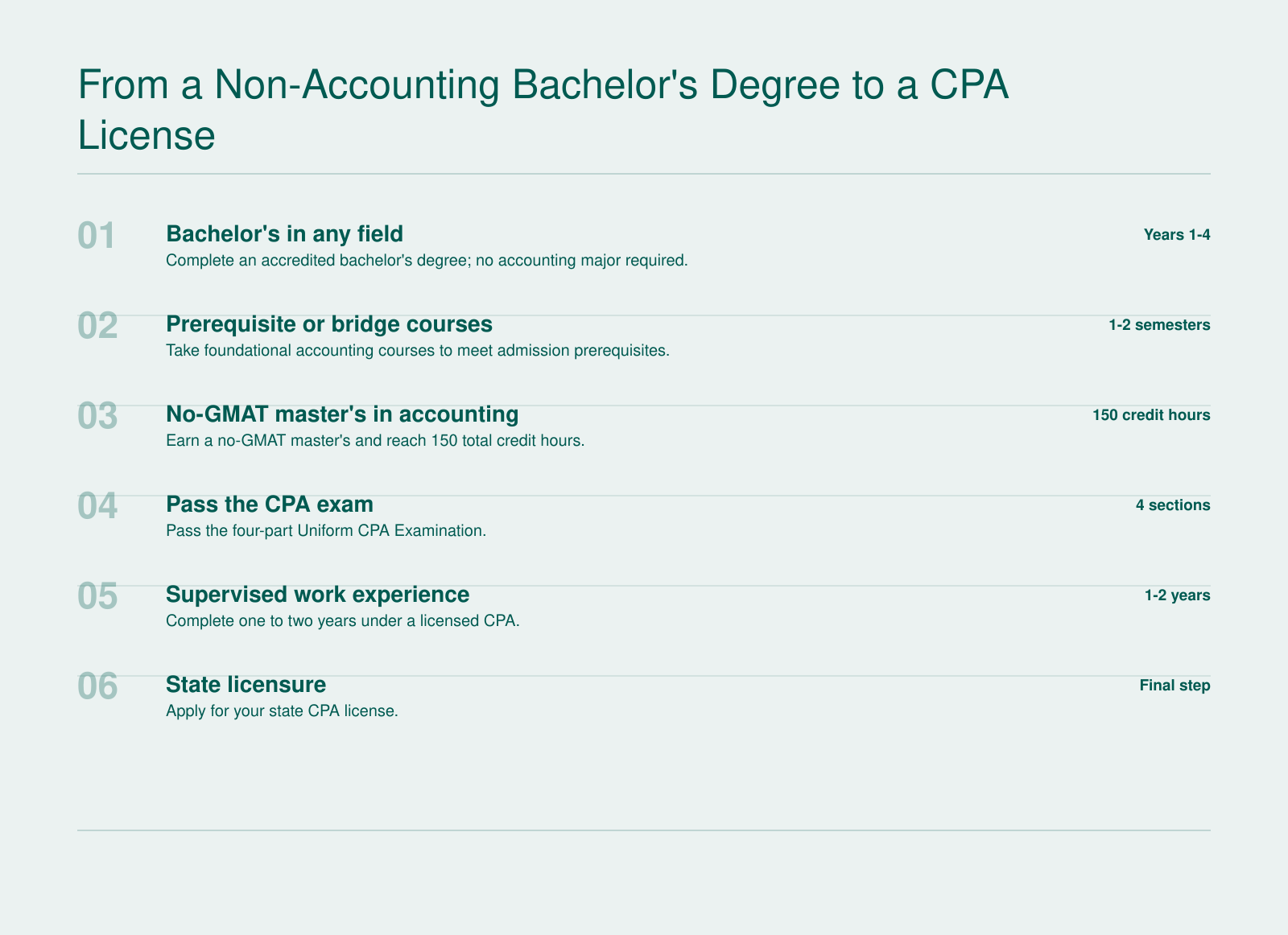
From a Non-Accounting Bachelor's Degree to a CPA License
Requirements vary by state, especially the experience hours and total credit count.
Prerequisites for Career Changers and Non-Accounting Majors
Yes, many programs admit students without an accounting bachelor's degree, though extra prerequisite or bridge credits can add time and cost.
- Bachelor's degreeA regionally accredited degree in any field is the baseline; Michigan-Flint accepts arts, science, engineering, and business majors.
- Minimum GPAVaries by program; many set a stated threshold with conditional admission for strong candidates below it.
- Foundational courseworkCommon prerequisites include financial and managerial accounting, intermediate accounting, statistics, and microeconomics; Michigan Ross requires a C or better.
- Bridge or foundation coursesRoss's Paton Summer Immersion covers two of five prerequisites before fall; Scranton's MAcc Bridge adds nine credits (ACC505, ACC506, ACC507).
- Application materialsSubmit transcripts, a resume, and a statement of purpose.
- English proficiencyInternational applicants need TOEFL or IELTS unless their degree was in English.
At University of Massachusetts-Lowell, accounting master's graduates earned a median of $78,034 one year after completion.
Online, On-Campus, and Accelerated Formats, Plus Start Dates
How fast can you finish, and does it matter whether you do it online? Most of the top-ranked programs here are campus-based, but online master's in accounting options exist: Rutgers runs its governmental accounting MAcc fully online with a part-time track, and Walsh College offers online, virtual, and on-campus sections of the same degree. Asynchronous courses, like those at Colorado State University Global, let you watch lectures and post work on your own schedule; synchronous or "virtual" sections meet live at a set time.
Timelines and start dates
Accelerated master's in accounting programs are common: Arizona advertises as few as nine months, Northeastern seven, and Emporia State builds 30 credits into 12 months using seven-week terms. Part-time students stretch further, with Franklin University's one-course-at-a-time format running about 31 months.
Starts vary. Nevada Reno takes applications for fall, spring, and summer (July 27, December 15, and April 6 deadlines). Ohio University's spring 2027 cohort applies by December 7, 2026, and begins January 4. Transfer allowances are modest: 6 credits at Ohio, up to 9 at Nevada Reno.
Employers generally see one diploma. An online degree from an AACSB-accredited school carries the same credential as the campus version.
Accounting programs by state
No-GMAT Master's in Accounting FAQ
Prospective students often weigh test waivers against career questions. These answers focus on the practical points that matter for admission, work, and recruiting.
Do all no-GMAT master's in accounting programs also waive the GRE?
Are online no-GMAT accounting master's degrees respected by employers?
Will skipping the GMAT hurt my chances of landing a Big Four internship or job?
Can I start a no-GMAT accounting master's while working full time?
Compare Accounting programs on the data that matters
Explore more Business & Management specializations or browse every graduate field.
All Business & Management programs