Best Master's in Early Childhood Education Programs in Massachusetts
Compare 29 accredited Early Childhood Education programs in Massachusetts at 23 schools, with graduate earnings, cost, debt, and completion data from IPEDS and the U.S. College Scorecard.

Bridgewater State University enrolls teachers who already hold an initial Massachusetts license; Westfield State University offers both professional and initial licensure routes. Boston University and Merrimack College build PreK-2 initial licensure into the degree. That split matters before any other comparison.
Approximate net price runs from about $16,000 at Salem State University to roughly $42,000 at Boston College. Formats range from in-person evening cohorts to fully online study.
A lower price means little if the program doesn't lead to the license you need.
Key Points
- Check that a program is DESE-approved before you apply if you want a PreK-2 license.
- Earnings are program-level medians, so compare them with net price rather than school reputation.
- Merrimack College and Gordon College deliver much of their coursework online, easing work and study.
Top 10 Master's in Early Childhood Education Programs in Massachusetts
Every school on this list earned its spot through what graduates actually earn and how the institution performs, not name recognition. Earnings figures are program-level medians measured four years after finishing, and graduation rates describe the whole school, not just the education department. Net prices are approximate federal estimates, so confirm graduate costs with each school.
Boston College
#1Chestnut Hill, MA · ~$38,000/yr (est.)
Best for: Aspiring teachers wanting licensure or non-licensure paths
Boston College in Chestnut Hill offers a campus-based M.Ed. built around a humanistic, developmentally appropriate approach for pre-K through grade 2. Graduates earn a median of about $68,576 four years after finishing, and the school's overall graduation rate is 91%. Approximate net price is around $41,704, the highest on this list, so weigh it against the strong outcomes.
- 37 credits across 15 courses plus a practicum
- 1.5 to 2 years full-time
- Fall, spring, or summer starts
- Licensure and non-licensure pathways
- Pre-K through grade 2 focus
- Partnerships with local schools and the BC Children's Center
- GRE-free admission
University of Massachusetts-Amherst
#2Amherst, MA · $15,000 – $20,000/yr (est.)
Best for: Future family services and policy professionals
UMass Amherst's Child Study and Early Education M.Ed. is a campus program with concentrations spanning teaching, family services, public policy, and interdisciplinary childhood studies. It suits students who want career options beyond the classroom, such as nonprofit work or early intervention. The school's overall graduation rate is 83%, and approximate net price is about $22,383, well below the private schools above.
- Master of Education with an early childhood focus
- Concentrations in family services, public policy, or interdisciplinary childhood studies
- Pathway to PreK-2 professional licensure for licensed teachers
- Careers in teaching, nonprofits, early intervention, and consulting
- Concentration covering infancy to eight years
- Emphasis on cultural context
- Training in assessing children individually and in groups
- Family services concentration
- Focus on programming for diverse settings
- Valued international and nonprofit experience
Boston University
#3Boston, MA · $65,000 – $70,000/yr (est.)
Best for: Working adults needing evening classes
Boston University's Wheelock M.Ed. prepares educators to work with children ages 3 to 8, with four pathways including routes to Massachusetts PreK-2 licensure. Graduates earn a median of about $62,027 four years after finishing, and the school's overall graduation rate is 89%. Approximate net price is about $24,402, and no prior education background is required.
- 34 credits
- Four program pathways
- Full-time and part-time options
- Evening coursework offered
- Leads to Massachusetts PreK-2 teacher licensure
- Field experience included
- No entrance exam required
- Scholarships available
Merrimack College
#4North Andover, MA · ~$37,000/yr (est.)
Merrimack College in North Andover pairs a low-cost, 36-credit M.Ed. with a fast 13-month full-time option and online or on-campus delivery. Graduates earn a median of about $61,055 four years after finishing, and the school's overall graduation rate is 70%. The program includes a 450-hour practicum and PreK-2 initial licensure.
- 36 credits at $620 per credit
- 13 months full-time, 2 to 3 years part-time
- No GRE or GMAT required
- 450-hour practicum
- PreK-2 initial licensure, DESE-approved
- Sheltered English Instruction endorsement
- Six starts per year
Westfield State University
#5Westfield, MA · $5,000 – $10,000/yr (est.)
Westfield State University is a public campus option aimed at teachers who already hold an initial Massachusetts license and want professional licensure. Graduates earn a median of about $53,768 four years after finishing, and approximate net price is about $16,721, among the lowest here. The school's overall graduation rate is 54%.
- 34 credits
- For teachers with an initial Massachusetts license
- Prepares for Professional Early Childhood Licensure
- Up to six graduate credits toward the initial license
- Three years of teaching needed for professional licensure
- DESE-approved teacher education programs
Gordon College
#6Wenham, MA · ~$9,000/yr (est.)
Gordon College in Wenham delivers its early childhood M.Ed. online, with initial and professional licensure options centered on pre-K through grade 2 and the science of reading. Program-level earnings are not reported, but the school's overall graduation rate is 69% and approximate net price is about $24,883. It is a faith-based option with small classes.
- Fully online option available
- Initial and professional licensure tracks
- Pre-K through grade 2 focus
- Science of reading curriculum
- Small class sizes
University of Massachusetts-Boston
#7Boston, MA · ~$20,000/yr (est.)
UMass Boston offers three M.Ed. tracks: initial PreK-2 licensure, community professional, and early intervention. Graduates earn a median of about $76,298 four years after finishing, the highest on this list. The school's overall graduation rate is 49%, and approximate net price is about $17,707.
- Three tracks: licensure, community professional, early intervention
- 2 to 3 years to complete
- 2.75 minimum GPA, two recommendation letters
- Test scores optional
- $75 application fee
- 37 credits, 13 courses
- 300-hour practicum
- MTEL exams required
- Portfolio capstone
- 36 credits, 12 courses
- Capstone project instead of practicum
- Suits nonprofit and policy roles
- No entrance exam required
Endicott College
#8Beverly, MA · $15,000 – $20,000/yr (est.)
Endicott College in Beverly runs a 36-credit hybrid M.Ed. for PreK-2 with a Massachusetts initial licensure option. Graduates earn a median of about $73,257 four years after finishing, second only to UMass Boston here. The school's overall graduation rate is 76%, and approximate net price is about $40,654.
- 36 credits in a hybrid format
- 300 practicum hours
- MTEL workshops at no additional cost
- Play-based and research-based instruction
- Job placement support and personal advising
Salem State University
#9Salem, MA · $5,000 – $10,000/yr (est.)
Salem State University is a public option with an Initial License track in its early childhood M.Ed. Graduates earn a median of about $60,928 four years after finishing. The school's overall graduation rate is 50%, and approximate net price is about $15,996, the lowest on this list.
- Master of Education degree
- Initial License track
Bridgewater State University
#10Bridgewater, MA · ~$9,000/yr (est.)
Bridgewater State University offers three Massachusetts-aligned early childhood M.Ed. paths: non-licensure, initial licensure, and professional licensure. Graduates earn a median of about $57,978 four years after finishing. The school's overall graduation rate is 53%, and approximate net price is about $16,383.
- 31 credits
- For licensed teachers only
- GRE or MTEL scores required
- Comprehensive exam exit requirement
- 33 credits including a 12-credit practicum
- 80 hours of prepractica
- MTEL exam scores required
- PreK-2 licensure preparation
- 30 credits
- Initial Massachusetts license required
- Applications of Technology concentration
- Comprehensive exam required
Cost & outcomes by school
Federal data for the highest-earning Early Childhood Education programs, independent of the ranking above. Earnings are this field's master's graduates four years after completing, where the Scorecard reports them.
| School | Earnings | Tuition / yr | Debt | Grads/yr | Format |
|---|---|---|---|---|---|
| University of Massachusetts-Boston MA | $76,298 | $20,456 | $24,000 | 100 | Campus |
| Endicott College MA | $73,257 | $15,534 | — | 19 | Hybrid |
| Boston College MA | $68,576 | $37,520 | — | 23 | Campus |
| American International College MA | $67,175 | $13,314 | $20,500 | 57 | Online |
| Cambridge College MA | $66,861 | $11,763 | — | 25 | Hybrid |
| Boston University MA | $62,027 | $67,626 | $25,500 | 10 | Campus |
| Fitchburg State University MA | $61,409 | $6,246 | — | 9 | Online |
| Merrimack College MA | $61,055 | $36,800 | $25,588 | 109 | Online |
| Salem State University MA | $60,928 | $9,360 | $15,041 | 82 | Campus |
| Lesley University MA | $58,844 | $19,890 | $34,401 | 54 | Hybrid |
| Bridgewater State University MA | $57,978 | $9,297 | $20,500 | 48 | Campus |
| Westfield State University MA | $53,768 | $8,676 | — | 5 | Campus |
Sources: U.S. Department of Education. Tuition and graduates: IPEDS. Earnings and debt: College Scorecard, this field's master's graduates; a dash means no figure is reported.
Cost, debt & payoff
Median earnings of this field's master's graduates (4 yrs after completing) vs. their median federal loan debt · U.S. College Scorecard
Across these programs the median graduate earns about $61,718 and finishes with roughly $24,000 in debt — a ratio that clears a common rule of thumb (keep debt below first-year salary). Tuition and debt vary widely school to school, so check the per-school figures in the table above before you shortlist.
Online and Hybrid Early Childhood Education Master's Programs in Massachusetts
Online coursework saves commuting time in many master's programs in Massachusetts, but every licensure route still ends in a PreK-2 classroom. The real question is how much of the online master's in early childhood education program fits around your workday. Merrimack College and Gordon College deliver their programs online, Endicott College runs a hybrid format, and Boston College, UMass Amherst, Boston University, Westfield State, UMass Boston and Bridgewater State are campus-based.
Salem State's initial-licensure MEd falls in between. Its evening courses run online with both live and self-paced work, yet the pre-practicum and final practicum are full-time and in person. Elsewhere, Fitchburg State and Bay Path University advertise 100% online programs. American International College teaches remotely through live sessions held once a week within eight-week courses.
Placement rules matter as much as format. AIC lets candidates complete the 300-hour practicum in their current school or district, as long as it is an approved Massachusetts public school. Salem State also permits field assignments in your own classroom for candidates in qualifying roles.
If you already work with young children, get written confirmation that your current setting can count toward practicum hours before you apply.
Massachusetts Prek–2 Teaching License: What Early Educators Need
Cost, Tuition, and Massachusetts Licensure: Comparing the Most Affordable ECE Master's Options
Tuition comes from federal data, and net price is approximate and calculated for the whole institution, so it is not a quote for any one program. Mandatory fees and MTEL test fees cost extra, and no school here published a full fee schedule we could confirm. For comparison, American International College lists $500 per credit and an estimated $18,600 for its initial licensure track, though its materials cite 33 to 39 credits. Salem State also offers an advanced studies MEd that leads to professional licensure, and per-credit rates for Salem State, Fitchburg State, and Framingham State were not confirmed, so ask each bursar for a full total.
| School | Program | Licensure Path | Credits | Graduate Tuition | Approx. Net Price |
|---|---|---|---|---|---|
| Fitchburg State University | Early Childhood Education, MEd (PreK-2), online | Initial licensure (PreK-2) | 39 | $6,246 | $14,262 |
| Bay Path University | Early Childhood Education (MSEd/EdS), online | Supports Massachusetts licensure (type not specified) | N/A | $15,162 | $14,271 |
| Salem State University | Early Childhood Education, MEd, Initial License | Initial licensure (PreK-2) | 30 to 39 | $9,360 | $15,996 |
| Framingham State University | Early Childhood Education, MEd, hybrid | Advances an existing license to Professional | N/A | $10,965 | $16,114 |
| Bridgewater State University | Early Childhood Education (Non-Licensure) | Non-licensure (initial license required to enroll) | 31 | $9,297 | $16,383 |
Related Articles
Which Massachusetts Early Childhood Master's Programs Skip the GRE?
Do you need the GRE for a Massachusetts early childhood education master's? The answer depends on the program, and not every school publishes a test policy: some are master's programs with no GRE required, while others may use the GRE only conditionally.
- BU Wheelock: Publishes no GRE requirement. Spring 2027 applications close December 15, 2026; the school welcomes a range of backgrounds, so a non-education bachelor's may be considered.
- Salem State: Lists no GRE policy. Minimum GPA is 2.75, and applications are reviewed on a rolling basis.
- Fitchburg State: Publishes no GRE requirement; admission references the MTEL Communication and Literacy test. Review is rolling.
- Bridgewater State: Requires a 2.8 GPA, or 3.0 in upper-division work, plus MTEL Foundations of Reading or Early Childhood scores. A GRE score of 291 may serve as a remedy below that.
- American International College: Requires a 3.0 GPA and uses the GRE only as conditional evidence for lower GPAs; online MEd admission is rolling.
- Lesley University: Publishes no current GRE or rolling deadline policy; confirm directly with admissions.
- Merrimack College: Requires no GRE or GMAT and accepts applicants without an education background.
Always confirm with admissions before paying for any test.
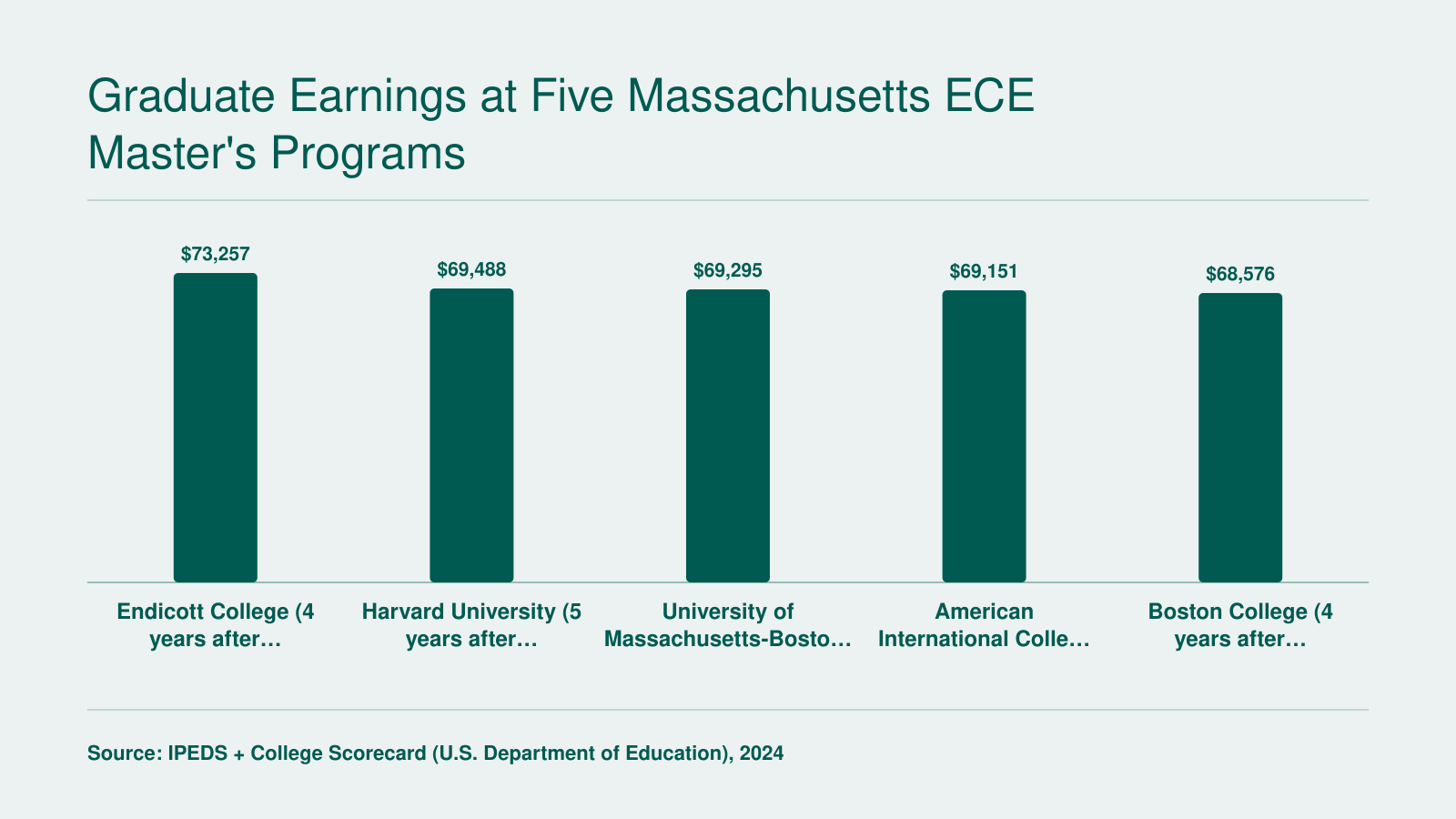
Graduate Earnings at Five Massachusetts ECE Master's Programs
These are median earnings for people who completed each school's early childhood education master's program, as reported in the College Scorecard. The time window differs by school, so each bar is labeled with its own. The figures reflect program completers in the Scorecard, not all early educators statewide.
How Long Does a Master's in Early Childhood Education Take?
Full-time study can finish an early childhood master's in Massachusetts in about one to two years, while part-time schedules typically run two years or longer. Credit loads drive much of the difference, usually 30 to 39 credits. American International College requires 33 for licensure and 30 for degree-only study, while UMass Boston, one of the elementary education master's programs with initial licensure in Massachusetts, requires 37 for its PreK-2 initial license.1
Licensure tracks also add a supervised practicum, generally at least 300 hours split across PreK, kindergarten, and the early grades at schools such as Endicott College and Salem State University. That doesn't make non-licensure automatically faster, though. UMass Boston quotes two to three years for both tracks, depending on course load.1
If speed matters, Salem State runs a one-year, three-semester accelerated plan that starts in summer, and Fisher College's online M.Ed. can wrap up in as little as 14 months full time.2
Working teachers carrying two or three courses a semester should budget roughly two to three years, based on UMass Boston's estimates.1 Fitchburg State, whose 39-credit licensure program takes at least 2.5 years, allows up to six.
How These Massachusetts ECE Master's Programs Earned Their Spots
Value to the student drove every placement on this list: what a program costs you, weighed against what its graduates go on to earn and owe. A well-known name had to clear the same bar as a regional state university.
Five inputs shaped the order:
- Net price: what students actually pay after aid.
- Graduate earnings: measured at the program level where available, but some schools use the institution-wide median.
- Median debt: what graduates typically borrow.
- Completions: how many students finish the degree.
- Online availability: whether you can enroll without relocating.
Prestige and advertising play no role. Earnings and debt figures are College Scorecard medians. Graduation rates are institution-wide, covering all students at a school rather than early childhood candidates alone.
Questions Applicants Ask About Massachusetts Early Childhood Master's Degrees
Can I earn a master's in early childhood education in Massachusetts if my bachelor's isn't in education?
Is there a non-licensure master's in early childhood education for people who don't plan to teach in public schools?
Are Massachusetts licensure tests included in the curriculum or required separately?
Compare Early Childhood Education programs on the data that matters
Explore more Education & Teaching specializations or browse every graduate field.
All Education & Teaching programs