Most Affordable Master's in Accounting Programs
Compare 710+ accredited most affordable Accounting programs at 520+ schools, with graduate earnings, cost, debt, and completion data from IPEDS and the U.S. College Scorecard.

What is the cheapest way to reach the 150 credit hours that 15 jurisdictions still require for CPA licensure? For many graduates with a 120-credit bachelor's, it is a 30-credit master's in accounting at a public university.
Annual in-state graduate tuition at the schools ranked here runs from $6,242 at Texas A&M University-Central Texas to $11,612 at CUNY Queens College. Fees, residency rules, and format can widen that gap quickly.
Sticker price matters less than whether those credits satisfy your state board.
Key Points
- FIU's online accounting master's totals $29,423.97 despite $900 per credit.
- CUNY schools show a pronounced in-state vs out-of-state tuition gap.
- Most states require 150 semester hours for CPA licensure.
Top 10 Affordable Master's in Accounting Programs
The ten programs below pair low graduate tuition with focused accounting coursework, flexible delivery, and CPA exam preparation. Several are AACSB-accredited and many offer online or evening formats for working students. Each entry shows in-state and out-of-state tuition and delivery format, so you can weigh cost and schedule side by side.
Texas A&M University-Central Texas
#1Killeen, TX · $5,000 – $10,000/yr (est.)
Best for: Online learners pursuing Texas CPA eligibility
Texas A&M University-Central Texas offers a 30-credit Master of Science in Accounting with a fully online option, building on a BBA foundation. The curriculum covers auditing, taxation, regulation, and ethics, and meets Texas CPA exam education requirements. Students join the Warrior Accounting Society and Beta Gamma Sigma, and the business college holds AACSB accreditation.
- AACSB accredited business college
- 30 total credit hours
- Fully online option available
- Prepares for CPA
- Builds on BBA in Accounting
- Curriculum includes auditing, taxation, ethics
- Warrior Accounting Society and Beta Gamma Sigma
- Meets Texas CPA pre-education requirements
CUNY Bernard M Baruch College
#2New York, NY · $11,000 – $21,000/yr (est.)
Best for: New York-based students wanting in-person CPA prep
CUNY Bernard M Baruch College in New York City offers an MS in Accountancy through the Zicklin School of Business with dual AACSB accreditation in business and accounting. The program has two concentration options, fall and spring starts, and course waivers that can shorten the degree. Graduates pursue public accounting, taxation, corporate finance, and consulting.
- AACSB accredited business and accounting
- 2 concentration options
- Fall and spring start dates
- NYS Licensure Qualifying Registered program
- Prepares for CPA exam
- STEM option for Information Analytics
- Course waivers shorten the program
- Careers in public accounting, taxation, consulting
CUNY Hunter College
#3New York, NY · ~$11,000/yr (est.)
Best for: Working professionals needing evening Manhattan classes
CUNY Hunter College's one-year M.S. in Accounting in Manhattan features evening classes designed for students who need to intern or work during the day. The program meets New York's 150-credit CPA requirement and is a registered CPA licensure-qualifying pathway. Students have landed internships at FASB, the SEC, and Big 4 firms.
- One-year program
- Evening classes for daytime internships
- Prepares for Uniform CPA Examinations
- CPA licensure-qualifying program
- Fulfills 150-credit CPA requirement
- Internships at FASB, SEC, Big 4
- Located in Manhattan's Upper East Side
CUNY Brooklyn College
#4Brooklyn, NY · $10,000 – $15,000/yr (est.)
CUNY Brooklyn College offers a 30-credit M.S. in Accounting with a fully online option and rolling admissions. The curriculum covers tax research and planning, SEC accounting requirements, and quantitative methods, and meets the 150 semester-hour CPA requirement. GMAT scores are optional, and the Magner Career Center connects students to internships and job fairs.
- No GMAT required
- Test optional
- 30 total credit hours
- Rolling admissions
- Fully online option available
- 2 letters of recommendation required
- Prepares for CPA licensure
- Meets 150 semester-hour CPA requirement
California State University-Los Angeles
#5Los Angeles, CA · ~$9,000/yr (est.)
California State University-Los Angeles offers an M.S. in Accounting with three concentrations: Accounting Information Systems, Financial and Public Accounting, and Taxation. The 33-unit program includes an 18-unit core and 15 units of electives, with a Main Campus location in Los Angeles. Graduates prepare for professional accounting exams or doctoral study.
- 18-unit core with auditing, ethics, leadership
- 15 units of AIS electives
- Focus on business intelligence and big data
- 33 total credit hours
- Main Campus location in Los Angeles
- 18-unit core plus public accounting electives
- Careers in public accounting and government
- 3.0 GPA minimum
- 15 units of taxation electives
- Includes IRS VITA program course
- Prepares for professional accounting exam
- Careers in public accounting and finance
Texas A & M International University
#6Laredo, TX · ~$7,000/yr (est.)
Texas A&M International University in Laredo offers a 30-credit Master of Professional Accountancy that prepares students for the CPA exam. The campus-based program requires GRE or GMAT scores, but a strong GPA can waive the exam. Graduates work in banking, insurance, government, and corporate staffing.
- Entrance exam required: GRE or GMAT
- 30 total credit hours
- 3.0 GPA minimum
- 2 letters of recommendation required
- Prepares for Certified Public Accountant Examination
- 300-word personal statement required
- Resume with three references required
- Careers in banking, insurance, government
CUNY Lehman College
#7Bronx, NY · ~$12,000/yr (est.)
CUNY Lehman College's 30-credit M.S. in Accounting is certified by the New York State Department of Education to meet CPA-150E requirements. The online program offers fall and spring start dates and bridge courses for non-accounting majors. Graduates enter public, industry, governmental, and nonprofit accounting roles.
- 30 total credit hours
- Starts fall and spring
- 3.0 GPA minimum
- Prerequisite courses for non-accounting majors
- Certified for CPA-150E requirements
- Direct pathway to CPA readiness
- Careers in public, nonprofit accounting
- Priority, regular and final deadlines
CUNY Queens College
#8Queens, NY · ~$12,000/yr (est.)
CUNY Queens College's 30-credit M.S. in Accounting offers evening and weekend courses in Queens, with full-time or part-time pacing. The program is registered with the New York State Education Department for CPA eligibility and reports a 97% employment rate. Graduates pursue public accounting, internal audit, taxation, and consulting.
- Approximately one to two years
- 30 total credit hours
- Full-time and part-time options
- 97% job placement rate
- Evening and weekend courses
- Registered with NYSED for CPA eligibility
- Comprehensive Exam required to graduate
- 150 credit hours toward CPA
The University of Texas Rio Grande Valley
#9Edinburg, TX · $5,000 – $10,000/yr (est.)
The University of Texas Rio Grande Valley offers a Master of Accountancy with hybrid and accelerated online options, housed in the AACSB-accredited Robert C. Vackar College of Business and Entrepreneurship. Students study auditing, financial management, and data analytics, and the degree meets Texas CPA exam requirements. A Graduate Select Scholarship worth up to $1,000 is available.
- AACSB accredited
- Fully online option available
- Prepares for Certified Public Accountant exam
- Scholarship up to $1,000
- Careers: CFO, CEO, board chair
- Focus on auditing, finance, analytics
- Faculty mentorship outside classroom
- Hybrid and accelerated online options
California State University-San Bernardino
#10San Bernardino, CA · ~$10,000/yr (est.)
California State University, San Bernardino offers a Master of Science in Accountancy with campus and online options, including a CAPE Blended pathway for CSUSB accounting students to earn bachelor's and master's degrees together. The program prepares students for CPA and CMA certification and doctoral study, with a strong ethical leadership emphasis.
- Prepares for CPA, CMA
- Careers in public accounting and finance
- Accelerated bachelor's to master's route
- Simultaneous bachelor's and master's degrees
- Transfer nine credits from BA
- Prepares for doctoral and research studies
- Leaders in professional ethical conduct
- Fully online option available
- Prerequisite courses required
- Prepares for California CPA exam
- Full-semester classes
- Faculty with practitioner experience
- Accelerated online prerequisite option
Cost & outcomes by school
Federal data for the highest-earning Accounting programs, independent of the ranking above. Earnings are this field's master's graduates four years after completing, where the Scorecard reports them.
| School | Earnings | Tuition / yr | Debt | Grads/yr | Format |
|---|---|---|---|---|---|
| New York University NY | $134,461 | $42,726 | $33,052 | 156 | Campus |
| Fordham University NY | $126,830 | $26,752 | $37,000 | 42 | Campus |
| George Washington University DC | $126,566 | $36,414 | $36,992 | 22 | Campus |
| Loyola University Maryland MD | $122,816 | $20,070 | — | 29 | Hybrid |
| Golden Gate University CA | $120,311 | $17,070 | $48,218 | 30 | Online |
| Indiana University-Bloomington IN | $119,951 | $11,756 | $32,000 | 76 | Campus |
| The University of Texas at Austin TX | $117,656 | $12,006 | $25,000 | 183 | Campus |
| Sacred Heart University CT | $117,457 | $34,394 | $20,500 | 52 | Hybrid |
| University of Virginia VA | $117,392 | $23,526 | — | — | Campus |
| Fairfield University CT | $117,339 | $21,448 | $28,450 | 59 | Campus |
| Pace University NY | $115,804 | $30,770 | $20,500 | 44 | Hybrid |
| University of Connecticut CT | $113,488 | $22,872 | $21,075 | 77 | Online |
Sources: U.S. Department of Education. Tuition and graduates: IPEDS. Earnings and debt: College Scorecard, this field's master's graduates; a dash means no figure is reported.
Cost, debt & payoff
Median earnings of this field's master's graduates (4 yrs after completing) vs. their median federal loan debt · U.S. College Scorecard
Across these programs the median graduate earns about $93,185 and finishes with roughly $25,025 in debt — a ratio that clears a common rule of thumb (keep debt below first-year salary). Tuition and debt vary widely school to school, so check the per-school figures in the table above before you shortlist.
What an Affordable Master's in Accounting Really Costs
Florida International University's online Master of Accounting, an Online Master's in Accounting program, lists $900 per credit across 30 credits, but the published total comes to $29,423.97: the difference is a university fee of $68.93 per credit, athletics and health charges spread over three semesters, an annual photo ID charge, and a one-time $35 orientation fee.1 Advertised per-credit rates rarely tell the whole story across master's in accounting programs.
Fees that sit outside the per-credit rate
- Florida Southern College: 30 credits at $875 per credit (2026-27), plus a technology fee that scales by course load, from $25 a semester for up to four credits to $100 at nine or more, and a $250 enrollment deposit credited toward first-semester tuition.2
- Eastern Connecticut State University: $750 per credit, a $60 mandatory semester fee, and a $50 application fee.3
- UMass Lowell: $610 per credit for online graduate courses and $655 for online business, plus a $30 term registration charge and a $75 graduate business application fee.4
Build your own estimate
Multiply the per-credit rate by total credits, add every per-term and per-credit fee, then budget separately for books and CPA exam review, which Oklahoma, for one, excludes from its published totals.5 Institution-wide net price figures mostly describe undergraduates, so work from the program's own cost page instead.
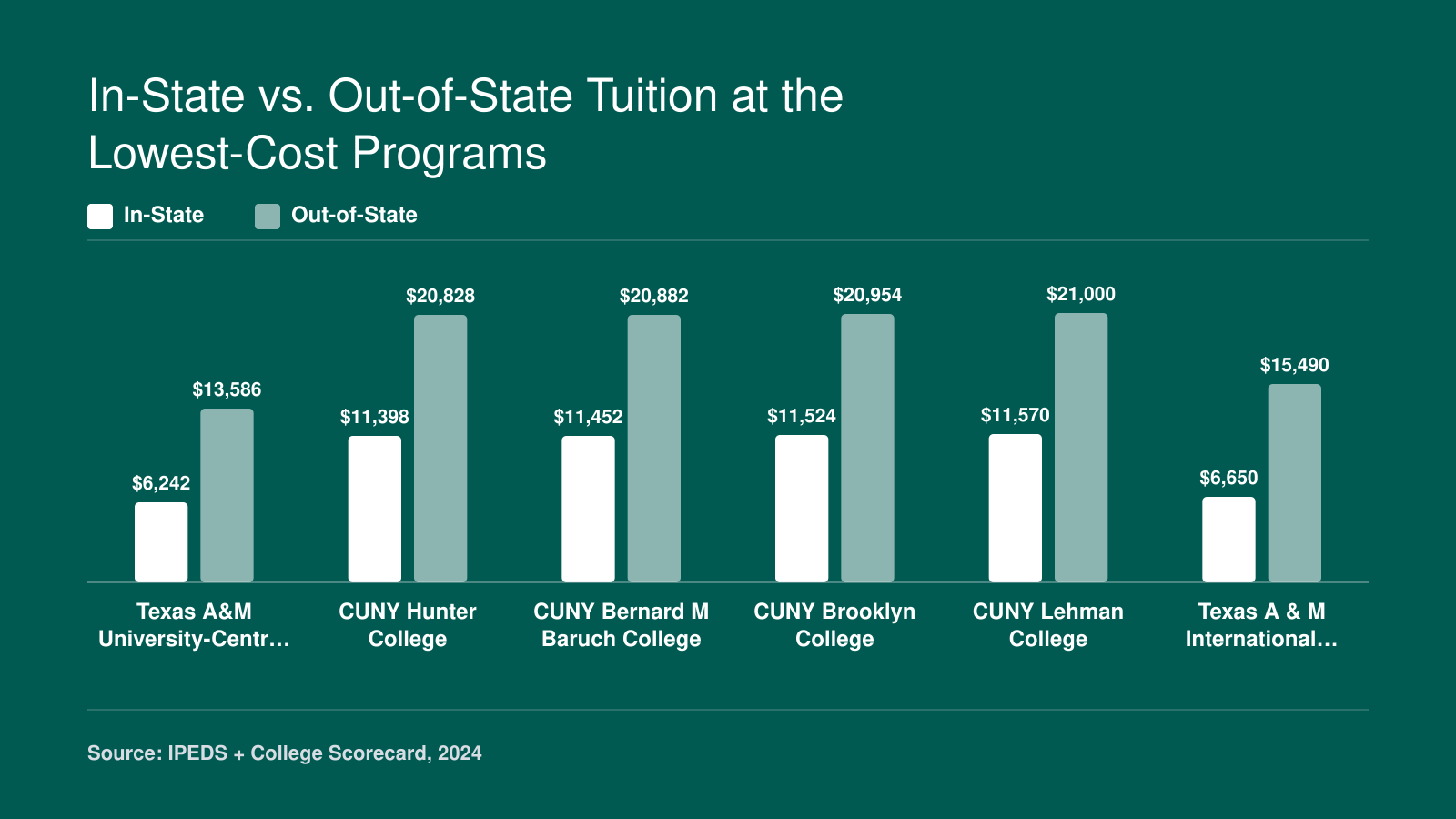
In-State vs. Out-of-State Tuition at the Lowest-Cost Programs
The chart compares published per-year graduate tuition and fees for in-state and out-of-state students at the most affordable accounting master's programs in this ranking. These are annual figures, not total program cost. CUNY schools show a pronounced residency gap of roughly $9,400, while Texas A&M campuses offer smaller gaps, which matters for online students who may be charged out-of-state rates.
Related Articles
Online vs. On-Campus Accounting Master's: Format and Price Trade-Offs
Format changes the true cost and experience of an accounting master's. Asynchronous online programs trade live face time for total schedule control, synchronous online courses keep live sessions but still remove the commute, and on-campus study offers the richest recruiting access but usually the least schedule flexibility. Working professionals should weigh each format against their job hours, state residency, and networking goals.
| Aspect | Asynchronous online | Synchronous online | On-campus |
|---|---|---|---|
| Schedule flexibility | Complete coursework anytime with no set login times. CSU Global, Auburn University at Montgomery, Northern Kentucky University, and Michigan-Flint describe fully asynchronous formats. | Live classes at set times, often in the evening. University of Oklahoma holds Zoom sessions one to two times per week at 7 p.m. Central, and SUNY Brockport offers synchronous courses at or after 5 p.m. | Fixed weekly class times plus commuting. Evening sections are less common and reduce flexibility for working students. |
| Residency pricing | Many public universities charge a flat online rate regardless of state, so out-of-state learners often avoid the full out-of-state premium. | Some public programs keep the out-of-state premium, while others extend in-state or flat rates to online students. Check the program's tuition page before applying. | In-state residents pay the lowest tuition. Out-of-state students usually face the full premium unless they qualify for a waiver. |
| Networking and recruiting access | Limited live interaction with classmates and faculty. Career services and alumni networks may still be available remotely. | Live class discussions and some virtual recruiting events, but less spontaneous networking than on campus. | Strongest access to accounting firms, career fairs, and faculty referrals. |
| Pace | Self-paced within term deadlines. You can speed up or slow down around full-time work. | Fixed weekly rhythm. Easier to schedule around a job than on campus, but less flexible than asynchronous courses. | Cohort or full-time pacing. Often fastest to complete, but hardest to combine with a full-time job. |
| Best fit for working professionals | Easiest to pair with full-time jobs and unpredictable hours. | Works well if your evenings are free and you want live structure and accountability. | Best when you can reduce work hours or study full-time. |
Will Your Degree Get You to the 150 CPA Credit Hours?
Only 15 jurisdictions still require 150 semester hours for CPA licensure; 24 allow a 120-credit alternative.1 A 120-credit bachelor's leaves a 30-credit gap, and a master's in accounting is a straightforward way to close it while adding graduate accounting and business coursework. Traditional licensure also typically asks for one year of qualifying experience.2
Recent laws now allow a 120-credit route with two years of experience.2 South Carolina, Tennessee, New York, Texas, and Colorado have adopted or scheduled this path.1 Tennessee's version took effect January 1, 2026;3 Texas on August 1, 2026;4 New York in November 2026;5 and Colorado on January 1, 2027.1
Credit totals aren't the whole story. State boards set specific accounting and business course-hour minimums. Tennessee requires 30 accounting hours;3 Texas requires 27 upper-level accounting hours plus a 3-hour ethics course;4 New York requires 33 total accounting hours.5 Because these rules vary, check your state board and NASBA before enrolling.2 Some accelerated master's in accounting programs build in CPA exam content or count toward the 150 hours by design, but course selection must match your state's requirements.
Admissions Checklist for Low-Cost Accounting Master's Programs
Use this checklist to compare admission requirements, because low-cost accounting master's programs vary widely on GPA, test, prerequisite, and transfer-credit policies.
- Bachelor's degree and GPAExpect a regionally accredited bachelor's degree. Published minimum GPAs vary: Delaware and Michigan State list 3.0; Nevada accepts 2.75 for AACSB-accredited applicants or 3.0 otherwise; Central Arkansas uses 2.70 overall or 3.00 in the last 60 credits.
- Prerequisite courseworkNon-accounting majors often need foundation courses in financial, intermediate, and managerial accounting, tax, auditing, or business law. At Delaware, prerequisites do not count toward the 30-credit M.S., so added courses can raise the total cost.
- GMAT or GRE requirementsPolicies differ. Delaware, Nevada Online MAcc, UMass Lowell, and Penn State Great Valley require no GMAT/GRE. Michigan State waives the test at a 3.0 GPA; NYU Stern offers a GRE waiver with a 3.00 GPA. Other programs require or recommend scores.
- Graduate transfer creditCredit limits are narrow. Nevada allows up to 9 transfer credits; Penn State Great Valley allows up to 10. Confirm before enrolling whether prior graduate work will reduce the required credits.
Accounting programs by state
Compare Accounting programs on the data that matters
Explore more Business & Management specializations or browse every graduate field.
All Business & Management programs