Best MBA/MPAcc Programs
Compare 16 accredited MBA/MPAcc programs at 15 schools, with graduate earnings, cost, debt, and completion data from IPEDS and the U.S. College Scorecard.

Can one degree get you both MBA leadership training and the graduate accounting credits most states require to sit for the CPA exam? That is the premise of an MBA/MPAcc, a combined Master of Business Administration and Master of Professional Accountancy usually completed faster than earning each degree on its own.
Few universities offer this exact pairing. Eastern Washington University's online dual track lists $27,200 in total tuition on a 14-month timeline; the University of Washington's Foster School runs its concurrent version over three years. That scarcity narrows the search in a way a standalone MBA hunt never does.
Most applicants still apply to each program separately, so the credential that closes the 150-hour CPA gap also carries two sets of admissions rules.
Key Points
- The dual degree builds toward the 150 credit hours CPA licensure requires.
- Only 195 of 1,085 AACSB institutions also hold accounting accreditation.
- Eastern Washington's online dual degree is a 14-month, per-credit program.
Best MBA/Mpacc Schools: 2027 Rankings
Few schools offer a true MBA/MPAcc dual degree, so this list covers every qualifying program in our data rather than padding to ten. The three schools below pair a master's-level business core with CPA-focused accounting coursework, with important differences in format, cost, and admissions path.
University of Washington-Seattle Campus
#1Seattle, WA · ~$19,000/yr (est.)
Best for: Full-time students targeting Seattle accounting networks
The University of Washington's Foster School of Business offers a full-time MBA and Master of Professional Accountancy as a three-year concurrent degree with two concentrations: Auditing and Assurance or Taxation. The Auditing and Assurance track emphasizes financial reporting and audit procedures, while Taxation focuses on tax strategy. Students apply separately to both the MBA and MPAcc, and the university graduates 85% of students institution-wide.
- Full-time MBA and MPAcc concurrent degree
- Concentration in Auditing and Assurance
- Three-year program
- Requires separate applications to both degree programs
- Prepares for public accounting, corporate finance, or consulting
- Concurrent MBA and MPAcc pathway
- Concentration in Taxation
- Three-year full-time format
- Separate applications to both programs
- Emphasizes tax strategy and advanced accounting
Eastern Washington University
#2Cheney, WA · ~$14,000/yr (est.)
Best for: Working professionals needing flexible online CPA prep
Eastern Washington University's online dual MBA and Master of Professional Accounting prepares students for CPA licensure while adding leadership coursework in finance, operations, and marketing. The 64-credit program features six-week courses, seven start dates per year, and flexible admissions with GMAT waivers available. Institution-wide, the university graduates 43% of students.
- 64 total credit hours
- $26,240 total program tuition
- $410 per credit
- 100% online delivery
- Six-week course sessions
- Seven start dates per year
- GMAT waiver available
- CPA exam preparation
University of West Georgia
#3Carrollton, GA · ~$6,000/yr (est.)
Best for: Georgia residents wanting face-to-face CPA coursework
The University of West Georgia offers a combined Master of Public Accounting and MBA on its Carrollton campus. Students complete 45 credits in financial reporting, auditing, tax, cost accounting, and management while preparing for Georgia's CPA exam. The university graduates 43% of students institution-wide.
- 45 total credit hours
- Prepares for CPA exam in Georgia
- Face-to-face instruction on Carrollton campus
- Transfer up to 6 credit hours
- Prior learning credit accepted
- Separate applications for each program
- $55 application fee
Cost & outcomes by school
Federal data for the highest-earning MBA/MPAcc programs, independent of the ranking above. Earnings are this field's master's graduates four years after completing, where the Scorecard reports them.
| School | Earnings | Tuition / yr | Debt | Grads/yr | Format |
|---|---|---|---|---|---|
| Belmont University TN | $113,806 | $27,810 | $53,160 | 56 | Hybrid |
| Virginia Commonwealth University VA | $108,337 | $17,252 | $54,332 | 94 | Campus |
| Gonzaga University WA | $104,495 | $21,987 | $32,188 | 10 | Campus |
| Mercer University GA | $101,623 | $14,971 | $39,318 | — | Campus |
| University of West Georgia GA | — | $6,046 | — | — | Campus |
| Lamar University TX | — | $8,642 | — | — | Campus |
| Southern Utah University UT | — | $8,577 | — | — | Hybrid |
| Washburn University KS | — | $10,787 | — | — | Campus |
| North Carolina State University at Raleigh NC | — | $12,101 | — | — | Hybrid |
| Iowa State University IA | — | $12,967 | — | — | Campus |
| Eastern Washington University WA | — | $14,106 | — | — | Online |
| Saint Peter's University NJ | — | $16,035 | — | — | Campus |
Sources: U.S. Department of Education. Tuition and graduates: IPEDS. Earnings and debt: College Scorecard, this field's master's graduates; a dash means no figure is reported.
Cost, debt & payoff
Median earnings of this field's master's graduates (4 yrs after completing) vs. their median federal loan debt · U.S. College Scorecard
Across these programs the median graduate earns about $106,416 and finishes with roughly $46,239 in debt — a ratio that clears a common rule of thumb (keep debt below first-year salary). Tuition and debt vary widely school to school, so check the per-school figures in the table above before you shortlist.
What an MBA/Mpacc Is and How We Ranked These Programs
Eastern Washington University's online dual MBA/MPAcc lists $27,200 in total program tuition at $425 per credit and a 14-month timeline, which gives you a sense of what this degree is: two credentials earned on one track, not two separate enrollments stacked end to end.
What the dual degree actually covers
An MBA/MPAcc (sometimes written MPAcc/MBA or paired with a Master of Professional Accountancy) blends a shared business core with advanced accounting coursework. On the MBA side you get finance, strategy, operations, and organizational management. On the accounting side you go deeper into financial reporting, taxation, audit, and assurance, the core of the MBA in Accounting. The University of Washington's Foster School, for example, pairs its full-time MBA with the MPAcc and offers an auditing and assurance focus. The practical payoff is that you leave with the accounting credit depth most state boards expect for CPA eligibility, plus the management breadth that pure accounting master's programs skip.
Who it fits
This degree makes the most sense for people aiming at controller or CFO seats, Big Four advisory and audit staff who want a path out of pure technical work, and career changers coming from a non-accounting undergraduate background who need genuine accounting depth without giving up general management training. If you only want the CPA, a standalone MAcc is faster and cheaper. If you have no interest in the CPA exam, a straight MBA (see Best MBA Programs) is the better buy.
What we looked at
- Cost: Net price after aid and published graduate tuition, so the comparison reflects what students actually pay rather than sticker price.
- Completion: Institutional graduation rates, as a signal of whether students finish what they start.
- Outcomes: Federal earnings and debt figures where they have been published for the program.
- Flexibility: Whether the degree is available as an Online MBA, on campus, or both.
Two honest limits: net price and graduation rate are institution-wide averages covering undergraduates too, not dual-degree cohorts. And program-level earnings have not been published for every MBA/MPAcc track here, so cost and completion carry more weight in those cases.
MBA/Mpacc Program Cost and Net Price Compared
These figures compare the most relevant published costs for the dual-degree programs below. Graduate in-state and out-of-state tuition come from each institution's federal reporting, and net price is a schoolwide average after grant and scholarship aid, so it should not be read as a quote for this specific dual degree. Schools that publish per-credit pricing or a fixed program total are shown where available; for example, Belmont University lists its MBA/MAcc at $1,645 per credit, about $93,765 for the 57-credit program, with a December 1 deadline.
| School | Program | In-state tuition | Out-of-state tuition | Net price (after aid) | Per-credit tuition | Total program cost | Application deadline |
|---|---|---|---|---|---|---|---|
| University of West Georgia | Combined MPAcc/MBA | $6,046 | $19,600 | $12,786 | N/A | N/A | N/A |
| Eastern Washington University | Online MBA/MPAcc | $14,106 | $29,892 | $13,886 | $425 | $27,200 | Oct 19, 2026 |
| University of Washington | MBA/MPAcc | $18,792 | $32,811 | $14,091 | N/A | N/A | N/A |
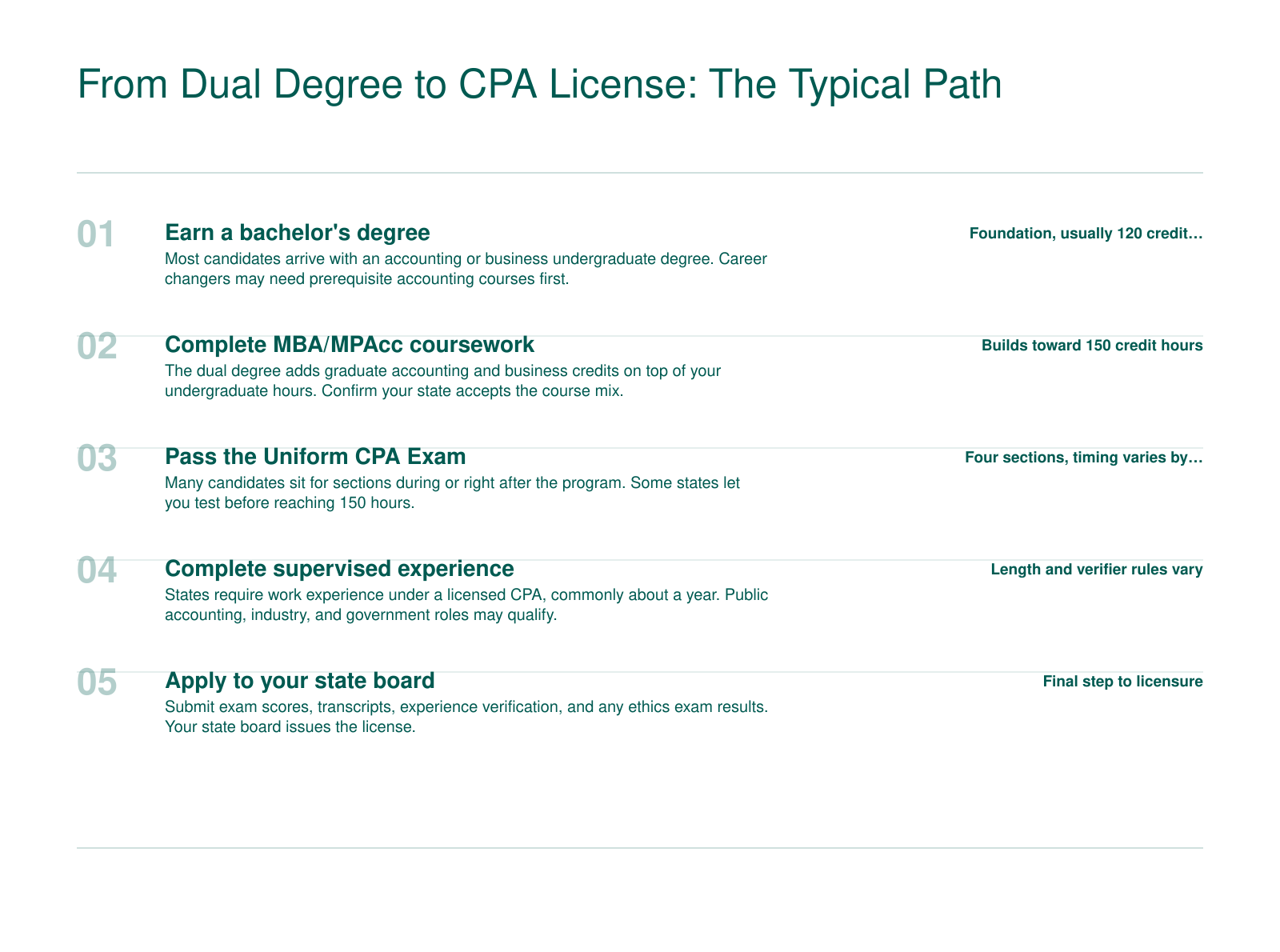
From Dual Degree to CPA License: The Typical Path
An MBA/MPAcc is built to close the gap between a bachelor's degree and the 150 credit hours most states require for CPA licensure. Exact hour, experience, and timing rules vary by state, so check the state table that follows before you plan your sequence.
Related Articles
AACSB Accreditation: Why It Matters for CPA Candidates and Employers
Business vs. Accounting Accreditation
AACSB accredits business schools, and it separately accredits master's in accounting programs through its Accounting Accreditation Committee.1 A school can hold one without the other. Business accreditation alone does not mean the accounting program has been reviewed on its own terms, so look for both if accounting rigor is a priority.
Where the Schools Stand
AACSB's directory confirms business accreditation in 2026 for Metropolitan State University of Denver2, Pittsburg State University3, Kansas State University4, the University of Colorado Colorado Springs5, and The University of Texas at Austin6 (listed for its Executive MBA, not an MPAcc). Eastern Washington University also advertises its dual MBA/MPAcc as AACSB accredited. Morgan State University stands out: it holds both business and accounting accreditation.7 For the other schools, including the Washington and Georgia programs, confirm status yourself using the step below. The directory entries we reviewed do not show a separate accounting accreditation for the remaining schools.
What It Means for the CPA Path
AACSB is not a nationwide CPA eligibility rule. State boards of accountancy decide credit hours, course level, subject areas, and which institutions they recognize. Every U.S. state and territory requires at least 150 semester hours for licensure10, and boards may add coursework, exams, or work experience.
Texas shows how specific this gets. Candidates need 120 semester hours for the baccalaureate, 21 upper-level business hours, and, for applicants beginning August 1, 2026, 24 upper-level accounting hours, all from a Board-recognized institution.89 Texas's published materials do not say AACSB accreditation automatically qualifies every course.8 The University of Rhode Island says plainly that its AACSB-accredited accounting degree alone does not satisfy licensure education.10
Employers generally read AACSB as a quality signal, not a substitute for board eligibility. Accreditation can make a transcript easier to evaluate, but your state board has the final word.
Verify Before You Apply
Search the AACSB accredited-schools directory for each school, and check whether the accounting accreditation appears alongside the business listing. Then confirm credit requirements with your state board.
As of July 8, 2026, AACSB lists 1,085 accredited institutions in 71 countries and territories, but only 195 also hold its separate accounting accreditation. That is fewer than one in five. If an accounting-focused MBA/MPAcc matters to you, check whether a school has this extra credential.
MBA/Mpacc Graduate Salaries, Debt, and Return on Investment
A dual MBA/MPAcc is only worth the added time and tuition if the projected earnings lift clears the debt you will carry, and the institutions ranked here offer quite different affordability profiles.
Program-level earnings are still limited
For these MBA/MPAcc tracks, program-level College Scorecard earnings are not yet published for the one-year and four-year after finishing windows. That means no federal data currently isolates how much the accounting credential adds above a standard MBA at these schools. Use the institution-level figures below as context, not as a program-specific earnings promise.
Institution-level earnings and debt at graduation
Ten years after entering college, median earnings for federal aid recipients are about $78,500 at University of Washington-Seattle, about $57,900 at Eastern Washington University, and about $49,600 at University of West Georgia. Median federal debt at graduation runs about $14,600 at UW-Seattle, about $19,500 at Eastern Washington, and about $24,000 at West Georgia. Higher earnings and lower debt do not always align, but UW-Seattle stands out on both measures in this set. Program-level median federal debt at completion and the estimated 10-year monthly payment are not yet available, so request those figures directly from each school's aid office.
Use the return ratio as a rough screen
An institution-level return ratio that compares median earnings to median federal debt across all graduate outcomes sits near 5.4 at UW-Seattle, 3.0 at Eastern Washington, and 2.1 at West Georgia. This is a broad affordability signal, not a dual-degree outcome. A higher ratio can still hide a poor fit if the accounting-specific curriculum is weak or if CPA eligibility requirements extend your timeline, so weigh it alongside program length, format, and accreditation.
Online vs Campus MBA/Mpacc Programs: Which Format Fits
At $425 per credit hour, Eastern Washington University's online MBA/MPAcc dual degree keeps tuition the same for in-state and out-of-state students, with a listed total of $27,200 before any required foundation courses.
Delivery in These Programs
Delivery varies in this ranking. University of Washington-Seattle lists its MBA/MPAcc as an on-campus program. University of West Georgia lists its MPAcc/MBA as hybrid and online with a Carrollton campus option. Eastern Washington University's MBA/MPAcc is 100 percent online, with six-week courses, seven start dates a year, and a completion path of as few as 14 months. The 64-credit, 16-course sequence does not state an on-campus residency requirement, but applicants should confirm whether any live sessions or proctoring rules apply. The program page also does not specify whether the six-week courses use synchronous meetings or fully asynchronous pacing, so working students should confirm the weekly time commitment before enrolling. If you are weighing a hybrid structure, check each school's current catalog because delivery modes can shift by term.
Trade-offs by Format
Online delivery tends to fit working accountants who need CPA credit hours while keeping a job. EWU's online format, for example, advertises flexible start dates and a pay-by-the-course structure, and it does not charge a nonresident tuition premium. Campus programs, including UW-Seattle and West Georgia, may give you more direct access to in-person recruiting events, faculty office hours, and graduate assistantships, which can matter for Big Four accounting recruiting. The degree credential itself is normally the same: a dual MBA/MPAcc completed online generally does not say online on the diploma.
Cost Check
Because online tuition is not always cheaper, review the most affordable MBA programs and each school's published rates carefully. At EWU, the listed total of $27,200 applies to both in-state and out-of-state students, but students without a business or accounting undergraduate degree may need extra foundation courses whose cost is added on top. For campus programs, compare the published resident and nonresident tuition before deciding, and ask about assistantship stipends or tuition waivers that may offset cost.
MBA/Mpacc Admissions Requirements and GMAT/GRE Policies
Requirements vary by school, and dual-degree tracks often mean two applications. Confirm every detail with each admissions office before you apply.
- Bachelor's degree and GPAExpect to need a bachelor's degree, and Eastern Washington University's online program specifies a regionally accredited institution. Its standard GPA benchmark is 3.0, and Pittsburg State's online MPAcc also lists 3.0. Eastern Washington may consider a 2.5 to 3.0 GPA case by case, typically alongside three or more years of work experience or an acceptable GMAT score.
- GMAT or GREPolicies differ widely. Belmont's MBA/MAcc makes the GMAT or GRE optional. Eastern Washington lists the exam but offers waivers, and its official materials say many applicants qualify without defining every category. Waivers commonly depend on work experience, undergraduate GPA, or professional credentials such as a CPA. Ask each school what qualifies.
- Accounting prerequisitesNon-accounting majors usually need foundation coursework first. William & Mary lists Principles of Accounting, Statistics, Cost Accounting, Auditing, and U.S. Federal Taxation, though published prerequisite counts conflict, so verify the current list. Eastern Washington names Intermediate Accounting I and II, Cost Accounting I, Auditing I, and Federal Income Tax I. Washburn's flexible MAcc expects equivalent undergraduate accounting.
- Résumé, essays, and recommendationsBelmont asks for an essay, résumé, transcripts, two recommendations, and an interview. Eastern Washington has no standard work-experience minimum but requires a professional résumé. Three or more years of experience is the alternative route for applicants below a 3.0 GPA.
- Dual applications, fees, and English scoresVCU requires separate applications to both programs, and William & Mary requires both admissions processes. Application fees are unclear in some sources: Belmont's materials conflict on whether a fee applies. International applicants should expect to submit English proficiency scores, so check each school's accepted tests and minimums.
MBA/MPAcc programs by state
Compare MBA/MPAcc programs on the data that matters
Explore more MBA specializations or browse every graduate field.
All MBA programs