Most Affordable MBA/MPAcc Programs
Compare 16 accredited most affordable MBA/MPAcc programs at 15 schools, with graduate earnings, cost, debt, and completion data from IPEDS and the U.S. College Scorecard.

A dual MBA/MPAcc is one program that awards two master's degrees, sharing credits so the same coursework counts toward both: Southern Utah University's joint MAcc/MBA saves 18 credits versus earning them separately. For CPA candidates, that single load clears the 150-hour requirement and adds a general management credential.
Average net price after aid runs from roughly $10,500 at Southern Utah to about $35,100 at Gonzaga University. Those are institution-wide averages, not quoted program prices, and residency status moves the number far more than reputation does.
Key Points
- Shared credits cut required courses, such as Virginia Commonwealth's 12-credit overlap.
- Median earnings five years after finishing range from $92,800 to $124,000.
- A dual MBA/MPAcc typically clears the 150-hour CPA credit requirement.
Best Affordable MBA/Mpacc Schools: 2027 Rankings
A dual MBA and accounting master's can look expensive until you compare credit sharing, resident pricing, and total net cost. These programs stand out for pairing strong accounting credentials with realistic price tags, whether you study on campus or online.
Southern Utah University
#1Cedar City, UT · $9,000 – $25,000/yr (est.)
Best for: Budget-focused students wanting credit savings
Southern Utah University's Dixie L. Leavitt School of Business offers a joint Master of Accountancy/Master of Business Administration that cuts 18 credits compared with earning the two degrees separately. The 48-credit integrated path can be completed on campus or online, with fall, spring, and summer starts. The school holds AACSB International accreditation, and graduates report a 96.5% employment rate with a dedicated career coach coordinating internships.
- 48 total credit hours
- Saves 18 credits versus separate MAcc and MBA
- AACSB International accredited
- Online and on-campus options
- Fall, spring, and summer start dates
- GMAT or GRE required, with GPA or experience waivers
- $60 application fee and rolling decisions
- 96.5% graduate employment rate reported
University of Washington-Seattle Campus
#2Seattle, WA · ~$19,000/yr (est.)
Best for: Seattle-area professionals pursuing public accounting
The University of Washington's Foster School of Business lets full-time MBA students pursue a concurrent Master of Professional Accountancy with concentrations in auditing and assurance or taxation. The three-year path requires separate applications to both programs and blends advanced accounting with core business training. Located in Seattle, the program provides direct access to the region's public accounting and corporate finance employers.
- Three-year concurrent degree
- Auditing and Assurance concentration
- Separate applications to MBA and MPAcc
- Interdisciplinary business and accounting curriculum
- Three-year concurrent degree
- Taxation concentration available
- Requires separate applications to both programs
- Available to Foster MBA students
University of West Georgia
#3Carrollton, GA · ~$6,000/yr (est.)
Best for: Georgia residents targeting CPA eligibility
University of West Georgia combines an MPAcc and MBA in a 45-credit sequence on its Carrollton campus, with transfer credit and prior learning credit available to lower cost and time. The Richards College of Business holds AACSB business and separate AACSB accounting accreditation, one of only five such institutions in Georgia. The program prepares graduates for the CPA exam in Georgia and accepts up to six transfer credits.
- 45 total credit hours
- $55 application fee
- Transfer up to 6 credit hours
- Prior learning credit accepted
- Separate applications for each degree
- Prepares for the CPA exam
- Face-to-face instruction on Carrollton campus
Saint Peter's University
#4Jersey City, NJ · ~$16,000/yr (est.)
Saint Peter's University offers a combined M.B.A./M.S. in Accountancy through its Guarini School of Business in Jersey City, New Jersey. The dual degree has no application fee and no GRE or GMAT requirement, with part-time study available and credit for prior education. Admission decisions are typically made within two weeks once documents are submitted.
- No entrance exam required
- No application fee
- Full-time and part-time options
- Two-week admissions decision
- Credit for prior educational experience
- Guarini School of Business
Washburn University
#5Topeka, KS · ~$11,000/yr (est.)
Washburn University's School of Business offers a dual MBA and Master of Accountancy that shares credit between both programs. Six MBA hours count toward the MAcc and six MAcc hours count toward the MBA, cutting the total from 60 credits to 45. Students must apply separately to each program and complete all coursework within six years.
- 45 total credit hours, 15 courses
- Six MBA credits count toward MAcc
- Six MAcc credits count toward MBA
- 60 credits if degrees earned separately
- Apply separately to both programs
- Six-year completion window
- May join dual program after starting either degree
Eastern Washington University
#6Cheney, WA · ~$14,000/yr (est.)
Eastern Washington University's fully online MBA and Master of Professional Accounting covers both business leadership and CPA preparation, with six-week courses and seven start dates per year. The program applies the same tuition rate to in-state and out-of-state students, an unusual affordability advantage for an online dual degree. EWU's program is AACSB accredited and offers a GMAT waiver.
- AACSB accredited
- 64 total credit hours, 16 courses
- 100% online delivery
- Six-week course sessions
- Seven start dates per year
- $410 per credit, $26,240 total program tuition
- GMAT waiver available
- CPA exam preparation
Mercer University
#7Macon, GA · ~$15,000/yr (est.)
Mercer University's Stetson-Hatcher School of Business offers a combined MBA and Master of Accountancy totaling 60 credit hours, with 30 hours in each degree. The program includes a capstone, electives, and waivable foundation courses for students with equivalent undergraduate work. The structure allows students to reduce foundation coursework and finish between 63 and 69 hours depending on waivers.
- 60 total credit hours
- 30 MBA credit hours, including 18 core and 3 capstone
- 30 MAcc credit hours, including 18 core
- 9 elective hours in each degree
- 63 to 69 total hours with foundation courses
- Foundation coursework is waivable with equivalent classes
Virginia Commonwealth University
#8Richmond, VA · ~$17,000/yr (est.)
Virginia Commonwealth University offers a dual MBA and Master of Accountancy with a data analytics concentration, reducing total credits from 72 to 60 by sharing 12 credits. Students may begin the two programs in different semesters but must be enrolled in both for at least one semester before graduating from either. A program manager and accounting faculty adviser help plan the course of study, and diplomas may be awarded sequentially or simultaneously.
- 60 total credit hours versus 72 separately
- 12 shared credits across both degrees
- Data analytics concentration adds 12 elective credits
- Separate applications and admission to each degree
- Can begin degrees in different semesters
- Diplomas awarded sequentially or simultaneously
- Program manager and accounting faculty adviser
Gonzaga University
#9Spokane, WA · ~$22,000/yr (est.)
Gonzaga University's Graduate School of Business lists an MBA/M.Acc dual degree within an AACSB International accredited school founded in 1921. The program emphasizes ethical decision-making, managerial and analytical skills, and understanding diverse and global perspectives. Its Jesuit institutional values are woven into the business curriculum.
- AACSB International accredited
- Dual MBA and Master of Accountancy
- School established in 1921
- Ethics integrated into business decisions
- Jesuit institutional values
- Managerial decision-making focus
Belmont University
#10Nashville, TN · ~$28,000/yr (est.)
Belmont University's Jack C. Massey College of Business offers an MBA/MAcc dual degree designed to be completed in two years with evening, year-round, and select online classes. The program carries AACSB business and accounting accreditation, and applicants can submit GMAT or GRE scores but are not required to do so. Prerequisites include 18 hours of undergraduate accounting, economics, and statistics.
- AACSB accredited business and accounting
- 57 total credit hours, two years
- $1,645 per credit, $93,765 total program tuition
- Evening, year-round, select online classes
- Fall, spring, and summer start dates
- GMAT or GRE optional
- Prerequisites include 18 hours of accounting
- No entrance exam required
Cost & outcomes by school
Federal data for the highest-earning MBA/MPAcc programs, independent of the ranking above. Earnings are this field's master's graduates four years after completing, where the Scorecard reports them.
| School | Earnings | Tuition / yr | Debt | Grads/yr | Format |
|---|---|---|---|---|---|
| Belmont University TN | $113,806 | $27,810 | $53,160 | 56 | Hybrid |
| Virginia Commonwealth University VA | $108,337 | $17,252 | $54,332 | 94 | Campus |
| Gonzaga University WA | $104,495 | $21,987 | $32,188 | 10 | Campus |
| Mercer University GA | $101,623 | $14,971 | $39,318 | — | Campus |
| University of West Georgia GA | — | $6,046 | — | — | Campus |
| Southern Utah University UT | — | $8,577 | — | — | Hybrid |
| Lamar University TX | — | $8,642 | — | — | Campus |
| Washburn University KS | — | $10,787 | — | — | Campus |
| North Carolina State University at Raleigh NC | — | $12,101 | — | — | Hybrid |
| Iowa State University IA | — | $12,967 | — | — | Campus |
| Eastern Washington University WA | — | $14,106 | — | — | Online |
| Saint Peter's University NJ | — | $16,035 | — | — | Campus |
Sources: U.S. Department of Education. Tuition and graduates: IPEDS. Earnings and debt: College Scorecard, this field's master's graduates; a dash means no figure is reported.
Cost, debt & payoff
Median earnings of this field's master's graduates (4 yrs after completing) vs. their median federal loan debt · U.S. College Scorecard
Across these programs the median graduate earns about $106,416 and finishes with roughly $46,239 in debt — a ratio that clears a common rule of thumb (keep debt below first-year salary). Tuition and debt vary widely school to school, so check the per-school figures in the table above before you shortlist.
What You'll Actually Pay: Tuition, Fees, and Hidden Costs
Your real MBA/MPAcc dual-degree bill is per-credit tuition multiplied by total credits, plus fees, and it rarely matches the net price a school publishes. Net price is an institution-wide average after aid, so treat it as a rough guide only.
How the Total Gets Built
Eastern Washington University shows the arithmetic clearly. Its online MBA/MPAcc lists $425 per credit across 64 credits, or $27,200 in tuition.1 The listed rate doesn't split by residency, so the usual in-state versus out-of-state gap may not apply online. Confirm that, and ask what technology or program fees come on top.
The University of West Georgia's combined program requires 45 graduate hours. Its program-level figures show a wide residency gap, roughly $6,000 in-state versus $19,600 out-of-state, so nonresidents on campus should price carefully. Mandatory campus fees are added, and the total varies by instructional method.
The Foundation Course Trap
Without an undergraduate accounting degree, expect extra work. West Georgia asks for 15 additional upper-division accounting hours, plus a five-course business core if you lack a business degree. Eastern Washington lists ACCT 510 to 514 as prerequisites.1 Depending on rates, these can add several thousand dollars, so request a transcript evaluation before comparing sticker prices.
Dual Degree vs. Two Separate Degrees: Where the Savings Come From
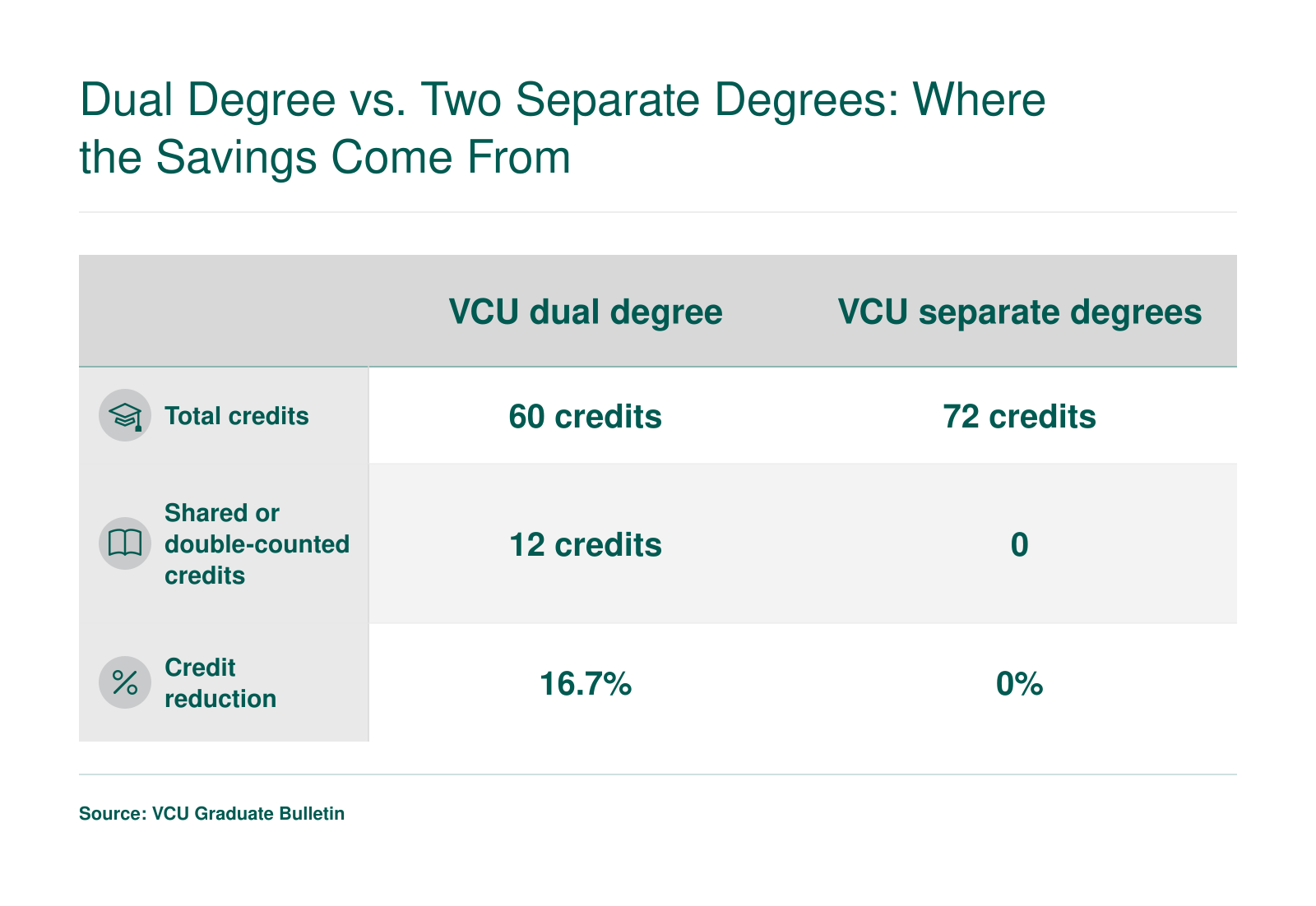
At Virginia Commonwealth University, the dual MBA/MAcc path requires 60 credits instead of the 72 credits needed to earn the MBA and MAcc separately. That overlap of 12 shared credits is the main savings lever, and the same pattern shows up at Washburn, where a 45-credit dual degree replaces a 60-credit separate path. Exact totals vary by school.
Related Articles
Return on Investment: Earnings, Debt, and Payback
Among the affordable MBA and MPAcc programs that report earnings, median pay five years after finishing ranges from about $92,800 at Southern Utah University to roughly $124,000 at Virginia Commonwealth University. Belmont University ($120,000), the University of Washington ($115,270), and Syracuse University ($109,100) sit in the upper middle. Eastern Washington University reports median earnings of about $60,700 one year after finishing, a shorter window that is not directly comparable.
Median debt also varies sharply. Southern Utah carries the lowest median debt here at $14,739, and its 10-year monthly payment of $168 is the lightest. The University of Washington and Eastern Washington both report $20,500 in median debt with a $233 monthly payment. Virginia Commonwealth's $54,332 median debt leads to a $618 monthly payment, while Belmont is close at $53,160 with a $605 payment.
CPA exam performance is published for only one of these schools. Belmont reported a 73.5% first-time pass rate in 2025, ahead of the national first-time rate of 60.2% and Tennessee's 64.8%.1 Programs without reported earnings or debt are omitted rather than estimated.
A dual MBA/MPAcc lets a set of courses count toward both degrees, so you pay for fewer total credits than you would earning the two separately.
CPA Eligibility: Does a Dual MBA/Mpacc Get You to 150 Hours?
Dual MBA/MPAcc programs, like other MBA programs, almost always clear the 150-semester-hour bar on raw credit count. A 120-credit bachelor's plus a combined master's load that typically runs well past 30 credits puts you over the line with room to spare. The harder question is whether your coursework hits the specific accounting and business minimums your state board enforces, because total hours alone do not make you eligible.
What one state actually requires
Texas is a useful illustration. To sit for the Uniform CPA Examination, candidates need 120 semester hours including 21 upper-level accounting hours and 21 upper-level related business hours through July 31, 2026, with the accounting and business requirements each rising to 24 hours on August 1, 2026.1 Certification under the traditional route requires a bachelor's or graduate degree, 150 semester hours, and one year of qualifying work experience.2 Requirements differ meaningfully from state to state, so treat Texas as an example rather than a template.
New pathways change the math
Effective August 1, 2026, Texas adds an alternative route: a bachelor's degree with 120 semester hours, 24 upper-level accounting hours, 21 upper-level business hours, a three-hour ethics course, passage of the exam, and two years of experience.3 If your state offers something similar, the master's becomes a choice about speed and salary rather than a licensing requirement. Map each program's accounting electives against your own board's rules before you enroll, and compare accelerated master's in accounting programs when speed matters for CPA eligibility.
Online vs. Campus: Flexibility and Realistic Completion Times
Delivery modes in the programs below run from fully online to campus-based, with a few hybrid options. Full-time schedules often target about two years, while Eastern Washington's Online MBA dual degree shows the fastest advertised path: 64 credits across 16 courses, six-week asynchronous sessions, and seven start dates per year can add up to a 14-month minimum. That pace assumes students keep a fairly heavy course load.
Working professionals comparing affordable online MBA programs usually proceed more slowly. Eastern Washington's MBA guidance suggests about eight credits, or two courses, per quarter for full-time workers1, while the MPAcc side recommends one course at a time2. At those loads, completion typically stretches beyond two years, and part-time timelines of three years or more are common. Online students should also check residency rules: even the asynchronous format may require most credits to be taken through Eastern Washington rather than transferred, and the catalog does not spell out whether residency means physical campus attendance.
Admissions Checklist for Affordable MBA/Mpacc Programs
Use this checklist to prepare your application.
- Bachelor's degreeConfirm your undergraduate degree is from an accredited institution and matches the program's required major.
- Minimum GPAEastern Washington sets a 3.0 cumulative GPA baseline, with a 2.5 route available if you have three years of verified work experience or score at least 1050 on an admission index.
- GMAT/GREEastern Washington waives the GMAT for many applicants, but waiver policies vary, so confirm whether you qualify.
- Accounting prerequisitesNon-accounting majors at Eastern Washington complete intermediate, cost, auditing, and tax coursework; West Georgia adds 15 upper-division accounting credits.
- Business foundationsStudents without a business background may need finance, accounting, and quantitative analysis, or West Georgia's five-course business core.
- Work experienceWork experience is not a universal requirement; at Eastern Washington it matters mainly for the lower-GPA admission pathway.
- Applications and deadlinesWest Georgia requires separate online applications to both programs with a $55 fee each; Eastern Washington's deadline is Dec. 14, 2026.
MBA/MPAcc programs by state
MBA/Mpacc Dual Degree FAQs
Quick answers to common questions about MBA/MPAcc dual degrees.
What is the cheapest MBA/MPAcc dual degree program?
What is the difference between an MBA and an MPAcc?
Is an MBA/MPAcc dual degree worth the extra cost?
Compare MBA/MPAcc programs on the data that matters
Explore more MBA specializations or browse every graduate field.
All MBA programs