Master's in Kinesiology & Exercise Science Programs With No GRE Required
Compare 210+ accredited no-gre Exercise Science programs at 190+ schools, with graduate earnings, cost, debt, and completion data from IPEDS and the U.S. College Scorecard.

A growing share of kinesiology and exercise science master's programs have dropped the GRE, so test fees and months of prep no longer block qualified applicants. That shift matters in fields like athletic training, where a CAATE-accredited master's is required for Board of Certification eligibility.
"No GRE" can mean a permanent policy or a conditional waiver tied to GPA or work experience. The programs below differ in format, thesis option, tuition, and career path, and some are Accelerated Master's in Kinesiology & Exercise Science tracks, but admissions committees now lean on transcripts, recommendations, and relevant experience.
Key Points
- Several programs waive the GRE for 2026 applicants with a 3.0 GPA.
- Texas A&M Corpus Christi, UT Permian Basin, and Cincinnati run asynchronous master's.
- LSU structures 36 credits over four semesters.
Top 10 No-GRE Master's in Kinesiology & Exercise Science Programs
This list highlights accredited master's programs in kinesiology and exercise science where the GRE is not part of the standard admission equation. Each entry notes the program's delivery format, credit structure, published tuition when available, and the kind of hands-on or research experience students should expect. Use the list as a shortlist for comparing cost, format, and career focus.
California State University-Long Beach
#1Long Beach, CA · $9,000 – $19,000/yr (est.)
Best for: California students wanting research-based lab training
Cal State Long Beach's M.S. in Exercise Science pairs advanced coursework in physiology, biomechanics, and neuromotor control with hands-on work in dedicated exercise physiology and movement science labs. Students can finish with a thesis, project, or comprehensive exam, so the program fits both research and applied careers. Admission is fall-only and prerequisite coursework is required, but the GRE is not.
- No entrance exam required
- Fall start only
- Prerequisite coursework required
- Thesis, project, or comprehensive exam option
- Hands-on labs: exercise physiology and movement science
- Covers physiology, biomechanics, and motor control
Smith College
#2Northampton, MA · $60,000 – $65,000/yr (est.)
Best for: Aspiring intercollegiate coaches of women's teams
Smith College's 53-credit master's in exercise and sport studies is built for aspiring coaches of women's college teams. Students spend the two-year program as assistant coaches while studying biomechanics, exercise physiology, sport psychology, and gender in sport. The program holds Level V NCACE accreditation and offers substantial scholarships, with a selective incoming class. Admission is test optional, and international applicants may need to submit TOEFL scores.
- 53 total credit hours
- $2,100 per credit
- Two-year coaching residency format
- NCACE Level V accreditation
- Focus on coaching women's intercollegiate teams
- Test optional; TOEFL for international applicants
University of Mississippi
#3University, MS · $5,000 – $10,000/yr (est.)
Best for: Pre-health students seeking research experience
The University of Mississippi's 30-credit Master of Science in Exercise Science explores human movement, cardiopulmonary health, and athletic performance. Students may complete a thesis, internship, or elective capstone and can participate in research while building a foundation for clinical exercise physiology, strength and conditioning, or pre-health study. The GRE is not required, and applications are accepted throughout the year with materials recommended at least three weeks before the desired term.
- 30 total credit hours
- 3.0 GPA minimum
- Thesis, internship, or capstone option
- No GRE required
- Research participation available
- Prepares for PT, OT, or medical school
University of Nevada-Las Vegas
#4Las Vegas, NV · ~$7,000/yr (est.)
UNLV's M.S. in Kinesiology centers on an exercise physiology emphasis, with thesis, professional paper, and accelerated BS-MS subplan options. Admission requires a related undergraduate major and a 2.75 overall GPA or 3.00 in the last two years, and the GRE is optional. Students start in fall, spring, or summer and can move into research, clinical, or athletic settings.
- Exercise physiology emphasis available
- Thesis track: 33 credits
- Professional paper track: 24-30 credits
- GRE optional
- 2.75 overall GPA minimum
- Three start dates per year
- Accelerated BS-MS subplan available
University of Memphis
#5Memphis, TN · $10,000 – $15,000/yr (est.)
The University of Memphis offers a Health Studies master's with a concentration in Exercise, Sport and Movement Sciences. Students complete a research laboratory residency, applied project, or thesis and must pass a written comprehensive exam. GRE and PRAXIS II scores are optional, and admission requires a 2.75 baccalaureate GPA.
- Exercise, Sport and Movement Sciences concentration
- Research residency, applied project, or thesis
- Written comprehensive exam required
- GRE and PRAXIS II optional
- 2.75 GPA minimum
- May 1 and November 1 deadlines
Merrimack College
#6North Andover, MA · ~$37,000/yr (est.)
Merrimack College's M.S. in Exercise and Sport Science offers concentrations in Exercise Science and Strength and Conditioning, with a flexible format that mixes online courses and on-campus classes meeting one or two days per week. The degree can be completed in as little as nine months, and fieldwork, capstone projects, and fellowship placements build professional experience. The program requires no application fee or GRE, and fellowships may cover up to 100 percent of tuition.
- Exercise Science and Strength and Conditioning concentrations
- No GRE required
- $0 application fee
- As little as nine months
- Up to 100 percent tuition fellowships
- Online or on-campus course mix
University of Cincinnati
#7Cincinnati, OH · ~$15,000/yr (est.)
The University of Cincinnati's online Master of Science in Exercise Science is fully asynchronous and can be completed in one year or three semesters. The 30-credit curriculum combines research methods, advanced exercise physiology, pathophysiology, nutrition, and psychological foundations with a capstone or internship and 12 elective credits. Admission requires a 3.0 GPA and no GRE, and the program prepares students for ACSM and NSCA certification exams.
- 30 total credit hours
- Fully online asynchronous format
- 1 year or 3 semesters
- 3.0 GPA minimum
- No GRE required
- Capstone or internship option
- Prepares for ACSM and NSCA exams
Lionel University
#8Carpinteria, CA · $10,000 – $15,000/yr (est.)
Lionel University's online Master of Science in Exercise Science is a 45 quarter credit program with three concentrations: Strength and Conditioning, Fitness Leadership, and Corporate, Clinical, and Community Wellness. Courses run 10 weeks and the degree typically takes 9 to 12 months, at $440 per credit with no application fee. Admission requires no test scores, and the university is accredited by the Distance Education Accrediting Commission.
- 45 quarter credit hours
- $440 per credit
- No test scores required
- $0 application fee
- 10-week online courses
- Three concentrations available
- DEAC accredited
Kennesaw State University
#9Kennesaw, GA · ~$7,000/yr (est.)
Kennesaw State's Master of Science in Exercise Science combines face-to-face coursework with labs in body composition, muscular fitness, and metabolic function. The 30-credit program takes about two years and includes internships with partners like Wellstar, along with faculty research collaborations. GRE scores are optional, and fall and spring entry options provide scheduling flexibility.
- 30 total credit hours
- Two-year completion
- 3.0 GPA minimum
- GRE optional
- Internships with Wellstar
- Fall and spring entry
Montana State University
#10Bozeman, MT · ~$8,000/yr (est.)
Montana State's M.S. in Exercise and Nutrition Sciences offers an Exercise Physiology and Nutrition concentration with access to movement science, nutrition research, and human performance labs. The program requires no GRE, and students can pursue research assistantships or a verification statement toward registered dietitian pathways. Montana residents benefit from a much lower in-state tuition rate than out-of-state students.
- Exercise Physiology and Nutrition concentration
- No GRE required
- Research assistantships available
- Verification statement for registered dietitian pathway
- Movement science and human performance labs
- In-state tuition $6,299; out-of-state $30,784
Cost & outcomes by school
Federal data for the highest-earning Exercise Science programs, independent of the ranking above. Earnings are this field's master's graduates four years after completing, where the Scorecard reports them.
| School | Earnings | Tuition / yr | Debt | Grads/yr | Format |
|---|---|---|---|---|---|
| Northeastern University MA | $73,724 | $26,020 | $37,375 | 35 | Campus |
| California State University-Long Beach CA | $72,540 | $8,898 | $25,602 | 86 | Campus |
| University of North Carolina at Chapel Hill NC | $71,951 | $12,751 | — | 32 | Campus |
| American Public University System WV | $70,509 | $8,700 | $35,798 | 180 | Online |
| University of South Carolina SC | $67,786 | $14,134 | $30,110 | 50 | Campus |
| Wayne State University MI | $66,774 | $17,960 | $30,750 | 45 | Campus |
| University of Memphis TN | $66,104 | $11,628 | $28,579 | 29 | Campus |
| Texas State University TX | $64,908 | $8,997 | $30,500 | 37 | Campus |
| University of Cincinnati OH | $59,231 | $14,902 | $24,050 | 90 | Online |
| Central Connecticut State University CT | — | $14,562 | — | — | Campus |
Sources: U.S. Department of Education. Tuition and graduates: IPEDS. Earnings and debt: College Scorecard, this field's master's graduates; a dash means no figure is reported.
Cost, debt & payoff
Median earnings of this field's master's graduates (4 yrs after completing) vs. their median federal loan debt · U.S. College Scorecard
Across these programs the median graduate earns about $60,376 and finishes with roughly $28,488 in debt — a ratio that clears a common rule of thumb (keep debt below first-year salary). Tuition and debt vary widely school to school, so check the per-school figures in the table above before you shortlist.
What No-GRE Kinesiology Programs Ask for Instead
- Bachelor's degreeA bachelor's degree is the baseline; many accept related majors like exercise science or biology.
- Minimum GPAGPA expectations range from 2.5 to 3.0; Avila lists 2.5, while UW–Madison, San Francisco State, and Seattle use 3.0.
- Prerequisite courseworkAnatomy and physiology, exercise physiology, and statistics are common prerequisites; Abilene Christian adds biomechanics and college algebra.
- Letters of recommendationLetters are not universal; Abilene Christian requires two, while others may ask only select applicants.
- Personal statementA personal statement often replaces the GRE as the writing sample.
- Application deadlinesDeadlines vary by term; UW–Madison lists December 1 for spring, Seattle February 15 for fall 2026.
- Transfer creditTransfer limits also vary; UW–Madison allows up to 14 graduate credits.
Online vs. Campus No-GRE Kinesiology Programs
The biggest fork is scheduling and access. Fully online tracks at Texas A&M University Corpus Christi, UT Permian Basin, and the University of Cincinnati are asynchronous and built for working coaches and trainers, while campus or hybrid formats at Southeastern and Lamar keep more structured in-person learning. If you need research lab time and assistantships for a PhD, campus is usually the stronger fit.
| Dimension | Online | Campus or hybrid |
|---|---|---|
| Schedule flexibility | Fully asynchronous options; no campus visits required at Texas A&M University Corpus Christi, UT Permian Basin, and LSU. | Scheduled in-person meetings; hybrid formats at Southeastern and Lamar mix campus and online sessions. |
| Lab and hands-on access | Often uses virtual labs, recorded demonstrations, and local practicum or clinical sites arranged near the student. | Direct on-campus lab access and supervised activities during in-person sessions; hybrid formats preserve some lab time. |
| Internship placement | Students typically secure a local approved site; faculty may provide guidance but not direct on-campus placement. | On-campus programs often maintain local site relationships and can place students more directly. |
| Tuition structure | Many online programs charge a flat per-credit rate regardless of residency. | Campus programs more often separate in-state and out-of-state tuition rates. |
| Time to completion | University of Cincinnati's online MS in Exercise Science can be finished in about one year, with 30 credits. | Southeastern's hybrid MS in Kinesiology uses a two-year format with selected in-person courses each fall and spring. |
| Typical track | Tends to favor non-thesis, applied coursework and final projects. | More often offers thesis research, faculty mentorship, and graduate assistantships for students headed toward a PhD. |
Thesis, Non-Thesis, and Concentration Options
Most kinesiology and exercise science master's degrees fall in the 30 to 36 credit range, including many master's programs with no GRE required. Montclair State's 33-credit M.S. runs two years, LSU's 36 credits typically take four semesters2, and Texas Tech structures its 36 credits over two years3. The University of Cincinnati's 30-credit online master's in kinesiology is built to finish in one year.1
The bigger decision is how you finish. A thesis fits students headed toward a PhD or a research career. LSU and Kennesaw State each allot 6 thesis credits24, and Kennesaw's thesis spans at least two consecutive semesters4. Non-thesis routes end in applied work instead. Cincinnati's final-semester Applied Experience offers a capstone or an internship of 100+ hours1, and Azusa Pacific requires a capstone rather than a thesis.5
Common concentrations include:
- Exercise physiology: UNT offers it alongside sport and exercise psychology and applied movement science.6
- Strength and conditioning: Azusa Pacific folds it into exercise science with biomechanics and sport nutrition.5
- Sport management: Montclair State's Sport Administration concentration targets athletics leadership.
If you plan to pursue the NSCA's CSCS or an ACSM credential, favor a program with a supervised internship or practicum. Kennesaw's field experience, for example, runs 120 to 360 hours depending on credits4, giving you hands-on practice that supports certification prep and job applications.
Related Articles
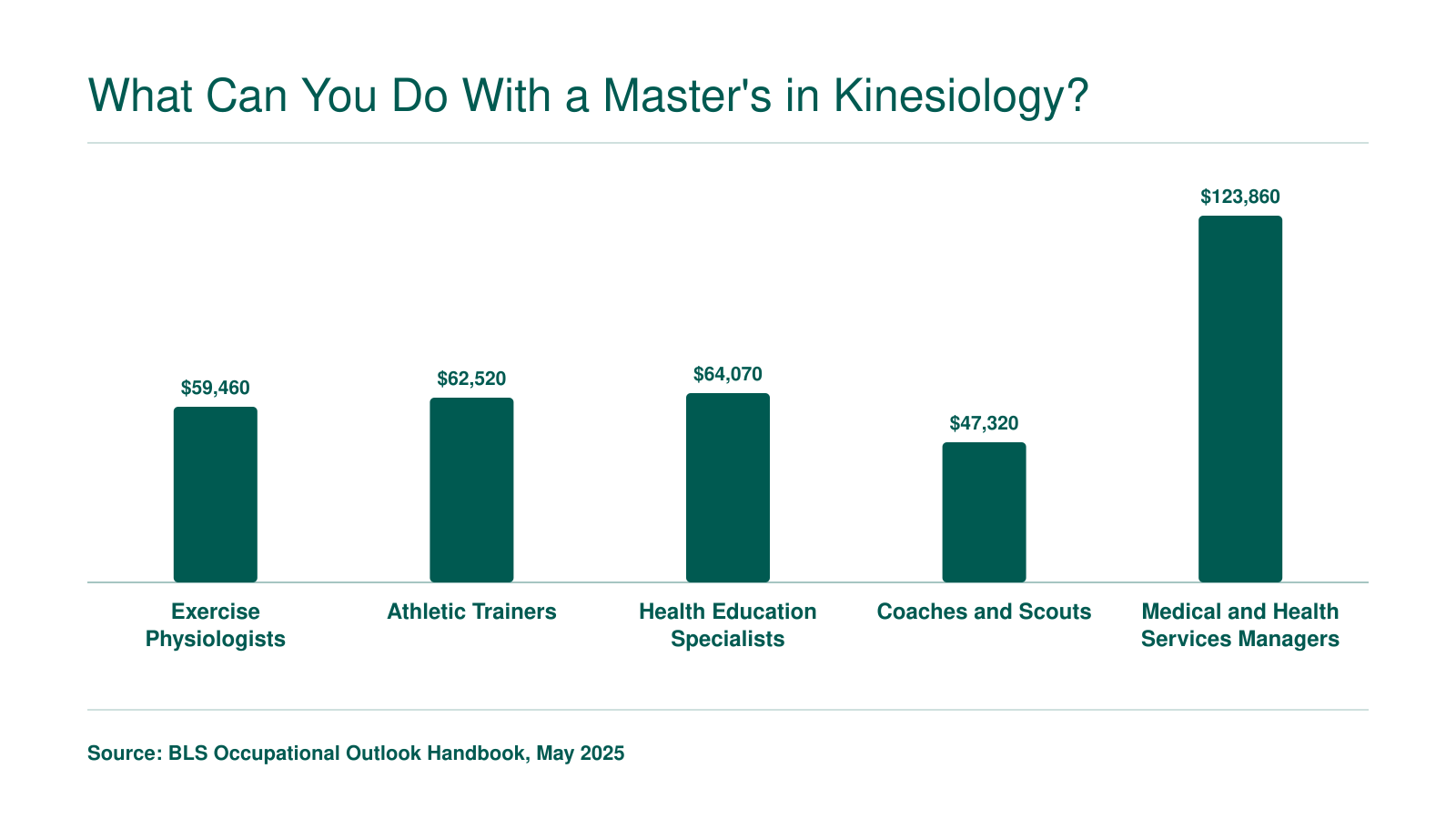
What Can You Do With a Master's in Kinesiology?
Median annual wages below come from the Bureau of Labor Statistics Occupational Outlook Handbook, May 2025 data. Athletic trainers must hold Board of Certification (BOC) certification to practice, while a master's can support advancement into supervisory, clinical, or college-level roles. Medical and health services managers, the highest-paid occupation shown, often benefit from additional leadership experience.
Tuition Costs and Financial Aid for No-GRE Programs
Published per-credit rates below are the most complete figures available for no-GRE kinesiology and exercise science master's programs. These figures do not always include mandatory fees, and campus programs may set separate in-state and out-of-state rates, so confirm the full cost with each school. Funding can lower the real cost: graduate assistantships at many programs cover tuition or provide a stipend, and federal Direct Unsubsidized and Grad PLUS loans, employer tuition assistance, and association scholarships are common options.
| School | Format | Per-Credit Tuition | Total Credits | Estimated Total Tuition |
|---|---|---|---|---|
| Louisiana State University | Online | $644 per credit | 36 | $23,184 |
| Eastern Kentucky University | Not stated | $620 per credit | 30 | $18,600 |
| University of Florida | Not stated | $585.75 per credit, including fees | 30 | $17,572.50 |
Exercise Science programs by state
No-GRE Kinesiology Master's FAQ
Is the GRE required for a master's in kinesiology?
Can I get a master's in kinesiology online without the GRE?
How long does a master's in kinesiology take?
What GPA do you need for a kinesiology master's degree?
Compare Exercise Science programs on the data that matters
Explore more Healthcare specializations or browse every graduate field.
All Healthcare programs