Best Online Master's in Kinesiology & Exercise Science Programs
Compare 70+ accredited online Exercise Science programs, with graduate earnings, cost, debt, and completion data from IPEDS and the U.S. College Scorecard.

Annual in-state graduate tuition for the fully online kinesiology and exercise science programs ranked here runs from $6,693 at Florida Atlantic University to $17,370 at Canisius University, so price alone won't tell you which degree leads to a certification or a better job.
Every program in this ranking is fully online, with no required hybrid or on-campus component. That means the real comparison shifts to exam prep, internship placement, and the first-year salary a program's graduates report.
With NSCA set to require CASCE-accredited degrees for first-time CSCS candidates by 2030, that deadline should be part of the enrollment decision now, not an afterthought.
Key Points
- In-state tuition runs $6,693 at Florida Atlantic to $20,103 at Western Michigan.
- Concordia University-Chicago reports the highest first-year median earnings among ranked programs.
- Most programs below do not require the GRE; LSU offers grade waivers.
Top 10 Best Fully Online Master's in Kinesiology & Exercise Science Programs
These 10 master's programs are fully online options in kinesiology and exercise science, so hybrid and low-residency formats are excluded. Each program is reviewed for its delivery mode, concentration options, affordability, and graduate outcomes. The order reflects a composite of institutional data and program features, not any single metric.
Florida Atlantic University
#1Boca Raton, FL · $7,000 – $18,000/yr (est.)
Best for: Florida residents maximizing in-state tuition savings
Florida Atlantic University's fully online MS in Exercise Science and Health Promotion offers concentrations in exercise physiology and health promotion, with fall, spring, and summer starts. Florida residents pay in-state graduate tuition and fees of $4,879, while out-of-state students pay $17,324; the estimated net price is $8,752. Admission requires a 3.0 GPA in the last 60 undergraduate credits.
- 30-credit online program with fall, spring, and summer starts
- Requires 3.0 GPA in last 60 undergraduate credits
- Charles E. Schmidt College of Science
- International applicants submit TOEFL, IELTS, or Duolingo scores
The University of Texas at El Paso
#2El Paso, TX · $5,000 – $10,000/yr (est.)
Best for: Future exercise scientists seeking lab research mentors
UTEP's fully online MS in Kinesiology, available through Finish@UT, offers concentrations in motor behavior, strength and conditioning, and metabolic and exercise research. Full admission requires a related bachelor's degree and a 3.0 GPA, and the GRE is waived for UTEP kinesiology graduates from the past five years. In-state graduate tuition and fees are $9,744, out-of-state $25,502, and the estimated net price is $9,403.
- Concentrations in motor behavior, strength and conditioning, and metabolic and exercise research
- Five state-of-the-art research labs, including Stanley E. Fulton Gait Research Lab
- Fast-track option for undergraduates to earn graduate credit
- Prepares for research and teaching or doctoral study
The University of Texas at Tyler
#3Tyler, TX · ~$8,000/yr (est.)
Best for: Pre-health students needing thesis or internship flexibility
UT Tyler's online MS in Kinesiology combines core courses in exercise physiology and biomechanics with concentrations in human performance, nutrition, and general exercise science. Students choose a thesis or internship capstone, and formats include fully online, on-campus, and hybrid options. In-state graduate tuition and fees are $9,736, out-of-state $25,494, and the estimated net price is $13,323.
- Concentrations in human performance, nutrition, and general exercise science
- 36 credit hours with thesis or capstone option
- Requires 3.0 GPA and three recommendation letters
- NIH-funded research and Lifespan Wellness Research Center
Calvin University
#4Grand Rapids, MI · ~$11,000/yr (est.)
Calvin University's fully online Master of Exercise Science offers concentrations in performance and sport science and health and exercise rehabilitation. Students complete seven foundational courses and three concentration-specific courses, with full-time or part-time enrollment and a 12-month minimum completion time. Tuition and fees are $39,350 for all students, and the estimated net price is $22,992.
- Concentrations in Performance and Sport Science and Health and Exercise Rehabilitation
- Seven foundational courses plus three concentration courses
- 12-month minimum completion; full-time or part-time enrollment
- Requires 2.8 GPA, two recommendation letters, and a personal statement
McDaniel College
#5Westminster, MD · ~$10,000/yr (est.)
McDaniel College's MS in Exercise Science and Physical Education offers tracks in general studies, administration, and scientific perspectives, with the scientific perspective track supporting preparation for ACSM or NSCA certification exams. Tuition and fees are $52,081, and the estimated net price is $21,916. A thesis or comprehensive examination option lets students tailor the program to their goals.
- Tracks in general studies, administration, and scientific perspectives
- Prepares for ACSM or NSCA certification exams
- Requires 2.8 GPA and three recommendation letters
- Thesis option or comprehensive examination
- Coursework in research design and statistics
Saint Xavier University
#6Chicago, IL · ~$14,000/yr (est.)
Saint Xavier University's Master of Science in Exercise Science is fully online and offers an optional strength and conditioning concentration. The program includes a two-day onsite intensive at the Human Performance Lab, with one-year accelerated, two-year traditional, and 4+1 dual-degree paths. Tuition and fees are $37,940, and the estimated net price is $10,970; the strength and conditioning track is $530 per credit.
- Six core courses in research methods, ethics, behavior psychology, and communication
- Two-day onsite intensive at the Human Performance Lab
- One-year accelerated, two-year traditional, or 4+1 dual-degree options
- $530 per credit, 100% online
- Prepares for NSCA-CSCS certification
- Applied project for hands-on experience
- Access to Human Performance Lab and networking seminars
Tennessee Tech
#7Cookeville, TN · $10,000 – $15,000/yr (est.)
Tennessee Tech's fully online MA in Exercise Science offers concentrations in adapted physical education, lifetime wellness, and sport management. Paid graduate assistantships can cover tuition and fees, and the institution is nationally accredited. In-state graduate tuition and fees are $11,376, out-of-state $15,576, and the estimated net price is $14,246.
- Concentrations in Adapted Physical Education, Lifetime Wellness, and Sport Management
- Fully online, nationally accredited program
- Paid graduate assistantships cover tuition and fees
- Adapted PE track leads physical activity for individuals with disabilities
University of North Dakota
#8Grand Forks, ND · ~$14,000/yr (est.)
The University of North Dakota's fully online MS in Kinesiology is a 30-credit, asynchronous program that covers exercise physiology, biomechanics, sport psychology, and coaching. Online tuition is the same for all students, so in-state and out-of-state graduate tuition and fees are $10,951 and $15,570, respectively, with an estimated net price of $18,551.
- 30-credit, two-year fully online asynchronous program
- Same online tuition for any residency
- Carnegie R1 institution with free tutoring and professional workshops
- Internship in kinesiology available
- Requires 2.8 GPA, no campus visits required
University of Cincinnati
#9Cincinnati, OH · ~$15,000/yr (est.)
The University of Cincinnati's online MS in Exercise Science is a 30-credit, asynchronous program that can be completed in one year or three semesters. No GRE is required, and the curriculum prepares students for NSCA CSCS/CPSS and ACSM EP/CEP exams. In-state tuition and fees are $13,976, out-of-state $29,310, and the estimated net price is $25,648.
- 30-credit program completed in one year or three semesters
- 100% online and asynchronous
- No GRE required; 3.0 GPA and one recommendation letter
- Prepares for NSCA CSCS/CPSS and ACSM EP/CEP exams
- Capstone or internship plus 12 elective credits
Canisius University
#10Buffalo, NY · ~$17,000/yr (est.)
Canisius University's online MS in Exercise Science is a 33-credit program that can be completed in one to two years. Internship opportunities include sites such as the Buffalo Bills and Roswell Park Cancer Institute, and the program prepares students for CSCS and NASM certifications. Tuition and fees are $34,500, and the estimated net price is $17,940.
- $945 per credit; 33 credit hours
- Complete in one to two years; full-time or part-time
- Internships with Buffalo Bills and Roswell Park Cancer Institute
- Prepares for CSCS and NASM certifications
- Alumni include performance coaches and exercise physiologists
Cost & outcomes by school
Federal data for the highest-earning Exercise Science programs, independent of the ranking above. Earnings are this field's master's graduates four years after completing, where the Scorecard reports them.
| School | Earnings | Tuition / yr | Debt | Grads/yr | Format |
|---|---|---|---|---|---|
| Adelphi University NY | $79,199 | $32,822 | $41,000 | 20 | Hybrid |
| American Public University System WV | $70,509 | $8,700 | $35,798 | 180 | Online |
| University of Florida FL | $68,986 | $12,737 | $31,447 | 136 | Hybrid |
| United States Sports University AL | $67,850 | $18,468 | $28,488 | 17 | Hybrid |
| Concordia University-Chicago IL | $66,304 | $10,782 | $21,612 | 239 | Online |
| Florida Atlantic University FL | $66,095 | $6,693 | — | 29 | Online |
| Hardin-Simmons University TX | $63,632 | $15,110 | $22,459 | 18 | Online |
| Concordia University-Saint Paul MN | $62,713 | $8,550 | $32,175 | 41 | Online |
| East Texas A&M University TX | $62,497 | $7,338 | $22,372 | 36 | Hybrid |
| University of Cincinnati OH | $59,231 | $14,902 | $24,050 | 90 | Online |
| Pennsylvania Western University PA | $59,065 | $11,261 | $30,500 | 163 | Online |
| Liberty University VA | $56,966 | $8,730 | $29,153 | 160 | Hybrid |
Sources: U.S. Department of Education. Tuition and graduates: IPEDS. Earnings and debt: College Scorecard, this field's master's graduates; a dash means no figure is reported.
Cost, debt & payoff
Median earnings of this field's master's graduates (4 yrs after completing) vs. their median federal loan debt · U.S. College Scorecard
Across these programs the median graduate earns about $60,376 and finishes with roughly $28,488 in debt — a ratio that clears a common rule of thumb (keep debt below first-year salary). Tuition and debt vary widely school to school, so check the per-school figures in the table above before you shortlist.
How We Ranked Fully Online Kinesiology and Exercise Science Programs
Fully Online Only
Every master's in kinesiology online program on this list can be completed without setting foot on campus. We excluded programs that require hybrid attendance, weekend intensives, or on-campus residencies, because "online" should mean you can earn the degree from wherever you live and work. If a program advertised distance learning but still demanded in-person weeks, it didn't qualify.
What Goes Into the Ranking
We build our comparisons of the best master's in kinesiology and exercise science programs on verifiable federal data, not school marketing. The inputs include:
- Cost: graduate tuition and fees, plus the average net price students actually pay after grants and scholarships.
- Completion: institution-wide graduation and retention rates, which signal whether students finish what they start.
- Outcomes: program-level graduate earnings and debt, where the federal government publishes them.
Pulling from College Scorecard and IPEDS keeps the rankings independent of any school's advertising or self-reported claims.
Honest Limits
We want you to read these numbers correctly. The net price figure is the university-wide average after aid; your own cost can differ with your residency and financial awards. Graduation and retention rates cover the whole university, not the kinesiology department specifically, since federal data isn't broken out that finely.
Some programs show no earnings figure. That means the federal government hasn't published program-level data for that degree yet, often because the program is newer or too small to report. It is not a sign of weak outcomes, so we don't penalize a program for a gap that reflects reporting rules rather than quality.
What an Online Master's in Kinesiology Really Costs: Tuition, Fees, and Debt
Published tuition for the online kinesiology master's programs ranked here runs from $6,693 at Florida Atlantic University to $20,103 at Western Michigan University for in-state students, and from $10,537 at Trevecca Nazarene University to $29,681 at Western Michigan for out-of-state students. Treat those numbers as a floor. Credit totals, mandatory fees, and residency rules all push the real price of the degree higher.
Why Per-Credit Rates Understate the Bill
The more useful number is the full program cost: total credits multiplied by the per-credit rate, plus every required fee. Trevecca shows the gap clearly. Its listed tuition is $10,537, but its own program page puts total tuition at $18,579 (33 credits at $563 each). Other programs follow the same math, though some of these figures come from secondary sources and may not reflect 2026 rates:
- LSU Online: 36 credits at $644 per credit, about $23,184 in tuition.
- Concordia University St. Paul: 33 credits at $475, about $15,675.
- UTRGV: roughly $16,000 total, plus a $50 graduation fee.
- UT Permian Basin: about $11,730 to $12,903 for 30 to 33 credits, with additional fees possible.
Fees vary widely. A.T. Still University requires a student technology fee on top of tuition, and East Texas Baptist University has reported a $70 per-course online fee plus a $330 charge each semester. Small charges like these add up over a two-year program.
Flat Rates Shrink the Residency Gap
Many online programs charge one rate no matter where you live. LSU's online M.S. uses flat-rate tuition with no out-of-state fees, and Georgia Southern, the University of North Dakota, and East Texas Baptist have reported similar single-rate policies. Southern Mississippi has reported waiving out-of-state tuition for fully online programs. Saint Xavier, Trevecca, and Canisius charge the same in-state and out-of-state tuition. If you live outside a public university's state, a flat online rate can make a master's in kinesiology online cheaper than your own state's option.
What Graduates Actually Borrow
Program-level debt data is sparse for this field. Canisius University is the clear exception: its exercise science master's graduates carry a median debt of $30,913, which works out to about $352 a month on a standard 10-year repayment plan. Compare that payment against realistic starting pay before committing to a higher-priced program.
Before You Compare Schools
Pull up each school's bursar or tuition page and confirm two things: the exact credit count required to graduate and every mandatory fee (technology, distance learning, graduation). Multiply, add, and compare total program costs side by side, not per-credit rates.
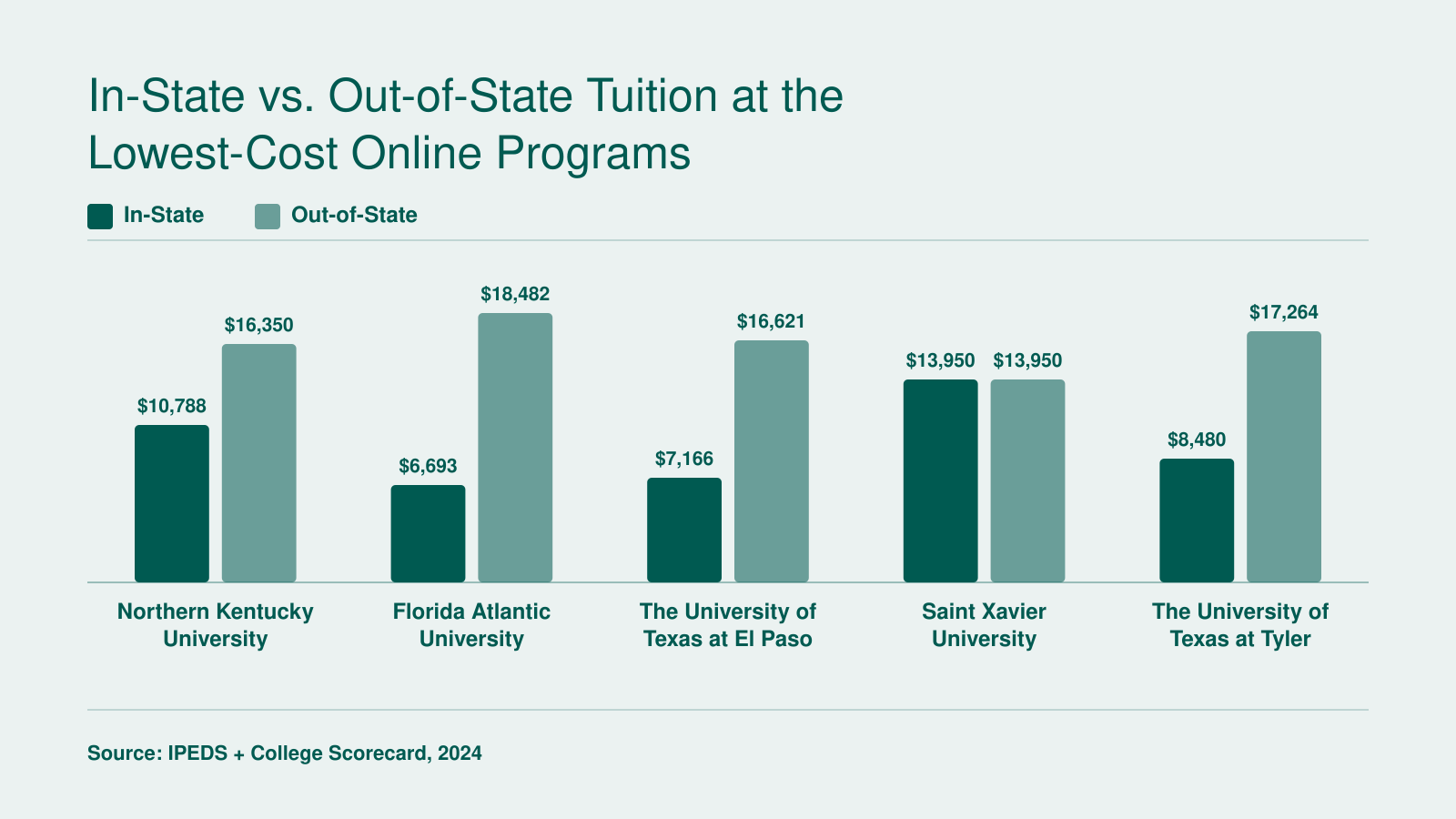
In-State vs. Out-of-State Tuition at the Lowest-Cost Online Programs
In-state and out-of-state published graduate tuition and fees vary widely among fully online kinesiology programs. Saint Xavier University charges the same annual amount either way, which is a sign of flat online pricing. The figures below are annual published graduate tuition and fees, not total program cost or net price.
Starting January 1, 2030, the NSCA will require first-time U.S. candidates for its CSCS exam to hold a bachelor's degree or higher from a strength and conditioning program accredited through CASCE, according to the NSCA Certification Handbook. If you plan to coach athletes, check a program's own accreditation, not just the university's.
Practicums, Internships, and Capstones: What 'Fully Online' Really Means
Field Hours Still Happen Near Home
The University of Cincinnati's online M.S. in Exercise Science is 100% online, yet its final-semester, 3-credit Applied Experience can be an internship requiring at least 100 hours at an approved site, plus a portfolio and presentation. That pattern is common: "fully online" usually describes the coursework, not every requirement. Hour counts vary widely. Tiffin University's M.S. in Clinical Exercise Physiology calls for 150 hours, which can come from current employment, prior experience, or a new position. Mississippi State University's 2025-2026 handbook sets 300 documented hours over at least 10 weeks, in a position the student hasn't held before. Michigan State University's M.S. in Kinesiology internship requires 60 hours per semester credit, with up to 15 of those allowed off-site. Saint Xavier University pairs fully online coursework with a two-day onsite lab intensive, so budget for travel.
Thesis or Capstone: Match It to Your Goal
UT Tyler and McDaniel College both offer a thesis or capstone option, and Ouachita Baptist University lets students choose between a 100-hour internship and a thesis. A thesis makes sense if you're aiming for a PhD, a research lab, or college teaching, because it produces evidence that you can design and finish a study. A capstone, project, or internship fits working coaches, trainers, and clinicians who want applied skills and a reference from a supervisor. Check the fine print: Mississippi State pairs its directed study and internship routes with comprehensive exams.
Asynchronous Classes and Working Schedules
Cincinnati and the University of North Dakota both deliver asynchronous online classes, meaning you work through material on your own schedule against weekly deadlines rather than logging in at set times. That flexibility matters if you coach evenings or work clinical shifts. Synchronous sessions build connection with faculty but can clash with a full-time job, so ask whether any course meets live and in which time zone.
Ask Who Finds the Internship Site
At Michigan State, the student arranges the internship site, and an advisor or committee must pre-approve it. Many curriculum pages, including Cincinnati's, don't say who handles placement. Before applying, ask:
- Do I find the site and supervisor myself?
- Can my current job count toward required hours?
- Will the program approve a site in my state?
Related Articles
Admissions Checklist: GRE, GPA, Prerequisites, and Transfer Credits
The short answer on the GRE: most of the programs below do not require it. Several have dropped or suspended the GRE entirely, while others make scores optional or offer waivers tied to grades, such as LSU’s waiver for applicants with a 3.0 in their last 60 undergraduate hours.
- Minimum GPAMost programs expect a 2.75–3.0 cumulative GPA. Avila lists 2.5–2.75 (with a provisional route), Arkansas allows 2.70–2.99 with additional GRE criteria, and Cincinnati, UT Arlington, LSU, URI, Illinois State, and San Francisco State list 3.0.
- Prerequisite courseworkCommon prerequisites include human anatomy and physiology, exercise physiology, biomechanics or functional anatomy, and statistics. Some programs add general biology, chemistry, exercise testing, or college algebra. Non-kinesiology majors can often qualify with leveling work, Avila requires KN 516, and San Francisco State lists a 24-unit undergraduate equivalency.
- Transfer creditsMost program pages do not publish a single transfer maximum. Where specified, limits are narrow; San Francisco State, for example, caps pre-prerequisite graduate work at 6 units.
- Other materialsApplications typically ask for a résumé or CV, two or three recommendation letters, and a statement of purpose; some programs consider relevant certifications or experience in place of missing prerequisites.
Concordia University-Chicago has the highest first-year median earnings among the ranked online kinesiology and exercise science master's programs.
Exercise Science programs by state
Frequently Asked Questions About Online Kinesiology Master's Programs
Prospective students often ask how these degrees compare, whether employers value online credentials, and what admission really requires. Here are concise answers to the most common questions about online kinesiology and exercise science master's programs.
What is the difference between kinesiology and exercise science?
Are online kinesiology master's degrees respected by employers?
Can I get into an online kinesiology master's with a bachelor's in an unrelated field?
How long does an online master's in exercise science take while working full time?
Compare Exercise Science programs on the data that matters
Explore more Healthcare specializations or browse every graduate field.
All Healthcare programs