Best Master's in Kinesiology & Exercise Science Programs in Pennsylvania
Compare 7 accredited Exercise Science programs in Pennsylvania, with graduate earnings, cost, debt, and completion data from IPEDS and the U.S. College Scorecard.

A thesis-driven campus degree and a fully online master's can lead to the same certification exams but produce very different weeks. Pennsylvania's ranked programs include both, with institution-wide net price running from roughly $15,700 at Commonwealth University to about $32,900 at Penn State.
The harder question is fit. Clinical exercise physiology, strength and conditioning, and doctoral preparation pull toward different labs, internships, and schedules. Pennsylvania licenses no exercise physiologist title, so what you carry into the job market is the degree plus an ACSM or NSCA credential.
Key Points
- In-state tuition ranges from $11,261 at PennWest to $26,034 at Penn State.
- Pennsylvania has no exercise physiologist license, so ACSM or NSCA certification carries the weight.
- West Chester reports $52,753 median earnings five years after graduates finish the master's.
Ranked: The Best Master's in Kinesiology & Exercise Science Schools in Pennsylvania
Six Pennsylvania universities made this list, and they differ sharply in format, from a thesis-driven campus degree at Penn State to fully online options at Commonwealth and PennWest. Tuition figures below are approximate averages from federal data, and net price is institution-level, so your own cost will depend on aid and assistantships. Graduation rates describe each school as a whole, not the kinesiology program.
Pennsylvania State University
#1University Park, PA · ~$26,000/yr (est.)
Best for: Future doctoral applicants wanting thesis research
Penn State's Master of Science in Kinesiology is a campus program at University Park built around research, with six areas of study from biomechanics to exercise physiology and a required thesis. Listed tuition averages roughly $20,600 in-state and $41,800 out-of-state, with an institution-level net price near $32,900. The school graduates about 86% of its students, and the GRE is not required.
- Campus program at University Park
- Six areas of study, including biomechanics and motor control
- 30 credits ending in a thesis and oral defense
- 3.0 junior/senior GPA expected; GRE not required
- Graduate assistantships available
- Labs include the Biomechanics Laboratory and Noll Physiological Research Center
- 10 hours of SARI training required
West Chester University of Pennsylvania
#2West Chester, PA · $10,000 – $15,000/yr (est.)
Best for: Working professionals needing hybrid part-time study
West Chester University in West Chester offers a hybrid M.S. in Exercise and Sport Science with full-time and part-time paths and three concentrations. Tuition averages about $10,800 in-state and $22,600 out-of-state, with an institution-level net price near $23,300. The school graduates roughly 71% of its students, and the program gives hands-on time in an on-campus Human Performance Laboratory.
- Hybrid format, full-time or part-time
- 33 credits
- Concentrations: Applied Sports Performance, Clinical Exercise Physiology, Sport and Exercise Psychology
- Core includes biostatistics and two research courses
- Lab equipment includes EMG, EKG, force plates and VO2 testing
- Faculty hold ACSM, NSCA, NATA and AASP credentials
Gannon University
#3Erie, PA · ~$24,000/yr (est.)
Best for: Hands-on learners seeking internship placements
Gannon University in Erie runs its M.S. in Applied Exercise Physiology as a one-calendar-year campus program, with evening and online classes in fall and spring. Listed tuition is about $40,700, with an institution-level net price near $22,600 after aid. The school graduates about 66% of its students, and students finish with either a thesis or a six-credit internship.
- 36 credits completed in one calendar year, starting in summer
- Thesis or 6-credit academic-year internship
- Internship sites include university athletics and local hospitals
- Admission needs a 2.75 GPA, essay, resume and interview
- Rolling admissions for the summer cohort
- Part-time option available
Commonwealth University of Pennsylvania
#4Bloomsburg, PA · ~$12,000/yr (est.)
Commonwealth University in Bloomsburg delivers its M.S. in Applied Exercise Physiology fully online, aimed at students heading toward cardiac rehabilitation and clinical roles. Tuition averages about $11,000 in-state and $22,900 out-of-state, with an institution-level net price near $15,700. The school graduates about 54% of its students, and the GRE is not required.
- 100% online, 30 credits
- Finish in 12 to 18 months
- Three start dates a year: fall, spring and summer
- 3.0 GPA; 2.7 to 2.99 may be admitted provisionally
- Prerequisites: Anatomy and Physiology I and II, Exercise Physiology
- Thesis or capstone option
- GRE not required
Pennsylvania Western University
#5California, PA · $11,000 – $12,000/yr (est.)
Pennsylvania Western University offers a fully online M.S. in Exercise Science and Health Promotion, with concentrations in performance enhancement, sports psychology and wellness coaching. Tuition averages about $11,400 in-state and $16,100 out-of-state, with an institution-level net price near $18,300. The school graduates about 52% of its students, and its NASM partnership can reduce time and tuition for certified professionals.
- 100% online, full-time or part-time
- 39 to 45 credits
- Concentrations: Performance Enhancement, Sports Psychology, Wellness Coaching
- NASM academic partner; NASM certifications can earn credit
- Post-graduation career support and success coaching
East Stroudsburg University of Pennsylvania
#6East Stroudsburg, PA · ~$12,000/yr (est.)
East Stroudsburg University offers a campus M.S. in Exercise Science with a 12-month accelerated schedule and a choice of thesis or internship. Tuition averages about $11,500 in-state and $19,500 out-of-state, with an institution-level net price near $18,100. The school graduates about 43% of its students, and the program draws on five labs and NCAA Division II athletics.
- 12-month accelerated program on campus
- Concentrations: Exercise Physiology, Biomechanics, Sport Nutrition
- Thesis or internship route
- Two start dates a year, fall and spring
- 250+ internship placement sites
- Five laboratories and NCAA Division II athletics experience
Cost & outcomes by school
Federal data for the highest-earning Exercise Science programs, independent of the ranking above. Earnings are this field's master's graduates four years after completing, where the Scorecard reports them.
| School | Earnings | Tuition / yr | Debt | Grads/yr | Format |
|---|---|---|---|---|---|
| Pennsylvania Western University PA | $59,065 | $11,261 | $30,500 | 163 | Online |
| Commonwealth University of Pennsylvania PA | $55,315 | $12,140 | — | 37 | Online |
| East Stroudsburg University of Pennsylvania PA | $53,081 | $11,790 | $20,500 | 17 | Campus |
| Indiana University of Pennsylvania PA | $51,581 | $12,672 | $29,025 | 44 | Campus |
| West Chester University of Pennsylvania PA | — | $12,652 | — | 8 | Hybrid |
| Gannon University PA | — | $23,840 | — | 6 | Campus |
| Pennsylvania State University PA | — | $26,034 | — | 4 | Campus |
Sources: U.S. Department of Education. Tuition and graduates: IPEDS. Earnings and debt: College Scorecard, this field's master's graduates; a dash means no figure is reported.
Cost, debt & payoff
Median earnings of this field's master's graduates (4 yrs after completing) vs. their median federal loan debt · U.S. College Scorecard
Across these programs the median graduate earns about $54,198 and finishes with roughly $29,025 in debt — a ratio that clears a common rule of thumb (keep debt below first-year salary). Tuition and debt vary widely school to school, so check the per-school figures in the table above before you shortlist.
Online and Hybrid Master's in Exercise Science Options in Pennsylvania
Master's in Kinesiology & Exercise Science programs have moved partly online, though the lab-heavy core of the field still ties much of the training to a campus. Pennsylvania Western University offers its master's 100% online with full- and part-time pacing. Commonwealth University of Pennsylvania lists a fully online option with a thesis or capstone track. West Chester University runs a hybrid format that pairs online coursework with access to its Human Performance Laboratory. Gannon University is campus-based but schedules evening and online classes in fall and spring. Penn State and East Stroudsburg are campus programs that expect regular in-person attendance.
Before applying to online master's programs in Pennsylvania, ask whether courses run live or self-paced and whether any campus visits are required. Out-of-state applicants should confirm that the school is authorized to enroll students in their home state and that a practicum or internship can be arranged locally.
For working professionals, part-time online study protects income, but you lose routine hands-on time with VO2, force-plate and motion-capture equipment. If clinical exercise physiology or research is the goal, hybrid lab access is worth the commute.
Which Pennsylvania Master's in Kinesiology Programs Waive or Drop the GRE?
Pennsylvania programs do not agree on the GRE, and several do not say where they stand compared with master's programs with no GRE required. Penn State leans toward dropping it, West Chester still lists it, and the rest publish nothing we could confirm.
- Penn State: The Penn State Kinesiology Graduate Application and Admissions Process page calls the GRE optional, while the Graduate Bulletin says not required.1 Minimum GPA 3.00 for junior and senior years. Background coursework varies by specialization. No 2026 deadline confirmed. The Capital campus does not require the GRE either.2
- West Chester University: Required per the current department page, though no minimum score is given. An older catalog sets a 1000 combined score minimum. GPA 2.8 overall and 3.0 in the major. Prerequisites: anatomy and physiology I and II, exercise physiology, biomechanics, statistics.
- Gannon University: No published policy.
- Commonwealth University of Pennsylvania: No published policy.
- Pennsylvania Western University: No published policy.
- East Stroudsburg University of Pennsylvania: No published policy.
Treat a missing policy as unresolved, not as a waiver. Confirm GRE rules, GPA cutoffs, prerequisites, and deadlines with the department before you apply.
Related Articles
Cost of a Master's in Exercise Science in Pennsylvania and What Licensure Requires
Listed in-state graduate tuition runs from $11,261 at Pennsylvania Western University to $26,034 at Pennsylvania State University, with Gannon University at $23,840 and the other ranked public schools between roughly $11,800 and $12,700. Institution-wide average net price, which is not a program quote, tells a similar story: about $15,700 at Commonwealth University of Pennsylvania, $18,100 at East Stroudsburg University of Pennsylvania, and $32,875 at Penn State. Treat these as comparison points, not bills.
Credit load changes the total. Penn State requires at least 30 credits1, West Chester University of Pennsylvania 33, Gannon 36, and Pennsylvania Western 39 to 45. Current per-credit rates and fees were not confirmed, so multiply the credits by the rate on each school's bursar page.
Assistantships and licensure
Graduate assistantships are the main way to pay for the degree. Penn State's departmental assistantships are limited, but they cover full tuition plus a stipend for the 10-month academic year, with about 10 hours a week of teaching and 10 of thesis research.2 Awards are typically made in spring, so finish your application by the end of fall. Commonwealth also lists assistantships.
Pennsylvania does not issue a state license for exercise physiologists, so national certifications carry the credentialing weight. The callout below covers them.
Pennsylvania Licensure for Exercise Science Careers
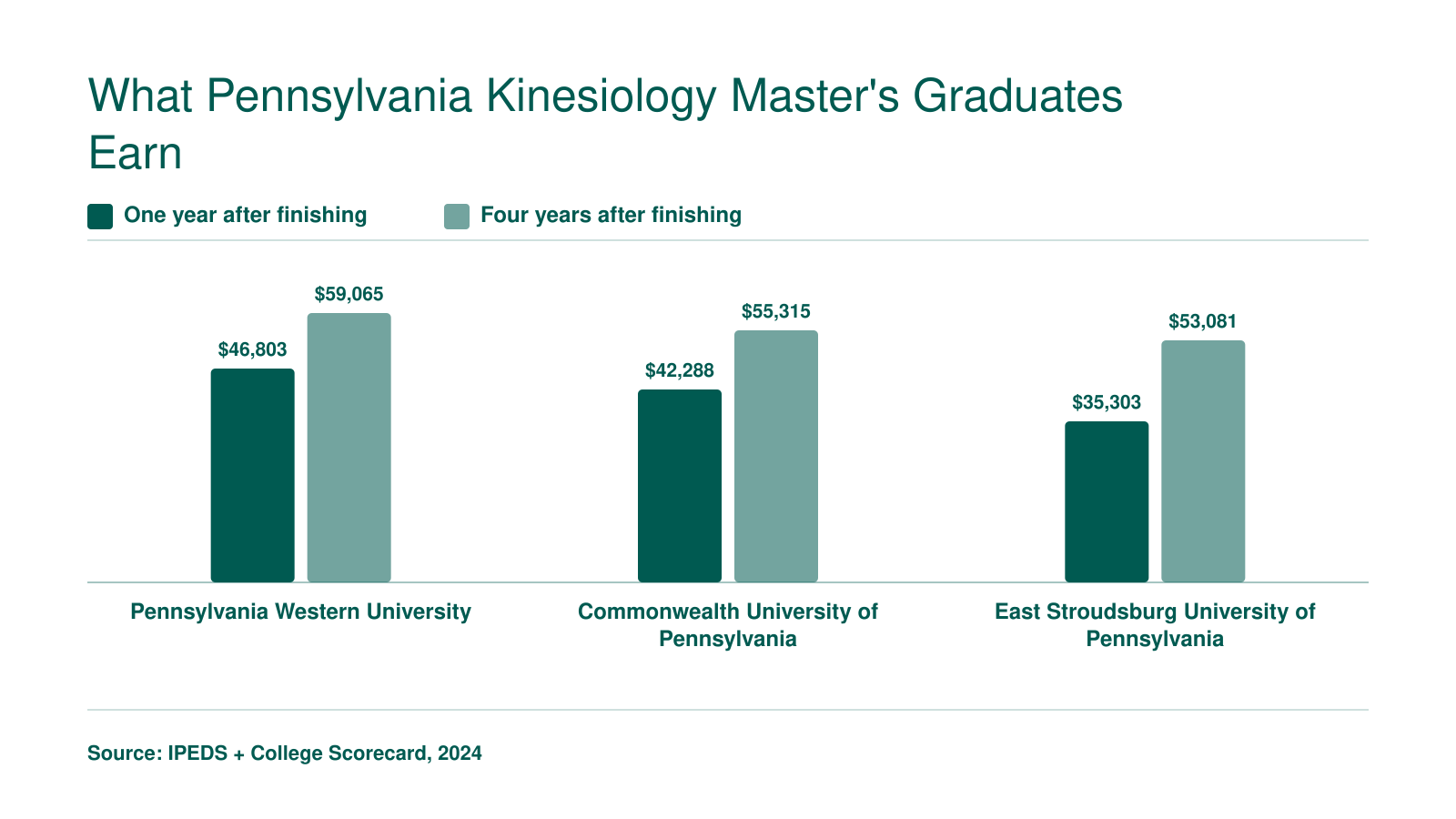
What Pennsylvania Kinesiology Master's Graduates Earn
Program-level median earnings come from federal College Scorecard data for graduates of each school's exercise science master's. West Chester University reports $52,753 five years after finishing. Median program debt is published for Pennsylvania Western University ($30,500) and East Stroudsburg University ($20,500), but not Commonwealth University. Penn State and Gannon report no program-level earnings figure, so they are left out of the chart.
CAAHEP Accreditation and ACSM/NSCA Certification Prep at Pennsylvania Programs
A CAAHEP-accredited degree and the clinical hours behind it are two separate things, and certification eligibility depends on both. CAAHEP, through its Committee on Accreditation for the Exercise Sciences (CoAES), accredits exercise science and exercise physiology programs. Among the schools here, Commonwealth University's M.S. in Applied Exercise Physiology and East Stroudsburg University's M.S. programs in Clinical Exercise Physiology and Exercise Science are identified as CAAHEP-accredited. Confirm current status in the CAAHEP directory before you apply.
The stakes are rising. ACSM says that from August 15, 2027, candidates for both the EP and CEP credentials must graduate from a CAAHEP-accredited program or one that has formally started the process. The ACSM-CEP also calls for 600 hours in qualified clinical settings, plus CPR/AED certification.
Practicum and clinical placement
East Stroudsburg's clinical track requires 300+ clinical hours across 11 networks and eight centers, so students may need extra experience to reach ACSM's 600. Commonwealth offers a thesis or a 6-credit practicum, though its hours are not published. Commonwealth's M.S. is also described as NSCA-recognized, which supports CSCS preparation.
Regional accreditation from Middle States remains the baseline check for any program.
In Pennsylvania, certification, not a state license, is what employers look for; ACSM and NSCA credentials matter most for exercise science graduates.
Pennsylvania Master's in Kinesiology FAQ
How long does a master's in exercise science take?
What can you do with a master's in kinesiology in Pennsylvania?
Can you work full time while earning an exercise science master's in Pennsylvania?
Compare Exercise Science programs on the data that matters
Explore more Healthcare specializations or browse every graduate field.
All Healthcare programs