Best Master's in Kinesiology & Exercise Science Programs in Washington
Compare 5 accredited Exercise Science programs in Washington, with graduate earnings, cost, debt, and completion data from IPEDS and the U.S. College Scorecard.
Washington offers a narrow field of kinesiology and exercise science master's degrees, which makes the choice between them more consequential than in states with dozens of options. Washington State University, Western Washington University, and Central Washington University each run a distinct program, blending public research depth with regional-university accessibility.
In-state graduate tuition and fees across these programs run from $7,231 to $8,240 a year, so cost separates them less than structure does: thesis versus elective-heavy paths, funding availability, and admissions requirements. Washington does not license kinesiologists under a general title, which shifts the real weight of the decision onto earnings outcomes and certification fit rather than a mandatory credential.
Key Points
- Ranked programs are campus-only in 2027; WSU's GRE optional, WWU dropped it.
- Central Washington exercise science grads earn $67,447; WSU grads earn $63,633.
- Washington licenses athletic trainers but not general kinesiologists or exercise physiologists.
Ranked: Best Master's in Kinesiology & Exercise Science Programs in Washington
Washington's graduate programs in kinesiology and exercise science include a research-focused option at Washington State University, a thesis-centered degree in Bellingham, and a broad elective path in Ellensburg. The three programs below are all campus-based and offer distinct strengths for different career goals.
Washington State University
#1Pullman, WA · ~$15,000/yr (est.)
Best for: Aspiring clinical and community health researchers
Washington State University's Master of Science in Nutrition and Exercise Physiology is a two-year program at the Spokane campus that lets students choose between Combined, Human Nutrition, and Exercise Physiology tracks. The program emphasizes clinical and community-based population-health training through partnerships in Eastern Washington and beyond, and applicants can skip the GRE. Graduates often move into industry, academe, public health, or doctoral study, with eligible residents of Western states able to access reduced tuition through the Western Regional Graduate Program.
- Three tracks: Combined, Human Nutrition, Exercise Physiology
- Two-year program at WSU's Spokane campus
- 3.0 GPA minimum and three recommendation letters required
- Prerequisite courses in nutrition, chemistry, biochemistry, and physiology
- GRE no longer required for applicants
- Western Regional Graduate Program tuition option for eligible residents
Western Washington University
#2Bellingham, WA · $14,000 – $27,000/yr (est.)
Best for: Students wanting a thesis-driven research degree
Western Washington University offers a Master of Science in Kinesiology with an Exercise Science option and a Sport and Exercise Psychology option, delivered face-to-face in Bellingham. The Exercise Science path is especially research-focused, and every student in that option completes a master's thesis. The program emphasizes applying scientific principles of movement and performance to health, fitness assessment, and community wellness, making it a strong fit for students considering doctoral study or evidence-based practice roles.
- Two concentration options: Exercise Science and Sport and Exercise Psychology
- Campus-based program in Bellingham
- Exercise Science students complete a master's thesis
- Two-year academic program
- Focus on exercise, human movement, and performance
Central Washington University
#3Ellensburg, WA · ~$13,000/yr (est.)
Best for: Exercise science graduates wanting elective flexibility
Central Washington University's Master of Science in Exercise Science is a campus-based degree in Ellensburg designed for students who already hold a background in exercise science or a closely related field. The curriculum includes 14 to 24 credits of advisor-approved electives in exercise science and health promotion plus 5 to 18 credits in related disciplines, which allows students to shape the degree toward clinical, higher education, or community fitness goals. Graduates pursue careers in higher education, clinical settings, corporate and community wellness, and athletic development, or continue to doctoral study.
- Degree for exercise science or closely related majors
- Biological and chemical science majors encouraged
- 14-24 advisor-approved elective credits in exercise science and health promotion
- 5-18 elective credits in related disciplines
- General chemistry and introduction to statistics recommended
- Careers in higher education, clinical, corporate, and community fitness
Cost & outcomes by school
Federal data for the highest-earning Exercise Science programs, independent of the ranking above. Earnings are this field's master's graduates four years after completing, where the Scorecard reports them.
| School | Earnings | Tuition / yr | Debt | Grads/yr | Format |
|---|---|---|---|---|---|
| Central Washington University WA | $69,174 | $13,220 | $23,950 | 33 | Campus |
| Washington State University WA | — | $14,845 | — | 10 | Campus |
| Western Washington University WA | — | $13,878 | — | 5 | Campus |
| Eastern Washington University WA | — | $14,106 | — | 3 | Campus |
| Bastyr University WA | — | $37,951 | — | — | Online |
Sources: U.S. Department of Education. Tuition and graduates: IPEDS. Earnings and debt: College Scorecard, this field's master's graduates; a dash means no figure is reported.
Online and Hybrid Kinesiology Master's Programs in Washington
An online master's in exercise science or hybrid kinesiology master's lets you complete some or all coursework away from campus. None of the three ranked schools, Washington State, Western Washington, and Central Washington, publishes a fully online or hybrid track; all are campus-based.
Western Washington's M.S. in Kinesiology (Exercise Science option) is face to face in Bellingham. Courses run on a two-year alternating schedule during the academic year, so plan on at least two years on site. No part-time or evening schedule is published. Washington State describes a full-time, two-year degree1, though its 2026-2027 graduate handbook defines part-time enrollment as 2 to 9 credits2, so a slower pace may be negotiable with your advisor. Central Washington's catalog lists no online, evening, or summer-hybrid format.
The reason is practical. Exercise physiology and biomechanics rely on labs, testing equipment, and faculty-supervised research, which is hard to replicate remotely. Confirm any scheduling flexibility with the program directly before applying.
Which Washington Master's Programs Waive or Make the GRE Optional
Washington's kinesiology and exercise science master's programs reflect the broader shift away from GRE requirements. Washington State University now treats the GRE as optional, and Western Washington University has eliminated the requirement. Because admission policies can change, confirm the current GRE and prerequisite details with the program coordinator before applying.
| School | GRE Policy | Minimum GPA | Key Prerequisites |
|---|---|---|---|
| Washington State University | GRE optional; scores may be submitted but are not required | 3.00 cumulative undergraduate GPA, with exceptions possible below 3.00 | Prior knowledge valued in neuroscience, bioengineering, biology, health and wellness, psychology, or sociology, shown through coursework or work experience |
| Western Washington University | GRE requirement eliminated; scores are not required | Not published | Introductory statistics (MATH 240 or equivalent); undergraduate kinesiology or equivalent coursework in exercise science, behavioral and cultural foundations, and activity areas |
Related Articles
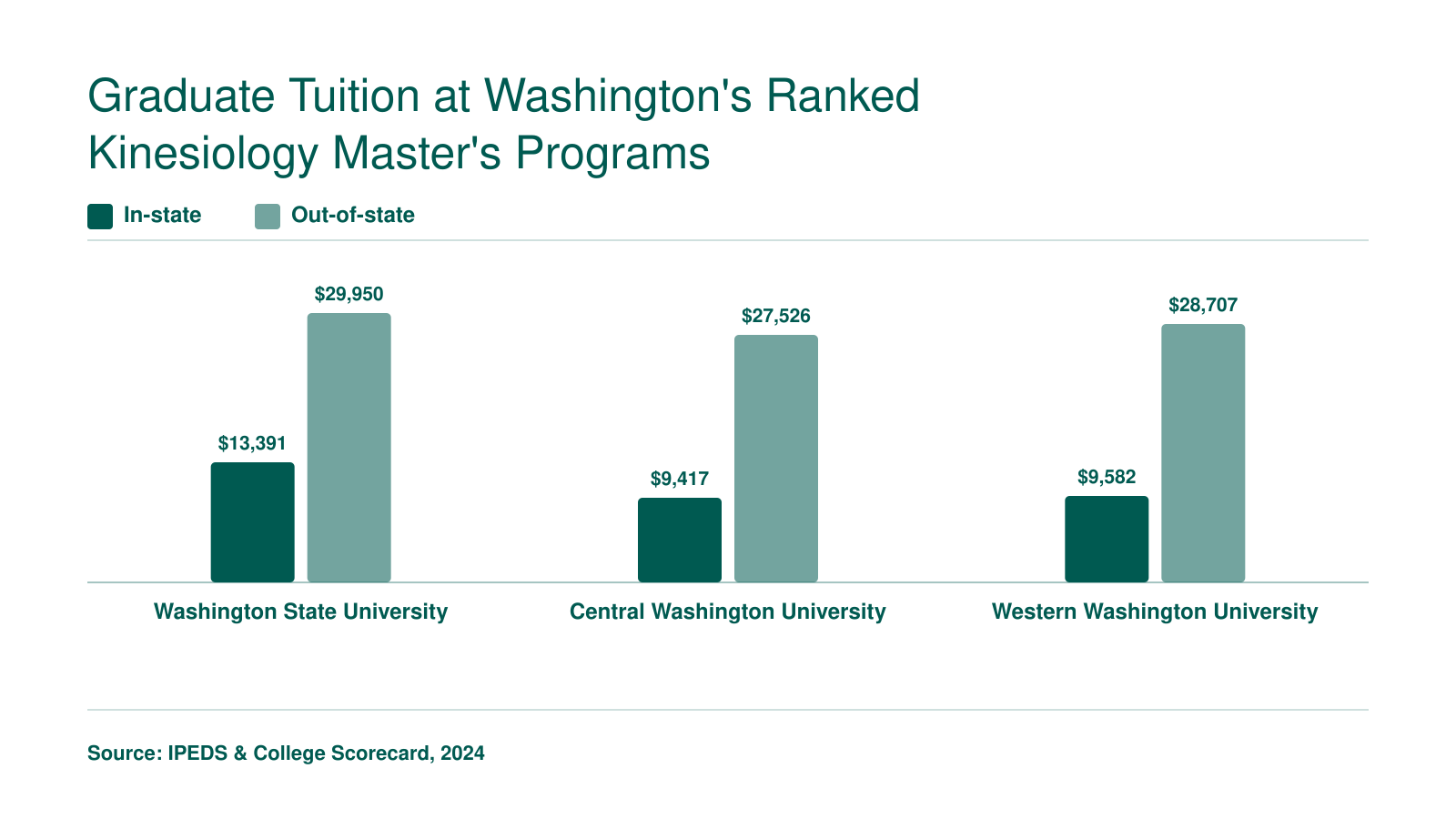
Graduate Tuition at Washington's Ranked Kinesiology Master's Programs
The in-state versus out-of-state rate is the biggest cost lever for Washington graduate students. These bars show published annual graduate tuition and fees, not institution-wide average net price.
Cost, Funding, and Assistantships for Washington Master's Students
Paying your own way versus landing a funded assistantship can mean the difference of tens of thousands of dollars over a degree. Master's in Kinesiology & Exercise Science programs here vary in both credit load and how much funding they put on the table.
Credit Loads and Total Cost
Credit totals shape the base price. Western Washington University's Exercise Science option runs 47 to 50 credits, while Washington State University's non-thesis Kinesiology track requires at least 34 credits.1 Multiply the per-credit rate by your credit total to estimate the full cost. Current per-credit graduate rates for WSU and WWU were not published in the sources reviewed here, so confirm figures with each department before you budget for the cost of master's degree in Washington.
Assistantships and Waivers
Teaching and research assistantships are the strongest funding path:
- Washington State University: Appointments carry a tuition waiver, monthly stipend, and health benefits, renewable up to three years, and require 10 credits per semester.1 WRGP waivers may apply to residents of WICHE-member states with a 3.0 GPA.2
- Western Washington University: Health and Human Development assistants teach and earn a quarterly stipend plus tuition support for Fall, Winter, and Spring, requiring 8 credits per quarter and yearly reapplication.
One practical tip: contact the department directly about assistantship deadlines, which often fall before the general application deadline.
Washington Licensure and Certification for Kinesiology Graduates
Career Paths and Earnings for Washington Kinesiology Master's Graduates
Central Washington University's exercise science master's graduates report median earnings of $67,447 five years after finishing, and Washington State University's report $63,633 over the same window. Both figures are for the Master's in Kinesiology & Exercise Science field, not the whole institution, and they are solid but not high for a graduate degree.
The degree maps to four tracks:
- Clinical exercise physiology and cardiac rehab: Western Washington University's program lists 360 clinical hours and 90 field placement hours, which helps build clinical experience. Pay at entry is often modest unless it is paired with credentials.
- Strength and conditioning or collegiate sport: WSU's non-thesis option is typically aimed at coaching and healthcare practice.
- Research and PhD or PT pipeline: WSU's thesis option typically suits students heading toward a PhD, and CWU describes preparation for doctoral-level study.
- Corporate or public health wellness: WSU lists industry, academe, and public health, and CWU lists higher education and clinical settings.
None of these departments publishes placement rates, PhD or PT acceptance figures, or named employers. Treat the earnings figures as a guide, not a guarantee.
How to Choose the Right Washington Kinesiology Master's Program
Start with thesis versus non-thesis. A thesis track fits PhD or research goals. Washington State University offers both: a thesis route (34 semester hours, with 9 thesis credits and an oral defense) and a non-thesis route built around a 3-credit final project, aimed at practitioners.1 Western Washington University's Exercise Science option requires a thesis for everyone.3
Next, check hands-on requirements. WSU lists 3 internship credits (135 contact hours), but confirm whether every student must complete them.2 WWU lists internship as a course option, not a stated universal requirement.3
Then weigh concentration fit against cost and format, and compare affordable exercise science master's programs. Exercise physiology, biomechanics, motor behavior, and nutrition emphasis vary by program, so read faculty research areas.
Use this decision rule:
- Career goal: research or practice sets your track.
- Funding: compare assistantship and tuition support.
- Location and format: commute, campus, or flexibility last.
Frequently Asked Questions About Kinesiology Master's Programs in Washington
Which Washington kinesiology master's program is the best overall?
What is the total tuition for a master's in kinesiology in Washington?
Can a kinesiology master's help me get into physical therapy or PA school?
Do I need an exercise science bachelor's to apply?
Compare Exercise Science programs on the data that matters
Explore more Healthcare specializations or browse every graduate field.
All Healthcare programs