Master's in Applied Psychology Programs With No GRE Required
Compare 70+ accredited no-gre Applied Psychology programs at 50+ schools, with graduate earnings, cost, debt, and completion data from IPEDS and the U.S. College Scorecard.

Dropping the GRE has become common in graduate admissions, but "common" is not a policy, and the wording on each program's page decides whether you need a score. Third-party lists of no-GRE programs also go stale within a cycle or two.
Use the guide to verify programs rather than rank them. It shows how to read GRE language, confirm it on official pages, and check accreditation, total cost, and format. Applied psychology master's degrees also stop short of independent clinical licensure, which shapes every choice that follows.
Key Points
- No GRE, test-optional, and GRE waiver mean different application requirements.
- Check the program page, not the graduate school page, for 2026 policy.
- Industrial-organizational psychologists earned a median wage of $193,950 in May 2025.
Master's in Applied Psychology Programs With No GRE Required
-
#1
Capella University
MS in Psychology
$66,014median earnings $15,092grad tuition / yr $41,000median federal debt 1,611grads / yrNo GRE required53 credits24 monthsVisit program site →70score -
#2
Lamar University
Applied Psychology
$66,540median earnings $8,642grad tuition / yr $29,355median federal debt 490grads / yrNo GRE required60 creditsVisit program site →63score -
#3
American Public University System
Master of Arts in Psychology
$8,700grad tuition / yrNo GRE required39 creditsVisit program site →60score -
#4
Virginia Wesleyan University
Master of Arts in Applied Psychology
$8,982grad tuition / yrNo GRE required30 credits2 yearsVisit program site →60score -
#5
California State University-Chico
Master of Arts in Psychology: Applied Option/School Psychology
$9,996grad tuition / yrNo GRE required3 yearsVisit program site →59score -
#6
Northeastern University
Master of Science in Applied Psychology
$76,859median earnings $26,020grad tuition / yr $41,000median federal debt 35grads / yrNo GRE requiredVisit program site →59score -
#7
Northeastern University
Applied Psychology, MS
$76,859median earnings $29,174grad tuition / yr $41,000median federal debt 69grads / yrNo GRE requiredVisit program site →58score -
#8
Keiser University-Ft Lauderdale
Applied Psychology MS (Mandarin)
$69,452median earnings $36,230grad tuition / yr $46,748median federal debt 29grads / yrNo GRE required36 creditsVisit program site →48score
How we rank. Each program is scored on graduate figures only: the field's master's earnings and debt, graduate tuition and the number of master's graduates, normalized across all programs in this field. Data comes from the U.S. Department of Education's IPEDS and College Scorecard; no school pays for placement.
Compare the top programs
| Rank | School | Earnings | Tuition / yr | Debt | Grads/yr | Format |
|---|---|---|---|---|---|---|
| 1 | Capella University MN | $66,014 | $15,092 | $41,000 | 1,611 | Online |
| 2 | Lamar University TX | $66,540 | $8,642 | $29,355 | 490 | Campus |
| 3 | American Public University System WV | — | $8,700 | — | — | Online |
| 4 | Virginia Wesleyan University VA | — | $8,982 | — | — | Online |
| 5 | California State University-Chico CA | — | $9,996 | — | — | Campus |
| 6 | Northeastern University MA | $76,859 | $26,020 | $41,000 | 35 | Online |
| 7 | Northeastern University MA | $76,859 | $29,174 | $41,000 | 69 | Online |
| 8 | Keiser University-Ft Lauderdale FL | $69,452 | $36,230 | $46,748 | 29 | Campus |
Sources: U.S. Department of Education. Tuition and graduates: IPEDS. Earnings and debt: College Scorecard, this field's master's graduates; a dash means no figure is reported.
Cost, debt & payoff
Median earnings of this field's master's graduates (4 yrs after completing) vs. their median federal loan debt · U.S. College Scorecard
Across these programs the median graduate earns about $67,727 and finishes with roughly $51,081 in debt — a ratio that clears a common rule of thumb (keep debt below first-year salary). Tuition and debt vary widely school to school, so sort the ranking by "Most affordable" or "Lowest debt" to weigh cost against outcomes.
No GRE, Test-Optional, or GRE Waiver: Why the Exact Wording Matters
Does "no GRE" mean the same thing on every admissions page? No, and the difference can change your application plan.
For No-GRE master's programs, "no GRE" means scores are never requested. Test-optional means scores are accepted but not required. A GRE waiver means scores are required unless you meet stated conditions, such as a minimum GPA, work experience, or a prior graduate degree.
What Official Pages Actually Say
Clemson states the General GRE is "not required" for its applied psychology master's programs.1 Lamar also says scores are not required, though its usual admission review looks for a 3.0 cumulative GPA and a 3.0 psychology GPA.2 That is a general admission standard, not a waiver trigger. Fordham calls the GRE "optional" for its Applied Psychological Methods M.S. and sets no minimum, yet says top submitters are expected to exceed the 60th percentile on each subtest with a GPA of at least 3.30.3 So optional can still mean strong scores help. San Diego State requires the General Test but publishes no minimum cutoff.
Check the Cycle
Many pages do not label a policy for 2026-27. Rutgers names Fall 2026 and Fall 2027 deadlines,4 but others do not. Confirm the term, and email admissions if the page is undated.
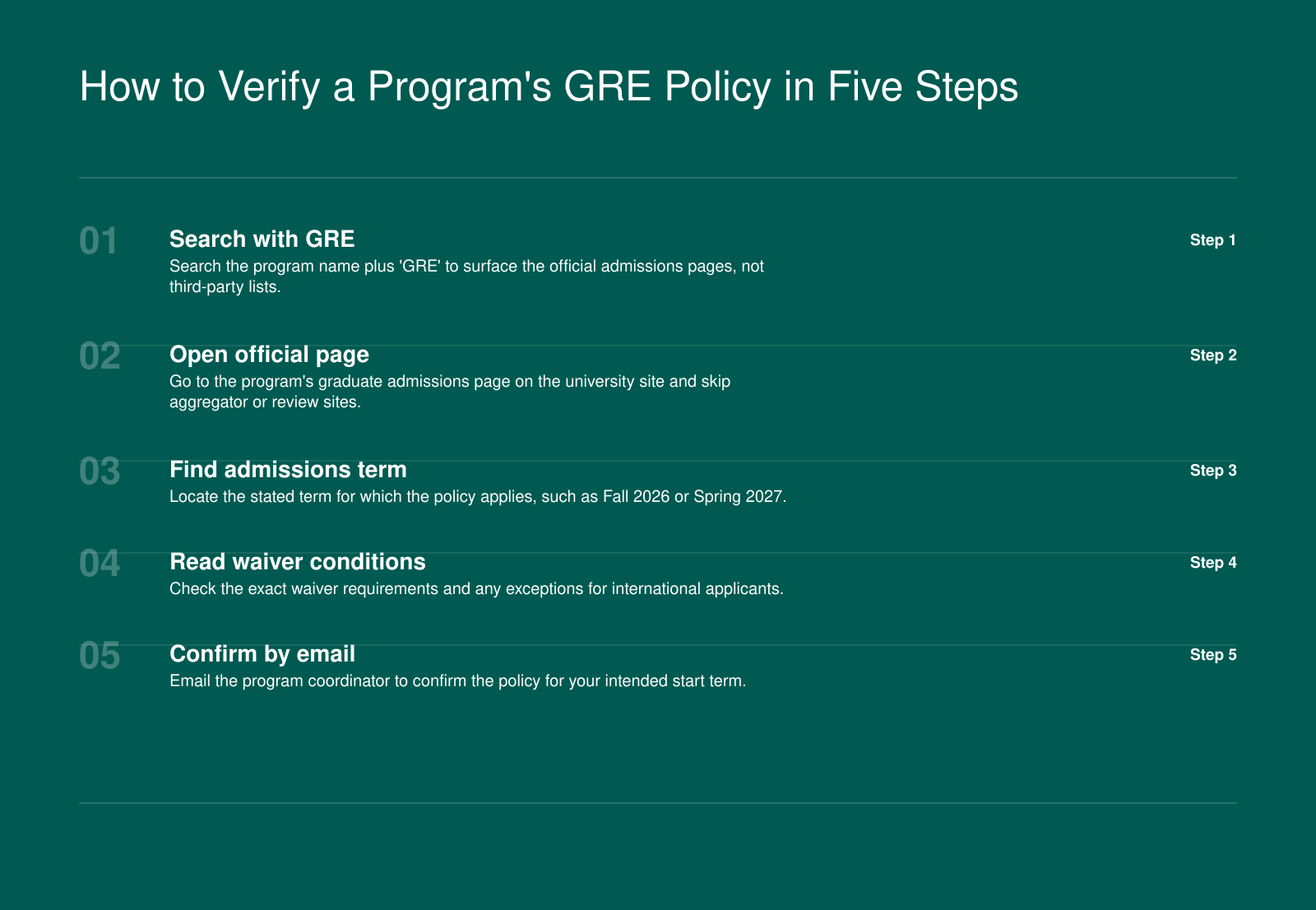
How to Verify a Program's GRE Policy in Five Steps
Always confirm the GRE policy for the specific term you plan to start. When a program-level admissions page conflicts with the general graduate school page, follow the program-level page.
What to Check on an Applied Psychology Admissions Page
- GRE policy and termLook for "test-optional," "no GRE required," or a waiver path, and note which term it applies to.
- Minimum GPACheck overall and psychology GPAs; requirements range from no minimum to 3.5 depending on the program.
- Undergraduate prerequisitesCommon required or helpful courses are introductory psychology, statistics, and research methods.
- Non-psychology bachelor'sSome programs accept any major; others require psychology or equivalent. Without psychology coursework, you may complete prerequisites before enrolling or enter conditionally.
- DeadlinesConfirm priority and final deadlines for admission and funding; priority dates often matter for assistantships.
- International requirementsNon-native English speakers usually submit TOEFL or IELTS scores; some programs set a higher GPA bar for international applicants.
- Transfer credit limitsAsk how many prior graduate credits transfer and whether they reduce time or cost.
- Internship or practicumCheck whether a practicum or internship is required, if placements are arranged, and any background-check steps.
Related Articles
Accreditation Checks for No-GRE Applied Psychology Programs
Dropping the GRE says nothing about program quality for a master's in psychology with no GRE required; accreditation, faculty, and outcomes do. Start with institutional accreditation from a recognized accreditor (formerly called regional), which employers, doctoral programs, and federal aid rely on.1 Search the U.S. Department of Education's DAPIP database by exact legal name and campus, then cross-check CHEA for the same agency, status, and dates. A school's own claim of being "accredited" is not enough.
Program-level accreditation is a separate check. APA's general policy says it accredits doctoral programs,2 but its current materials show master's accreditation began in 2024, limited to health service psychology fields such as clinical, counseling, and school psychology.3 It does not accredit industrial/organizational psychology.4 MPCAC accredits some master's programs in counseling and applied psychology, including M.S. in Applied Psychology programs, but it supplements institutional accreditation rather than replacing it.5 Confirm the exact program in each directory.
Walk away if you see:
- No accreditor listed: the school names none.
- Unrecognized agency: neither ED nor CHEA recognizes it.
- Guaranteed admission: serious programs do not promise it.
Online, Hybrid, and On-Campus Formats and Field Experience
Format changes pacing and fieldwork more than anything else. Shippensburg's online M.S. is a one-year applied psychology master's when taken full-time, or a two-year part-time path through asynchronous eight-week terms.1 The University of Southern California's online program typically runs 16 months,2 while Clemson's on-campus program is designed for two academic years3 and San Diego State's on-campus M.S. takes two to three years.4 North Florida offers an 18-month online or on-campus/hybrid path.5 Shippensburg ends with a capstone;1 USC requires 240 internship hours that must differ from current job duties;2 Clemson lets students choose a thesis, internship, or research hours.3
Thesis and non-thesis options also vary. Northern Michigan allows a capstone or thesis,6 Texas A&M-Central Texas requires a six-credit thesis,7 and Arizona State offers a thesis, applied project, or capstone, though online students may take only the capstone.8 If you plan to pursue a PhD or PsyD, compare clinical psychology master's no GRE requirements and choose the thesis track when one is available.
Before enrolling, check whether field hours are required, optional, or replaced by an applied project. Online learners should ask who arranges placement sites, since many programs expect you to secure a local site yourself.
What You Can Do With a Master's in Applied Psychology, and Its Licensure Limits
An applied psychology master's prepares you for workplace and community roles, not for independent clinical practice. Knowing which side of that line your goals fall on matters before you enroll.
Where graduates work
The degree fits roles that use behavioral science in organizations and programs:
- HR and people analytics
- Organizational development
- UX research
- Program evaluation
- Market research
- Behavioral health support roles
- Nonprofit program management
The Bureau of Labor Statistics lists a master's as the typical entry-level degree for industrial-organizational psychologists.1
The licensure limit
Psychologist licensure is a doctoral path. Texas requires a doctorate, two exams, and 1,750 internship hours plus 1,750 post-doctoral hours.2 Arizona's board offers no psychologist license to anyone whose highest degree is a master's.3
LPC and LMFT licenses are separate. Oregon's boards look for CACREP-, CORE-, or COAMFTE-accredited programs or content-equivalent degrees4; Minnesota's LPC board accepts CACREP or CHEA5; both also require supervised hours. An applied psychology degree qualifies only if the state board finds it meets those rules, and many do not.
If you want clinical work, check your state licensing board's academic requirements before enrolling, and consider no GRE counseling psychology programs or MFT programs no GRE required instead.
The most recent available BLS data show industrial-organizational psychologists earned a median annual wage of $193,950 in May 2025, a role open to master's graduates.
Applied Psychology programs by state
Frequently Asked Questions About No-GRE Applied Psychology Programs
Are there online applied psychology master's programs with no GRE?
Can I get into an applied psychology master's program without a psychology bachelor's?
Is an applied psychology master's degree worth it?
Will skipping the GRE hurt my chances of getting into a doctoral program later?
Compare Applied Psychology programs on the data that matters
Explore more Psychology specializations or browse every graduate field.
All Psychology programs