Best Clinical Nurse Specialist (CNS) MSN Programs in Wisconsin
Compare 1 accredited Clinical Nurse Specialist programs in Wisconsin, with graduate earnings, cost, debt, and completion data from IPEDS and the U.S. College Scorecard.
Where in Wisconsin can a nurse still earn the CNS credential at the master's level rather than the doctorate? The honest answer is a short list. Clinical nurse specialists work on unit outcomes, evidence-based practice, and systems change rather than the primary care panels emphasized in FNP MSN programs in Wisconsin, and much of that preparation in this state has moved to the DNP or to post-graduate certificates.
What remains at the master's level carries graduate tuition from roughly $10,184 to $19,656 a year. Confirm a track is still enrolling students before you build an application around it.
Key Points
- Edgewood University, Alverno College, and UW-Parkside are the Wisconsin schools with CNS master's tracks.
- Annual graduate tuition runs from $10,184 at UW-Parkside (residents) to $19,656 at Edgewood.
- CCNE accreditation and 500 supervised clinical hours are the baseline for national CNS certification.
Best Clinical Nurse Specialist (CNS) MSN Programs in Wisconsin, Ranked
Very few Wisconsin schools offer a true CNS master's. UW-Madison and UW-Eau Claire place their CNS training at the DNP level, and UW-Milwaukee offers a post-graduate certificate rather than an MSN. That leaves the three schools below with CNS tracks inside an MSN. Because the pool is so small, delivery format and how each school secures clinical placements matter more than usual.
Edgewood University
#1Madison, WI · $15,000 – $20,000/yr (est.)
Best for: Working RNs needing flexible start dates
Edgewood University in Madison offers an MSN with an Adult Gerontology Clinical Nurse Specialist pathway, one of five MSN pathways. It is delivered in a hybrid format with part-time or full-time pacing, 8-week classes and six start dates a year. Listed graduate tuition is $19,656 for both in-state and out-of-state students, and the school graduates about 60% of its students overall. Federal data for the school's master's-level nursing graduates shows median earnings of about $109,385 four years after completion. Confirm CCNE status directly with the school, as it was not verified in our data.
- True MSN with a CNS Adult Gerontology pathway
- Hybrid delivery with full-time and part-time options
- Six start dates a year with rolling admission
- Most classes last 8 weeks
- Requires a BSN and a current RN license
- Built-in MSN-to-DNP option for doctoral study
- Small cohorts with a high-touch clinical model
- Guaranteed admission for Edgewood BSN grads with a 3.0 GPA from the past three years
Alverno College
#2Milwaukee, WI · $10,000 – $15,000/yr (est.)
Best for: Milwaukee nurses wanting hospital-based practicums
Alverno College in Milwaukee offers an MSN with an Adult Gero Clinical Nurse Specialist concentration, taught on campus and covering care from acute to primary settings. Graduate tuition is listed at $11,148 for in-state and out-of-state students alike, plus about $870 in fees, and the college graduates roughly 49% of its students overall. It is the only listing here with CCNE accreditation confirmed in federal accreditation records. Federal data for its master's nursing graduates shows median earnings of about $118,338 four years after completion, and the college reports practicum relationships with regional hospitals and long-term-care settings.
- True MSN with a CNS Adult Gero concentration
- On-campus delivery in Milwaukee
- CCNE accredited
- Three clinical practicums required
- Capstone project required
- Coursework in advanced pharmacology and health assessment
- Accepts a Wisconsin RN license or a multistate compact license
- Traditional MSN listed at 39 to 42 credits
University of Wisconsin-Parkside
#3Kenosha, WI · ~$10,000/yr (est.)
Best for: Budget-focused Wisconsin residents
The University of Wisconsin-Parkside in Kenosha is the public option, with graduate tuition of $8,892 in-state and $19,519 out-of-state, so residents see the biggest savings here. It graduates about 40% of its students overall, a figure that covers the whole institution rather than the CNS track. The MSN with a Clinical Nurse Specialist concentration holds its core courses on campus. School materials cite CCNE accreditation, but our accreditation records did not verify it, so confirm before applying. We found no program-level earnings figures, so none are shown.
- True MSN with a CNS concentration
- Core courses held on the Parkside campus
- Two concentration options within the MSN
- Prepares nurses for advanced practice in community and institutional settings
- School materials cite Wisconsin Board of Nursing and CCNE accreditation
- Center for Nursing Research supports student research
Cost & outcomes by school
Federal data for the highest-earning Clinical Nurse Specialist programs, independent of the ranking above. Earnings are this field's master's graduates four years after completing, where the Scorecard reports them.
| School | Earnings | Tuition / yr | Debt | Grads/yr | Format |
|---|---|---|---|---|---|
| Edgewood University WI | $109,385 | $19,656 | — | 58 | Hybrid |
Sources: U.S. Department of Education. Tuition and graduates: IPEDS. Earnings and debt: College Scorecard, this field's master's graduates; a dash means no figure is reported.
How We Rank Wisconsin CNS Master's Programs
CCNE accreditation is the first filter: it is required to sit for national CNS certification and to qualify for advanced practice registered nurse recognition in Wisconsin. Without it, a graduate cannot move from the classroom to licensed practice, so each accredited clinical nurse specialist program here carries verified CCNE standing.1
From there, we weigh three things that shape a student's actual experience and return:
- Cost: Graduate tuition and the institution's average net price after aid. Net price is an institution-wide average, not a quote for any one student, so treat it as a ballpark rather than a bill.
- Outcomes: Institutional graduation rate, a signal of whether enrolled students finish what they start.
- Accessibility: Whether the CNS track runs on campus, online, or in a hybrid format, since format often decides whether a working nurse can realistically attend.
We weigh these together across Wisconsin master's programs rather than letting any single figure dominate, so an affordable program with weak completion does not outrank a stronger, slightly costlier one.
Online and Hybrid CNS Master's Options in Wisconsin
If you're working while you study, how a program delivers clinical hours matters as much as whether the lectures are online, compare Edgewood's setup with the Best Online Clinical Nurse Specialist MSN Programs list. Edgewood University, based in Madison, offers both tracks mostly online, but neither is fully remote.
Fully online coursework, in-person clinical pieces
The general MSN Clinical Nurse Specialist track (42 credits, 501 clinical hours) runs online, while practicum and advanced-practice courses carry in-person clinical requirements. The Adult-Gerontology CNS track (45 credits) is online and asynchronous but adds a required one-day clinical bootcamp at the Madison campus before rotations begin. Budget for that trip if you live out of state.
Placement and out-of-state clinicals
Edgewood describes placement as collaborative: the coordinator works with you rather than simply assigning or leaving you to find every preceptor yourself. Its network is strongest in Wisconsin, so out-of-state students should expect to contribute local contacts. Rotations outside Wisconsin are allowed when state authorization is in place.
Before you apply, confirm two things directly with admissions: whether part-time pacing fits your schedule, and exactly how much of the preceptor search falls on you.
Did you know? ANCC reported an 88% first-time pass rate for its Adult-Gerontology CNS exam in 2025 (140 of 159 first-time test takers). Since national exams decide who earns the credential, check that any Wisconsin program you consider is accredited and prepares you for CNS certification eligibility.
GRE and Admission Requirements for Wisconsin CNS Master's Programs
Clinical nurse specialist preparation in Wisconsin is shifting toward the doctoral level, so confirm that a master's track is still enrolling before you apply. Across the Wisconsin graduate nursing admissions pages reviewed for 2026, the GRE is rarely part of the picture; where a policy is stated, standardized tests are not required, echoing many No-GRE master's programs.1 We could not confirm a published GRE policy for Edgewood University, Alverno College, or the University of Wisconsin-Parkside, so ask each admissions office directly rather than assuming a waiver.
The core prerequisites look similar:
- Degree: A BSN from a nationally accredited nursing program.
- GPA: A 3.0 minimum on a 4.0 scale is the common floor, sometimes measured on recent or nursing coursework.
- License: An unencumbered RN license, often from Wisconsin or a Nurse Licensure Compact state. Some programs let you apply before the license is finalized.
- Experience: Ranges from recommended to one year of professional nursing practice.
Deadlines vary widely. Some programs admit fall only with a December 1 cutoff, while others run application windows that close March 31.2 So check each school's calendar early.
Related Articles
Cost of a CNS Master's in Wisconsin and the Path to Licensure
Tuition and Net Price
Annual graduate tuition runs from $10,184 for Wisconsin residents at University of Wisconsin-Parkside to $19,656 at Edgewood University, a range worth comparing with the Most Affordable Clinical Nurse Specialist MSN Programs. Parkside, the public option here, charges nonresidents $20,811. Alverno College lists $12,018 regardless of residency, and Edgewood's rate is also the same for every state.
Edgewood's adult-gerontology CNS track requires 45 credits over roughly three years of full-time study. The school does not publish a 2026 per-credit rate, so request a full cost sheet before you compare program totals.
Average net price after aid is $11,772 at Parkside, $22,540 at Alverno and $26,113 at Edgewood. Those are institution-wide averages, not quotes for a nursing graduate student. If you work for a hospital system, ask about tuition assistance before you enroll.
Licensure in Wisconsin
As of September 1, 2026, Wisconsin issues a separate APRN license that recognizes the clinical nurse specialist role, according to the state's Advanced Practice Registered Nurse (APRN) page. To qualify, you need:
- RN license: an active Wisconsin or multistate RN license.
- Degree: a Board-approved graduate nursing degree in the CNS role.
- Certification: current national CNS certification, such as ACCNS-AG, ACCNS-P, or ACCNS-N.
- Other requirements: malpractice coverage and a passing score on the state jurisprudence exam.
The license does not let you prescribe. Prescribing requires a separate prescriptive authority certificate, which calls for 45 contact hours of clinical pharmacology completed within the preceding five years.1
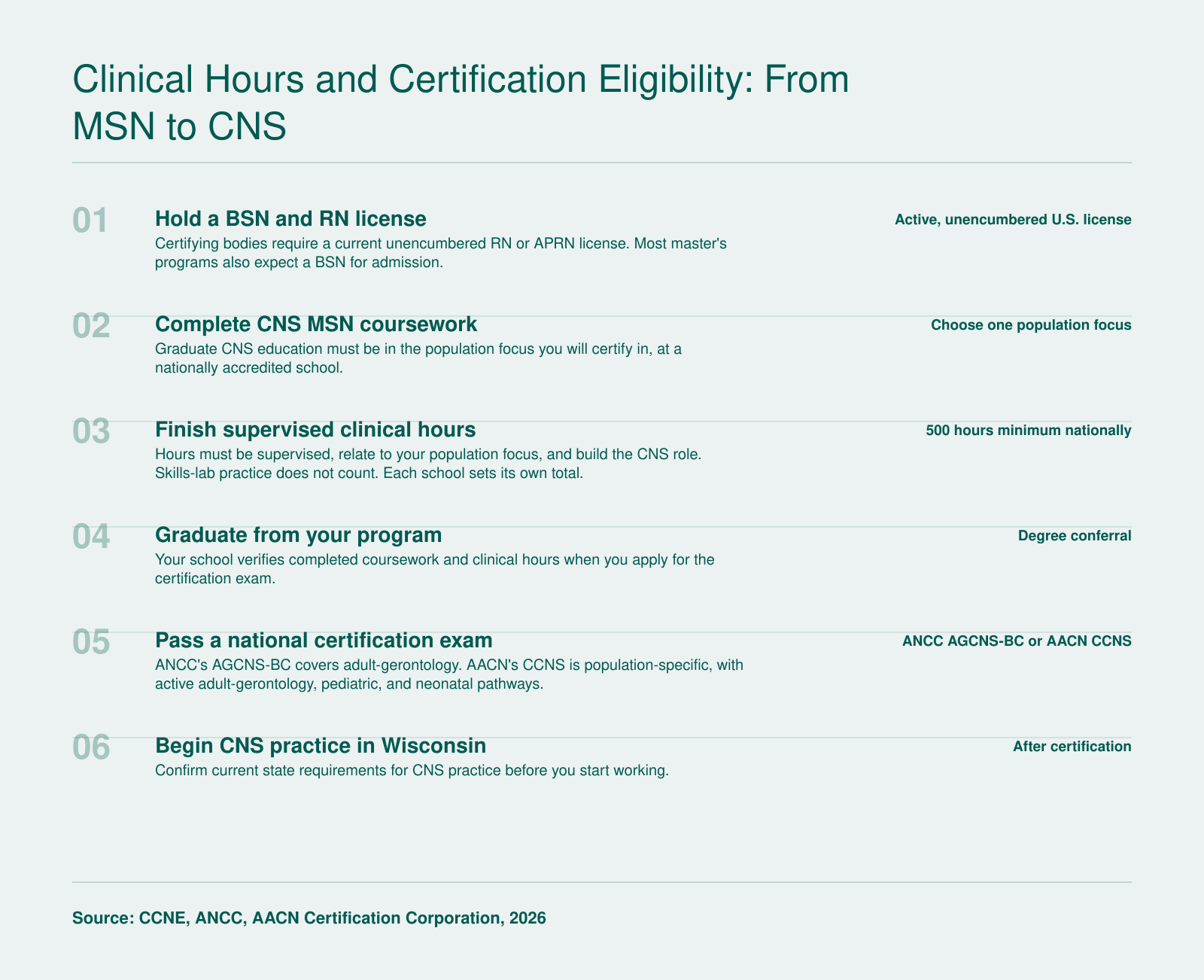
Clinical Hours and Certification Eligibility: From MSN to CNS
National standards set 500 supervised clinical hours as the floor for CNS master's preparation, and many programs require more. Our research did not confirm the exact hour totals for Edgewood University, Alverno College, or University of Wisconsin-Parkside, so ask each admissions office for its current figure. Hours must fall within the population focus you plan to certify in.
Frequently Asked Questions About CNS Master's Programs in Wisconsin
What is the difference between a clinical nurse specialist and a nurse practitioner?
How long does it take to complete a CNS MSN program in Wisconsin?
What certifications can I earn after a CNS MSN in Wisconsin?
Can I earn a post-master's CNS certificate online if I already hold an MSN?
Compare Clinical Nurse Specialist programs on the data that matters
Explore more Nursing specializations or browse every graduate field.
All Nursing programs