Best Health Systems Management MSN Programs
Compare 17 accredited Health Systems Management programs, with graduate earnings, cost, debt, and completion data from IPEDS and the U.S. College Scorecard.

Moving from charge nurse to service-line director or system executive rarely means leaving nursing, but it almost always means a different credential, not a Nurse Practitioner path. A health systems management MSN trades advanced clinical practice for finance, staffing, quality improvement, and governance.
Cost varies far more than curriculum. Reported net price among the schools here runs from about $10,440 at Cal State Long Beach to $38,509 at Drexel, across fully online, hybrid, and campus-based delivery.
Price and format settle more applications than reputation does. Nearly every program expects an unencumbered RN license and a BSN, though associate-degree nurses have bridge routes, non-nursing bachelor's holders have Direct Entry MSN options, and practicum hours still have to be arranged somewhere near where you already work.
Key Points
- Practicum hours range from 90 at Shawnee State to 500 at three other schools.
- Only about 25.1% of U.S. registered nurses hold a graduate degree (AACN, 2024).
- Net price and graduate earnings from federal data, not prestige, ordered the programs here.
10 Health Systems Management MSN Programs for 2027
For nurses aiming to move from bedside to system level leadership, the right MSN in health systems management should offer more than a title. The programs below stand out for their blend of accredited nursing education, practical leadership coursework, and flexibility for working RNs. Use the cards to compare format, concentration options, and institution wide completion signals before shortlisting.
Drexel University
#1Philadelphia, PA · ~$39,000/yr (est.)
Best for: Working nurses needing online flexibility
Drexel's online MSN in Nursing Leadership in Health Systems Management is built for working nurses who need a part-time route to senior administrative roles. The 45-credit curriculum covers project management, healthcare economics, fiscal management, and strategic planning, with a 160-hour practicum completed at an approved site. CCNE accreditation and the absence of an on-campus requirement make it a flexible choice for nurses balancing full-time employment.
- Online, part-time format designed for working nurses
- CCNE accredited
- 45 credits required
- 160 practicum hours completed at approved site
- Requires BSN, 3.0 GPA, current U.S. RN license
- Courses include project management, healthcare economics, fiscal management
- Two professional references and personal statement required
- Electives available; writing-intensive course required
University of Alabama at Birmingham
#2Birmingham, AL · ~$9,000/yr (est.)
Best for: Hybrid learners prioritizing salary potential
UAB's hybrid MSN in Nursing Health Systems Administration combines online synchronous classes with on-campus intensives, preparing nurses for unit-level and system-wide leadership. The 36-credit program emphasizes financial management, human resources, quality improvement, and patient safety, and it can be completed in two years of part-time study. Its graduates report strong salary outcomes, making it a notable option for nurses who want leadership depth without a full-time campus schedule.
- Hybrid format with online synchronous classes and on-campus intensives
- CCNE accredited
- 36 credit hours; two-year part-time completion
- Requires BSN, 3.0 GPA, unencumbered nursing license
- Tuition $723 per credit hour for residents and non-residents
- Emphasizes financial management, quality improvement, patient safety
- 28 didactic credits and 8 clinical practicum credits
- Requires descriptive statistics course; GRE may be required for some
Lewis University
#3Romeoville, IL · ~$16,000/yr (est.)
Best for: Online nurses focused on leadership development
Lewis University's online MSN with a Healthcare Systems Leadership specialization focuses on healthcare administration, quality improvement, and organizational leadership. The program is designed for working professionals who need a flexible online format and offers courses in strategic planning and healthcare policy. Its CCNE accreditation and clear leadership track make it a solid fit for nurses targeting management roles rather than clinical advanced practice.
- Fully online MSN with Healthcare Systems Leadership concentration
- CCNE accredited
- Requires BSN and nursing license
- Focuses on healthcare administration and organizational leadership
- Includes strategic planning and healthcare policy coursework
- Covers quality improvement training
- Financial aid options available
California State University-Long Beach
#4Long Beach, CA · $9,000 – $19,000/yr (est.)
Cal State Long Beach's campus-based MSN in Nursing and Health Systems Executive Management has historically prepared nurses for executive management roles, with coursework in governance, human resources, continuous quality improvement, and population-based care delivery. It requires a BSN and current RN licensure and includes practicum experiences in organizational settings. Prospective applicants should confirm current availability, as program directories indicate the program is currently suspended.
- Campus-based MSN with Nursing and Health Systems Executive Management concentration
- CCNE accredited
- Requires BSN and current RN licensure
- Includes practicum experiences in organizational settings
- Covers health systems governance and human resources management
- Includes continuous quality improvement and population-based care delivery
- Culminates in executive management project
College of Our Lady of the Elms
#5Chicopee, MA · ~$18,000/yr (est.)
Elms College's fully online MSN in Nursing and Health Services Management pairs healthcare finance and human capital management with nursing informatics. A 5-credit practicum and capstone project give students real-world application, and the program holds CCNE accreditation. It is a practical online option for nurses seeking management roles in diverse healthcare settings.
- Fully online MSN
- CCNE accredited
- Requires BSN and RN license
- 5-credit practicum with capstone project
- Covers healthcare finance and human capital management
- Includes nursing informatics and global healthcare perspectives
- Advanced health assessment, pathophysiology, pharmacology courses
University of Southern Indiana
#6Evansville, IN · ~$12,000/yr (est.)
The University of Southern Indiana offers a fully online MSN with a Healthcare Systems Leadership concentration that can be completed in 2.5 to 3 years. Its 36-credit curriculum integrates finance, business management, and information systems, and admission requires a BSN with a 3.0 GPA. CCNE accreditation and no on-campus requirements make it a convenient choice for working nurses.
- 100% online, 36 credit hours
- CCNE accredited
- Complete in 2.5 to 3 years
- Requires BSN, 3.0 GPA, unencumbered RN license
- Undergraduate statistics course prerequisite
- Focus on finance, business management, information systems
- No on-campus requirements
- Online application with $40 fee
University of Wisconsin-Green Bay
#7Green Bay, WI · ~$10,000/yr (est.)
UW-Green Bay's hybrid MSN in Nursing Leadership and Management in Health Systems blends online coursework with 378 practicum hours arranged locally. The 34-credit program covers leadership, fiscal management, quality improvement, and healthcare policy, with a master's project capstone. It is a flexible part-time path for registered nurses who want a systems-level credential without relocating.
- Hybrid format with online coursework and local practicum
- CCNE accredited
- 34 credits; part-time model available
- 378 practicum hours required
- No entrance exams required
- Requires 3.0 GPA, RN license, statistics course
- Master's project capstone
- Focus on leadership, fiscal management, quality improvement, healthcare policy
Florida Institute of Technology
#8Melbourne, FL · ~$24,000/yr (est.)
Florida Tech's M.S. in Healthcare Management is open to students from any undergraduate major, making it a fit for career changers moving into health systems leadership. The 30-credit curriculum includes healthcare finance, ethics, economics, information systems, and a research capstone, with courses online, on campus, or at satellite sites. It does not hold a nursing-specific accreditation, so it is best viewed as a health management option rather than an MSN.
- Open to all undergraduate majors; prerequisite waivers available
- 30 total credit hours
- Capstone required
- Online, on-campus Melbourne, and satellite delivery
- Courses include telemedicine, mobile health, health disparities
- Healthcare finance, ethics, economics, information systems electives
- GRE or GMAT accepted for admission
- Not a nursing-specific MSN or CCNE accredited
Indiana Wesleyan University-National & Global
#9Marion, IN · ~$11,000/yr (est.)
Indiana Wesleyan's online MSN in Health Systems Leadership is priced at a locked-in per-credit rate, with a 34-credit curriculum that includes a hands-on capstone practicum. Admission accepts an associate degree in nursing with a 3.0 GPA and an unencumbered license, making it an accessible bridge for ADN-prepared nurses. The program integrates a Christian worldview and prepares graduates for executive roles across healthcare settings.
- Fully online, 34 credit hours
- $595 per credit hour with locked-in tuition rates
- Requires associate degree in nursing, 3.0 GPA, unencumbered license
- Three professional references required
- Criminal background check required
- Hands-on capstone practicum
- Focus on nursing leadership and evidence-based practices
- Christian worldview integration
Rivier University
#10Nashua, NH · ~$13,000/yr (est.)
Rivier University's online MSN in Leadership in Health Systems Management can be completed in about two years, with the option to transfer up to 12 credits. The 36-credit program covers healthcare finance, administration, and information systems, and includes nursing leadership practicums. It is ACEN accredited and designed for working professionals seeking a senior leadership pathway.
- Fully online format
- ACEN accredited
- 36 credit hours; estimated 2 years
- Transfer up to 12 credits
- 2026-2027 per-credit rates: $733 business, $769 nursing, $1,200 clinical
- Includes nursing leadership practicums
- Covers healthcare finance, administration, information systems
- Next start date January 19, 2027
Cost & outcomes by school
Federal data for the highest-earning Health Systems Management programs, independent of the ranking above. Earnings are this field's master's graduates four years after completing, where the Scorecard reports them.
| School | Earnings | Tuition / yr | Debt | Grads/yr | Format |
|---|---|---|---|---|---|
| University of Alabama at Birmingham AL | $136,395 | $8,640 | $41,000 | 74 | Hybrid |
| Drexel University PA | $98,899 | $39,261 | $44,416 | 89 | Online |
| California State University-Long Beach CA | $98,156 | $8,898 | $31,281 | 44 | Campus |
| Indiana Wesleyan University IN | $93,813 | $10,926 | $49,408 | 40 | Online |
| The University of Texas at Dallas TX | $83,425 | $15,168 | $35,395 | 68 | Campus |
| University of Southern Indiana IN | $81,652 | $11,667 | $26,200 | 63 | Online |
| Aspen University AZ | — | $5,910 | — | — | Online |
| University of West Georgia GA | — | $6,046 | — | — | Online |
| University of Wisconsin-Green Bay WI | — | $10,244 | — | — | Hybrid |
| Palm Beach Atlantic University FL | — | $12,305 | — | — | Online |
| Post University CT | — | $7,955 | — | 24 | Online |
| Auburn University at Montgomery AL | — | $9,136 | — | 18 | Online |
Sources: U.S. Department of Education. Tuition and graduates: IPEDS. Earnings and debt: College Scorecard, this field's master's graduates; a dash means no figure is reported.
Cost, debt & payoff
Median earnings of this field's master's graduates (4 yrs after completing) vs. their median federal loan debt · U.S. College Scorecard
Across these programs the median graduate earns about $95,985 and finishes with roughly $38,198 in debt — a ratio that clears a common rule of thumb (keep debt below first-year salary). Tuition and debt vary widely school to school, so check the per-school figures in the table above before you shortlist.
Behind the Numbers: The Data That Ordered This List
This list favors programs where nurses pay less to enroll and earn more after graduating. The comparison starts with federal data, not marketing copy. IPEDS confirms which schools award the MSN in health systems management and separates undergraduate from graduate tuition so the list uses the graduate rate, not a blended number. We pair that with each school's net price after aid, so a high sticker price does not automatically sink a program. Where College Scorecard reports program-level earnings and debt, those figures carry the most weight. Because program earnings are not published for every school, we also look at institution-wide completion rates as a signal that students finish what they start. Scorecard debt data is also uneven, so the list treats missing debt as a gap rather than a penalty.
What the Data Cannot Capture
Net price is an average across all students at a school, not the amount you will personally pay. You may pay far less with strong aid, or far more as an out-of-state online student. Completion rates are institution-wide, not specific to this MSN track. And some programs still lack published Scorecard earnings, so the financial picture is incomplete for them.
What to Check Beyond the Numbers
The rankings cannot see practicum support, faculty access, or cohort culture. Those factors determine whether a program fits your working life. Use the practicum section below to ask schools directly, and check the cost table to compare actual aid-adjusted prices.
Health Systems Management MSN Program Cost: Tuition, Net Price, and Hidden Fees
The table below shows the lowest-cost health systems management MSN programs by average net price, with graduate tuition in-state and out-of-state side by side. Net price is an institution-wide average after grants and scholarships, not a personal cost quote, and it does not include technology, practicum or clinical placement, background check, or graduation fees, which typically add several hundred to a few thousand dollars to the total cost. To lower the actual bill, ask about employer tuition reimbursement, check whether online students qualify for in-state tuition, and review HRSA Nurse Corps loan repayment options.
| School | Graduate Tuition In-State | Graduate Tuition Out-of-State | Net Price After Aid |
|---|---|---|---|
| California State University-Long Beach | 8898 | 18978 | 10440 |
| University of West Georgia | 6046 | 19600 | 12786 |
| University of Southern Indiana | 11667 | 21948 | 12923 |
| Auburn University at Montgomery | 9136 | 19558 | 13224 |
| University of Wisconsin-Green Bay | 10244 | 20229 | 13369 |
| Indiana Wesleyan University-National & Global | 10926 | 10926 | 16898 |
| Lewis University | 15800 | 15800 | 17028 |
| College of Our Lady of the Elms | 17670 | 17670 | 17545 |
| University of Alabama at Birmingham | 8640 | 21168 | 18749 |
| Post University | 7955 | 7955 | 21634 |
Entry Routes: BSN-to-MSN, ADN-to-MSN, and Non-Nursing Bachelor's Paths
Requirements are program-specific, so confirm details with each school before applying. These are the patterns across the schools here.
- Core requirementsExpect an unencumbered RN license and a nursing degree from an accredited program. A 3.0 minimum GPA is typical, though Rutgers prefers a 3.2. Work experience varies: Duquesne asks for one year of full-time RN work before clinical courses, while WGU sets no RN work requirement.
- ADN-to-MSN bridgesBradley accepts ADN or diploma RNs and adds NUR 300, 303, 404, and 407. WGU's track starts from an ADN or nursing diploma. UAB, Grand Canyon, and Aspen also offer bridge routes. At UAB, applicants complete three bridge classes before graduate coursework.
- RNs with a non-nursing bachelor'sDuquesne, Bradley, and Memphis admit them. Memphis adds NURS 3007, Professional Nursing for RNs. Saint Anselm accepts a related-field bachelor's. Simmons and Rutgers require a nursing bachelor's. Applicants without RN licensure are usually steered toward an MHA or MBA.
- Application itemsPlan on a resume, references, and a goal statement. Entrance exams are not a universal requirement. UAB asks for GRE, GMAT, or MAT scores only if your GPA is under 3.2.
- Do I need a BSN to enroll?Not always. Programs with an ADN-to-MSN track, such as Bradley and WGU, accept associate-prepared RNs. Your RN license matters more than the bachelor's degree.
Related Articles
Practicum Hours and Placement Support: The Make-or-Break Detail
Practicum requirements swing widely. Shawnee State requires 90 precepted hours plus at least 36 hours of scholarly research.1 Norwich identifies 350 hours across two practicum courses.2 The University of San Diego, Ohio University, and Tennessee Tech each point to 500 hours, though Tennessee Tech describes three practicum courses3 and has students plan hours with an advisor to reach the total.
Who Finds the Preceptor?
Ask this question of admissions at MSN schools first. Some schools handle placement. After enrollment, San Diego identifies the site and preceptor and manages approvals and compliance, across four practicums.
Others expect you to do the legwork:
- Shawnee State: You propose a site and preceptor, due to your practicum faculty supervisor at least two months before the course starts.1
- Norwich: You find the preceptor, who must work full-time in healthcare leadership, and the university approves the choice.2
- Miami University: You contact at least two potential preceptors before submitting a form to the placement coordinator.4
- Florida State: You secure a preceptor in consultation with the program coordinator, then complete clinical clearance.
Franklin University's 2026 handbook says preceptors should be master's-prepared nurses, administrators, or educators with at least two years of experience, but the excerpt doesn't say who arranges placements. Ask.
Using Your Own Employer
Many programs allow it, with conditions. San Diego lets you propose your workplace, subject to approval, with hours completed outside your normal job duties. Tennessee Tech allows a preceptor who works at your facility, but not your supervisor or anyone with direct authority over you.3 Policies differ by school, so confirm in writing.
Lock It In Before You Enroll
If you're a working nurse, line up a preceptor commitment before you start. Approval paperwork, affiliation agreements, and lead times like Shawnee State's two months can push a practicum back a full term if you wait until you're enrolled.
Only about 25.1% of registered nurses in the U.S. hold a graduate degree as their highest education: 20.6% a master's and 4.5% a doctorate, according to AACN's Nursing Workforce Fact Sheet (2024). That scarcity is a real edge: an MSN sets you apart for leadership roles in a field where most nurses stop at the bachelor's level or below.
What Medical and Health Services Managers Earn Nationally
The national median annual wage for Medical and Health Services Managers is
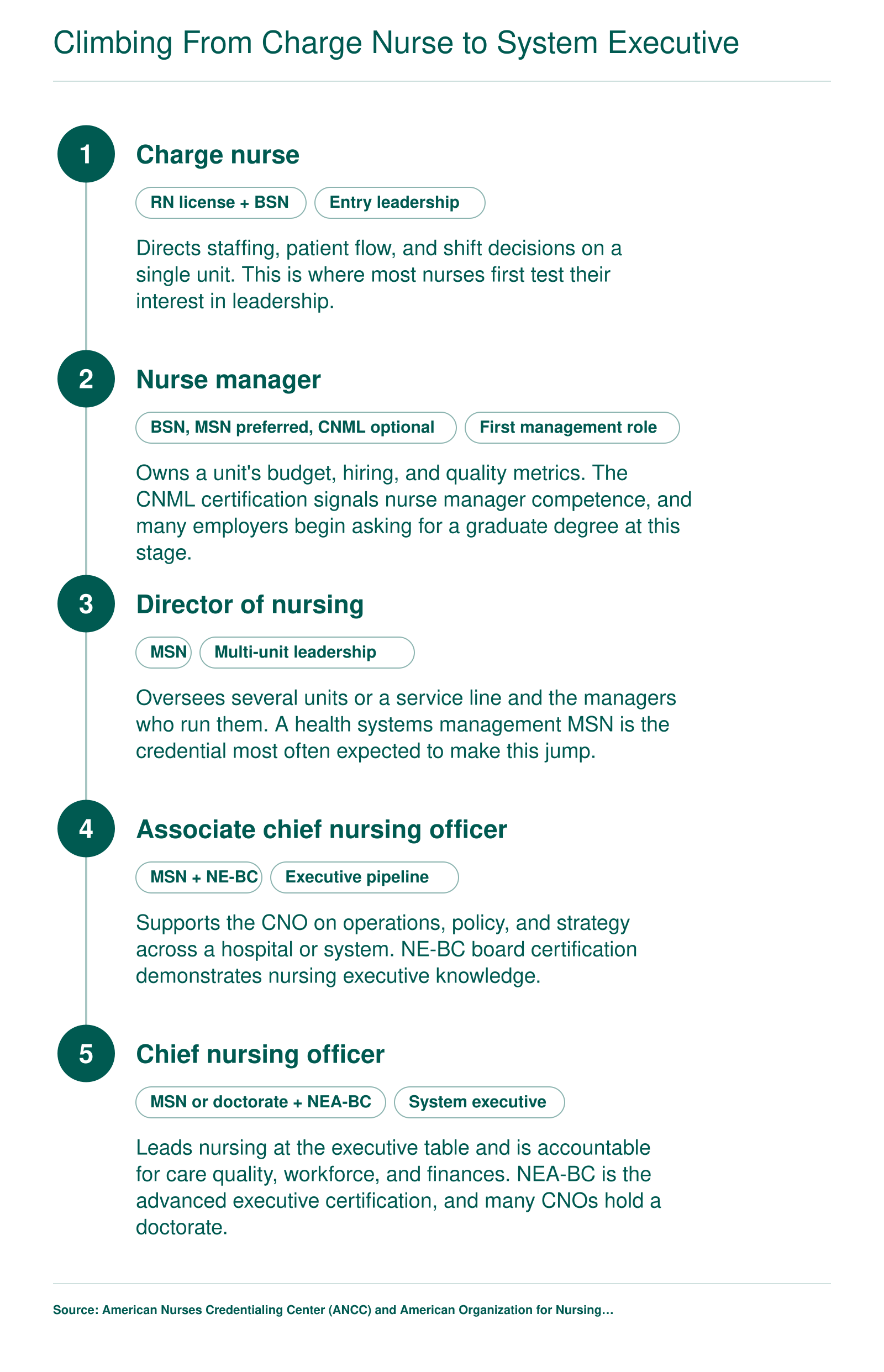
Climbing From Charge Nurse to System Executive
Nursing leadership follows a fairly predictable ladder, and each rung tends to ask for a new credential. The MSN in health systems management is built for the middle of this climb, where bedside experience has to turn into budget, staffing, and strategy responsibility.
Health Systems Management MSN vs. MBA in Healthcare Management
Purdue Global's MSN/MBA runs 88 credits, 48 of them in business, which shows how much a dual degree can add to your load.1 Before committing, compare what each path actually buys you.
Admission and Curriculum
- Health systems management MSN: Requires an active RN license and usually a BSN. Coursework centers on nursing leadership, quality, patient safety, and a supervised practicum tied to nurse executive practice.
- Healthcare MBA: Typically open to any bachelor's degree, no nursing license required. Expect finance, accounting, operations, strategy, analytics, and human resources, with healthcare management as the context.healthcare management
- MSN/MBA dual degree: Requires RN admission on the nursing side and awards two separate degrees. Benedictine has students complete its nurse executive leader concentration before the MBA7, Maryland has students finish the MSN and then continue, and Johns Hopkins awards neither degree until all coursework is done.6
Length, Cost, and Credentials
Dual degree totals vary widely: 51 credits at Robert Morris2, 57 at MidAmerica Nazarene (about 24 months)3, 60 at Indiana Wesleyan4 (about 36 months)5, 61 at Johns Hopkins6, and 66 to 72 at Maryland. Part-time study can stretch these further. Practice hours differ as well, from 504 at Johns Hopkins6 to 520 at Indiana Wesleyan.5 Since most schools charge by the credit, a dual degree almost always costs more than a standalone MSN.
Nurse executive certifications from organizations such as ANCC and AONL are built around nursing licensure and leadership experience. An MBA by itself does not open that door.
How Employers Read Each Degree
No published dataset shows what share of chief nursing officer postings require an MSN, so treat any confident percentage with suspicion. What program literature does support: a nursing leadership MSN maps most directly to nurse executive and CNO work, while the MBA adds financial and enterprise management that finance, operations, and strategy tracks tend to reward. The dual degree layers both; it does not let an MBA substitute for nursing preparation.
The Decision Rule
If you want to lead nursing, as a director, CNO, or system nurse executive, stay in the MSN. If you are aiming at COO, CFO, service line, or other business-side executive roles, choose an MBA program or the dual degree, and budget for the extra credits.MBA program
Health Systems Management programs by state
Quick Answers Before You Compare Programs
How does a health systems management MSN differ from a nursing administration MSN?
Will prior graduate credits transfer, and how long does part-time study take?
Can I earn a health systems management MSN online?
Compare Health Systems Management programs on the data that matters
Explore more Nursing specializations or browse every graduate field.
All Nursing programs