Best Adult-Gerontology Primary Care Nurse Practitioner (AG-PCNP) MSN Programs in Connecticut
Compare 4 accredited Adult Gerontology Primary Care Nurse Practitioner programs in Connecticut, with graduate earnings, cost, debt, and completion data from IPEDS and the U.S. College Scorecard.

Which Connecticut MSN programs train RNs to manage chronic conditions in adults and older patients across clinics, private practices, and long-term care? Only a few offer the AG-PCNP master's; the ranked programs here are Yale University on campus, Quinnipiac University in a hybrid format, and Post University fully online.
That small field shapes your options. Format, cost, and admissions requirements differ sharply. Post, for one, expects a BSN, an active RN license, and a year of work experience before you start.
Key Points
- Post University charges $588 to $603.75 per credit for online AGPCNP MSN.
- Quinnipiac's hybrid format includes three required on-campus immersions.
- Connecticut APRN licensure requires national certification plus 30 pharmacology hours.
Ranked: Connecticut's Best AG-PCNP MSN Programs
Each program below earned its spot on what matters after graduation: what you'll pay, whether students finish, and how well the degree positions you for board certification. The profiles focus on delivery format, accreditation, clinical preparation, and the practical details that shape your experience before and after the MSN.
Yale University
#1New Haven, CT · ~$50,000/yr (est.)
Best for: Nurses seeking research-focused MSN
Yale's Adult/Gerontology Primary Care NP specialty trains nurses to deliver comprehensive primary care across the adult lifespan. The curriculum integrates the 4Ms framework, mentation, medication, mobility, and what matters most, to build age-friendly care. Students complete simulation labs and school-arranged clinical placements, with full-time and part-time study options. Graduates are eligible for national certification and the MSN is consistently ranked among the nation's top programs.
- CCNE accredited
- Full-time and part-time options
- Simulation lab with standardized patients
- Clinical preceptors provided by school
- Focus on age-friendly 4Ms framework
- Small cohort sizes
- Prepares for national certification
Quinnipiac University
#2Hamden, CT · ~$19,000/yr (est.)
Best for: Connecticut residents wanting arranged clinicals
Quinnipiac's MSN in Adult-Gerontology Primary Care prepares nurses for primary care across clinics, offices, and skilled nursing settings. The mostly online program includes three one-week on-campus immersions and offers full-time or part-time pacing. Connecticut residents receive school-arranged clinical sites, while students in other approved states may need to secure their own preceptors. The program holds CCNE accreditation and reports a 100% first-time certification pass rate.
- CCNE accredited
- Complete in 2+ years
- Full-time and part-time options
- 100% first-time certification pass rate
- Three on-campus immersions required
- Dedicated faculty advisers
- Seamless transition to DNP program
- U.S. News top online nursing program
Post University
#3Waterbury, CT · ~$8,000/yr (est.)
Best for: Online learners valuing affordability
Post University's online MSN Adult Gerontology Primary Care Nurse Practitioner program offers flexible monthly starts and a 28-month timeline. The curriculum covers advanced assessment, pharmacology, and aging concepts, with individualized clinical preceptorships. The program requires a BSN and one year of nursing experience, and holds CCNE accreditation.
- CCNE accredited
- 28-month program length
- 42-45 credit hours
- Monthly start dates available
- BSN degree and RN license required
- One year nursing experience needed
- Individualized clinical preceptorships
- Focus on adult gerontology primary care
Cost & outcomes by school
Federal data for the highest-earning Adult Gerontology Primary Care Nurse Practitioner programs, independent of the ranking above. Earnings are this field's master's graduates four years after completing, where the Scorecard reports them.
| School | Earnings | Tuition / yr | Debt | Grads/yr | Format |
|---|---|---|---|---|---|
| Yale University CT | $131,639 | $49,500 | $118,849 | 108 | Campus |
| Post University CT | — | $7,955 | — | 262 | Online |
| Western Connecticut State University CT | — | $15,039 | — | 18 | Campus |
| Quinnipiac University CT | — | $19,140 | — | 51 | Hybrid |
Sources: U.S. Department of Education. Tuition and graduates: IPEDS. Earnings and debt: College Scorecard, this field's master's graduates; a dash means no figure is reported.
Can You Earn an AG-PCNP Master's Online in Connecticut?
Yes, with important caveats. Among the programs on this page, Post University's AG-PCNP MSN is fully online, with 8-week courses and monthly start dates; see how it compares with the best online adult-gerontology primary care nurse practitioner MSN programs. Quinnipiac uses a hybrid format: didactic coursework is online, but students complete three required on-campus immersions. Published materials do not specify how long those immersions last or which semesters they fall in, so confirm the current schedule before enrolling. Yale's program is campus-based, meaning more in-person coursework; contact the school for the current on-site calendar.
No matter the delivery label, online never means online clinicals. Every AG-PCNP student completes supervised, in-person clinical hours, usually at Connecticut sites. Even a fully online program like Post's arranges precepted clinical experience in the student's community. If you are comparing an out-of-state online program with online master's programs in Connecticut, ask the school to confirm in writing that it can place you at Connecticut clinical sites before you apply.
Related Articles
Which Connecticut AG-PCNP Programs Waive the GRE?
Graduate nursing admissions have quietly shifted away from standardized tests, as master's programs with no GRE required lean harder on licensure, GPA, and bedside experience. Published GRE policies remain uneven, however.
Quinnipiac University
The Quinnipiac AGPCNP admissions page does not list a GRE requirement or waiver, so treat it as unstated rather than waived. What the page does specify: a BSN, a statistics prerequisite, an unencumbered RN license, a 3.0 minimum GPA, and at least one year or 2,000 hours of nursing experience.
Yale and Post
As of this writing, neither school publishes a clear AGPCNP GRE policy on its primary nursing admissions pages for this cycle. Confirm directly with graduate admissions before applying.
Deadlines and start terms
Quinnipiac admits for fall and spring. Its published deadlines are for the 2027-28 cycle: fall priority is February 15, 2027, with rolling review through August 1; spring priority is September 15, 2027, with rolling review through January 1, 2028.
Connecticut APRN Licensure and AGPCNP Board Certification
What an AG-PCNP Master's Costs in Connecticut
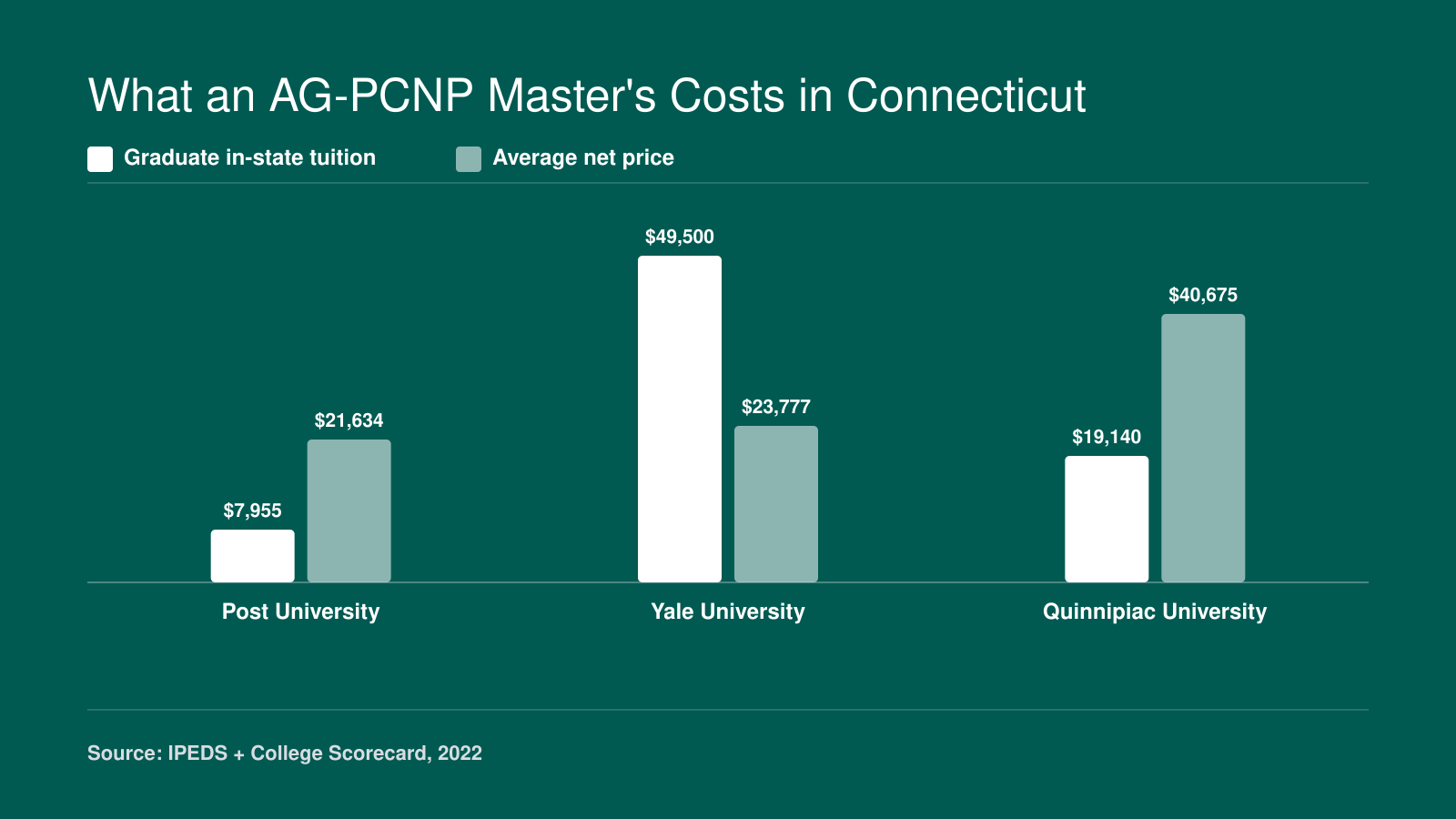
Post University lists per-credit rates of $588 to $603.75 for its online AGPCNP MSN and expects 42-45 credits, with an estimated total of about $30,884 including fees. Quinnipiac charges $1,085 per graduate credit across 45-50 credits, putting total tuition and fees between $52,825 and $59,250. Beyond tuition, clinical fees, immersion travel, background checks, and certification exam fees can add to the final bill.
Primary Care vs. Acute Care: AG-PCNP and AG-ACNP Programs in Connecticut
Adult-gerontology nurse practitioner programs prepare students for one of two distinct scopes of practice. Primary care AGNP training emphasizes longitudinal outpatient and residential care, while acute care AGNP training emphasizes hospital-based and critical care roles. The certification exams and clinical placements follow that same dividing line.
| Dimension | AG-PCNP MSN | AG-ACNP MSN |
|---|---|---|
| Typical practice settings | Outpatient adult and older adult primary care clinics, community health centers, long-term care and nursing facilities, and home-based primary care | Hospital acute care units, intensive care units, emergency departments, and inpatient specialty services |
| Patient acuity focus | Lower acuity chronic disease management, preventive care, and functional and cognitive decline managed over time | Higher acuity acute illness, clinical deterioration, complex hospital care, and rapid changes in condition |
| Certification exams | Separate adult-gerontology primary care NP certification exams rather than the acute care exams listed in the next column | ANCC Adult-Gerontology Acute Care Nurse Practitioner Certification (AGACNP-BC) and AACN ACNPC-AG certification |
| Typical clinical rotation sites | Adult and geriatric outpatient clinics, primary care practices, community health settings, and long-term care facilities | Hospital acute care, critical care, emergency, and inpatient specialty units |
| Connecticut schools on this page with published offerings | Quinnipiac University offers an AG-PCNP hybrid MSN track | Yale University offers a two-year Adult/Gerontology Acute Care Nurse Practitioner specialty; Quinnipiac University offers a hybrid 51-credit AG-ACNP MSN track |
AG-PCNP Master's Programs in Connecticut: Quick Answers Before You Apply
How long does an AGPCNP program take in Connecticut?
Which Connecticut AGPCNP MSN programs are CCNE accredited?
How many clinical hours do Connecticut AG-PCNP programs require, and will the school find my preceptors?
Can I keep working as an RN while completing a Connecticut AG-PCNP master's?
Compare Adult Gerontology Primary Care Nurse Practitioner programs on the data that matters
Explore more Nursing specializations or browse every graduate field.
All Nursing programs