Best Master of Divinity (MDiv) Programs in Michigan
Compare 7 accredited Divinity programs in Michigan, with graduate earnings, cost, debt, and completion data from IPEDS and the U.S. College Scorecard.
A Master of Divinity at Sacred Heart Major Seminary runs 123 credit hours of residential priestly formation. At Andrews University it is 78 credits, while Calvin Theological Seminary and Western Theological Seminary each require 87 and offer hybrid formats. That spread shapes cost and timeline, a key factor in the Most Affordable Master of Divinity Programs list.
Michigan's MDiv programs track denominations closely: Catholic, Reformed, Adventist, and ecumenical urban ministry each have a home here.
Ordination bodies set their own standards, so an accredited degree from the wrong tradition can still leave you short of the pulpit.
Key Points
- Sacred Heart Major Seminary in Detroit has the lowest average net price here, about $11,916.
- Michigan licenses no clergy; ordination comes from your denomination, and chaplaincy typically requires four CPE units.
- Hybrid delivery is common in Protestant seminaries, but most programs still require some time on campus.
Best Master of Divinity (Mdiv) Schools in Michigan: 2027 Rankings
Sacred Heart Major Seminary in Detroit comes out on top. It has the lowest approximate average net price after aid among the schools reporting that figure (about $11,916), and the school's overall graduation rate is 67%. It is a Catholic priestly formation program, so fit matters as much as rank. Several other schools below offer ministry degrees under different titles, noted in each entry.
Sacred Heart Major Seminary
#1Detroit, MI · ~$35,000/yr (est.)
Best for: Catholic priesthood candidates
Sacred Heart Major Seminary in Detroit prepares men for Catholic priesthood through a 123-credit MDiv built on human, spiritual, intellectual, and pastoral formation. Graduate tuition is about $24,120, and the approximate average net price after aid is $11,916. The school's overall graduation rate is 67%, and median earnings ten years after entry are $49,295.
- 123 total credit hours
- 2.5 GPA minimum
- Four formation areas: human, spiritual, intellectual, pastoral
- Clinical pastoral education and parish internships
- Daily Eucharist and spiritual direction
- Up to 41 transfer credits accepted
Andrews University
#2Berrien Springs, MI · $25,000 – $30,000/yr (est.)
Best for: Learners wanting flexible start terms
Andrews University in Berrien Springs offers a hybrid MDiv with five start dates a year. Graduate tuition is about $35,056, the highest in this group, and the approximate average net price after aid is $12,547. The school's overall graduation rate is 72%, and median earnings ten years after entry are $53,187, the highest reported here.
- 78 total credit hours
- Six semesters for full-time students
- Five start dates per year, fall, spring, and summer
- 2.5 GPA minimum and three recommendation letters
- Prerequisite courses required
- Scholarships and financial aid available
Cornerstone University
#3Grand Rapids, MI · $5,000 – $10,000/yr (est.)
Best for: Aspiring chaplains choosing campus or online
Cornerstone University in Grand Rapids offers its MDiv on campus and online, with a mentored ministry residency in a real church setting. Graduate tuition is about $23,000, and the approximate average net price after aid is $20,301. The school's overall graduation rate is 62%, and median earnings ten years after entry are $47,314.
- 75 total credit hours
- No entrance exam required, test optional
- 2.5 GPA minimum, one recommendation letter
- Greek, Hebrew, and biblical interpretation
- Sola Scriptura scholarship covers 75% of tuition
- Transfer up to 75% of credits
Kuyper College
#4Grand Rapids, MI · ~$5,000/yr (est.)
Kuyper College in Grand Rapids does not list an MDiv in this data. It offers an online Master of Ministry for working ministry professionals, so treat it as an adjacent option. Graduate tuition is about $27,660, and the approximate average net price after aid is $15,644. The school's overall graduation rate is 50%.
- 36 total credit hours across 12 courses
- Eight-week course terms
- Capstone and e-portfolio required
- Video conferencing and digital seminars
- Built around the student's own ministry setting
Rochester Christian University
#5Rochester Hills, MI · ~$13,000/yr (est.)
Rochester Christian University in Rochester Hills offers a hybrid Master of Applied Theology rather than an MDiv, so check ordination requirements before applying. Graduate tuition is about $29,196, and the approximate average net price after aid is $21,456. The school's overall graduation rate is 44%.
- 30 total credit hours, fall start
- Six concentrations, including Urban Ministry Leadership and Church Planting
- Earn a Certificate in Applied Theology along the way
- Synthesis and capstone project required
Ecumenical Theological Seminary
#6Detroit, MI · ~$13,000/yr (est.)
Ecumenical Theological Seminary in Detroit offers a hybrid MDiv with a social justice and urban ministry focus. Students choose between a traditional ecumenical track and an Urban Transformation and Renewal track. Full-time students finish in about three years, and part-time study runs four to seven.
- 112 quarter credit hours
- Traditional Ecumenical Ministry track
- Urban Transformation and Renewal track
- Supervised field education
- Part-time completion in four to seven years
- Offered since 2006
Western Theological Seminary
#7Holland, MI · $15,000 – $20,000/yr (est.)
Western Theological Seminary in Holland offers the same MDiv curriculum on campus or through distance learning. Full-time residential students can finish in three years, and working adults can take up to five.
- 87 total credit hours
- Residential track in three years, part-time up to five
- Same curriculum online and residential
- Intercultural immersion, biblical capstone, and Credo project
- Transfer credits accepted
Calvin Theological Seminary
#8Grand Rapids, MI · ~$18,000/yr (est.)
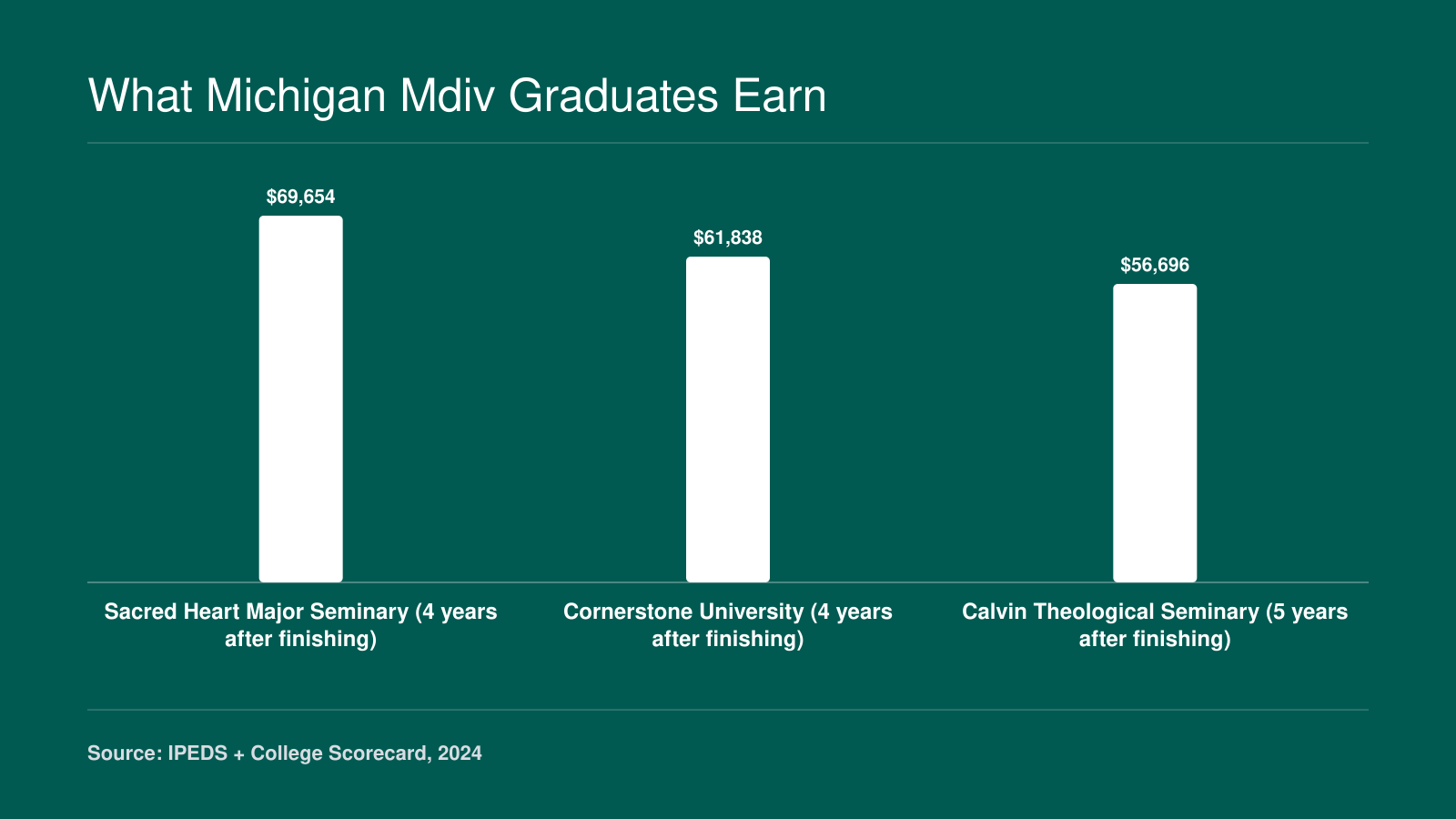
Calvin Theological Seminary in Grand Rapids teaches in the Reformed tradition and is the preferred pathway to Christian Reformed Church ordination. Its hybrid MDiv requires two on-campus intensive weeks a year. Median earnings five years after completion are $56,696 for the program.
- 87 total credit hours
- Complete in three to four years
- Hybrid option with two on-campus intensive weeks per year
- 2.7 GPA minimum, rolling admissions
- No prior theology study required
Cost & outcomes by school
Federal data for the highest-earning Divinity programs, independent of the ranking above. Earnings are this field's master's graduates four years after completing, where the Scorecard reports them.
| School | Earnings | Tuition / yr | Debt | Grads/yr | Format |
|---|---|---|---|---|---|
| Sacred Heart Major Seminary MI | $69,654 | $34,920 | — | 26 | Campus |
| Cornerstone University MI | $61,838 | $9,522 | — | 20 | Campus |
| Rochester Christian University MI | — | $13,176 | — | 9 | Hybrid |
| Ecumenical Theological Seminary MI | — | $12,840 | — | 4 | Hybrid |
| Western Theological Seminary MI | — | $17,020 | — | 37 | Hybrid |
| Calvin Theological Seminary MI | — | $17,603 | — | 38 | Hybrid |
| Andrews University MI | — | $29,156 | — | 91 | Hybrid |
Sources: U.S. Department of Education. Tuition and graduates: IPEDS. Earnings and debt: College Scorecard, this field's master's graduates; a dash means no figure is reported.
Online and Hybrid Mdiv Options in Michigan
Hybrid delivery now dominates Protestant seminary education in Michigan, while Catholic priestly formation has stayed on campus. So yes, you can earn a Master of Divinity largely online here, but rarely without some time in person.
Hybrid and online formats
Calvin Theological Seminary, featured in the best online Master of Divinity programs ranking, offers the most flexible menu: residential, synchronous online, fully online, and hybrid. Its hybrid track requires two one-week intensives per year in Grand Rapids. Calvin's own pages describe the timing differently (fall and spring on one, March and October on another), so confirm dates with admissions. Western Theological Seminary in Holland and Ecumenical Theological Seminary in Detroit also list hybrid formats, and Western says online and residential students follow the same curriculum. Andrews University lists a hybrid MDiv as well. Published residency details vary, so ask each school for its intensive schedule.
Campus-first programs
Sacred Heart Major Seminary in Detroit is residential, built around daily Eucharist, parish internships, and formation. Cornerstone University's MDiv is 100% online, according to the seminary's site; verify the current delivery directly.
Kuyper College's online program is a Master of Ministry, not an MDiv, so it will not meet ordination requirements that call for the full degree.
Michigan Master's in Divinity Programs That Waive or Make the GRE Optional
Among Master's Programs in Michigan, most seminaries skip the GRE for MDiv admission, a policy shared by many No-GRE master's programs; they rely instead on transcripts, references, and a statement of faith. Still, you should confirm each program's policy directly, because testing practices are set school by school and change over time.
What the published policies show
- Moody Theological Seminary (Michigan): The current graduate admissions page lists no GRE or standardized test requirement. It calls for an online application, official transcripts, and two references: one pastoral and one attesting to Christian character, each from someone who has known you at least a year and is not a relative. Reference forms stay valid six months. Applicants must be active in a Protestant church; no prior theological study is required.
- Calvin, Cornerstone (Grand Rapids Theological Seminary), and Sacred Heart Major Seminary: We could not verify a current GRE policy from their official pages. Check their admissions sites before assuming any testing requirement.
Common prerequisites that replace testing
Expect a bachelor's degree, a minimum GPA, pastoral or character references, a personal faith statement, and sometimes a background check. Catholic seminarians typically need diocesan sponsorship and may complete a psychological evaluation.
Mdiv Tuition in Michigan: Most Affordable Programs and Financial Aid
The schools below are ordered by average net price, which is an institution-wide approximation and not the price of one seminary program. Listed tuition and credit counts show the likely scale of a full degree, but several programs here are ministry or applied theology master's degrees and not a standard MDiv. Calvin Theological Seminary lists 2026-2027 MDiv tuition of $650 per credit, with academic scholarships of 30% or more for students taking at least five credits. Beyond that, expect denominational scholarships, seminary merit awards, church-matching grants (ask each school, since none were confirmed), and federal Direct Unsubsidized loans. Grad PLUS rules have changed for new borrowers, so confirm eligibility with each financial aid office.
| School | Program | Listed graduate tuition | Average net price (institution-wide) | Total credits | Cost and aid notes |
|---|---|---|---|---|---|
| Sacred Heart Major Seminary | Master of Divinity (MDiv) | $34,920 | $11,916 | 123 | No 2026 per-credit rate or named scholarships confirmed |
| Andrews University | Master of Divinity | $29,156 | $12,547 | 78 | Financial aid and scholarships available; amounts not confirmed |
| Kuyper College | Master of Ministry | $5,400 | $15,644 | 36 | Online; not a standard MDiv |
| Cornerstone University | Master of Divinity | $9,522 | $20,301 | 75 | $3,090 per semester full-time; Sola Scriptura scholarship covers 75% for qualifying on-campus students; other seminary scholarships often up to 50% |
| Rochester Christian University | Master of Applied Theology | $13,176 | $21,456 | 30 | Hybrid; not a standard MDiv |
Related Articles
Accreditation and Denominational Pathways for Michigan Mdiv Programs
Michigan has accredited MDiv programs, and for ministry the accreditor that matters most is the Association of Theological Schools (ATS). Denominations, chaplaincy endorsers and doctoral programs commonly look for ATS accreditation in theology master's programs, so a degree without it can narrow your path to ordination, hospital or military chaplaincy, or a later DMin or PhD.
- Calvin Theological Seminary (Christian Reformed Church)2: Calvin Theological Seminary's ATS member profile shows ATS accreditation in good standing since 1944, with its current period running through July 31, 2028.1 The MDiv is the main CRC ordination track but does not confer ordination by itself. Candidates also complete synodical candidacy, which ordinarily requires a cumulative GPA of at least 2.85 plus 2-credit courses in CRC History, CRC Polity, and Christian Theology in Reformed Confessions.
- Cornerstone University (interdenominational): Cornerstone Theological Seminary's ATS member profile shows ATS approval for the MDiv, and the university is accredited by the Higher Learning Commission. Students come from 36 denominations, so your own church sets ordination requirements.
- Sacred Heart Major Seminary (Roman Catholic): This Detroit seminary's route to ordination runs through Catholic priestly formation rather than a Protestant candidacy process. Ask the school directly about its current accreditation and how the MDiv fits into formation.
Before enrolling anywhere, ask your denomination's ordaining body which seminaries and courses it accepts.
Ministry Credentialing and Chaplaincy in Michigan
What Michigan Mdiv Graduates Earn
Median earnings for MDiv graduates vary by school, and the time window differs by program, so each bar is labeled with its own. Andrews University and Rochester Christian University have no program-level earnings figure in the federal data, so they appear in this comparison without a number. Ministry pay varies by denomination and congregation size, so treat these figures as directional ROI signals rather than salary promises.
Frequently Asked Questions About Michigan Mdiv Programs
How long does an MDiv take in Michigan, full-time versus part-time?
Do Michigan MDiv programs require Greek and Hebrew?
Can I transfer credits or use advanced standing to shorten a Michigan MDiv?
Which Michigan MDiv programs lead to ordination?
Compare Divinity programs on the data that matters
Explore more Religion & Theology specializations or browse every graduate field.
All Religion & Theology programs