Best Master of Divinity (MDiv) & Seminary Programs
Compare 270+ accredited Divinity programs, with graduate earnings, cost, debt, and completion data from IPEDS and the U.S. College Scorecard.

A Master of Divinity typically takes three to four years and requires 72 to 79 credits, and for most ordination and chaplaincy tracks it is the required credential, not the shorter Master of Theology. Net price after aid varies sharply across the ten schools ranked here, from about $10,800 at New Orleans Baptist Theological Seminary to nearly $30,000 at Duke, before full-tuition and living-stipend awards are considered.
Accreditation and denominational fit remain the first filters; online, residential, and hybrid formats then determine how much of that degree you can complete where you live. Program-level earnings are not yet published for any top-ranked MDiv school, so the cost side currently carries more weight than salary data.
Key Points
- Duke Divinity considers every admitted MDiv student for aid covering 25% to 100% of tuition.
- Confirm ATS accreditation and denominational fit before comparing cost or online format.
- Most online MDiv programs are hybrid, requiring campus intensives and a local supervised ministry placement.
10 Best Master of Divinity (Mdiv) Schools and Seminaries
The top tier of this list separates itself by pairing rigorous theological study with substantial field formation and unusually strong scholarship or net-price packages, not by brand name alone. The schools below appear in order of their overall ranking, with delivery format and cost noted where they meaningfully change the decision.
Grove City College
#1Grove City, PA · ~$9,000/yr (est.)
Best for: Accelerated learners entering ministry directly
Grove City College in western Pennsylvania is distinct for an accelerated four-year combined bachelor's and Master of Arts in Theology and Ministry, with ministry courses taken at the undergraduate tuition rate. The cohort-based model includes mentored ministry, church placements, and internships, and its 36 graduate credits transfer toward a Master of Divinity elsewhere. The school reports a $21,700 tuition and an 83% institution-wide graduation rate.
- Complete in just four years as an accelerated BA/MA track
- 36 total graduate credit hours
- Offered at undergraduate tuition rate
- Cohort-based structure with personal mentorship
- Church placements and internships
- 95% job placement rate
- 36 transferable credits toward an MDiv
- More than 20 campus ministry groups
Harvard University
#2Cambridge, MA · $55,000 – $60,000/yr (est.)
Best for: Students exploring multifaith chaplaincy and academia
Harvard Divinity School offers a three-year, full-time residential Master of Divinity that combines theological study, two field education placements, and optional language work, with a sizable share of graduates entering chaplaincy, academia, and public policy rather than congregational roles alone. The school reports an average net price around $19,100 and a 98% institution-wide graduation rate. It is best suited to students who want an interreligious, university-based setting.
- Three-year, full-time residential program
- 96 total units across 24 courses
- Two field education placements
- Language study options include Pali
- Certificate in Religion and Public Life available
- About 40% enter traditional ministry roles
- Required Senior Seminar and paper
Yale University
#3New Haven, CT · ~$50,000/yr (est.)
Best for: Aspiring pastors needing substantial financial aid
Yale Divinity School's three-year residential MDiv emphasizes formation in a consistent cohort, biblical interpretation, theology, and practical ministry, with a six-credit internship and elective exploration. The school reports a 96% institution-wide graduation rate and an average net price near $23,800. Its need-based aid is substantial: 95% of students receive full-tuition scholarships, which makes the sticker price less informative than the net price.
- Three-year, 100% in-person program
- 72 total credit hours
- Cohort-based structure for first three semesters
- Six-credit internship plus 15 credits of electives
- 95% of students receive full-tuition need-based scholarships
- Joint degree options in law, management, environment, medicine
- Practical training in preaching and pastoral counseling
University of Chicago
#4Chicago, IL · ~$69,000/yr (est.)
University of Chicago Divinity School offers a three-year, cohort-based MDiv in Hyde Park, within walking distance of five seminaries and welcoming students from multiple faith traditions. The program requires 27 courses and field education across all three years, with dual degree and certificate options. Its institution-wide graduation rate is 96%, and the average net price is about $14,900.
- Three-year, cohort-based curriculum
- 27 total courses
- Field education all three years
- Dual degree and certificate options available
- Welcomes students of many faith traditions
- Walking distance of five seminaries
- January priority deadline for full funding consideration
World Mission University
#5Los Angeles, CA · ~$6,000/yr (est.)
World Mission University in Los Angeles has a three-year, 79-credit MDiv that combines biblical languages and hermeneutics with practical ministry courses and field education. A distinctive 50-page ministry project and comprehensive Bible exam are required, and up to 39 credits may transfer into the program. The school reports an average net price of about $15,800 and a 100% institution-wide graduation rate.
- Three-year, 79-credit program
- Transfer up to 39 credits
- 50-page ministry project required
- Comprehensive Bible exam required
- Ministry field education required
- 2.5 GPA minimum
- Prepares for diverse ministry roles
Vanderbilt University
#6Nashville, TN · ~$58,000/yr (est.)
Vanderbilt Divinity School's three-year, 72-credit MDiv is ecumenical and does not require a prior ministry commitment, with for-credit field education and a capstone project. The school reports an average net price near $15,800 and a 94% institution-wide graduation rate. It stands out for its vocational focus, reporting that 100% of graduates were placed in vocational settings within a year.
- Three-year, 72-credit professional degree
- Ecumenical school welcoming all faiths
- No prior ministry commitment required
- 100% job placement rate within a year
- For-credit immersive field education
- Capstone project required
- Transfer up to 12 graduate credits
- Cross-disciplinary coursework across Vanderbilt
Grace School of Theology
#7The Woodlands, TX · $5,000 – $10,000/yr (est.)
Grace School of Theology in The Woodlands, Texas, offers a fully online 95-credit MDiv with five concentration options and two field practicums, making it a flexible fit for working students. The school reports a 100% institution-wide graduation rate and an average net price around $11,900. Its interdisciplinary concentration lets students customize eight credit hours toward areas like counseling, church planting, or pastoral ministry.
- Fully online 95-credit program
- Five concentration options
- Customize eight credits across ministry areas
- Two field practicums provide ministry experience
- Prepares for Doctor of Ministry study
- Deep exegetical study in Hebrew and Greek
- 2.0 GPA minimum
Duke University
#8Durham, NC · ~$67,000/yr (est.)
Duke Divinity School's three-year residential MDiv combines 24 courses in scripture, theology, ethics, preaching, worship, and biblical languages with two units of field education. All M.Div. students receive scholarship support covering 25 to 100 percent of tuition, and the school reports a 97% institution-wide graduation rate and an average net price near $29,600. Students can add certificates or dual degrees and come from more than 50 denominations.
- Three-year residential program with 24 courses
- Scholarships cover 25 to 100 percent of tuition
- Two units of field education
- Students from more than 50 denominations
- Certificates available like chaplaincy, preaching, theology and arts
- Dual degrees with M.P.P. or M.S.W.
- Field education internships up to $10,000
- 2.8 GPA minimum
University of Notre Dame
#9Notre Dame, IN · ~$65,000/yr (est.)
University of Notre Dame's three-year campus-based MDiv prepares lay students, vowed religious, and Holy Cross seminarians for ministry in the global Catholic Church through academic study, human and spiritual formation, and extensive field education. Every admitted student receives a full-tuition scholarship, a living stipend, and health insurance coverage. The university reports a 95% institution-wide graduation rate and an average net price near $26,800.
- Three-year campus-based program
- Full-tuition scholarship for all admitted students
- Living stipend of $5,000-$8,000 per year
- Health insurance premium covered
- Formation for lay and vowed religious
- Hands-on ministry placements
- Graduates serve in parishes, schools, nonprofits
New Orleans Baptist Theological Seminary
#10New Orleans, LA · ~$9,000/yr (est.)
New Orleans Baptist Theological Seminary offers a hybrid MDiv with more than twenty concentrations, including biblical languages, expository preaching, chaplaincy and pastoral care, and marriage and family counseling. Students can move between asynchronous and live online coursework, which supports working learners. The school reports an average net price around $10,800 and a 74% institution-wide graduation rate.
- Hybrid learning with traditional and online formats
- Over twenty concentrations available
- 84-hour Christian Ministry track
- 87-hour Biblical Languages track
- 87-hour Chaplaincy and Pastoral Care track
- 93-hour Marriage and Family Counseling track
- Prepares for pastoral roles, chaplaincy, counseling, church planting
Cost & outcomes by school
Federal data for the highest-earning Divinity programs, independent of the ranking above. Earnings are this field's master's graduates four years after completing, where the Scorecard reports them.
| School | Earnings | Tuition / yr | Debt | Grads/yr | Format |
|---|---|---|---|---|---|
| The King's University TX | $100,714 | $10,530 | $41,000 | 52 | Hybrid |
| Concordia Seminary MO | $97,155 | $32,260 | $13,910 | 68 | Campus |
| Lenoir-Rhyne University NC | $95,302 | $13,020 | — | 12 | Hybrid |
| Church Divinity School of the Pacific CA | $94,644 | $17,660 | — | 22 | Hybrid |
| Luther Seminary MN | $81,169 | $18,760 | $41,000 | 80 | Hybrid |
| The Master's University and Seminary CA | $81,084 | $10,410 | $24,402 | 57 | Campus |
| Concordia Theological Seminary IN | $80,818 | $36,900 | $33,254 | 38 | Campus |
| Faith International University WA | $73,387 | $7,350 | — | 24 | Online |
| Indiana Wesleyan University IN | $69,914 | $10,620 | $42,191 | — | Online |
| Moody Bible Institute IL | $69,835 | $9,702 | $25,442 | 92 | Online |
| Dallas Theological Seminary TX | $69,603 | $20,412 | $26,509 | 256 | Hybrid |
| Midwestern Baptist Theological Seminary MO | $68,891 | $8,477 | $27,450 | 385 | Online |
Sources: U.S. Department of Education. Tuition and graduates: IPEDS. Earnings and debt: College Scorecard, this field's master's graduates; a dash means no figure is reported.
Cost, debt & payoff
Median earnings of this field's master's graduates (4 yrs after completing) vs. their median federal loan debt · U.S. College Scorecard
Across these programs the median graduate earns about $60,267 and finishes with roughly $41,000 in debt — a ratio that clears a common rule of thumb (keep debt below first-year salary). Tuition and debt vary widely school to school, so check the per-school figures in the table above before you shortlist.
How We Rank the Best Mdiv and Seminary Schools
Seminary study has moved steadily toward online and hybrid formats, so how you study now matters almost as much as what you pay.
What the Ranking Weighs
Our list of the best master of divinity programs looks at four things a prospective student can verify:
- Net price: What students pay on average after grants and scholarships.
- Graduation rate: The share of students who finish their degree.
- Earnings and debt: Program-level graduate earnings and borrowing from federal College Scorecard data, where reported.
- Format availability: Whether the MDiv is offered online, on campus, or in a hybrid model.
Reading the Numbers Correctly
Two caveats keep the data honest. Graduation rates are institution-wide, not specific to the MDiv, so a university's figure reflects all of its students. Net price is an average after aid, not a personal quote. Your own cost depends on your finances and any church or seminary scholarships you secure. Many seminaries are small, and program-level earnings for divinity degrees are often not yet published, so some schools are compared on fewer measures.
What the Ranking Does Not Measure
No dataset can tell you whether a seminary's theology matches yours within the wider Religion & Theology Master's Programs field. The ranking leaves out doctrinal tradition, denominational fit, and ordination requirements. Before you apply, review the accreditation and denominational fit guidance in the next section and the master of theology vs master of divinity distinction.
Most Affordable Mdiv Programs and Full-Tuition Scholarships
Seminary sticker price is often misleading because many ATS schools reduce it substantially with institutional aid, denominational grants, and church-matching scholarships. Full-tuition support is common: Duke Divinity automatically considers MDiv applicants for scholarships covering 25 percent to 100 percent of tuition, Yale Divinity meets 100 percent of demonstrated need with a March 1 aid deadline, and Candler School of Theology reports that 100 percent of its MDiv students receive scholarships covering 50 to 100 percent of tuition. Southern Baptist seminaries also offer Cooperative Program discounts, such as a 40 percent tuition savings at Southern Baptist Theological Seminary, so compare net price and full aid packages rather than published tuition and ask residential programs about housing stipends.
| School | Format | Tuition | Net Price |
|---|---|---|---|
| Holy Apostles College and Seminary | Online | $9,580 | $10,117 |
| New Orleans Baptist Theological Seminary | Hybrid | $12,468 | $10,829 |
| Grace School of Theology | Online | $7,720 | $11,881 |
Related Articles
ATS Accreditation and Denominational Fit: Two Filters Before You Apply
A cheaper or more flexible MDiv is only a bargain if your church and future employers will recognize it, so accreditation and denominational fit should narrow your list before cost or format does.
Why ATS Accreditation Matters
The Commission on Accrediting of the Association of Theological Schools (ATS) is the specialized accreditor for graduate theological degrees, according to the ATS accreditation overview. Its ATS Standards of Accreditation define the MDiv as a professional master's degree requiring at least 72 semester credits or the equivalent. Ordination bodies, chaplaincy certifying organizations, and seminaries reviewing transfer credit commonly treat ATS accreditation as the baseline sign of a legitimate ministry degree.
To verify a school:
- Status: Find the school in the ATS member directory and confirm it is listed as "Accredited in Good Standing."1
- Degree approval: Check the ATS Approved Degrees listing to confirm the MDiv itself is approved, not just the institution.
- Online format: ATS has a separate fully online degree programs policy for professional degrees, and some schools operate under exceptions. Confirm the approval covers the format you plan to take.
- Cross-check: Match the school's own accreditation statement against what ATS publishes.2
ATS vs. Institutional Accreditation
ATS reviews theological programs specifically. Institutional (often called regional) accreditation evaluates a college or university as a whole. Many seminaries and university divinity schools hold both, and some denominations or employers look for both. If that matters for your path, confirm each accreditation separately.
Matching Your Tradition
You will encounter mainline Protestant seminaries, evangelical (often multidenominational) seminaries, Southern Baptist seminaries, Catholic seminaries and theology schools, and ecumenical or university divinity schools that train students from many traditions. Theology, worship practice, and field placements differ across them, and ordination rules are not uniform:
- United Methodist: ATS accreditation alone typically is not enough; candidates are generally expected to study at a United Methodist-related or approved school.
- Catholic: Ordination runs through Catholic seminaries and church approval, not ATS status.
- Southern Baptist: Expectations are largely set by the local church and vary.
- PC(USA), ELCA, Episcopal: Candidacy processes govern education requirements, so confirm current rules with your presbytery, synod, or diocese.
Some denominations accept an MDiv earned elsewhere but may require additional coursework in denominational history, polity, or doctrine from an approved seminary.
The Practical Takeaway
Before you apply, contact your denomination's ordination or candidacy office and get its education requirements in writing. An inexpensive MDiv that leaves you retaking denominational coursework can end up costing more than the approved option.
Distance learning enrollment in theological education changes each year, so verify current data rather than rely on one static figure. ATS counted more than 23,000 students taking at least one online course in a recent year, and fully online MDiv approval arrived only in August 2013. Cross-check ATS Annual Data Tables, BLS.gov, and school accreditation pages.
Online vs. Residential vs. Hybrid Mdiv Programs: What to Know
"Online MDiv" rarely means you never set foot on campus. In practice, most distance-friendly seminaries run a hybrid model: coursework delivered over the internet, plus required in-person intensives and a supervised ministry placement you complete where you live. ATS accreditation permits this.1 The accreditor distinguishes limited distance education from comprehensive distance education, the latter allowing half or more of a degree to be delivered online,2 but it does not dictate how any individual school structures delivery. That means the format question has to be answered school by school.
How residency requirements actually vary
Christian Theological Seminary in Indianapolis requires MDiv students to attend three August intensives on campus, covering formation, trauma-informed leadership, and preaching and public witness, with other coursework offered online in real time.3 Portland Seminary at George Fox University pairs online classes with an annual BridgeWeek intensive in Portland each fall, preceded for new students by a one-day online orientation called WaterFront.4 Duke Divinity School's hybrid MDiv ordinarily requires eleven terms of synchronous learning across in-person residencies and online sessions.5 Andrews University offers in-person, online, and intensive options but requires half of total credits to come from on-campus classes.6
Synchronous versus asynchronous matters just as much for working pastors. Duke combines weekly Zoom meetings with prerecorded lectures, discussion forums, and group study.5 A program built on fixed weekly video sessions is a different scheduling problem than one you can work through at midnight.
Field education and formation
Every ATS-accredited MDiv requires supervised practical experience, but the mechanism differs.1 Duke students complete two field education internships plus one or more self-initiated experiences totaling at least 400 contact hours, a structure that supports placements near where students already serve.5 CTS requires a year of supervised ministry.3 What published program pages often do not spell out is whether your own congregation or current ministry employer can serve as the site, so ask the field education office directly before you enroll.
Verify acceptance before you commit
Some denominations and chaplaincy endorsing bodies still scrutinize how formation happens at a distance, and ordination committees sometimes impose residency expectations the seminary itself does not. Confirm with your judicatory, bishop, or endorser that the specific format you are considering will be accepted. Also budget honestly for travel: three or four trips a year for intensives is a real cost that tuition comparisons tend to hide.
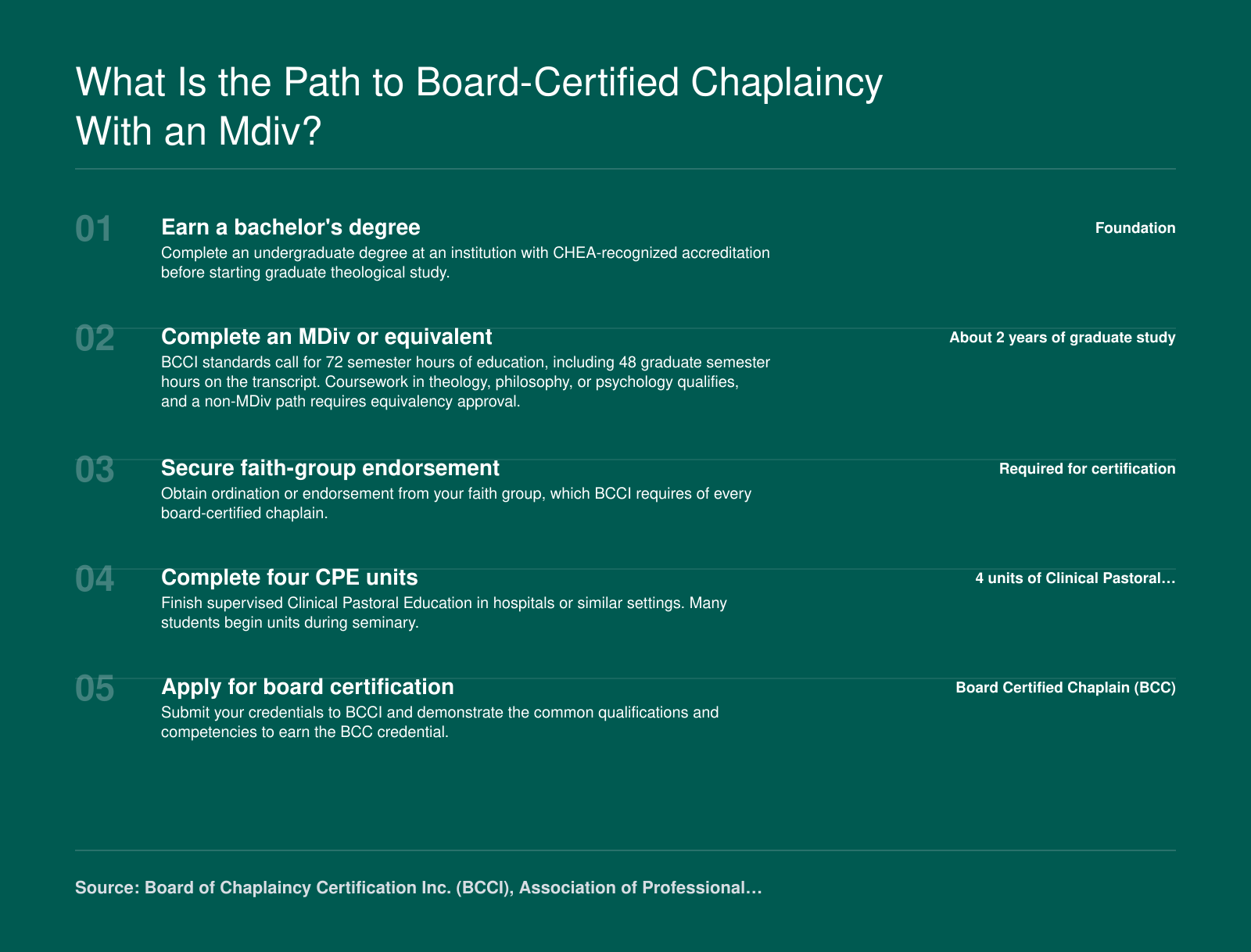
What Is the Path to Board-Certified Chaplaincy With an Mdiv?
Board certification through the Association of Professional Chaplains follows a set order, and an MDiv covers most of the academic portion. Military chaplaincy adds its own endorsement and service requirements on top of these steps.
Divinity programs by state
Frequently Asked Questions About Mdiv Programs
These answers cover the questions prospective students ask most often when comparing seminaries. Policies differ by school, so confirm details with each admissions office before you apply.
How long does it take to get an MDiv?
Can you get an online MDiv that is accredited?
Is a Master of Divinity worth it?
Do you need to belong to a specific denomination to enroll in a seminary's MDiv program?
Can I transfer MA or ThM credits into an MDiv later?
Compare Divinity programs on the data that matters
Explore more Religion & Theology specializations or browse every graduate field.
All Religion & Theology programs