Best Master of Divinity (MDiv) Programs in North Carolina
Compare 12 accredited Divinity programs in North Carolina, with graduate earnings, cost, debt, and completion data from IPEDS and the U.S. College Scorecard.

An MDiv typically demands 72 to 90 credit hours and three years of full-time study, and it remains the expected credential for ordination in many denominations and for board-certified chaplaincy.
In North Carolina, price varies far more than pay. Duke MDiv graduates earned a median of about $44,000 one year out; Campbell and Wake Forest graduates earned close to $41,000.
Annual tuition above $66,000 rarely squares with a ministry salary unless scholarships cover most of it.
Key Points
- Hood Theological Seminary graduates earned a median $57,031 one year after finishing their MDiv.
- Published graduate tuition runs from about $6,900 to nearly $69,000 per year before aid.
- North Carolina does not license clergy, so denominations set ordination and ATS accreditation matters.
Best Master of Divinity Programs in North Carolina: 2027 Ranking
The strongest North Carolina master's in divinity options stand apart on measurable results: the school's graduation rate, reported graduate earnings, and how much tuition is offset by scholarships. Duke and Wake Forest lead on those measures, while several lower-priced online and hybrid programs trade outcome strength for flexibility. Association of Theological Schools (ATS) status could not be confirmed in the ATS member directory for every school below, so verify it directly before you apply.
Duke University
#1Durham, NC · ~$67,000/yr (est.)
Best for: Scholarship-seeking residential students
Duke Divinity School in Durham is the clearest outcomes leader on this list, with the highest graduation rate among the ranked schools (about 97%, the school's graduation rate rather than the program's) and the strongest reported graduate earnings. The Master of Divinity is a three-year residential program rooted in a Methodist, ecumenical tradition, with students from more than 50 denominations. Admitted students receive institutional scholarship support covering 25% to 100% of tuition. ATS accreditation status could not be confirmed in the ATS directory.
- 3-year residential program with 24 total courses
- 2.8 GPA minimum for admission
- Institutional scholarships cover 25% to 100% of tuition
- Two units of field education; internships up to $10,000
- Dual degrees available with the M.P.P. or M.S.W.
- Certificates such as chaplaincy or preaching earned alongside the degree
- Take two classes outside the Divinity School
Manna University
#2Fayetteville, NC · ~$9,000/yr (est.)
Best for: Service members preparing for chaplaincy
Manna University in Fayetteville offers a Pentecostal/charismatic, broadly evangelical Master of Divinity at a much lower sticker price than the private research-university options. Its program is recognized by all U.S. military branches for chaplaincy candidates, which makes it relevant to service members. The school's graduation rate is about 80%. Completion data is thin (very few recent program completers), and ATS accreditation status could not be confirmed in the ATS directory.
- Concentrations in Biblical Studies or Christian Leadership
- 90 credit hours, 30 courses, with a capstone required
- $260 per credit; $33,650 total program tuition
- Classes on campus or fully online
- Full-time and part-time options
- Recognized by U.S. Armed Forces for chaplaincy
- Open to any bachelor's degree with a 2.8 GPA minimum
Wake Forest University
#3Winston-Salem, NC · $35,000 – $40,000/yr (est.)
Best for: Students targeting nonprofit and chaplaincy roles
Wake Forest University School of Divinity in Winston-Salem pairs a Baptist-rooted, ecumenical identity with an integrative, individualized curriculum. The school's graduation rate is about 89%, and graduates report strong early employment. The program is built for congregational, chaplaincy, and nonprofit paths, and program materials state ATS accreditation, though the ATS directory could not confirm it for this page.
- Integrative, interdisciplinary, individualized curriculum
- Capstone and internship reflection seminar required
- Part-time study allowed with associate dean permission
- Up to six years allowed to finish
- Electives in spirituality and interfaith dialogue
- Program materials state ATS accreditation
Campbell University
#4Buies Creek, NC · ~$16,000/yr (est.)
Campbell University Divinity School in Buies Creek is a Baptist-affiliated option with a lower price than the top two schools and a strong chaplaincy emphasis. The school's graduation rate is about 61%. Graduates report solid early employment, and the program centers on military, hospital, and prison chaplaincy plus community-based ministry. ATS accreditation status could not be confirmed in the ATS directory.
- Integrates biblical, historical, and theological study
- Prepares for military, hospital, and prison chaplaincy
- Pastoral ministry and church staff preparation
- Nonprofit and community-based ministry focus
- On-campus program in Buies Creek
Gardner-Webb University
#5Boiling Springs, NC · ~$12,000/yr (est.)
Gardner-Webb University in Boiling Springs is Baptist in origin and commitment, with small classes and a faculty mentor for each student. The school's graduation rate is about 55%. Program-level earnings are not yet available for this degree, and ATS accreditation status could not be confirmed in the ATS directory. Prospective students should confirm current MDiv enrollment details with admissions.
- Pastoral Studies concentration: 51-hour core plus 27-hour concentration
- 78 total credit hours; six concentration areas in all
- Starts listed for August 19, 2026 and January 11, 2027
- Dual M.Div./M.A. in Clinical Mental Health Counseling (111 hours)
- Counseling track designed to meet North Carolina licensure requirements
- Optional ministry trips to Israel, Greece, Turkey, and Cuba
- Classes offered on campus, online, or hybrid
Lenoir-Rhyne University
#6Hickory, NC · ~$13,000/yr (est.)
Lenoir-Rhyne University in Hickory brings a Lutheran heritage to a hybrid-online Master of Divinity that welcomes students of all denominations. The school's graduation rate is about 48%. Program materials state ATS accreditation, which we could not confirm in the ATS directory, and the degree is described as meeting United Methodist ordination requirements.
- 3-year, 84-credit-hour program
- Concentrations in Biblical Studies, Theology, or Faith Formation
- Cognates available in Leadership or Counseling
- Synchronous online classes with twice-yearly campus gatherings
- Supervised field education semesters required
- Described as meeting UMC ordination requirements
- Program materials state ATS accreditation
Carolina University
#7Winston-Salem, NC · ~$13,000/yr (est.)
Carolina University's Piedmont Divinity School in Winston-Salem offers a fully online, evangelical, nondenominational Master of Divinity at one of the lowest tuition rates here. The school's graduation rate is about 22%, well below the leaders, which matters when weighing a low price. ATS accreditation status could not be confirmed in the ATS directory.
- 3-year, fully online program
- 2.5 GPA and a bachelor's degree required
- Two recommendations and a testimony essay required
- Applicants must agree with the university's doctrinal statement
- Emphasis on Bible exposition and ministry planning
- Pathway to Th.M., Ph.D., or D.Min. study
Shaw University
#8Raleigh, NC · ~$14,000/yr (est.)
Shaw University Divinity School in Raleigh is a Baptist (American Baptist tradition) program at the South's first HBCU, with theological education dating to 1880. It focuses on leadership in the African American church and is offered online, hybrid, and in person. The school's graduation rate is about 22%, and program materials state ATS accreditation, which we could not confirm in the ATS directory.
- Focus on African American church leadership
- Prepares for ordained ministry and chaplaincy
- Online, hybrid, and in-person options
- Prepares for advanced theological study
- MDiv cohort of 72 students
- Program materials state ATS Commission on Accrediting status
Carolina College of Biblical Studies
#9Fayetteville, NC · ~$6,000/yr (est.)
Carolina College of Biblical Studies in Fayetteville is the lowest-priced MDiv on this list and is offered on campus or online. Its denominational affiliation and ATS accreditation status could not be confirmed in our research, and the school's graduation rate is not reported. The four-year, 84-hour structure suits working ministers, though it is the longest timeline listed.
- 4-year, 84-semester-hour program
- Three concentration options
- Advanced placement can cut the degree to 60 hours
- Biblical Greek and Hebrew included
- Internship in the final year
- Campus or online format
Carolina Christian College
#10Winston Salem, NC · ~$13,000/yr (est.)
Carolina Christian College in Winston-Salem is included for its ministry-focused graduate offering, but the listed program is a Master of Religious Education rather than a Master of Divinity. It suits education and pastoral-care roles more than ordination tracks. The school's graduation rate is about 15%, and its denominational affiliation and ATS status could not be confirmed.
- Not an MDiv; Pastoral Care concentration
- 57 credit hours with a capstone required
- 3.0 GPA minimum
- Complete in as few as three years; up to seven allowed
- Weekly meetings in a six-week format
- Prepares for Christian education and youth ministry leadership roles
Cost & outcomes by school
Federal data for the highest-earning Divinity programs, independent of the ranking above. Earnings are this field's master's graduates four years after completing, where the Scorecard reports them.
| School | Earnings | Tuition / yr | Debt | Grads/yr | Format |
|---|---|---|---|---|---|
| Lenoir-Rhyne University NC | $95,302 | $13,020 | — | 12 | Hybrid |
| Wake Forest University NC | $62,158 | $39,141 | $59,016 | 24 | Campus |
| Hood Theological Seminary NC | $59,012 | $20,410 | $60,530 | 22 | Hybrid |
| Duke University NC | $58,405 | $66,523 | $53,550 | 127 | Campus |
| Campbell University NC | $55,216 | $16,347 | $41,000 | 22 | Campus |
| Carolina University NC | $51,238 | $12,550 | — | 79 | Online |
| Carolina Christian College NC | — | $13,222 | — | — | Online |
| Carolina College of Biblical Studies NC | — | $5,940 | — | 8 | Online |
| Shepherds Theological Seminary NC | — | $8,845 | — | 50 | Hybrid |
| Manna University NC | — | $9,195 | — | 6 | Hybrid |
| Gardner-Webb University NC | — | $12,125 | — | 7 | Campus |
| Shaw University NC | — | $13,582 | $82,000 | 36 | Campus |
Sources: U.S. Department of Education. Tuition and graduates: IPEDS. Earnings and debt: College Scorecard, this field's master's graduates; a dash means no figure is reported.
Cost, debt & payoff
Median earnings of this field's master's graduates (4 yrs after completing) vs. their median federal loan debt · U.S. College Scorecard
Across these programs the median graduate earns about $58,709 and finishes with roughly $59,016 in debt — a ratio that clears a common rule of thumb (keep debt below first-year salary). Tuition and debt vary widely school to school, so check the per-school figures in the table above before you shortlist.
Online and Hybrid Master's in Divinity Options in North Carolina
Online and hybrid accredited master of divinity programs in North Carolina trade schedule flexibility for structured ministry formation, and the in-person requirements differ enough to check each school directly. Duke's hybrid MDiv includes three week-long Durham immersions each year plus scheduled Zoom classes around lunch Eastern, and it requires 400 or more hours of local field education across two units of at least 200 hours each. Lenoir-Rhyne's hybrid-online MDiv combines livestreaming with twice-yearly campus gatherings, though it does not specify the length or format of those gatherings, and it requires supervised field education semesters. Manna University, Carolina University, and Carolina College of Biblical Studies list online or hybrid formats, but their program pages do not clearly publish residency details; confirm synchronous class times, on-campus weeks, and placement rules with admissions. In practice, online rarely means zero travel for an MDiv, because field education usually happens in person at a local congregation or agency.
Which North Carolina Mdiv Programs Waive the GRE or Make It Optional?
A test score and a ministry file are two ways a seminary can judge readiness, and the published details for these schools speak mostly about the second.
A published GRE policy, required, optional, or waived, could not be confirmed for any school on this list, so we are not classifying any as No-GRE master's programs. Where a policy is not stated, we are not guessing. Ask admissions directly before you budget for the exam.
What the schools do list:
- Duke University: 2.75 GPA minimum.
- Manna University: 2.8 GPA minimum, a $50 application fee, and openness to any bachelor's degree.
- Carolina University: 2.5 GPA minimum, at least two letters of recommendation, and a testimony essay.
- Wake Forest University, Campbell University, Gardner-Webb University, Lenoir-Rhyne University, Shaw University, and Carolina College of Biblical Studies: no GRE policy or minimum GPA appears in the details we reviewed.
Expect a bachelor's degree, transcripts, a personal statement, and references to carry the most weight, much as they do for Master's in Christian Ministry applicants. Some schools also ask for church or ministry endorsement, so check each admissions page for that.
Related Articles
Mdiv Tuition and Financial Aid in North Carolina
What does an MDiv actually cost in North Carolina? Published graduate tuition among the theology master's programs covered here ranges from about $6,900 to nearly $69,000 per year before aid. Duke's standard MDiv costs $15,300 per term, its four-year format $11,475, and its hybrid format $7,650, according to Duke Divinity School tuition policies. Manna lists a $33,650 total program at $260 per credit. Campbell charges $670 per credit in Summer 2026 and $704 per credit from Fall 2026 through Spring 2027, plus a $420 full-time general fee, according to Campbell University Divinity School tuition and fees.
Those sticker numbers are not what most ministry students pay. Duke gives every MDiv student scholarship support covering 25% to 100% of tuition, with full-tuition fellowships for Black Church Studies and Latinx Studies residential students; part-time students are not eligible. Other schools here advertise general scholarships and military benefits, but published denominational discounts are scarce. Net price, the college-wide average cost after aid, runs from about $15,200 to $29,600 and is not an MDiv quote. A single average cost for a North Carolina MDiv is roughly $30,000 per year before aid.
Ministry and Chaplaincy Credentials in North Carolina
Career Outcomes and Earnings for Mdiv Graduates in North Carolina
A well-known divinity school and a smaller seminary can produce graduates with similar paychecks, so compare program results rather than reputation. Hood Theological Seminary graduates earned a median $57,031 one year after finishing. At the same point, Duke graduates earned $44,015 and Wake Forest graduates earned $40,732. Four years after finishing, medians were $95,302 at Lenoir-Rhyne (a small graduating group), $62,158 at Wake Forest, $58,405 at Duke, $55,216 at Campbell and $51,238 at Carolina University. Shaw graduates earned a median $44,627 five years after finishing.
Debt determines how far those salaries stretch. Median monthly payments on a 10-year plan are $466 at Campbell (on $41,000 borrowed), $609 at Duke, $671 at Wake Forest and $689 at Hood. Shaw's are $933, on a median debt of $82,000. On a first-year ministry salary near $40,000, a payment above $600 consumes a real share of take-home pay.
Common paths after the MDiv: - Congregational ministry and church staff roles - Hospital, military and prison chaplaincy - Nonprofit and community leadership - Doctoral study (ThM, PhD, DMin)
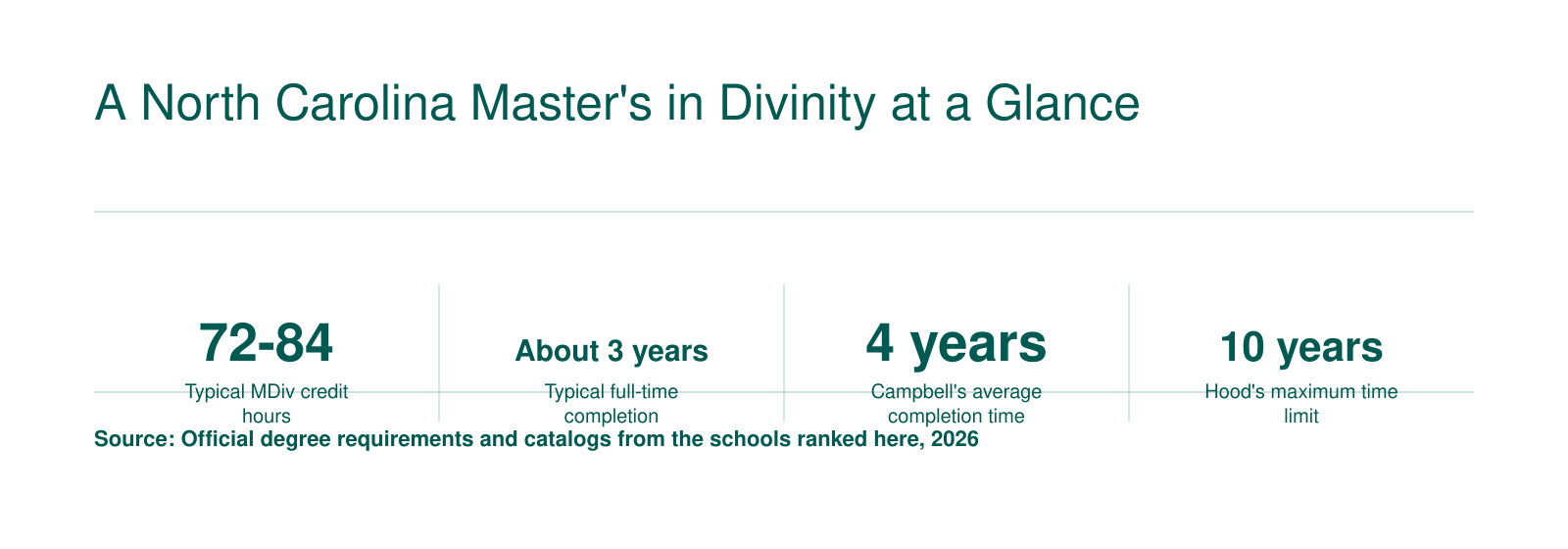
A North Carolina Master's in Divinity at a Glance
Credit totals and timelines vary by school, but the figures below show what most North Carolina MDiv programs ask of full-time students.
How We Rank North Carolina Mdiv Schools
What data actually decides where a North Carolina MDiv program lands on this list? Federal numbers, not reputation. Our rankings draw on IPEDS and College Scorecard data: graduate tuition, net price, graduation rate, and program-level earnings and debt for MDiv graduates where the government publishes them. No school pays for placement, and we do not use prestige surveys or reputation polls.
The data has limits worth knowing. Graduation rate and net price are reported institution-wide, so they describe the whole university or seminary rather than the divinity program alone. Many MDiv programs, especially smaller ones, have no published Scorecard earnings because their graduating groups are too small to report. When that figure is missing, we leave it missing rather than estimate it.
Frequently Asked Questions About Mdiv Programs in North Carolina
How long does an MDiv take in North Carolina?
When are MDiv application deadlines at North Carolina schools?
How selective are North Carolina divinity schools?
What can you do with an MDiv in North Carolina?
Compare Divinity programs on the data that matters
Explore more Religion & Theology specializations or browse every graduate field.
All Religion & Theology programs