Best Master's in Urban Ministry Programs
Compare 20+ accredited Urban Ministry programs, with graduate earnings, cost, debt, and completion data from IPEDS and the U.S. College Scorecard.

A Master of Divinity with an urban ministry concentration at Midwestern Baptist Theological Seminary runs 92 credit hours. A Master of Arts in Intercultural Studies at Maranatha Baptist University runs 33. Both get described as urban ministry training within Religion & Theology Master's Programs.
That spread shows up in price as well. Published graduate tuition ranges from roughly $9,522 a year at Cornerstone University to $29,156 at Andrews University, with campus, hybrid, and fully online formats represented. Reputation tracks poorly with cost in this field, and ministry salaries rarely repay the premium.
What usually determines a credential's value is the fieldwork placement behind it, not the institution's reputation.
Key Points
- Published graduate tuition runs from about $9,522 at Cornerstone University to $29,156 at Andrews University.
- Net price after aid can differ sharply from sticker tuition, so compare both.
- Graduation rates are institution-wide, so confirm fieldwork, format, and admissions rules with each school for 2027.
The 10 Best Master's in Urban Ministry Programs for 2027
This ranking weighs outcomes and affordability, not name recognition. Each school appears because its urban ministry concentration or degree offers meaningful city-focused training, and because the underlying numbers give students a clearer picture of cost and return. The programs below include campus, hybrid, and online options across several states, so working ministers and full-time students can compare living costs and net price as they weigh fit.
Andrews University
#1Berrien Springs, MI · $25,000 – $30,000/yr (est.)
Best for: Future pastors pursuing clinical pastoral education
Andrews University's MDiv includes a dedicated Urban Ministry concentration that pairs theological study with hands-on urban engagement. Students complete Clinical Pastoral Education in an urban setting, an Urban Ministry Project, and coursework in multi-ethnic preaching, reconciliation, and social innovation. The 18-credit concentration builds practical skills for church planting, nonprofit leadership, and ministry among diverse populations.
- 78 total credit hours
- 18-credit concentration added to the MDiv
- Includes Clinical Pastoral Education in an urban setting
- Includes hands-on Urban Ministry Project
- Social innovation and reconciliation courses
- Diversity and cultural intelligence training
Olivet Nazarene University
#2Bourbonnais, IL · ~$12,000/yr (est.)
Best for: Working ministers needing online field-based training
Olivet Nazarene University offers a fully online Master of Arts in Urban Ministry designed for working ministers. The two-year, 36-credit program includes required summer field experiences in Indianapolis and Chicago, connecting academic study with direct urban practice. Nazarene pastors and ministry partners receive a 50% tuition discount, making this a strong value for denominational leaders.
- 36 total credit hours
- Two-year, fully online program
- Two required summer field experiences
- Field placements in Indianapolis and Chicago
- 50% tuition discount for Nazarene pastors and ministry partners
- Pastoral scholarships available
Moody Bible Institute
#3Chicago, IL · ~$10,000/yr (est.)
Best for: Chicago-based students wanting hands-on neighborhood ministry
Moody Bible Institute's Master of Arts in Urban Ministry is rooted in Chicago, where students move between classroom study and neighborhood outreach. The program includes street evangelism, shelter service, Bible studies, and mission trips, emphasizing presence and relationship-building. Mentorship from faculty and a curriculum that blends theology with practical ministry prepare graduates for urban churches, parachurch organizations, and community nonprofits.
- Chicago-based urban ministry training
- Street evangelism on Chicago's West Side
- Service at local homeless shelters
- Mission trip to Asia
- Close mentorship relationships with professors
- Theology taught in accessible terms
Yale University
#4New Haven, CT · ~$50,000/yr (est.)
Yale Divinity School's Master of Sacred Theology allows students to build a concentration in urban or inner-city ministry. The flexible 24-credit degree can be completed in one year or spread over several, and students may draw on courses from law, public health, and sociology. A thesis or project exploring community organizing, housing justice, or similar questions lets students connect theological training to urban practice.
- 24 total credit hours
- One-year program or distributed over up to four years
- Concentration in urban or inner-city ministry
- Courses in other university departments
- Thesis or capstone option
- Prepares for doctoral studies
- Full-time and part-time options
Midwestern Baptist Theological Seminary
#5Kansas City, MO · ~$8,000/yr (est.)
Midwestern Baptist Theological Seminary offers a Master of Divinity with a concentration in Urban Ministry. The 92-hour program combines classical theology with urban evangelism, cross-cultural communication, and a supervised urban ministry practicum. Students prepare for pastoral roles, church planting, and outreach in urban neighborhoods from a Southern Baptist perspective.
- 92 total credit hours
- Three-year full-time program
- Supervised urban ministry field experience
- Urban evangelism and cross-cultural communication
- Methods for urban church revitalization
- No entrance exam required
- Test optional
- Association of Theological Schools accredited
Cornerstone University
#6Grand Rapids, MI · $5,000 – $10,000/yr (est.)
Cornerstone University's Master of Arts in Ministry Leadership with an Urban Cohort focus is designed for working leaders in Western Michigan. Cohorts of 12 to 25 meet one night a week, serving pastors, nonprofit staff, and community leaders in Grand Rapids, Kalamazoo, Lansing, and Muskegon. The 36-credit curriculum integrates biblical interpretation, servant-leadership, and urban development with a scholarship for urban cohort students.
- 36 total credit hours
- 12 total courses
- One-night-per-week cohort format
- Cohorts of 12 to 25 students
- Serves four Western Michigan cities
- Urban Cohort Scholarship offers limited tuition support
- Rolling admissions
Dallas Baptist University
#7Dallas, TX · ~$26,000/yr (est.)
Dallas Baptist University offers a Master of Arts in Global Leadership with a concentration in Urban Ministry. The 36-hour program blends Christian faith with global leadership skills through hybrid, online, and evening courses. Federal data report median earnings of about $46,400 four years after entry and median debt near $51,250 for graduates.
- 36 total credit hours
- Concentration in Urban Ministry
- Hybrid, online, and evening course options
- Synchronous online classes
- Careers in missions and church planting
- Dual master's degree options available
- Christ-centered servant leadership training
Wake Forest University
#8Winston-Salem, NC · $35,000 – $40,000/yr (est.)
Wake Forest University's Urban Ministry Studies program, founded in 2000, combines classroom study with urban immersion experiences in New York City and Washington, D.C. Students examine social justice, the vocation of the urban church, and ministry with marginalized groups. The program prepares graduates for pastoral, nonprofit, and community organizing roles.
- Founded in 2000 by Rev. Dr. Doug Bailey
- Urban immersion pilgrimages to New York City and Washington, D.C.
- Servant ministry in urban congregations
- Emphasis on advocacy and mercy ministry
- Prepares for urban pastoral and nonprofit leadership
- Based in Winston-Salem, North Carolina
Maranatha Baptist University
#9Watertown, WI · ~$7,000/yr (est.)
Maranatha Baptist University's Master of Arts in Intercultural Studies with an Urban emphasis prepares students for inner-city and restricted-access ministry. The 33-credit program covers church planting, discipleship in the city, and intercultural anthropology, with urban internships and optional summer mission trips. Students may complete the degree entirely online or on campus, with 8-week online sessions and no required live classes.
- 33 total credit hours
- Entire program online or on campus
- 8-week online course sessions
- Urban internship opportunities
- Summer mission trip opportunities
- Church planting and intercultural anthropology focus
- Synchronous and asynchronous options
Corban University
#10Salem, OR · ~$10,000/yr (est.)
Corban University's Master of Arts in Christian Leadership is a hybrid program that allows students to apply biblical principles directly to their current ministry context. The Christian Teaching track prepares students for roles such as Christian school teachers, associate pastors, and nonprofit managers. A 20% tuition discount for ministry and nonprofit employees adds affordability.
- 3 concentration options
- 20% tuition discount for ministry employees
- Taught by Bible and theology experts
- Apply tools to current ministry context
- Prepares for Christian school teaching roles
- Hybrid format for working professionals
Cost & outcomes by school
Federal data for the highest-earning Urban Ministry programs, independent of the ranking above. Earnings are this field's master's graduates four years after completing, where the Scorecard reports them.
| School | Earnings | Tuition / yr | Debt | Grads/yr | Format |
|---|---|---|---|---|---|
| Andrews University MI | $71,857 | $29,156 | — | 52 | Campus |
| Gordon-Conwell Theological Seminary MA | $52,471 | $25,665 | — | 91 | Hybrid |
| Dallas Baptist University TX | $46,406 | $25,862 | $51,250 | 28 | Hybrid |
| Bob Jones University SC | — | $10,860 | — | — | Online |
| Rochester Christian University MI | — | $13,176 | — | — | Campus |
| Fresno Pacific University CA | — | $13,780 | — | — | Campus |
| Ohio Dominican University OH | — | $14,010 | — | — | Hybrid |
| Midwestern Baptist Theological Seminary MO | — | $8,477 | — | 28 | Hybrid |
| Maranatha Baptist University WI | — | $7,360 | — | 17 | Campus |
| Luther Seminary MN | — | $18,760 | — | — | Hybrid |
| Lutheran School of Theology at Chicago IL | — | $18,960 | — | — | Hybrid |
| Corban University OR | — | $9,640 | — | 3 | Hybrid |
Sources: U.S. Department of Education. Tuition and graduates: IPEDS. Earnings and debt: College Scorecard, this field's master's graduates; a dash means no figure is reported.
How We Rank Urban Ministry Master's Programs
Choosing an urban ministry master's program, a specialized branch of Christian ministry master's programs, often comes down to a tradeoff between affordability and reliable career outcomes. That tension is even sharper in ministry, where salaries are often modest and monthly loan payments can follow graduates for years. A seminary program with a well-known name may charge more without showing better earnings for graduates.
The Inputs We Compare
- Graduate tuition and fees before aid
- Average net price after grants and scholarships for students at the institution
- Institution-wide graduation rate
- Program-level median federal loan debt
- Program-level median earnings for graduates, where the College Scorecard publishes them
Why Prestige and Reputation Are Not the Score
We skip reputation surveys and popular opinion. Small urban ministry cohorts rarely appear in those surveys, and a strong brand does not mean lower debt or higher graduate earnings. Instead, the ranking focuses on the financial realities a prospective student actually faces: what a program costs after aid and whether graduates are left with manageable debt.
Where the Data Has Limits
Net price averages the whole institution, so a specific ministry concentration may cost more or less than the figure shown. Many small urban ministry programs have too few graduates for the College Scorecard to publish program-level earnings or median debt. When that information is missing, the ranking reflects what is available; it should not be read as a sign that earnings are low or absent.
Before You Apply
Confirm current tuition, fees, and accreditation status directly with each school. Program costs change, and accreditation can affect financial aid eligibility and transfer credits.
What a Master's in Urban Ministry Costs: Tuition, Net Price, and Debt
How much does a master's in urban ministry actually cost from start to finish? At the schools ranked here, published annual graduate tuition runs from about $9,522 at Cornerstone University to $29,156 at Andrews University. Most programs fall between roughly $10,000 and $20,000 a year, which keeps this field among the more affordable theology master's programs.
Sticker Tuition vs. Net Price
Federal average net price figures range from $2,835 at Trinity International University to $22,613 at Barry University. Read those numbers with care. They are schoolwide averages driven largely by undergraduate aid, so a graduate student shouldn't assume the same discount. Treat them as a signal of how generous a school's aid culture is, not as a quote for your own bill.
Estimating Total Degree Cost
Per-credit pricing gives a clearer picture than annual tuition. These estimates exclude fees, so confirm current rates with each school:
- Lower cost: Cornerstone's urban cohort and Olivet Nazarene's online MA both list $475 per credit across 36 credits, or about $17,100 in tuition.
- Mid range: Moody Theological Seminary charges $555 per graduate credit for 2026 to 2027.1 Its exact credit total for urban ministry isn't confirmed, but a 36-credit path would come to roughly $20,000.
- Higher cost: Andrews offers urban ministry as a concentration within a 78-credit Master of Divinity, so the multi-year total will run well above the shorter MA programs.
Degree type matters as much as price per credit. An MDiv takes about twice the credits of a focused MA.
Debt After Graduation
The College Scorecard has not published program-level median debt or estimated monthly payments for these urban ministry programs. Schoolwide median debt at these institutions sits roughly between $16,600 and $27,000, but that mostly reflects undergraduate borrowing. On a ministry salary, keep total borrowing as close to zero as you can.
Ways to Lower the Bill
Several schools offer targeted aid for ministry students:
- Moody Urban Scholars Program: Full tuition assistance for 15 qualified candidates. In exchange, participants commit to three years of ministry in a specified Detroit neighborhood, take 18 credits each academic year, and complete at least 30 community service hours per semester.
- Moody institutional scholarships: Up to $3,000 per year based on need and merit, for degree-seeking students taking at least 6 credits per semester. U.S. applicants must file the FAFSA by May 1.2
- Denominational discounts: Ohio Dominican lists a 25% tuition discount for Diocese members, and Trinity offers a full-time ministry rebate.
Also ask your sending church or denomination about support before you borrow.
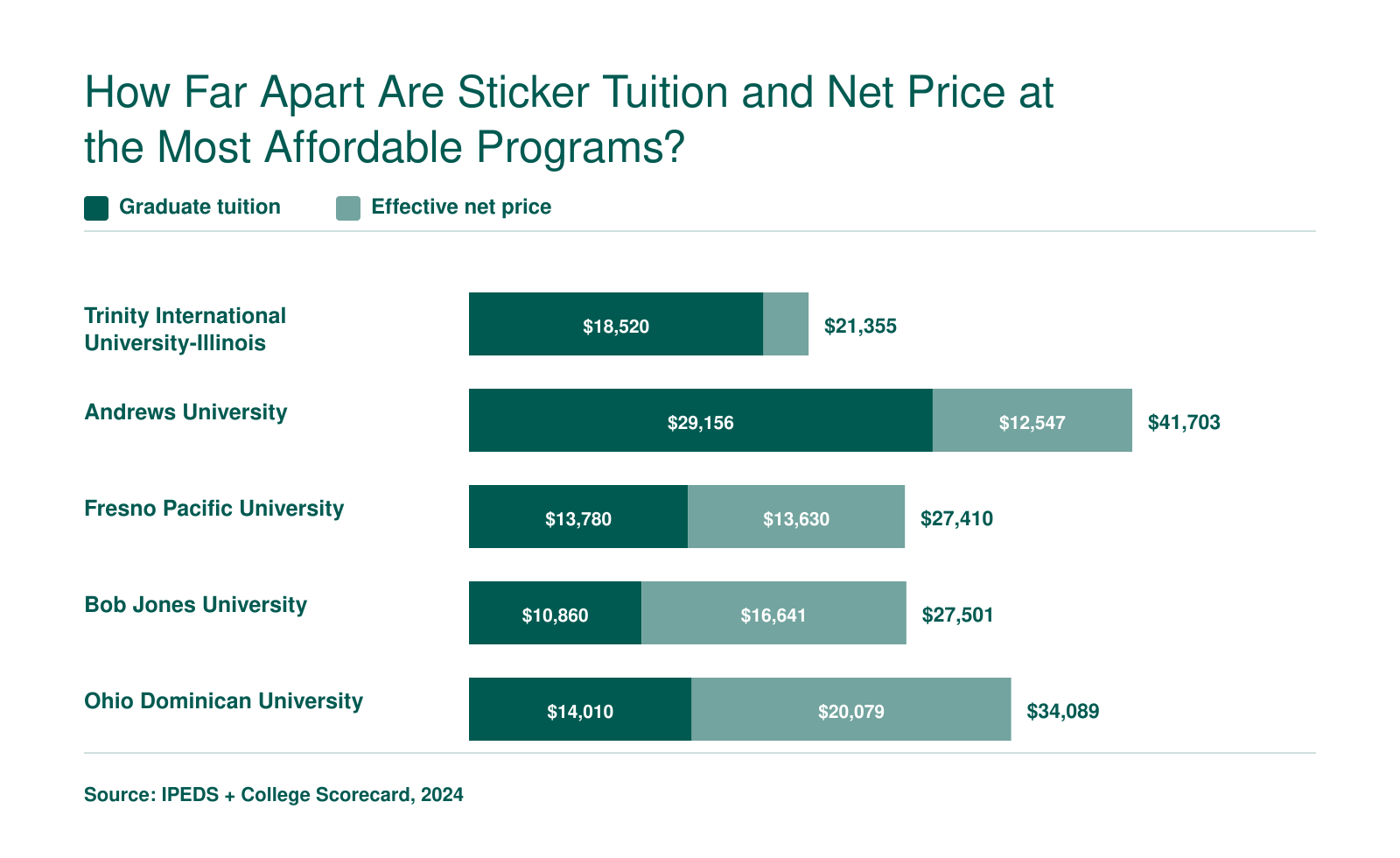
How Far Apart Are Sticker Tuition and Net Price at the Most Affordable Programs?
Listed graduate tuition is only part of the picture. The chart pairs each school's program tuition with its effective net price. Net price is an institution-wide average after aid and will vary by student. At Bob Jones University and Ohio Dominican University it runs higher than program tuition, because it reflects the school's full average cost of attendance across all students rather than this one program.
Related Articles
Online vs. Campus Urban Ministry Master's Programs
Urban ministry is learned in a specific place, so the format you choose shapes where and how you do your fieldwork more than it shapes the classroom. If you already serve a congregation or nonprofit, online and hybrid formats deserve a close look, because your current city can become your field site. Employer data on online degrees is mixed, but the gap narrows in fields like education, and ministry hiring often turns on references and experience as much as on delivery format.
| Factor | Online | Hybrid | On campus |
|---|---|---|---|
| Flexibility for working pastors | Highest. Coursework fits around church or nonprofit schedules without relocating. | Moderate. Mostly remote, with scheduled residencies or intensives to plan around. | Lowest. Fixed class times and commuting or relocation can conflict with a full-time role. |
| Field placement logistics | Usually arranged in your own city, often at your current ministry site with a local supervisor. | Local placement plus occasional campus or partner-site immersion. | Often placed with partner churches and agencies near the school, with faculty close by. |
| Cohort community | Built through discussion boards and video sessions. Takes more deliberate effort. | Intensives build in-person bonds that carry over into online terms. | Strongest daily contact with peers and professors. |
| Cost factors | Per-credit pricing, such as $610 per credit for Grand Canyon University's online Master of Arts in Urban Ministry. No relocation or commuting costs. | Tuition varies by school. Add travel and lodging for residencies. | Semester pricing, such as $8,250 per semester at Grand Canyon University. Housing and living costs are added in a new city. |
| City-based immersion | Depends on your own neighborhood and ministry context. Less exposure to other cities. | Short, focused immersions in a partner city can broaden your perspective. | Deepest exposure to one urban setting through regular placements and community partners. |
| Employer perception | 54% of employers worldwide rate an online graduate degree as equal in value to an in-person one. Interview odds dip slightly, by 2.5% in one study. | In a 2026 employer survey, 57% chose a hybrid graduate over fully online or fully on-campus candidates. | Still carries a modest edge in some surveys, though it disappears in fields where online degrees are common, including education. |
Urban ministry is learned on the block as much as in the classroom. Supervised fieldwork in real neighborhoods, congregations, and community agencies is what separates these degrees from a general ministry master's.
Admission Requirements for Urban Ministry Master's Programs
Requirements vary by school, format, and transfer status, so confirm current details with each admissions office. Published information is uneven, and several schools do not state a GRE policy, deadline, or faith-statement rule.
- Bachelor's degreeEvery program here expects a bachelor's degree from an accredited institution. The published requirements do not call for a ministry or theology major. Oakwood University instead lets students enter without its prerequisite Bible and urban ministry courses, then complete them as co-requisites.
- Minimum GPAGrand Canyon University lists a 2.8, and applicants at 2.5 or above may still qualify with a GRE combined score of 300 or a GMAT of 500. McCormick Theological Seminary and Oakwood University both list a 3.0.
- GRE policyOnly Grand Canyon mentions test scores, and only as an alternate path for lower-GPA applicants. McCormick and Oakwood do not publish a GRE requirement.
- Faith and reference materialsMcCormick asks for an autobiographical statement, a writing sample, an academic reference, and personal and church references. Oakwood requires two recommendation letters, with specific recommenders for pastors and church officers, and a Bible Literacy Entrance Test with a 70% minimum during orientation.
- Ministry experienceOakwood requires documented ministerial experience: two years within the last five. Grand Canyon requires supervised ministry hours during the program. McCormick looks for evidence of readiness and a faith-community connection.
- Deadlines and start termsCity Seminary of New York published 2026 registration dates of July 1 and February 1 for its winter and spring terms. Other schools did not publish deadlines, so check directly.
Urban Ministry programs by state
Frequently Asked Questions About Urban Ministry Master's Degrees
These answers draw on the 2026 program details covered earlier in this Religion & Theology Master's Programs guide. Credits, timelines, and tuition vary by school, delivery format, and fieldwork requirements, so confirm current figures with each admissions office before you apply.
How long does it take to complete a master's in urban ministry?
Do I need a bachelor's in ministry to apply to a master's in urban ministry?
Are there accredited online master's in urban ministry programs?
Is a master's in urban ministry worth it?
How is an urban ministry certificate different from a master's degree?
Compare Urban Ministry programs on the data that matters
Explore more Religion & Theology specializations or browse every graduate field.
All Religion & Theology programs