Best Master's in Theology Programs
Compare 300+ accredited Theology programs, with graduate earnings, cost, debt, and completion data from IPEDS and the U.S. College Scorecard.

Theology master's degrees range from academic research tracks to ordination-focused professional degrees; the wrong choice costs two years and delays ministry or doctoral work.
Graduate tuition in the ten ranked programs runs from $5,600 at World Mission University to $66,523 at Duke; net price after aid ranges from $11,881 to $41,704. An M.Div. trains pastors and chaplains, an M.T.S. or M.A. leans academic, and a Th.M. builds on prior study. Online delivery, admissions, and first-year earnings vary widely, as do accreditation and denominational fit, which gate ordination.
Key Points
- Net price is reported for 9 of the 10 ranked schools, averaged institution-wide.
- Check both ATS and regional accreditation before you apply to any seminary.
- Program-level earnings for theology graduates are not yet published, so weigh cost and debt carefully.
The 10 Best Master's in Theology Programs for 2027
These ten programs represent a range of theological traditions, formats, and price points. The list spans small online Catholic colleges, research divinity schools, and accelerated ministry tracks. Use each card to compare program focus and fit before weighing cost.
Catholic International University
#1Charles Town, WV · ~$7,000/yr (est.)
Best for: Online Catholic adults needing flexible theology
Catholic International University offers a fully online Master of Arts in Theology built around Catholic teaching, Scripture, philosophy, and church history. The 36-credit program uses eight core courses and four electives, and is designed for working adults in ministry, education, healthcare, and nonprofit leadership. Recognized by Forbes as a top online theology degree, it pairs flexible study with a worldwide Catholic community.
- 36 total credit hours
- 12 total courses
- Fully online flexible format
- Eight core courses plus four electives
- Forbes' Best Online Theology Degrees
- Worldwide Catholic community
- Concludes with comprehensive exam
Harvard University
#2Cambridge, MA · $55,000 – $60,000/yr (est.)
Best for: Aspiring doctoral researchers across world religions
Harvard Divinity School's Master of Theological Studies is a two-year, full-time academic degree for students who want to study religion across cultures and traditions. Students choose a concentration from 20 established fields or design one with an advisor, complete 64 units, and develop intermediate language competency in options such as Greek, Hebrew, Arabic, or Pali. Many graduates continue to doctoral study, while others apply the training to journalism, public life, or education.
- Two-year, full-time program
- 64 total credit hours
- 20 concentration options
- 16 half courses
- Intermediate language competency required
- Language options include Pali, Greek, Hebrew, Arabic
- Prepares for PhD in religion
- Earn Certificate in Religion and Public Life
Grove City College
#3Grove City, PA · ~$9,000/yr (est.)
Best for: Christian undergraduates pursuing accelerated pastoral ministry
Grove City College offers an accelerated B.A. plus M.A. in Theology & Ministry that prepares undergraduates for pastoral ministry, missions, and church leadership in four years. The cohort-based curriculum blends biblical studies, doctrine, and practical theology with leadership and management training, and includes church placements and internships. Priced at the undergraduate tuition rate, the program minimizes debt and provides 36 graduate credits transferable toward a future Master of Divinity.
- Complete in four years via accelerated BA plus MA
- 36 total credit hours
- Cohort-based structure
- Priced at B.A. tuition rate
- 36 transferable MA credits toward future MDiv
- Church placements and internships
- 95% job placement rate
- Many denominations accept MA for ordination
Yale University
#4New Haven, CT · ~$50,000/yr (est.)
Yale Divinity School's Master of Divinity is a three-year, 72-credit residential program for students called to pastoral ministry, chaplaincy, and spiritual leadership. The curriculum grounds students in biblical interpretation, theology, ethics, and church history, with practical training in preaching, pastoral counseling, and Christian education. Most students receive full-tuition scholarships based on need, and joint degrees in seven fields expand career options.
- Three-year, 72-credit program
- Six-credit internship plus electives
- Cohort-based in-person format
- 95% receive full-tuition scholarships
- Prepares for ordination to Christian ministry
- Joint degrees in seven fields
- Practical ministry in preaching, counseling, education
- Curriculum revamped in 2025
World Mission University
#5Los Angeles, CA · ~$6,000/yr (est.)
World Mission University's Master of Arts in Theology is a fully online, 42-credit program designed to equip Christian leaders through biblical, theological, and practical studies. The curriculum includes Scripture, church history, systematic theology, ethics, and supervised field education, with an emphasis on spiritual formation, cultural awareness, and social transformation. It is particularly suited for students seeking multicultural ministry training in churches and parachurch organizations.
- 42 total credit hours
- Minimum 2.5 GPA
- Field education required
- Emphasis on spiritual formation
- Multicultural ministry training
- Fully online format
- Equips Christian leaders for ministry
Duke University
#6Durham, NC · ~$67,000/yr (est.)
Duke Divinity School's Master of Theology is an advanced, two-semester degree for students who already hold an M.Div., M.T.S., or comparable theological master's. Students take eight elective courses, concentrate in biblical, historical, theological, or ministerial studies, and complete a thesis or comprehensive exam. The program is often a stepping stone to Ph.D. or D.Min. study, and 99% of students receive scholarships or grants.
- Two-semester advanced degree
- 8 elective courses
- Four concentration options
- 3.3 GPA minimum
- Thesis or capstone option
- Certificate in Chaplaincy available
- 99% receive scholarships or grants
- Builds on prior M.Div. or M.T.S.
Vanderbilt University
#7Nashville, TN · ~$58,000/yr (est.)
Vanderbilt Divinity School's Master of Theological Studies is a 48-credit academic degree offering two tracks: a general plan of study or a concentration tailored to vocational goals. Students take graduate courses across Vanderbilt University, may transfer up to 12 credits, and can waive courses based on prior undergraduate work. Graduates often enter non-ordained ministry, church leadership, nonprofit religious work, or doctoral study, with 95% securing vocational placement within a year.
- 48 total credit hours
- 95% job placement rate
- Two curricular tracks: general or concentration
- Transfer up to 12 graduate credits
- Take graduate courses across Vanderbilt
- Thesis or capstone option
- Welcomes all backgrounds and spiritual traditions
Grace School of Theology
#8The Woodlands, TX · $5,000 – $10,000/yr (est.)
Grace School of Theology's Master of Theology is a fully online, 29-credit advanced degree for students who already hold a Master of Divinity. It emphasizes Greek and Hebrew exegesis, systematic theology, and advanced research, and requires a thesis that demonstrates original scholarship. The program is designed as a bridge to doctoral studies and academic teaching, while also enhancing preaching and pastoral leadership.
- 29 total credit hours
- 3.0 GPA minimum
- Prerequisite Master of Divinity required
- Thesis required
- Prepares for doctoral programs
- Develops advanced Greek and Hebrew exegesis
- Fully online format
- Designed for academic teaching roles
University of Notre Dame
#9Notre Dame, IN · ~$65,000/yr (est.)
The University of Notre Dame's Master of Arts in Theology is designed for working professionals who want to deepen their grasp of the Catholic theological tradition. Students choose between a hybrid online track and a summer residential track, and the program draws Catholic school teachers, deacons, doctors, military service members, and parents. The theology department has been ranked No. 1 in the world in three of the past five years.
- Hybrid Online track and Summer Residential track
- Designed for working professionals
- Focus on Catholic theological tradition
- Ranked No. 1 in the world
- Two concentration options
- GRE optional for applicants
- Professors invested in Church life
Boston College
#10Chestnut Hill, MA · ~$38,000/yr (est.)
Boston College's M.A. in Theology and Ministry combines deep theological study with pastoral practice through 36-credit and 48-credit tracks, including six concentrations such as religious education, spirituality, and theology and the arts. The program uses online courses during the academic year and on-campus summer residencies, with hybrid and dual-degree options. Students can also cross-register at Harvard University and Boston University through a local academic consortium, broadening access to theological and interdisciplinary coursework.
- 36-credit and 48-credit tracks
- Six concentration options
- Hybrid summer residencies, online academic year
- No entrance exam required, test optional
- 100% job placement rate
- Dual degrees with MBA, MSW, MEd
- Field experience on 48-credit track
- Small-group spiritual formation seminar
Cost & outcomes by school
Federal data for the highest-earning Theology programs, independent of the ranking above. Earnings are this field's master's graduates four years after completing, where the Scorecard reports them.
| School | Earnings | Tuition / yr | Debt | Grads/yr | Format |
|---|---|---|---|---|---|
| The King's University TX | $100,714 | $10,530 | $41,000 | 52 | Hybrid |
| Concordia Seminary MO | $97,155 | $32,260 | $13,910 | 68 | Campus |
| Lenoir-Rhyne University NC | $95,302 | $13,020 | — | 12 | Hybrid |
| Church Divinity School of the Pacific CA | $94,644 | $17,660 | — | 22 | Hybrid |
| Luther Seminary MN | $81,169 | $18,760 | $41,000 | 80 | Hybrid |
| The Master's University and Seminary CA | $81,084 | $10,410 | $24,402 | 57 | Campus |
| Concordia Theological Seminary IN | $80,818 | $36,900 | $33,254 | 38 | Campus |
| Nazarene Theological Seminary MO | $74,925 | $11,020 | — | 19 | Hybrid |
| Faith International University WA | $73,387 | $7,350 | — | 24 | Online |
| Indiana Wesleyan University IN | $69,914 | $10,620 | $42,191 | — | Online |
| Moody Bible Institute IL | $69,835 | $9,702 | $25,442 | 92 | Hybrid |
| Dallas Theological Seminary TX | $69,603 | $20,412 | $26,509 | 256 | Hybrid |
Sources: U.S. Department of Education. Tuition and graduates: IPEDS. Earnings and debt: College Scorecard, this field's master's graduates; a dash means no figure is reported.
Cost, debt & payoff
Median earnings of this field's master's graduates (4 yrs after completing) vs. their median federal loan debt · U.S. College Scorecard
Across these programs the median graduate earns about $60,861 and finishes with roughly $41,000 in debt — a ratio that clears a common rule of thumb (keep debt below first-year salary). Tuition and debt vary widely school to school, so check the per-school figures in the table above before you shortlist.
M.A. vs. M.T.S. vs. M.Div. vs. Th.M.: Which Theology Degree Fits Your Goals
The M.A. in Theology and the Master of Theological Studies (M.T.S.) are both two-year academic degrees. The M.A. is generally positioned as an introductory theological degree, while the M.T.S. is framed as general academic theological study, and the line between them varies by school. The Master of Theology (Th.M.) is not an entry-level alternative to the Master of Divinity (M.Div.). It is typically an advanced degree for students who already hold an M.Div. or equivalent. Figures below come mainly from Duke Divinity School, which counts credit in its own course units, so requirements at other schools will differ. Verify details on each program page.
| Degree | Typical length and credits | Biblical language requirement | Thesis or capstone | Field education | Best-fit goal |
|---|---|---|---|---|---|
| M.A. in Theology | 24 months; 18 Duke course units | Depends on the field of specialization, if the degree has a language requirement | Not specified in the sources reviewed; confirm with the program | Does not count toward degree units at Duke | Introductory theological study, such as lay ministry or a first step before further study |
| M.T.S. | 24 months; 16 Duke course units | Depends on the field of specialization, if the degree has a language requirement | Not specified in the sources reviewed; confirm with the program | Does not count toward degree units at Duke | General academic theological study, which some students use as groundwork for doctoral work |
| M.Div. | 72 semester credits | Depends on the field of specialization, if the degree has a language requirement | Coursework plus a project or thesis | 9 semester units of field education | Graduate professional preparation for ministry; check your denomination's ordination requirements |
| Th.M. | 12 months; 24 semester credits | Proficiency in one biblical language (at least 6 credits in the same language); 12 credits for a Biblical Studies concentration | Comprehensive exam required; a thesis may be chosen instead | Does not count toward degree units at Duke | Advanced study in one discipline, often before a doctorate, for students who already hold an M.Div. or equivalent |
Accreditation and Denominational Fit: ATS, Regional Accreditors, and Ecumenical vs. Confessional Schools
How do I know a theology master's degree is properly accredited? Start by understanding that there are two layers, and they do different jobs.
The Two Accreditation Layers
Institutional accreditation (from one of six U.S. accreditors: MSCHE, NECHE, HLC, SACSCOC, WSCUC, or NWCCU) evaluates a whole institution.1 The ATS Commission on Accrediting reviews graduate theological education and approves specific degrees, including master of divinity programs. The U.S. Department of Education and CHEA recognize the ATS Commission on Accrediting as a faith-related accreditor.1 Nearly three-fourths of ATS schools also hold another accreditor, but you should not assume every school does.1 A university divinity school may have university accreditation plus ATS approval, while a free-standing seminary may rely on ATS alone.
Why it matters: PhD committees, credit-transfer offices, and federal aid eligibility all look at accreditation. Even so, accreditation does not guarantee ordination, denominational recognition, or transferable credit.
Spotting Unaccredited Seminaries
Be wary of schools that call themselves "accredited" without naming the agency, or that use an accreditor you cannot find in federal or CHEA records. Check the ATS Member Schools directory and its Approved Degrees listing2, then confirm institutional status in the Department of Education database or the CHEA directory3. Confirm that the exact degree, campus, and online option are covered. CHEA's ATS listing reflects a February 2026 baseline, so check for later changes.3
Ecumenical, Confessional, and Catholic Options
The spectrum runs from ecumenical university divinity schools, such as Duke, which welcome multiple Christian traditions, to confessional seminaries tied to a Catholic, evangelical, or mainline denomination. "Ecumenical" does not mean doctrinally neutral, and ATS accreditation does not make a school ecumenical. Check mission, governance, worship life, and faculty. Some confessional schools, like Liberty's Rawlings School of Divinity (ATS-accredited), ask students to affirm a faith statement.
For Catholic study, treat two categories separately. Within Religion & Theology Master's Programs, Catholic university theology departments grant civil master's degrees. Pontifical faculties hold Holy See authority to award ecclesiastical degrees, which are not necessarily equivalent to a civil master's. Verify a school's pontifical status directly rather than assuming it.
A Three-Question Fit Test
- Ordination: What does your denomination, diocese, or credentialing body require, and does it recognize this school's degree?
- Faith statement: Are you comfortable signing or living within the school's doctrinal expectations?
- Academic freedom: Do you want room to question your own tradition, or formation within it?
If your answers point in different directions, ask admissions how the program handles that tension.
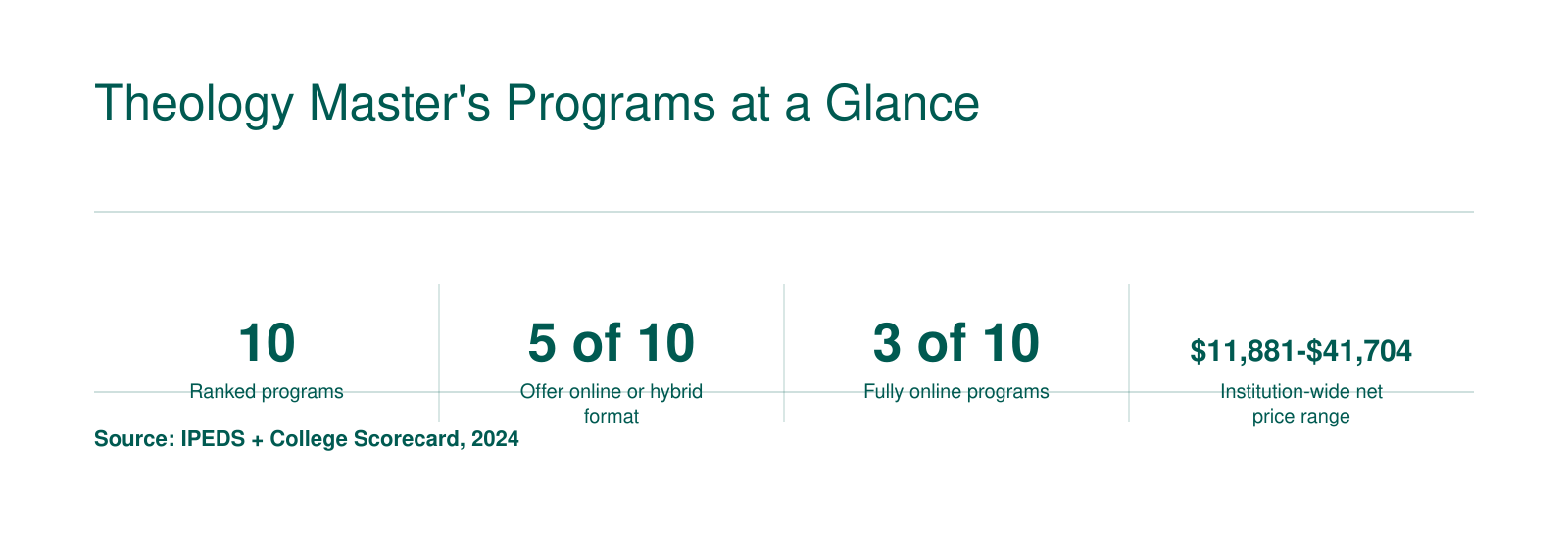
Theology Master's Programs at a Glance
These figures summarize the 10 ranked programs above. Net price and graduation rates are institution-wide, not specific to the theology program. Net price is reported for 9 of the 10 schools, and the range reflects those 9.
What a Theology Master's Degree Actually Costs After Aid
The real cost of a theology master's is the tuition charged for the credits you take, minus whatever the school, your denomination, and outside donors cover. Because nearly every seminary and divinity school is private, in-state and out-of-state students pay the same rate, so geography changes your living costs but not your tuition bill.
What the Lowest-Cost Programs Charge
At the affordable end, annual tuition runs roughly $5,600 at World Mission University, $5,840 for Grace School of Theology's Th.M., $6,936 at Catholic Distance University, and $7,768 at Holy Apostles College and Seminary (about $449 per credit). Average net price after aid at those institutions sits near $15,785, $11,881, $14,176, and $10,117 respectively, but treat those as approximate institution-wide averages across all students rather than a quote for the theology program itself.
Why Sticker Price Misleads
Harvard posts about $57,248 and Vanderbilt about $57,868 in graduate tuition, and almost nobody in divinity pays that. Harvard Divinity School's financial aid FAQ reports that roughly 90% of M.Div. and M.T.S. students receive institutional grant aid, mostly need-based, with awards generally running from 75% of tuition up to full tuition.1 Yale Divinity School's admissions and aid page offers need-qualified full-tuition scholarships plus merit awards that for 2026-27 cover 100% of tuition along with a stipend of $13,500 or $15,000, renewable with satisfactory progress and an annual aid application. Duke Divinity School's financial aid page distributes $11 million in scholarship support, every admitted M.Div. and M.T.S. student receives something, and Dean's Scholarships range from 50% to 100% of tuition.2 Boston University School of Theology set tuition scholarships at 70% for master's students taking at least six units a term and 60% for the online M.Div., with certified UMC ordination candidates eligible for an additional award covering half of online tuition.34 Sewanee admits may apply for a full tuition waiver, with select ordination-track students receiving $1,000 monthly living stipends.5
Before You Sign
Program-level debt and monthly repayment figures are not yet published for these theology programs, so price the offer letter, not the brochure. Full-tuition awards still leave housing and food uncovered, and a 2026 federal reclassification of theology as nonprofessional narrowed loan access.
Related Articles
According to ATS Annual Data Tables, online enrollment at member schools surged 42% in 2020. By 2024, 51% of students took courses online.
What Theology Master's Programs Look for in Applicants
Requirements vary by school and degree, so confirm the details with each program.
- Accredited bachelor's degree and GPAMost programs expect an accredited bachelor's degree. Published GPA floors run from 2.0 (Liberty's online M.Div.) to 2.80 (Wake Forest M.Div.). Duke lists 2.75, Vanderbilt strongly recommends 2.9 or higher, and Harvard sets no minimum. A published minimum is not necessarily a competitive score.
- GREThe GRE is usually optional or not required, including at Harvard, Chicago, Wake Forest, and Duke. La Sierra may still ask any applicant for it.
- Personal statementExpect an essay on your academic or vocational goals and why this program fits them.
- Recommendation lettersDuke requires three letters, drawn from academic, church, and personal or character references. Other schools differ.
- Denominational endorsementOrdination-track M.Div. applicants should ask their denomination and the school whether endorsement is required. It is not universal.
- Transfer creditLimits vary: Vanderbilt allows 12 hours (M.T.S.) or 24 (M.Div.), Duke 3 to 8 courses depending on degree, and Harvard none. Many schools also require recent coursework with a B- or better.
Theology programs by state
Frequently Asked Questions About Theology Master's Programs
These answers cover the questions applicants ask most about degree types, online study, student visas, and ordination. Requirements vary by school and denomination, so confirm specifics directly with each institution.
What is the difference between a Master of Arts in Theology and a Master of Theological Studies?
Are online theology master's programs respected?
Can international students earn a theology master's in the U.S. on an F-1 visa, and what limits apply to online coursework?
Can you be ordained with an M.T.S. or M.A. instead of an M.Div.?
Compare Theology programs on the data that matters
Explore more Religion & Theology specializations or browse every graduate field.
All Religion & Theology programs