Best Master's in Theology Programs in North Carolina
Compare 12 accredited Theology programs in North Carolina, with graduate earnings, cost, debt, and completion data from IPEDS and the U.S. College Scorecard.

A master's in theology is a graduate degree in Scripture, church history, and doctrine, ranging from a two-semester Th.M. to a 72-credit Master of Divinity. The best master's in theology programs in North Carolina span Duke and Wake Forest divinity schools, Baptist and Methodist seminaries, and online Bible colleges.
Program tuition runs from $4,500 at Greensboro College to $66,500 at Duke, while institution-wide net price spans roughly $16,500 to $29,600.
Ordination rules, not price, often decide which degree counts.
Key Points
- Lenoir-Rhyne's Christian Ministry MACM page states the GRE is not required.
- Hood Theological Seminary graduates report median earnings near $57,000 one year out.
- Chaplain certification requires 72 graduate hours and four CPE units.
Top 10 Master's in Theology Programs in North Carolina
North Carolina's theology master's options range from a research-focused Th.M. at a major university to low-cost online programs built for working ministers. Each card below notes who the program fits best, whether you are headed toward doctoral study, pastoral ministry, or a career change. Graduation rates cited are institution-wide figures, not rates for the theology program itself.
Duke University
#1Durham, NC · ~$67,000/yr (est.)
Best for: Divinity graduates heading to doctoral study
Duke Divinity School offers an advanced Master of Theology for students who already hold an M.Div., M.T.S., or comparable degree. The school's overall graduation rate is 97%. The program is completed in two semesters, with doctoral seminars available and a thesis or comprehensive exam. Duke participates in the Cooperative Baptist Fellowship of North Carolina partnership, which can bring scholarship support. It fits academically minded students and ministers preparing for Ph.D. or D.Min. study.
- Two-semester program with eight elective courses
- At least four courses in one major area
- Four concentration options, including Biblical and Historical Studies
- Thesis or comprehensive exam to finish
- Doctoral seminars available
- Requires a prior theological master's degree from an ATS-accredited school
- 3.3 GPA minimum
- Certificate in Chaplaincy available
Wake Forest University
#2Winston-Salem, NC · $35,000 – $40,000/yr (est.)
Best for: Ministry students pairing theology with a second field
Wake Forest's School of Divinity pairs a 72-credit, interdisciplinary Master of Divinity with an integrative capstone and an internship reflection seminar. The school's overall graduation rate is 89%. Students can combine the degree with bioethics, counseling, education, law, or sustainability. Wake Forest also takes part in the CBFNC scholarship partnership. It suits ministry-bound students who want a flexible, practice-oriented curriculum.
- 72 total credit hours
- Integrative capstone required
- Internship reflection seminar
- Dual-degree options with other graduate programs
- Electives in spirituality and interfaith dialogue
- Prepares for pastoral ministry, chaplaincy, and nonprofit leadership
Campbell University
#3Buies Creek, NC · ~$16,000/yr (est.)
Best for: Aspiring pastors wanting a close-knit campus
Campbell University's divinity program in Buies Creek blends Bible, history, and theology with practical training in leadership, mission, and worship. The school's overall graduation rate is 61%. The rural campus and spiritual-formation emphasis appeal to students still clarifying their calling. Campbell participates in the CBFNC partnership, which may provide scholarship support. It fits aspiring pastors, chaplains, and church staff.
- Integrates Bible, history, and theology with practical ministry
- Training in leadership, mission, and worship
- Chaplaincy paths in military, hospital, and prison settings
- Counseling and nonprofit ministry career options
- Spiritual formation in a supportive community
Gardner-Webb University
#4Boiling Springs, NC · ~$12,000/yr (est.)
Gardner-Webb's 36-credit Master of Arts in Bible and Theology is rooted in the Baptist tradition but welcomes an interdenominational cohort. The school's overall graduation rate is 55%. Up to 17 hours can be taken online, which suits working adults. Gardner-Webb also takes part in the CBFNC partnership. It fits lay leaders and church staff, and it can serve as a foundation for doctoral study.
- 36 total credit hours
- Up to 17 hours available online
- Covers Bible development, historical theology, and Christian ethics
- Baptist heritage with an interdenominational community
- Prepares for congregational and para-church ministry
- Financial aid available
Lenoir-Rhyne University
#5Hickory, NC · ~$13,000/yr (est.)
Lenoir-Rhyne's Master of Theological Studies with a Theology concentration is a 48-credit, two-year degree open to all denominations. The school's overall graduation rate is 48%. Students can attend on the Hickory campus or in a hybrid format with livestreamed classes and twice-yearly campus gatherings. It fits academically inclined students and career changers who want a flexible research-oriented degree.
- 48 total credit hours over two years
- 27-hour core plus seven electives
- Hybrid format with livestreamed classes
- On-campus gatherings twice a year
- Summative research project required
- Three concentration options
- Open to all denominations
Carolina University
#6Winston-Salem, NC · ~$13,000/yr (est.)
Carolina University in Winston-Salem offers a fully online, three-year Master of Divinity from a conservative evangelical perspective. The school's overall graduation rate is 22%, so ask about completion support. Admission requires a 2.5 GPA and two recommendation letters. It fits distance learners headed for pastoral or teaching roles who want a pathway to Th.M., Ph.D., or D.Min. study.
- Fully online, three-year program
- Emphasis on Bible exposition
- Covers Old and New Testament, hermeneutics, and church history
- 2.5 GPA minimum
- Two letters of recommendation minimum
- Pathway to advanced theology degrees
Shaw University
#7Raleigh, NC · ~$14,000/yr (est.)
Shaw University's School of Divinity in Raleigh, an HBCU, offers a Master of Arts in Theology and Ministry focused on justice-oriented service. The school's overall graduation rate is 22%. The program is built for working adults, with online, hybrid, and in-person options and customizable pacing. It fits bi-vocational leaders and career changers bringing theology into healthcare, nonprofit, business, or social-service work.
- Online, hybrid, or in-person study
- Interdisciplinary approach with specialization
- Degree customization for working adults
- Prepares bi-vocational professionals for justice work
- Serves healthcare, business, and nonprofit sectors
Carolina College of Biblical Studies
#8Fayetteville, NC · ~$6,000/yr (est.)
Carolina College of Biblical Studies in Fayetteville offers a 45-credit Master of Arts in Theological Studies, on campus or online, at some of the lowest tuition in the state. The school's overall graduation rate is not reported. The curriculum covers Old and New Testament surveys, hermeneutics, systematic theology, and discipleship. It fits pastors and lay people on a budget who want a doctrinally focused foundation.
- 45 total credit hours, about two years
- Campus or online format
- Old and New Testament surveys and hermeneutics
- Systematic theology and biblical leadership
- Scholarly research and writing emphasis
- Designed for pastors and lay people
Pfeiffer University
#9Misenheimer, NC · ~$12,000/yr (est.)
Pfeiffer University's Master of Arts in Practical Theology is rooted in the United Methodist tradition, with evening classes at its Charlotte campus. The school's overall graduation rate is 35%. Four specialization tracks cover Christian education, pastoral care and counseling, missions and evangelism, and church administration. It fits working adults pursuing United Methodist certification or deacon ordination.
- 40 total credit hours
- Four concentration options
- Evening classes at the Charlotte campus
- United Methodist certification pathways
- Partnership with Wesley Theological Seminary
- Transfer up to 15 semester hours
- 2.8 GPA minimum and three recommendation letters
- Rolling admissions; military benefits accepted
Greensboro College
#10Greensboro, NC · ~$5,000/yr (est.)
Greensboro College offers a fully online, 32-credit Master of Arts in Religion, Theology and Culture with asynchronous classes in 8-week terms. The school's overall graduation rate is 46%. Admission requires a bachelor's degree, a 3.0 GPA, and one letter of recommendation. It fits second-career students and working ministers who want an affordable, flexible academic degree.
- Fully online, asynchronous classes
- 32 total credit hours
- 8-week course terms
- Full-time (about two years) or part-time pacing
- Capstone project, thesis or exam
- 3.0 GPA minimum and one recommendation letter
- Covers biblical studies, ethics, theology, and church history
Cost & outcomes by school
Federal data for the highest-earning Theology programs, independent of the ranking above. Earnings are this field's master's graduates four years after completing, where the Scorecard reports them.
| School | Earnings | Tuition / yr | Debt | Grads/yr | Format |
|---|---|---|---|---|---|
| Lenoir-Rhyne University NC | $95,302 | $13,020 | — | 12 | Hybrid |
| Wake Forest University NC | $62,158 | $39,141 | $59,016 | 24 | Campus |
| Hood Theological Seminary NC | $59,012 | $20,410 | $60,530 | 22 | Hybrid |
| Duke University NC | $58,405 | $66,523 | $53,550 | 127 | Campus |
| Campbell University NC | $55,216 | $16,347 | $41,000 | 22 | Campus |
| Carolina University NC | $51,238 | $12,550 | — | 79 | Online |
| Pfeiffer University NC | — | $12,240 | — | — | Hybrid |
| Greensboro College NC | — | $4,524 | — | 2 | Online |
| Carolina College of Biblical Studies NC | — | $5,940 | — | 8 | Online |
| Shepherds Theological Seminary NC | — | $8,845 | — | 50 | Online |
| Gardner-Webb University NC | — | $12,125 | — | 7 | Hybrid |
| Shaw University NC | — | $13,582 | $82,000 | 36 | Hybrid |
Sources: U.S. Department of Education. Tuition and graduates: IPEDS. Earnings and debt: College Scorecard, this field's master's graduates; a dash means no figure is reported.
Cost, debt & payoff
Median earnings of this field's master's graduates (4 yrs after completing) vs. their median federal loan debt · U.S. College Scorecard
Across these programs the median graduate earns about $58,709 and finishes with roughly $59,016 in debt — a ratio that clears a common rule of thumb (keep debt below first-year salary). Tuition and debt vary widely school to school, so check the per-school figures in the table above before you shortlist.
Online and Hybrid Master's in Theology Programs in North Carolina
Online and hybrid theology master's programs in North Carolina exist, but the formats differ more than the labels suggest.
Carolina University (Master of Divinity), Greensboro College (Master of Arts in Religion, Theology and Culture), and Carolina College of Biblical Studies (Master of Arts in Theological Studies) are the clearest online options. Greensboro's classes are asynchronous. Carolina College of Biblical Studies also offers a campus format, and Shaw University lists online, hybrid, and in-person delivery.
Hybrid programs add travel. Duke's Hybrid Master of Divinity requires three one-week campus intensives a year (January, May, August). Lenoir-Rhyne's hybrid M.Div. and M.T.S. require two campus gatherings a year plus supervised field experience. Gardner-Webb allows up to 17 hours online in its 36-hour degree, and Pfeiffer is also listed as hybrid.
Duke's residential M.T.S. and Th.M., Wake Forest, and Campbell are campus-based. Hood and Shepherds should be confirmed directly. Published online tuition rates were not available to compare with campus rates, so ask each school.
Before enrolling, ask your denomination's ordination office whether it accepts the delivery format.
Which North Carolina Master's in Theology Programs Waive the GRE?
Graduate theology admissions have shifted away from standardized testing as seminaries compete for working ministers and second-career students, part of a broader movement toward No-GRE master's programs. Lenoir-Rhyne is the clearest case: its Christian Ministry MACM page states the GRE is not required. Shaw University does not publish a GRE policy on its graduate admissions page1, and Shepherds Theological Seminary does not list a clear GRE requirement in its public program materials. Applicants should contact those offices directly rather than assume a waiver.
Beyond testing, most programs still expect an accredited bachelor's degree, official transcripts, a statement of purpose, and two or three recommendation letters, often including a pastor or church reference. Shaw asks for two recommendations and an application essay.1 Minimum GPA and transfer credit limits vary by school, so check each program page. For a ThM, plan to hold an M.Div. or equivalent first.
Related Articles
Cost, Financial Aid, and North Carolina Licensure for a Master's in Theology
What You'll Actually Pay
Few master's programs in North Carolina publish both a per-credit rate and a credit total, so exact program prices are hard to calculate from public pages. One 2026 third-party ranking puts Carolina University's online theology cost at $6,750 but doesn't say whether that figure is annual or total, so confirm it directly. Degree type drives the total more than the posted rate. An M.Div. often requires 72 or more credits over about three years, while an MTS or MA typically takes two, so the M.Div. usually costs more overall. Lenoir-Rhyne's MA in Christian Ministry, for example, runs 49 credits over two years, and full-tuition scholarships are available.
Duke Divinity School reports more than $11 million in annual aid and gives every admitted student some support. Its Rural Fellowship covers full tuition for residential M.Div. students from the North Carolina and Western North Carolina annual conferences, and field education placements carry $10,000 stipends. Denominational member discounts are rarely posted, so ask each school.
Licensure and Certification
North Carolina does not license theology graduates. Ordination follows your denomination's standards. Chaplain job postings in the state commonly ask for an MA or M.Div., four CPE units, faith endorsement, and board-certification eligibility.1 Licensed counseling roles, such as Marriage & Family Therapy, require a separate counseling degree.
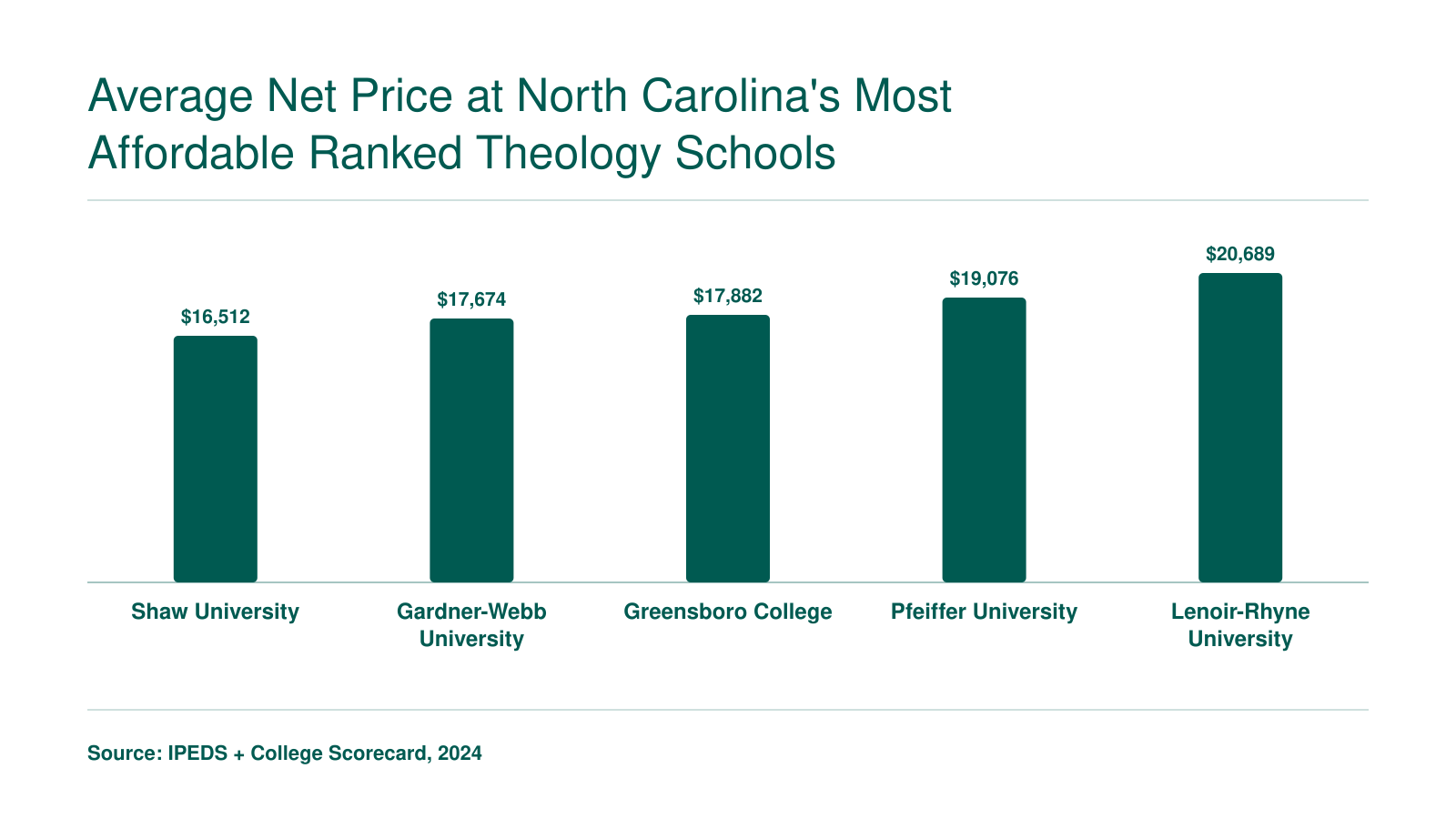
Average Net Price at North Carolina's Most Affordable Ranked Theology Schools
This chart compares the average net price at the lowest-cost schools on this list, from Shaw University to Lenoir-Rhyne University. Net price is an institution-wide average after grant aid, not a quote for the theology program. Published graduate tuition, covered in the cost section above, is set by each program and can differ sharply from these averages.
ATS Accreditation and Denominational Fit at Each Ranked School
ATS accreditation matters because many denominations require an ATS-accredited degree for ordination, chaplaincy boards often look for it, and doctoral programs commonly use it to judge whether a master's degree is sound preparation. Regional accreditation covers the university as a whole, while ATS reviews the theological program itself. University religious studies programs can hold regional accreditation without ATS membership, which suits academic study but may not satisfy an ordination or chaplaincy requirement. Ordination rules are set by each denomination, so confirm your path with both the school and your denominational office.
| School | ATS Accredited | Regional Accreditor | Denominational Affiliation | Ordination Preparation |
|---|---|---|---|---|
| Duke University (Duke Divinity School) | Yes | SACSCOC via Duke University | United Methodist; ecumenically open | Not stated; confirm with the school and your denomination |
| Wake Forest University (School of Divinity) | Yes | Not stated | Not stated | Not stated; confirm with the school |
| Campbell University (Divinity School) | Listed in the ATS directory; detailed status not stated | SACSCOC via Campbell University | Not stated | Not stated; confirm with the school |
| Gardner-Webb University (School of Divinity) | Yes | SACSCOC | Baptist; tied to the Baptist State Convention of North Carolina | Not stated; confirm ordination track with the school |
| Lenoir-Rhyne University (Lutheran Theological Southern Seminary) | Listed in the ATS directory; detailed status not stated | Not stated | Not stated | Not stated; confirm with the seminary |
| Shaw University (Divinity School) | Yes, Accredited in Good Standing | SACSCOC | Historically Black Baptist tradition | Offers an MA in Theology and Ministry; confirm ordination fit with the school |
| Hood Theological Seminary | Yes | SACSCOC | AME Zion Church seminary; serves many denominations | Not stated; confirm with the seminary and your denomination |
Future Board Certified Chaplains must document 72 graduate semester hours and four units of Clinical Pastoral Education, in addition to a qualifying degree in theology, philosophy, or psychology. That total, not any single diploma title, is why the Master of Divinity versus Master of Theological Studies decision matters for future chaplains.
Career Paths and Return on Investment for Theology Master's Graduates
Pulpit calls and hospital chaplaincy posts pay differently, and the schools here split along those lines. Where program-level figures exist, Hood Theological Seminary graduates report median earnings near $57,000 one year after finishing, Campbell University around $40,900 and Carolina University roughly $48,400. Duke University and Wake Forest University divinity graduates both land near $41,000 to $44,000 one year out, rising to the low $60,000s by the fourth year. Several schools on this list have no published program figure, so treat silence as missing data, not weak outcomes.
Debt reframes those numbers. Typical borrowing runs from roughly $41,000 at Campbell to about $82,000 at Shaw University, with Duke near $53,500 and Wake Forest close to $59,000. On a standard ten-year schedule that is roughly $466 a month at the low end and $933 at the high end.
Common destinations include pastoral ministry, chaplaincy, Christian education, nonprofit leadership and teaching. Duke notes placement of Master of Theology graduates into PhD and DMin programs. Nationally, clergy employment is projected to grow about 1% through 2034.
Frequently Asked Questions About Master's in Theology Programs in North Carolina
These answers cover the questions prospective students ask most when comparing Religion & Theology Master's Programs, including degree types, transfer rules, and admissions requirements. Policies change, so confirm details with each school's admissions office before you apply.
Which North Carolina program is best for academic theology?
What is the difference between an M.Div., MTS, and ThM?
Can I transfer credits from another seminary into a North Carolina theology master's?
Do I need an undergraduate degree in religion to apply?
Compare Theology programs on the data that matters
Explore more Religion & Theology specializations or browse every graduate field.
All Religion & Theology programs