
Duke University Master's Programs
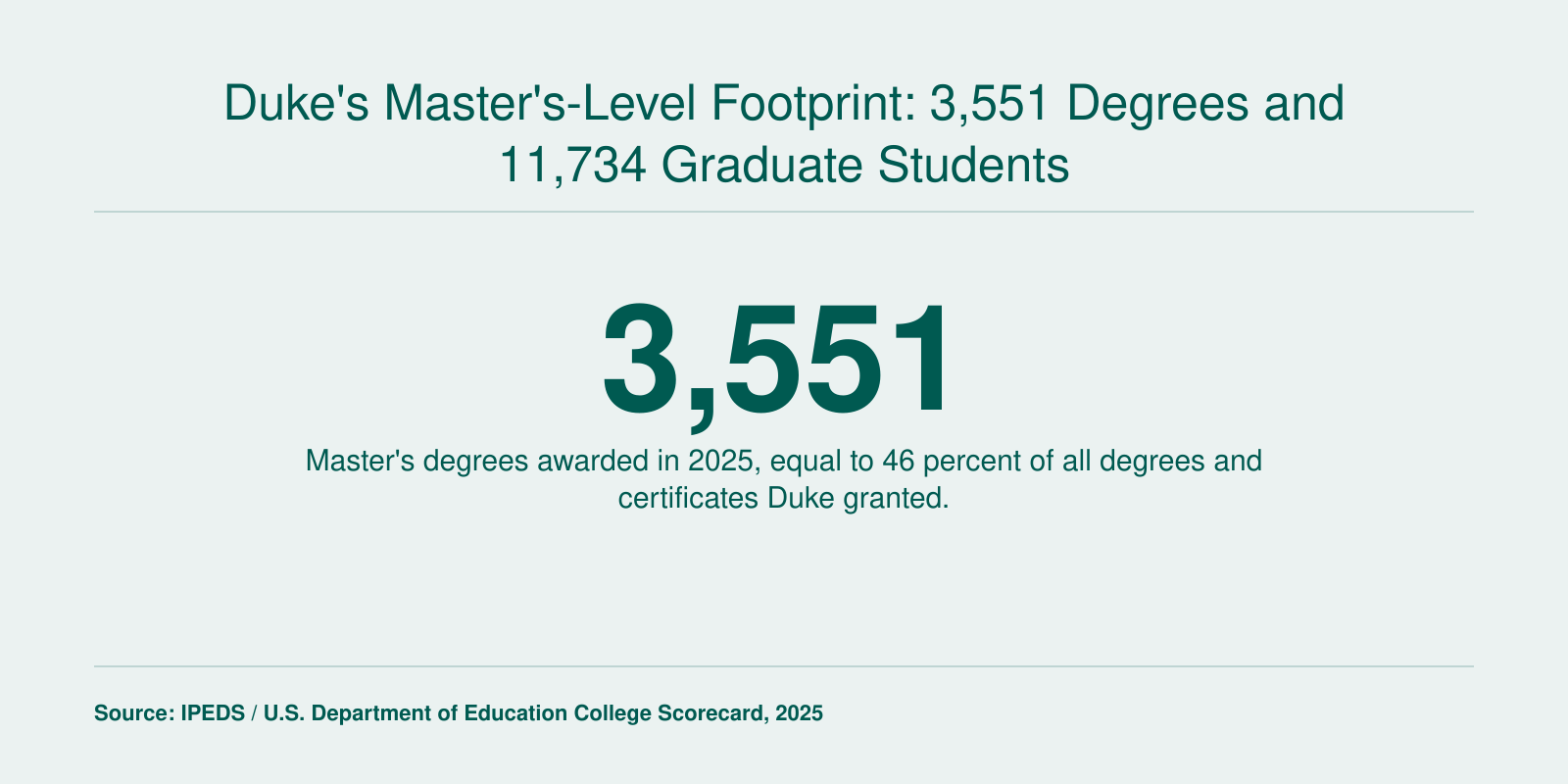
Duke awarded 3,551 master's degrees in 2025, 46 percent of every degree and certificate it granted that year, and it enrolled 11,734 graduate students. The university reports one institutional figure for graduate tuition and fees: $66,523 on average for a full-time year, per IPEDS. No program actually charges that number.
The spread underneath it is the decision. Median earnings four years after completion run from $58,405 in theological studies to $222,160 in business administration and management, while median federal debt ranges from $42,568 in engineering-related fields to $136,412 in allied health, according to College Scorecard data.
Averaging those outcomes produces a number that describes nothing a prospective student will experience.
Key Points
- Duke awarded 3,551 master's degrees in 2025, 46% of all degrees granted.
- Average graduate tuition and fees ran $66,523 in 2024, but programs price separately.
- Engineering-related graduates earned a median $144,681 with just $42,568 in federal debt.
Master's programs at Duke University
Business & Management All programs in this field →
Computers & IT All programs in this field →
Criminal Justice & Law All programs in this field →
Education & Teaching All programs in this field →
Healthcare All programs in this field →
Nursing All programs in this field →
Religion & Theology All programs in this field →
Science & Engineering All programs in this field →
Social Work & Social Sciences All programs in this field →
In the 2025 IPEDS completions data, Duke University awarded 3,551 master's degrees across 81 fields of study in 24 subject areas. Business & Management accounts for the most, 1,311 (37%), led by Management Sciences and Quantitative Methods, Other with 1,019. 51% of graduates were women and 47% were international students. That is down 5% from 3,734 in 2023.
Business & Management 1,311 degrees · 37%
- Management Sciences and Quantitative Methods, Other 1,01945% women
- Business Administration and Management, General 23837% women
- International Business/Trade/Commerce 4935% women
- Entrepreneurship/Entrepreneurial Studies 540% women
Health Professions 414 degrees · 12%
- Physician Assistant 8555% women
- Adult Health Nurse/Nursing 6478% women
- Family Practice Nurse/Nursing 6390% women
- Medical Informatics 3757% women
- Psychiatric/Mental Health Nurse/Nursing 3275% women
- Pediatric Nurse/Nursing 30100% women
- Bioethics/Medical Ethics 2483% women
- Women's Health Nurse/Nursing 22100% women
- International Public Health/International Health 2176% women
- Nursing Administration 1995% women
- Nursing Education 11100% women
- Maternal/Child Health and Neonatal Nurse/Nursing 683% women
- Also reported, no graduates in 2025: Nursing Science; Occupational Therapy/Therapist
Engineering Technology 331 degrees · 9%
- Engineering/Industrial Management 22746% women
- Engineering/Engineering-Related Technologies/Technicians, Other 8343% women
- Computer Software Technology/Technician 825% women
- Engineering Design 863% women
- Environmental/Environmental Engineering Technology/Technician 5100% women
Engineering 269 degrees · 8%
- Bioengineering and Biomedical Engineering 8255% women
- Electrical and Electronics Engineering 7332% women
- Computer Engineering, General 5836% women
- Mechanical Engineering 3421% women
- Civil Engineering, General 1663% women
- Systems Engineering 650% women
- Also reported, no graduates in 2025: Materials Engineering
Natural Resources & Conservation 188 degrees · 5%
- Natural Resources/Conservation, General 11671% women
- Environmental Studies 6269% women
- Forestry, General 1090% women
- Also reported, no graduates in 2025: Environmental/Natural Resources Management and Policy, General; Forest Management/Forest Resources Management
Biological & Biomedical Sciences 164 degrees · 5%
- Biostatistics 4976% women
- Biomedical Sciences, General 3479% women
- Infectious Disease and Global Health 3073% women
- Anatomy 1547% women
- Epidemiology 1573% women
- Pathology/Experimental Pathology 888% women
- Biology/Biological Sciences, General 367% women
- Biochemistry 250% women
- Ecology 250% women
- Genome Sciences/Genomics 2100% women
- Cell/Cellular Biology and Histology 1100% women
- Cell/Cellular and Molecular Biology 10% women
- Marine Biology and Biological Oceanography 1100% women
- Neuroscience 10% women
- Also reported, no graduates in 2025: Biomathematics, Bioinformatics, and Computational Biology, Other; Biophysics; Botany/Plant Biology; Immunology; Molecular Biology; Molecular Genetics; Pharmacology
Theology & Ministry 157 degrees · 4%
- Theology/Theological Studies 15751% women
- Also reported, no graduates in 2025: Divinity/Ministry; Theology and Religious Vocations, Other
Social Sciences 142 degrees · 4%
- Econometrics and Quantitative Economics 6048% women
- International Relations and Affairs 2552% women
- National Security Policy Studies 2020% women
- Political Science and Government, General 1963% women
- Political Economy 944% women
- Sociology, General 560% women
- Anthropology, General 475% women
Law & Legal Studies 113 degrees · 3%
- Legal Research and Advanced Professional Studies, Other 9349% women
- Programs for Foreign Lawyers 2050% women
- Also reported, no graduates in 2025: International Law and Legal Studies
Public Administration & Social Work 100 degrees · 3%
- Public Policy Analysis, General 10058% women
Computer & Information Sciences 93 degrees · 3%
- Computer Science 6330% women
- Artificial Intelligence 3017% women
Interdisciplinary Studies 71 degrees · 2%
- Data Science, General 5254% women
- Economics and Computer Science 1932% women
- Also reported, no graduates in 2025: Sustainability Studies
Physical Sciences 49 degrees · 1%
- Physics, Other 3936% women
- Chemistry, General 367% women
- Materials Science 333% women
- Optics/Optical Sciences 30% women
- Physics, General 1100% women
- Also reported, no graduates in 2025: Geology/Earth Science, General
Mathematics & Statistics 39 degrees · 1%
- Statistics, General 3746% women
- Mathematics, General 20% women
Liberal Arts & Humanities 26 degrees · 1%
- Liberal Arts and Sciences, General Studies and Humanities, Other 2669% women
- Also reported, no graduates in 2025: Humanities/Humanistic Studies
Visual & Performing Arts 23 degrees · 1%
- Fine Arts and Art Studies, Other 1275% women
- Music, General 650% women
- Dance, General 5100% women
- Also reported, no graduates in 2025: Art History, Criticism and Conservation
Philosophy & Religious Studies 18 degrees · 1%
- Christian Studies 1656% women
- Religion/Religious Studies 250% women
- Also reported, no graduates in 2025: Philosophy
Area, Ethnic & Gender Studies 12 degrees · 0%
- East Asian Studies 1258% women
Education 9 degrees · 0%
- Teacher Education, Multiple Levels 944% women
Psychology 7 degrees · 0%
- Research and Experimental Psychology, Other 757% women
Communication & Journalism 5 degrees · 0%
- Digital Communication and Media/Multimedia 540% women
History 4 degrees · 0%
- History, General 4100% women
English 3 degrees · 0%
- English Language and Literature, General 367% women
Languages & Linguistics 3 degrees · 0%
- Classics and Classical Languages, Literatures, and Linguistics, General 1100% women
- German Language and Literature 1100% women
- Romance Languages, Literatures, and Linguistics, General 1100% women
- Also reported, no graduates in 2025: Russian Language and Literature; Slavic Languages, Literatures, and Linguistics, General
Source: U.S. Department of Education, IPEDS completions 2025, master's degrees, first majors, by the field the school reports (CIP code). Programs we have verified and profiled are under Popular programs.
Graduate cost and enrollment at Duke University
| Average graduate tuition and fees, full-time, per year | $66,523 |
|---|---|
| Graduate students (12-month enrollment) | 11,734 |
| Studying fully online | 11% |
| Taking some online courses | 15% |
| Master's degrees awarded (2025) | 3,551 |
| Share of all degrees and certificates the school awards | 46% |
Source: U.S. Department of Education, IPEDS 2024. Tuition is the school-wide average a full-time graduate student is charged; each program sets its own rate, so check the program page.
Graduate outcomes by field
Master's degrees Duke University awards each year by field, with the median earnings of its graduates four years after completing and their median federal debt, where the Scorecard reports them.
| Field | Degrees / yr | Median earnings | Median debt |
|---|---|---|---|
|
Management, Executive MBA Figures for the whole field: Business Administration, Management and Operations |
238 | $222,160 | $80,630 |
|
Adult Gerontology Acute Care Nurse Practitioner, Adult Gerontology Primary Care Nurse Practitioner, Family Nurse Practitioner, Family Nurse Practitioner (FNP), Neonatal Nurse Practitioner, Nurse Executive Leadership, Pediatric Nurse Practitioner, Psychiatric Mental Health Nurse Practitioner, Womens Health Nurse Practitioner Figures for the whole field: Registered Nursing, Nursing Administration, Nursing Research and Clinical Nursing |
236 | $122,410 | $89,495 |
| Environmental Science | 178 | $96,411 | $48,310 |
|
Christian Ministry, Divinity, Theology Figures for the whole field: Theological and Ministerial Studies |
157 | $58,405 | $53,550 |
| Master of Laws | 113 | — | — |
| Public Policy | 100 | $109,274 | $66,331 |
|
Health Informatics, Health/Nursing Informatics Figures for the whole field: Medical Illustration and Informatics |
37 | $163,348 | $45,810 |
| Machine Learning | 30 | — | — |
| Political Science, Government | 28 | — | — |
| Teaching | 9 | $55,809 | — |
| Entrepreneurship | 5 | — | — |
Source: U.S. Department of Education — IPEDS completions (master's level) and College Scorecard field-of-study data.
Accreditation
Duke University is institutionally accredited by the Southern Association of Colleges and Schools Commission on Colleges.
- Law (LAW) - Professional schools — American Bar Association, Council of the Section of Legal Education and Admissions to the Bar
- Occupational Therapy (OTD) - Programs leading to a Doctoral Degree — American Occupational Therapy Association, Accreditation Council for Occupational Therapy Education
- Optometry (OPTR) - Residency programs — American Optometric Association, Accreditation Council on Optometric Education
- Physical Therapy (PT) - Professional programs for the physical therapist — American Physical Therapy Association, Commission on Accreditation in Physical Therapy Education
- Clinical Psychology (CLPSY) - PhD Doctoral programs — American Psychological Association, Commission on Accreditation
- Professional Psychology (IPSY) - Predoctoral internship programs — American Psychological Association, Commission on Accreditation
- Theology (THEOL) - Freestanding schools, as well as programs affiliated with larger institutions, offering graduate professional education for ministry and graduate study of theology — Commission on Accrediting of the Association of Theological Schools
- Nursing (CNDNP) - Nursing education programs at the doctorate degree levels — Commission on Collegiate Nursing Education
- Nursing (CNURED) - Nursing education programs at the baccalaureate degree levels — Commission on Collegiate Nursing Education
- Nursing (CNURED) - Nursing education programs at the graduate degree levels — Commission on Collegiate Nursing Education
- Nurse Anesthesia (ANEST) - Institutions and programs at the master's degree, post master's certificate or doctoral degree levels — Council on Accreditation of Nurse Anesthesia Educational Programs
- Medicine (MED) - Programs leading to the M.D. degree — Liaison Committee on Medical Education
- Teacher Education (TED) - Baccalaureate and graduate programs for the preparation of teachers and other professional personnel for elementary and secondary schools — National Council for Accreditation of Teacher Education
- Institutional Accreditation — Southern Association of Colleges and Schools, Commission on Colleges
Duke's Master's-Level Footprint: 3,551 Degrees and 11,734 Graduate Students
Duke awarded 3,551 master's degrees in 2025, which works out to 46 percent of the 7,776 degrees and certificates of every level the university granted that year, per IPEDS completions data. Graduate enrollment for 2024 stood at 11,734 students, and 3,102 of them, roughly 26 percent, took at least some coursework online. Average full-time graduate tuition and fees ran $66,523 for the year, a school-wide figure rather than the rate any single program charges.
Where Duke Is Strongest: The Fields That Award the Most Master's Degrees
Duke awarded 1,019 master's degrees in management sciences and quantitative methods in 2025, more than four times the 238 it granted in business administration and management operations, according to IPEDS completions data reported through the U.S. Department of Education's College Scorecard. The next-largest field, registered nursing, produced 236. That concentration shapes class sizes, employer recruiting, and how much choice you have inside a cohort, which is worth knowing before you apply.
The Rest of the Top Tier
Below the top two, volume settles into a professional cluster between roughly 100 and 240 degrees apiece: registered nursing (236), engineering-related fields (235), natural resources conservation and research (178), theological and ministerial studies (157), legal research and advanced professional studies (113), and public policy analysis (100). Allied health diagnostic programs (85), engineering technologies (83), biomedical engineering (82), and electrical and communications engineering (73) each add a steady but smaller stream. Bigger fields run multiple cohorts and formats a year; the 100-to-150 range usually means one intake and a tighter calendar.
The Programs Behind the Counts
The management sciences total comes largely from Fuqua's Master of Quantitative Management: Business Analytics and its Master of Management Studies, with the business administration figure carried by the Fuqua MBA family, including the weekend executive format. The Nicholas School supplies the Master of Environmental Management degrees, Sanford the Master of Public Policy, and the School of Nursing the MSN nurse practitioner tracks, from family and adult-gerontology primary care through neonatal, pediatric acute care, psychiatric-mental health, and women's health. Pratt's Cybersecurity Master of Engineering sits inside the engineering-related group. Legal research covers the Law School's Master of Laws and Master of Legal Studies, and the theology figure the Divinity School's ministerial degrees. The program directory below lists each of these degrees individually.
What the Shape of the Portfolio Means
Duke reads as a business and analytics school at the master's level, with serious secondary clusters in professional health, environment, and policy, rather than a broad liberal arts graduate portfolio. The two business fields together account for 1,257 degrees, more than a third of the 3,551 master's degrees Duke awarded. Applicants aiming at analytics, management, nursing, or environmental policy are choosing from the deepest part of the portfolio, with the widest set of formats and the largest alumni base to draw on. Applicants who want a humanities or social science master's will find a narrower menu than Duke's overall size suggests.
Duke Master's Tuition by Program: What Each School Actually Charges
Duke's $66,523 average graduate tuition and fees, reported to IPEDS for 2024, is an institutional average, not a program price. The programs below publish their own 2026-27 rates, and they bill in different ways: Fuqua's MMS as a flat program total, Pratt's MEng by semester, Sanford's MPP by year and term, and the School of Nursing's MSN by credit. Length matters as much as the rate, which is why a 30-week Fuqua master's and a two-year Sanford degree land in different places. Programs without a published 2026-27 rate are omitted rather than estimated.
| Program | School | Annual Tuition & Fees | Program Length | Estimated Total Program Cost |
|---|---|---|---|---|
| Master of Management Studies (MMS) | Fuqua School of Business | $72,231 (tuition $69,900 plus $2,331 mandatory fees) | 30 weeks (about one academic year) | $72,231 |
| Master of Engineering (MEng) | Pratt School of Engineering | $35,680 per semester (tuition); $1,430 mandatory fees for each of the first two semesters | 3 semesters (about 1.5 years) | $107,040 tuition, plus itemized fees for the first two semesters; insurance separate |
| Master of Public Policy (MPP) | Sanford School of Public Policy | $57,708 tuition per year; $28,854 per term (fees not itemized in published estimate) | 2 years | About $115,416 at the published annual rate for two years |
| Master of Science in Nursing (MSN) | School of Nursing | $2,345 per credit; $16,415 average semester tuition | Varies by MSN track; total credits not stated | N/A |
The Real Total Cost of a Duke Master's: Fees, Housing, and Living in Durham
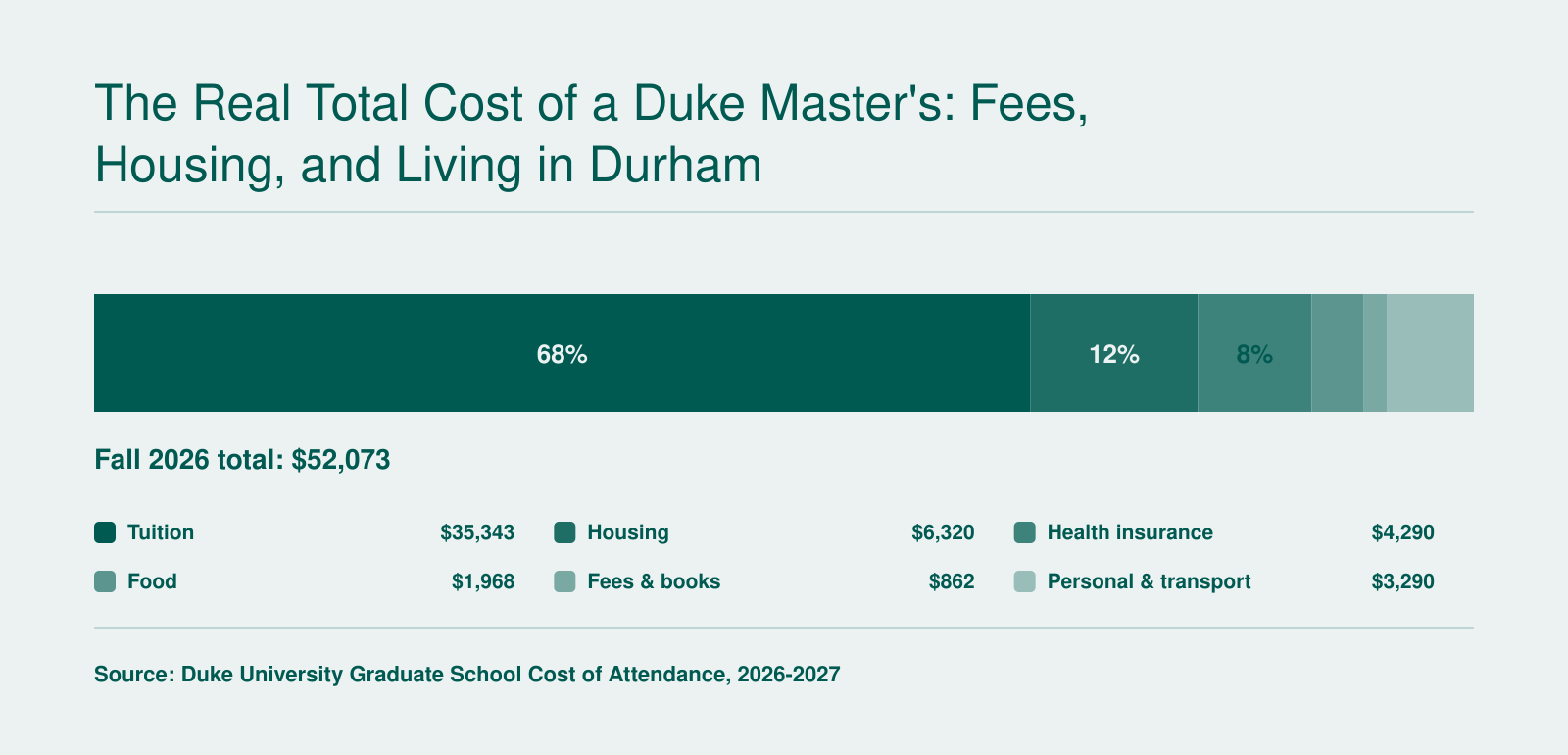
Duke's own cost-of-attendance figures for one Fall 2026 term add up to $52,073, and the university sets every line of it rather than borrowing national averages. Housing, health insurance, and food alone come to about $12,600 on top of tuition. A 12-month program such as Fuqua's compresses those living costs into a single year, while a two-year degree roughly doubles the housing and food lines before the second spring.
Career Outcomes by Field: Median Earnings and Federal Debt Four Years Out
Engineering-related master's graduates from Duke earned a median $144,681 four years after finishing and carried a median $42,568 in federal student debt, the best pay-to-debt ratio among Duke's larger master's fields. The figures below come from IPEDS and the U.S. Department of Education College Scorecard, which track graduates who received federal aid and measure earnings four years after completion rather than at the moment of hire.
The Field-by-Field Numbers
- Management Sciences and Quantitative Methods: $152,389 median earnings, $66,943 median federal debt. Duke's largest master's field, at 1,019 degrees awarded.
- Business Administration, Management and Operations: $222,160 and $80,630.
- International Business: $185,418 and $117,357.
- Engineering-Related Fields: $144,681 and $42,568.
- Allied Health Diagnostic, Intervention, and Treatment Professions: $132,468 and $136,412.
- Registered Nursing: $122,410 and $89,495.
- Public Policy Analysis: $109,274 and $66,331.
- Natural Resources Conservation and Research: $96,411 and $48,310.
- Theological and Ministerial Studies: $58,405 and $53,550.
Where Earnings and Debt Diverge
The two columns do not move together. Engineering-related fields pair strong earnings with the lowest debt load of the group. Allied health sits at the other end: graduates carry $136,412 in median federal debt against $132,468 in earnings, meaning debt slightly exceeds a year's pay. Nursing shows a milder version of the same pattern at $89,495 against $122,410. Debt tracks program length, clinical requirements, and how much federal aid students accept, not tuition alone.
What Duke's Own Schools Report on Placement
Program-level employment reports fill in the hiring picture. Fuqua's 2024 MMS: Foundations of Business Employment Report shows 80% of graduates accepting a job within six months, 152 acceptances, and 123 distinct employers, with 72% of full-time offers coming through graduate-facilitated searches and 28% through Fuqua. Pratt Master's Outcomes reports 76% of master's graduates employed full-time six months out, 12% continuing to further study, and an average starting salary of $85,000, with employers including Google, Microsoft, NVIDIA, Medtronic, and Epic. Sanford's May 2025 MPP outcomes place 45.59% in private-sector research and consulting, 20.59% in domestic nonprofits, and roughly 25% across state, local, and non-U.S. government, supported by 35 employer partners recruiting in 2025-2026.
How to Read These Figures
Treat every number here as a median for a field, not a promised starting salary. The $222,160 business figure in particular is measured four years after completion, well past a first-year offer. Field groupings also bundle several distinct programs, so a single degree can sit above or below its category's median.
Duke Master's Admissions: Deadlines, Tests, Prerequisites, and Selectivity
Duke does not run a single graduate admissions calendar. Each school sets its own rounds, tests, and prerequisites, so treat these as separate processes rather than variations on one application.
Deadlines and Round Structure
Fuqua's two pre-experience business master's degrees use multi-round admissions with the same opening and closing dates but different middle rounds. Both open on October 7, 2026, and close on April 13, 2027. The Master of Quantitative Management adds a January 6 round and a March 4 round; the Master of Management Studies adds a January 13 round and a March 4 round. International applicants needing visa processing are generally advised to target the earlier rounds rather than the final one.
Pratt's engineering master's programs admit for fall entry, with a stated application fee of $75.
The School of Nursing MSN runs rolling admissions for several programs: files are reviewed as they are completed, and decisions continue until cohort capacity is reached. That rewards early submission more than any single deadline.
Tests and Prerequisites
- Fuqua MQM: A four-year accredited undergraduate degree in a STEM, business, economics, or quantitative field is the stated preparation, and strong performance in math, statistics, and computing is expected. Applicants from other backgrounds are directed to contact admissions.
- Pratt engineering: A bachelor's in engineering, science, or a related field, plus transcripts, essays, a resume, three recommendations, and English proficiency for international applicants. The GRE is optional for 2026-27.
- Duke MSN: A BSN from an ACEN- or CCNE-accredited program, or an ADN plus a bachelor's in another field. One year of nursing experience is required for acute care tracks, and a three-credit statistics course with a C or better is required. The GRE is not required, and a 3.0 GPA receives preferential consideration.
What Selectivity Data Is Published
The Nicholas School's environmental management program and the Sanford School's public policy program publish no clear 2026 deadlines, fees, or test policies. Fuqua, Pratt, and Nursing publish requirements but no acceptance rates or cohort sizes. Where a program does not publish an acceptance rate, treat any figure you encounter elsewhere as an estimate, not an official number. Executive and online formats typically run separate admissions calendars from the campus programs, so confirm the timeline on the page for the specific format you intend to pursue.
Online, Hybrid, Executive, or On-Campus: How Duke Delivers Its Master's Degrees
Hybrid Is the Default, Not Online
Duke's master's portfolio leans campus-based, though most of the flexibility sits in hybrid formats. IPEDS counted 11,734 Duke graduate students in 2024, and only 11% of them were enrolled exclusively online, a reminder that Duke is a residential university first. Among the Duke master's programs we verified against the school's own pages, hybrid formats far outnumber fully online ones. The Accelerated Master of Science in Quantitative Management: Business Analytics at Fuqua is the clearest fully online example, built for working analysts who want the credential without relocating. Most other flexible options still keep a foot on campus.
What the Formats Look Like in Practice
- Campus: the Master of Engineering Management at Pratt and the Master of Management Studies at Fuqua are Durham programs first. International students on these tracks depend on F-1 status and a physical move to North Carolina.
- Hybrid professional: Fuqua's Weekend Executive MBA runs 22 months for working managers, and Sanford's Master of Public Policy pairs online coursework with short residencies.
- Hybrid clinical: most of Duke School of Nursing's nurse practitioner tracks (acute care, primary care, family, neonatal, pediatric, psychiatric-mental health, women's health) are hybrid, with supervised clinical hours arranged near home.
- Online with residencies: Pratt's online MEM takes roughly 24 months and requires three weeklong campus residencies, so it cannot be finished fully remotely, including for international students.
The Fine Print on "Hybrid"
The word covers a wide range. Sanford's executive MPA and the Master of Science in National Security Policy mix online instruction with in-person residencies, do not offer visa sponsorship, and cannot be completed remotely. Fuqua's Global Executive MBA and Pratt's FinTech master's, which takes 24 to 29 months of synchronous and asynchronous work plus in-person residences, use the label just as loosely. Executive formats also assume you already have a career to manage around. If remote completion or a student visa matters to you, ask each program which sessions are mandatory and where they meet.
Duke Kunshan
Duke's China campus runs its MMS as a 10-month in-person program split between Durham and Kunshan, not remotely. The Duke Graduate School lists Global Health and Medical Physics as the master's programs delivered through Duke Kunshan, and the international environmental policy master's is based there as well.
Paying for It: Assistantships, Fellowships, and Aid by Duke School
Duke Divinity's Dean's Scholarships cover 50% to 100% of tuition, and they are awarded on merit. Aid at Duke has to be read school by school: Fuqua, Pratt, the Nicholas School, Sanford, the School of Nursing, and Divinity each run their own logic, award sizes, and definitions of who qualifies.
Fuqua: Merit, Automatic, and Ranged
Daytime MBA scholarships are merit-based, and every admitted student is considered automatically with no separate scholarship application. Awards cover both years and stretch from partial to full tuition. Named awards carry their own terms: the Thomas F. Keller Scholarship is full tuition, University Scholars is one-half to full, Forte is partial to full, and Coverdell runs from 25% up to full tuition for returned Peace Corps volunteers. In the executive formats, Fuqua reports roughly 5% to 10% of students receiving full sponsorship, about 50% partial sponsorship, and 40% financing the degree themselves, often through loans. MMS, MSQM, and Executive MBA awards cover part of tuition, without a published typical amount.
Nicholas, Sanford, Nursing, Divinity
University Scholars fellowships reach incoming students at the Nicholas School, Sanford, and the School of Nursing, worth at least the equivalent of one year's tuition, though terms vary by department. For students comparing affordable master of divinity programs, Divinity adds a merit ladder below its Dean's Scholarships: 25% tuition awards for the M.A. in Christian Practice and the D.Min., plus a Divinity Tuition Award at varying amounts for Master of Divinity (MDiv) and MTS entrants who arrive without a merit scholarship. Divinity's Th.D., a doctoral program rather than a master's, shows the contrast plainly: six years of full tuition, required fees, health coverage, and a stipend.
Where PhD-Style Funding Stops
Assistantships and full waivers are the exception in professional master's programs, not the baseline, and Pratt's published master's aid detail is sparse enough that you should ask rather than assume.
The Number to Ask For
Duke's average graduate tuition and fees run $66,523 a year for full-time students (IPEDS 2024, via the U.S. Department of Education College Scorecard), a school-wide figure that individual programs price above or below. Treat it as a starting point, then ask each program's financial aid office three questions: the average award granted last year, the share of the cohort that received funding, and whether the award renews.
The $66,523 figure is an average, not a price tag: it is the school-wide mean for full-time graduate tuition and fees in 2024, and each Duke master's program sets its own rate on top of that starting point.
Accreditation, STEM Designation, and What They Mean for International Students
A Duke master's degree carries two layers of accreditation. Only one of them follows you into a licensing exam or a hiring manager's screening.
Institutional Trust, Then Program-Level Review
The baseline is institutional: Duke is accredited by the Southern Association of Colleges and Schools Commission on Colleges, the regional body that accredits the institution overall. Professional programs add a second layer that matters more for licensure and for employers who screen by credential. The School of Nursing's MSN is accredited by the Commission on Collegiate Nursing Education, the same body covering the school's DNP and post-graduate APRN certificate; the Master of Nursing went in for CCNE review in early 2026, with a decision expected that fall. Fuqua holds AACSB accreditation. Sanford's public policy master's: confirm program-level accreditation with the school directly.
STEM Status Is Decided Program by Program
No university-wide STEM label exists. Duke's Economics MAE, MSEC, and MQFE are STEM-designated under CIP 45.0603, and the Nicholas School describes its MEM and MF as STEM compliant. For any other program, the answer lives on the I-20: check that CIP code against the DHS STEM Designated Degree Program list before enrolling.
What the Designation Buys
F-1 students in a qualifying program can apply for a 24-month extension of post-completion OPT. Duke Visa Services requires current post-completion OPT, a qualifying CIP code, employment of at least 20 hours per week, and a signed Form I-983; filing opens 90 days before the EAD expires and closes 60 days after the DSO's SEVIS recommendation. Programs without the designation still permit standard post-completion OPT, but that is a far shorter runway to H-1B sponsorship, often a single cap season.
The Name Is Worth What the Field Pays
Duke's name carries weight in business, analytics, nursing, and environmental policy recruiting. It is harder to justify where field-level earnings trail the debt. Scorecard data shows Allied Health master's graduates at $132,468 in median earnings four years out against $136,412 in median federal debt, and International Business at $185,418 against $117,357. When debt outruns the paycheck, the premium has to come from something other than the diploma.
Engineering Master's Earnings: Strong Pay, Unusually Low Debt
Engineering is where Duke's master's outcomes look most favorable: strong pay paired with unusually light borrowing.
Duke Master's Programs FAQ
Duke's master's degrees span engineering, business, nursing, divinity, public policy, and more, so the answers below are rarely uniform. Cost, duration, testing, and delivery are set program by program rather than by the university as a whole. These answers pull the figures we use elsewhere in this guide into one place.
How much does a Duke master's degree cost in total?
What is the acceptance rate for Duke master's programs?
Can you earn a Duke master's degree online?
Does Duke require the GRE for master's programs?
How long does a Duke master's program take to complete?
Which Duke master's programs have the strongest career outcomes?
Compare Duke University against every school in its field
Every ranking scores programs on graduate earnings, graduate tuition, debt and completion data from IPEDS and the College Scorecard.
Master's programs in North Carolina Browse all fields