Best Women's Health Nurse Practitioner (WHNP) MSN Programs
Compare 50+ accredited Womens Health Nurse Practitioner programs at 30+ schools, with graduate earnings, cost, debt, and completion data from IPEDS and the U.S. College Scorecard.

Published tuition for a women's health nurse practitioner MSN ranges from about $9,000 in-state at Cal State Fullerton to more than $66,000 at Duke, and the bigger name does not automatically buy better clinical training. A WHNP is an advanced practice registered nurse (APRN) focused on gynecologic, reproductive, prenatal, and menopausal care across the lifespan.
The programs ranked here span campus, online, and hybrid formats, with real differences in net price, clinical hour totals, and GRE policies, some are part of the larger group of No-GRE master's programs.
Online delivery covers coursework only. To sit for the WHNP-BC exam, every graduate still needs at least 600 supervised clinical hours, and who arranges the preceptor often matters more than prestige.
Key Points
- Most WHNP MSN programs require at least 600 clinical hours for WHNP-BC eligibility.
- Program-level earnings for WHNP graduates are not yet published, so net price becomes the clearest cost signal.
- Georgetown and Emory deliver coursework online, but clinical hours must still be completed in person.
The 10 Best Women's Health Nurse Practitioner MSN Programs
Each program below had to prove its value on cost, completion, and graduate pay before it made the cut. The strongest options pair solid clinical training with clear certification prep, whether you need an online schedule or a campus-based cohort. Use the cards to compare formats, clinical hour requirements, and dual-specialty pathways as you build your shortlist.
Yale University
#1New Haven, CT · ~$50,000/yr (est.)
Best for: Ambitious nurses seeking elite on-campus mentorship
The on-campus MSN offers a Women's Health Nurse Practitioner specialty with comprehensive lifespan care, including gynecology, prenatal care, and complex reproductive conditions. Students benefit from a 10:1 student-faculty ratio, a state-of-the-art simulation lab, and a 100% NCC certification pass rate. The program also offers concentrations in adult oncology, diabetes, and gender and sexuality health justice, plus a dual nurse-midwifery option for qualifying students.
- CCNE accredited
- 100% NCC licensure pass rate
- 10:1 student-faculty ratio
- On-site clinical simulation center
- Dual nurse-midwifery specialty option
- 4 concentration options including gender and sexuality health justice
- Clinical placements arranged by school
- Eligible to audit Yale graduate courses
SUNY Downstate Health Sciences University
#2Brooklyn, NY · $12,000 – $25,000/yr (est.)
Best for: Budget-conscious nurses serving diverse New York communities
This Brooklyn-based public university delivers a full-time or part-time Master of Science in Women's Health Nurse Practitioner focused on culturally sensitive primary and reproductive care. The curriculum follows AACN essentials and APRN consensus guidelines, preparing graduates for New York State licensure and national certification. Its public mission and urban clinical settings make it a strong value option.
- Two-year full-time or three-year part-time option
- Campus-based in Brooklyn, NY
- Prepares for New York State licensure and national certification
- Follows AACN essentials and APRN consensus model
- Emphasis on culturally sensitive, lifespan care
- Includes advanced health assessment and diagnostic skills
University of Pennsylvania
#3Philadelphia, PA · ~$48,000/yr (est.)
Best for: Working RNs wanting dual midwifery credentialing
The Women's Health/Gender-Related Nurse Practitioner MSN offers full-time completion in as little as 14 months or part-time over two to three years. Clinical placements are arranged by the school across diverse settings, and students can pursue dual certification as nurse-midwives. Admission requires a BSN, RN license, and statistics course, and the program emphasizes wellness, research, and public policy.
- Full-time completion in 14 months
- Part-time options of 2 or 3 years
- Clinical placements arranged across diverse settings
- Eligible for dual nurse-midwife certification
- Requires BSN, 3.0 GPA, RN license, and statistics
- State-of-the-art simulation lab
- International experiences available
- Total estimated program cost $96,637 to $102,475
Georgetown University
#4Washington, DC · $60,000 – $65,000/yr (est.)
Georgetown's online WHNP program combines synchronous HD-streaming classes, 3D anatomy tools, and two in-person Objective Clinical Intensives for 44 credits over 23 months. The 783 clinical hours are arranged at approved sites, and graduates have achieved a 100% first-time NCC pass rate. The program is designed for working RNs seeking a rigorous, flexible route to certification.
- 23-month, 44-credit curriculum
- Synchronous online classes with HD streaming
- 100% first-time NCC pass rate
- 783 clinical hours at approved sites
- Two in-person Objective Clinical Intensives
- Practice with standardized patients
- Partial scholarships up to $35,000 available
- Rolling admissions with multiple cohort starts
Vanderbilt University
#5Nashville, TN · ~$58,000/yr (est.)
Vanderbilt offers both a standalone WHNP and a dual WHNP/Adult-Gerontology Primary Care NP pathway in a hybrid format. The standalone specialty requires 630 clinical hours and can be completed in four full-time semesters, while the dual option spans five semesters with 1,190 clinical hours. Both tracks feature small classes, clinical placement assistance, and preparation for certification exams.
- Hybrid online/in-person format
- 630 clinical practice hours
- Complete in 4 semesters full-time
- Part-time plan available
- Small collaborative classes
- Clinical placement assistance
- Dual WHNP/AGPCNP specialty
- Hybrid online/in-person format
- Five semesters full-time
- 1,190 clinical hours
- Prepares for both certification exams
- Small class sizes and faculty mentors
Duke University
#6Durham, NC · ~$67,000/yr (est.)
Duke's hybrid WHNP MSN combines distance coursework with immersive clinical experiences, including inpatient OB triage rotations and Centering Group Facilitation Workshop Certification. Students have access to more than 2,000 global clinical partners through a dedicated placement team, and the program emphasizes health equity and care for people of all gender identities. Merit scholarships and rolling admissions add flexibility.
- Hybrid learning format
- Rolling admissions
- Merit scholarships available
- Personalized mentorship from senior peers
- Centering Group Facilitation Certification
- 2,000+ global clinical partners
- In-patient OB triage rotations
Emory University
#7Atlanta, GA · ~$49,000/yr (est.)
Emory's online WHNP program blends online courses with in-person intensives, offering full-time completion in four semesters or part-time options. Students complete over 780 clinical hours in settings like OB/GYN clinics, family planning centers, and LGBTQ+ health centers, and are prepared for WHNP-BC certification. Emory's nursing master's programs are nationally ranked, and clinical placements are supported near the student.
- 4-semester full-time program
- Part-time options available
- 780 clinical hours
- Online courses with in-person intensives
- Prepares for WHNP-BC certification
- Clinical placements near you
- State-of-the-art simulation facilities
Ohio State University
#8Columbus, OH · ~$14,000/yr (est.)
Ohio State's on-campus WHNP MSN prepares graduates for NCC certification through holistic, client-centered primary care coursework and precepted clinical experiences across Ohio. The program accommodates part-time and full-time students and offers a dual Nurse-Midwifery/Women's Health NP track with over 1,000 clinical hours. Students develop skills in gynecologic, reproductive, and sexual health.
- On-campus program
- Prepares for NCC certification
- Holistic, client-centered lifespan care
- Precepted clinical experiences across Ohio
- Part-time and full-time options
- Dual certification eligibility
- Campus-based program
- Over 1,000 clinical hours
- ACME accredited track
- Includes pregnancy and childbirth care
- Covers newborn care up to 28 days
California State University-Fullerton
#9Fullerton, CA · $9,000 – $19,000/yr (est.)
Cal State Fullerton's campus-based MSN offers a Women's Health Care Concentration with two emphasis options: a standalone WHNP and a combined Nurse-Midwife/Women's Health NP track. Clinical placements are assigned by faculty, and the WHNP emphasis requires at least one year of clinical RN experience, preferably in OB/GYN, with no exceptions. Graduates are prepared for California nurse-practitioner certification.
- Campus-based program
- Clinical placements arranged by faculty
- Primary ambulatory care focus
- Covers women across the lifespan
- Requires one year RN experience, preferably OB/GYN
- Prepares for California NP certification
- Combined nurse-midwife/WHNP track
- Campus-based program
- Clinical placements assigned
- Includes pregnancy management and newborn care
- Family planning and well woman gynecology
- Requires six months labor-and-delivery RN experience
Case Western Reserve University
#10Cleveland, OH · ~$54,000/yr (est.)
Case Western's hybrid MSN with a WHNP major requires 38 credit hours and about 600 clinical hours, with full-time completion possible in 12 months across four semesters. The curriculum covers gynecologic and reproductive health, advanced assessment, pharmacology, and leadership, preparing graduates for certification. Part-time plans are available.
- 38 credit hours required
- About 600 clinical hours
- Full-time completion in 12 months
- Hybrid online and on-campus format
- Covers gynecologic and reproductive health
- Part-time plans available
Cost & outcomes by school
Federal data for the highest-earning Womens Health Nurse Practitioner programs, independent of the ranking above. Earnings are this field's master's graduates four years after completing, where the Scorecard reports them.
| School | Earnings | Tuition / yr | Debt | Grads/yr | Format |
|---|---|---|---|---|---|
| California State University-Fullerton CA | $182,816 | $8,994 | $41,000 | 20 | Campus |
| San Francisco State University CA | $152,207 | $9,370 | — | 26 | Campus |
| Fairleigh Dickinson University-Metropolitan Campus NJ | $145,105 | $19,068 | $40,432 | 57 | Online |
| Fairleigh Dickinson University NJ | $145,105 | $25,628 | $40,432 | 8 | Hybrid |
| SUNY Downstate Health Sciences University NY | $142,553 | $11,982 | $26,425 | 136 | Campus |
| University of Missouri-Kansas City MO | $139,097 | $13,726 | $43,050 | 81 | Hybrid |
| California State University-Long Beach CA | $138,776 | $8,898 | — | 63 | Campus |
| Yale University CT | $131,639 | $49,500 | $118,849 | 108 | Campus |
| Georgetown University DC | $127,831 | $61,670 | $127,131 | 259 | Online |
| Case Western Reserve University OH | $126,688 | $53,980 | $124,668 | 70 | Hybrid |
| Keiser University-Ft Lauderdale FL | $124,555 | $36,230 | $48,500 | 51 | Online |
| University of Pennsylvania PA | $124,042 | $47,844 | $49,400 | 219 | Campus |
Sources: U.S. Department of Education. Tuition and graduates: IPEDS. Earnings and debt: College Scorecard, this field's master's graduates; a dash means no figure is reported.
Cost, debt & payoff
Median earnings of this field's master's graduates (4 yrs after completing) vs. their median federal loan debt · U.S. College Scorecard
Across these programs the median graduate earns about $122,851 and finishes with roughly $48,167 in debt — a ratio that clears a common rule of thumb (keep debt below first-year salary). Tuition and debt vary widely school to school, so check the per-school figures in the table above before you shortlist.
Behind the List: Scoring Criteria and Why CCNE or ACEN Accreditation Is Non-Negotiable
A "best" list is only as useful as the numbers behind it, and in graduate nursing those numbers are not always what schools lead with. We rank these programs by verifiable metrics, not prestige. We look at graduate tuition, the institution's overall net price after aid, graduation rate, and when available, program-level earnings and debt reported through College Scorecard. Delivery format also matters because it changes what you can actually enroll in and complete.
What the List Actually Weighs
Two of those figures are campus-wide, not program-specific: graduation rate and net price. They reflect the institution as a whole, not one WHNP track, so read them as institutional context rather than a guarantee for a single graduate program.
Why Accreditation Is a Hard Gate
Accreditation is not a nice-to-have. The National Certification Corporation requires that your graduate nurse practitioner program be accredited by CCNE or ACEN before you can sit for the WHNP-BC exam. State boards of nursing apply the same gate for APRN licensure. If a program is not accredited, your clinical hours and degree may not qualify you to practice.
CCNE vs. ACEN: Two Valid Routes
CCNE, affiliated with the American Association of Colleges of Nursing, accredits baccalaureate, graduate, and residency or fellowship programs. ACEN has a wider scope, covering practical nursing through clinical doctorates, including master's and post-master's APRN programs. Neither is automatically better; what matters is that the specific MSN or post-master's NP program you choose, whether a women's health track or a family nurse practitioner program, holds one of these approvals.
How to Verify Before You Apply
Do not rely on a school's marketing page alone. Open the CCNE accredited-programs directory, search by current institution name and state, and narrow to the master's or APRN category. Confirm the record names the same nursing school and degree track, not just the university or a different program. For ACEN, use the Search Programs database and inspect the result for master's, MSN, or APRN designation. Ask the school for the exact program-level accreditation statement and compare it against the directory. Accreditation of the nursing school as a whole does not automatically cover the WHNP track.
Sticker Price vs. Net Price: Where the Cheapest WHNP MSN Programs Land
Sticker prices can look very different once aid is applied. The net price shown below is an institution-wide average after federal, state, and institutional aid, so it is not an exact quote for any individual student, but it is a useful comparison point. Several of the most affordable options here also offer online or hybrid formats. For WHNP students specifically, the HRSA Nurse Corps Scholarship and Loan Repayment programs, HRSA-funded advanced nursing education traineeships, employer tuition reimbursement, and graduate PLUS loans can lower the final cost. The Nurse Corps Loan Repayment program can pay up to 60 percent of qualifying nursing education debt for a two-year service commitment. Per-credit figures also matter: Carlow lists $946 per credit across 49 credits for a $46,354 total, Regis College charges $1,061 per credit with a $75 application fee, the University of Utah totals about $62,200 for 73 credits, and Georgetown's online WHNP runs about $116,688 for 44 credits. Among the online options shown here, Herzing lists $770 per credit across 54 credits.
| School | Graduate In-State Tuition | Graduate Out-of-State Tuition | Net Price | Format |
|---|---|---|---|---|
| Cal State Fullerton | $7,470 | $20,070 | $6,555 | Campus |
| Texas Woman's University | $8,640 | $18,480 | $11,963 | Hybrid |
| University of Missouri-Kansas City | $12,587 | $30,227 | $13,310 | Hybrid |
| Florida A&M University | $5,785 | $17,725 | $13,739 | Online |
| Herzing University-Minneapolis | $13,450 | $13,450 | $16,670 | Online |
Related Articles
WHNP Clinical Hour Minimums and Who Arranges Your Preceptor
Most WHNP MSN programs require at least 600 supervised clinical hours, and the certification path assumes you can document that floor. To sit for the WHNP-BC exam through the National Certification Corporation, candidates generally need a minimum of 600 clinical clock hours, with roughly 500 of those coming from direct patient care in an advanced-practice role. Individual programs often set a higher bar: the University of Cincinnati builds in 672 hours, Vanderbilt requires 630, and Emory's women's health and gender-related track reports more than 780 directly supervised hours. Online programs typically land in the 600 to 700 range.
What Actually Counts Toward Your Hours
These hours mean hands-on time with patients, not screen time. Direct patient care in women's health settings, including prenatal, gynecologic, and primary care encounters, is what accrues toward the minimum. Even in accredited online nurse practitioner programs, clinical hours are completed in person at an approved site, under a credentialed preceptor. Simulation and lab exercises may supplement your training, but programs rarely let simulation substitute for the core direct-care requirement.
Who Finds Your Preceptor
This is the detail that catches online students off guard. At Vanderbilt and Emory, placement is school-supported: a clinical placement team works with students and faculty to secure sites, often attempting to match your preferred geography, and Vanderbilt requires a placement request form before your preceptorship semester begins. Not every program operates this way. When a program expects you to source your own preceptor, finding a willing women's health provider near home becomes the single biggest stressor of the degree, and a slow search can delay graduation.
Format affects this too. Cincinnati's WHNP track runs online with no campus residency; the only in-person obligation is the clinical hours themselves. Emory, by contrast, blends online coursework with on-campus sessions roughly once or twice per semester, where students complete skills intensives and assessments.
Questions to Ask Admissions
- Placement support: Does the program guarantee or arrange your preceptor and clinical site, or are you responsible for finding your own?
- Geography and state rules: Can I complete rotations in my home state, and are there states where the program cannot place students because of licensing or site-approval restrictions?
- Residency logistics: How many on-campus visits are required, how long does each last, and what happens during them?
Get these answers in writing before you deposit. A strong placement team is worth more to an online student than a marginally lower tuition number.
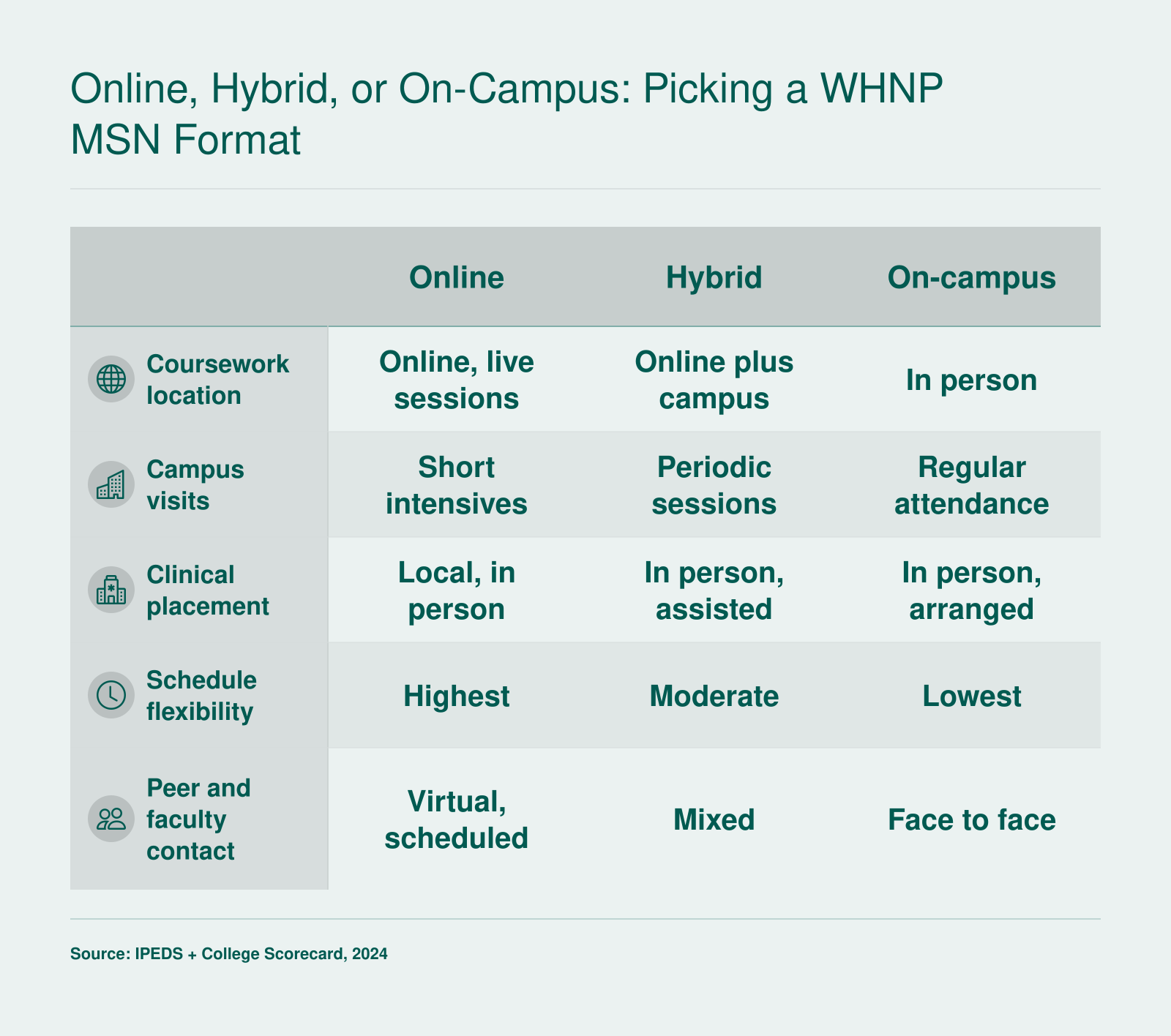
Online, Hybrid, or On-Campus: Picking a WHNP MSN Format
Among the schools ranked here, on-campus delivery is the most common format. Georgetown and Emory deliver coursework online, while Vanderbilt, Duke, and Case Western Reserve use a hybrid model. Can you complete a WHNP MSN online? The coursework, yes. The clinical hours, no: every format requires supervised, in-person patient care.
WHNP MSN Admission Checklist: BSN, Licensure, GRE, and Experience
Requirements vary by school and change each cycle, so confirm every item below with the program before you apply. These are the patterns across the schools researched here.
- Active, unencumbered RN licenseEvery program expects a current, unrestricted U.S. RN license. Some tie it to clinical placement. Georgia College & State University asks for a Georgia or Compact license, and Drexel requires a Pennsylvania RN license before clinical work begins.
- BSN from an accredited programGeorgetown, the University of Cincinnati, and Drexel look for a BSN from a CCNE- or ACEN-accredited school. Drexel also accepts NLN CNEA, and UAB accepts CCNE or CNEA. Regis College is the one school here that documents a bridge: ADN-prepared RNs complete 15 bridge credits with a B or better, and may need general education courses and statistics first.
- Minimum GPAA 3.0 is the usual threshold at Georgetown, Cincinnati, UAB, Drexel, and Regis. Georgia College references 2.75 for one pathway, but treat that as an exception, not the norm.
- GRE policyMost programs have dropped the GRE. Georgetown and Regis waive it. UAB is conditional: applicants below a 3.2 GPA submit a GRE (minimum 297) or GMAT (minimum 480). Cincinnati and Drexel do not state a policy in the research here, so ask them.
- RN work experienceCincinnati requires one year of U.S. RN experience and strongly prefers women's health. Labor and delivery or postpartum experience helps elsewhere, but minimums are often unpublished.
- Timeline and program lengthCincinnati's deadlines are November 15, 2026, March 15, 2027, and July 15, 2027. Regis's is November 30, 2026. Georgetown and Duke admit on a rolling basis. Georgia College's window runs from July 15 into March. Florida A&M's 42-credit program takes five semesters full-time or seven part-time.
Judging a Program by Its WHNP-BC Pass Rate and Job Placement
Two MSN programs can both promise expert women's health training, but their WHNP-BC pass rates often tell very different stories about how well that training actually prepares graduates. A curriculum can look impressive while still leaving students underprepared for certification, so pass rates and employment outcomes deserve a hard look before you commit.
Why certification pass rates matter
A strong WHNP-BC pass rate is a practical quality signal that cost, cohort size, and even graduation rate miss. Certification is the gateway to state licensure and independent or collaborative practice, so programs with consistently high pass rates are proving they teach to the actual clinical and decision-making demands of the role. Be careful with one-year snapshots, though. A single strong or weak year can be misleading, and some national figures mix repeat test takers with first-time candidates.
Recent WHNP-BC pass rates, national and school-reported
The National Certification Corporation's overall WHNP-BC pass rate was 80% in 20251, but that figure includes repeat takers, so it is not a true first-time benchmark. NCC's overall rates have moved from 94% in 2020, to 93% in 2021, 89% in 2022, 87% in 2023, and 79% in 2024, when 878 candidates tested.2 Georgetown University reports a 96% first-time certification average for its online MSN WHNP cohort in 2024, while Purdue Global reports a 93.7% average NP certification pass rate for 2024 graduates who attempted AANP, ANCC, or AACN exams, a figure that is not WHNP-specific. Because some school pages compare their results to a national first-time average that differs from NCC's overall rate, ask whether a first-time figure is school-reported or independently verified.
Questions to ask every program
Placement data is published less consistently than exam scores, so treat a missing employment figure as an information gap, not a reassuring absence. Before enrolling, ask for these specifics. - Three-year average: Request the program's first-time WHNP-BC pass rate over at least three years, not one isolated year. - Employment within 6-12 months: Ask what share of recent graduates are working as WHNPs within six to twelve months of finishing. - Missing numbers: If a program does not publish or share these figures, that gap is worth questioning, not overlooking.
Women's Health Nurse Practitioner Salary, Debt, and Job Settings
A program's price tag is easy to find, but what its graduates earn afterward is much harder to pin down, and that gap is the central difficulty in judging WHNP return on investment.
What the School-Level Data Shows
Federal data does not report earnings and median debt specifically for women's health nurse practitioner graduates at these schools. Federal reporting does not break out outcomes for this specialty, so we will not attach a graduate salary or debt figure to any individual school. The cost side is clearer. University of Pennsylvania lists a total program cost of roughly $96,637 to $102,475. Public options such as SUNY Downstate Health Sciences University and the University of Nebraska Medical Center list noticeably lower tuition than private schools like Duke, Georgetown, and Yale.
National Pay Context
The best defensible benchmark is the broader nurse practitioner category. The Bureau of Labor Statistics reports a median annual wage of $132,300 (about $63.61 an hour) for nurse practitioners as of May 2025, a category that includes adult gerontology primary care nurse practitioners and psychiatric mental health nurse practitioners. That figure covers all NP specialties, not WHNPs alone, and BLS does not publish a separate WHNP wage. The AANP 2024 Compensation Report breaks pay down by state, work setting, clinical focus, and experience, but the public summary does not give a WHNP-specific number, and we found no current NPWH salary survey. Expect your own pay to vary with state and employer.
Demand looks strong. BLS projects NP employment growing 41.0% from 2025 to 2035, from 336,300 to 474,100 jobs.
Where WHNPs Work
Common women's health nurse practitioner jobs include:
- OB-GYN and women's health practices: well-woman exams, contraception, prenatal and postpartum care.
- Family planning and reproductive-health clinics: contraception, STI care, and counseling.
- Hospital outpatient women's centers: often within large health systems and academic medical centers.
- Fertility clinics: a narrower setting that usually calls for additional experience.
- Community health centers: a mission-driven path serving underserved patients.
Available sources do not rank these settings by how many WHNPs they employ.
The ROI Takeaway
Compare total program cost with the national NP median. A program near $100,000, such as Penn's, costs less than one year of pre-tax pay at $132,300. A lower-cost public program narrows that ratio further. Treat the BLS figure as a ceiling for planning, not a promise, since WHNP pay may differ and pay by setting varies. Taxes, living costs, and lost RN income during full-time study all matter. When two programs prepare you equally well for certification, the cheaper one usually wins on return.
Womens Health Nurse Practitioner programs by state
Compare Womens Health Nurse Practitioner programs on the data that matters
Explore more Nursing specializations or browse every graduate field.
All Nursing programs