Best MBA in Entrepreneurship Programs
Compare 150+ accredited MBA in Entrepreneurship programs at 140+ schools, with graduate earnings, cost, debt, and completion data from IPEDS and the U.S. College Scorecard.

Is the best MBA in entrepreneurship worth two years away from your company and a tuition bill that tops $66,000 at Duke? For the best MBA for startup founders, the real test is less prestige than whether a program delivers capital access, a co-founder network, and room to test ideas before your own money is at stake.
Published graduate tuition runs from about $10,000 at the University of Houston to well above $60,000 at several private schools. The ranking relies on federal figures for earnings, debt, net price, and completions, not reputation surveys.
Program-level earnings for these concentrations are still sparse, so cost is often the clearest number a founder can compare.
Key Points
- Federal earnings figures for these specific programs have not yet been published.
- Founder totals mostly measure network size, not your odds of launching.
- Most programs are campus-based; Illinois is online and Syracuse is hybrid.
10 MBA Entrepreneurship Programs for 2027
Every school below earned its spot on what graduates actually earn, owe, and pay, not on brand prestige. Each card lists the entrepreneurship concentration, graduate tuition, and average net price as an institution-wide approximation so you can compare startup-focused MBAs on the numbers that matter.
University of Pennsylvania
#1Philadelphia, PA · ~$48,000/yr (est.)
Best for: Founders building venture-backed startups
Wharton's Entrepreneurship and Innovation MBA blends full-time coursework with field projects and business plan creation, backed by the Venture Lab's Explorer, Founder, Joiner, and Investor pathways. Students can test and scale ideas through VIP-X Philadelphia or pursue acquisition through the ETA Incubator and related coursework. This is a founder's school, but it also suits students aiming for venture roles or corporate innovation.
- Full-time MBA requiring 19 total credit hours
- No thesis or capstone required
- Supported by Wharton Venture Lab
- Field projects and business plan creation
- Access to entrepreneurial business leaders
- Venture Lab Explorer, Founder, Joiner, Investor pathways
- VIP-X Philadelphia accelerator for advanced founders
Duke University
#2Durham, NC · ~$67,000/yr (est.)
Best for: Professionals eyeing entrepreneurship through acquisition
Duke's MBA concentration in Entrepreneurship and Innovation uses experiential New Ventures courses to take students from idea discovery to market delivery. Mentored studies, the Fuqua Client Consulting Practicum, and entrepreneurship-through-acquisition coursework give startup founders and future investors practical reps before they commit capital or launch.
- Experiential courses learn by doing
- New Ventures: Discover, Develop, Deliver sequence
- Mentored study with external organizations
- Fuqua Client Consulting Practicum
- Entrepreneurship through acquisition course
- Healthcare technology commercialization focus
University of Michigan
#3Ann Arbor, MI · $29,000 – $58,000/yr (est.)
Best for: Public-university founders wanting hands-on investing
Michigan Ross offers a campus Full-Time MBA with an Entrepreneurship concentration and 12 career paths that include entrepreneurship and venture capital. Students manage student-run investment funds, complete real business problem-solving projects, and compete in a business plan competition with over $100,000 in prizes. Zell Scholars funding and small FACT groups add structured support for founders.
- Full-time program starting in fall
- More student-run investment funds than any other MBA
- Hands-on investing experience with real companies
- Real business problem-solving projects before internships
- Summer internships with startups or VC firms
- Business plan competition with $100,000 prizes
- Small career-specific FACT group support
- Zell Scholars funding for second-year entrepreneurs
Washington University in St Louis
#4St. Louis, MO · ~$65,000/yr (est.)
WashU Olin's Full-Time MBA with an Entrepreneurship Specialization requires 12 credits covering customer discovery, business planning, and entrepreneurial consulting. Students work through the CEL Entrepreneur Consulting Team and can tap the Olin Entrepreneurship and Venture Capital Association plus a STEM MBA option for extended OPT. It fits founders, startup operators, and corporate innovators.
- 12-credit entrepreneurship specialization
- Courses include Business Planning for New Enterprises
- CEL Entrepreneur Consulting Team experience
- Faculty advisor for each specialization
- Olin Entrepreneurship and Venture Capital Association
- STEM MBA option extends OPT for international students
University of Illinois Urbana-Champaign
#5Champaign, IL · ~$19,000/yr (est.)
Illinois offers an online MBA concentration in Entrepreneurship and Strategic Innovation for students who want a flexible 12-credit startup-focused path. The program develops creative thinking and innovation management under uncertainty, with experiential learning and competitive admission after a curriculum change form.
- Online MBA concentration requiring 12 credit hours
- Focus on managing innovation in uncertainty
- Experiential learning opportunities
- Builds a foundation of business practices
- Competitive admission after Curriculum Change Form submission
University of Minnesota-Twin Cities
#6Minneapolis, MN · ~$22,000/yr (est.)
Minnesota Carlson's MBA offers both a New Venture Track for founders and a Corporate Innovation Track for intrapreneurs. Students can test business models through the STARTUP course, build new ventures in Ventures Enterprise, and learn from an alumni network that founded Zipnosis, Bright Health, Sezzle, and Fulton Beer.
- New Venture Track focuses on launching new businesses
- STARTUP course tests business models with mentor feedback
- Ventures Enterprise develops and sustains new business ideas
- Alumni founded Zipnosis, Bright Health, Sezzle, Fulton Beer
- Full-time and part-time options with three start dates
- Carlson Business Career Center job search support
- Corporate Innovation Track emphasizes innovation within established companies
- Full-time on-campus and part-time online or HyFlex formats
- Interdisciplinary courses recommended
- Career paths include business ownership and consulting
Syracuse University
#7Syracuse, NY · $45,000 – $50,000/yr (est.)
Syracuse's Whitman MBA offers an Entrepreneurship and Emerging Enterprises concentration with a 54-credit hybrid format that combines 36 core credits with experiential internships and consulting projects. At least six experiential credits and an entrepreneurial mindset learning outcome prepare students to launch or lead innovation.
- Hybrid format combining on-campus and online
- 54 total credit hours with 36 in core business
- AACSB-accredited program
- 6 experiential credits through internships and consulting
- STEM concentrations extend OPT to 36 months
- 3.0 GPA minimum for admission
Loyola Marymount University
#8Los Angeles, CA · ~$23,000/yr (est.)
LMU's part-time MBA with an Entrepreneurship concentration is built for working professionals in Los Angeles, with evening classes and synchronous online options. The program requires 36 to 42 units and is ranked 11th nationally for entrepreneurship by U.S. News, with resources from the Fred Kiesner Center for Entrepreneurship and optional global immersion.
- Part-time MBA with evening classes for working professionals
- Synchronous online and on-campus options
- 36 total credit hours, 2 to 3 years to complete
- GMAT or GRE required with test waivers available
- Optional global immersion experience
- Fred Kiesner Center for Entrepreneurship resources
- Ranked 11th nationally for entrepreneurship by U.S. News
University of San Francisco
#9San Francisco, CA · ~$30,000/yr (est.)
USF's part-time MBA with Entrepreneurship and Innovation Concentration uses San Francisco's startup ecosystem through Silicon Valley Immersion, private equity and venture capital electives, and a required capstone. Students write business plans, explore social entrepreneurship, and prepare for founder or startup roles.
- 40-credit campus program for part-time students
- Silicon Valley Immersion course available
- Business plan writing and corporate innovation process
- Electives include Private Equity and Venture Capital
- Capstone project required
- Social entrepreneurship course option
University of Houston
#10Houston, TX · $10,000 – $19,000/yr (est.)
Houston's Bauer College offers an MBA/MS Entrepreneurship dual degree that pairs broad MBA coursework with a specialized entrepreneurship master's in as little as 30 months. Small cohorts of about 20 students, scholarships, and six MS specializations let students customize a path to launch, acquire, or scale a business.
- Dual MBA and MS Entrepreneurship degree
- 63 to 69 credit hours, as little as 30 months
- Six MS specializations including Business Analytics, Finance, Marketing
- Small cohorts of about 20 students
- GMAT or GRE required
- AACSB-accredited program
Cost & outcomes by school
Federal data for the highest-earning Entrepreneurship programs, independent of the ranking above. Earnings are this field's master's graduates four years after completing, where the Scorecard reports them.
| School | Earnings | Tuition / yr | Debt | Grads/yr | Format |
|---|---|---|---|---|---|
| University of Pennsylvania PA | $252,729 | $47,844 | $41,000 | 331 | Campus |
| Columbia Southern University AL | — | $3,936 | — | — | Online |
| Southeastern Oklahoma State University OK | — | $5,220 | — | — | Online |
| William Jewell College MO | — | $6,300 | — | — | Online |
| Florida Atlantic University FL | — | $6,693 | — | — | Online or campus |
| Sul Ross State University TX | — | $6,661 | — | — | Online |
| Kennesaw State University GA | — | $6,702 | — | — | Hybrid |
| University of West Alabama AL | — | $6,868 | — | — | Online |
| University of Nevada-Reno NV | — | $7,032 | — | — | Campus |
| California Miramar University CA | — | $7,300 | — | — | Hybrid |
| Louisiana Tech University LA | — | $7,995 | — | — | Campus |
| New Mexico Highlands University NM | — | $8,016 | — | — | Online |
Sources: U.S. Department of Education. Tuition and graduates: IPEDS. Earnings and debt: College Scorecard, this field's master's graduates; a dash means no figure is reported.
What Earned These Schools a Spot: Our Scoring Approach
The U.S. Department of Education's College Scorecard publishes earnings and debt figures for individual degree programs, not just whole universities, and that program-level detail is what drives the order of the Best MBA Programs above. We pair it with institutional tuition and net price figures from federal reporting, the same cost lens we use in affordable MBA programs.
The four inputs
- Median earnings after completion: What graduates of that specific MBA program actually earned in the years following graduation, drawn from federal tax records rather than self-reported surveys.
- Median federal debt at completion: The typical federal loan balance a graduate of that program carries when they finish.
- Average net price: What students pay once grants and scholarships are subtracted, usually well below sticker tuition.
- Completions: How many degrees the program awards, used as a proxy for scale and cohort size. Thin cohorts produce noisier earnings data.
Where this data falls short
Scorecard tracks wages. It does not track equity, founder ownership, or startup exits. A graduate who launches a company and pays themselves $40,000 for three years while building toward a liquidity event looks worse in the earnings data than a classmate who took a consulting job, even if the founder ends up far wealthier. Read earnings medians at entrepreneurship-heavy schools with that in mind.
Net price and graduation rates are also school-wide numbers. They describe the institution, not the entrepreneurship concentration specifically.
Venture Funds, Incubators, and Accelerators at Leading Business Schools
Startup resources at top MBA programs range from summer accelerators to pitch competitions with real cash, but the deal terms are not the same. Founders should compare what each resource actually offers before assuming a school will fund their company.
Concrete 2026 Numbers at Two Anchors
- Harvard Business School: The Rock Accelerator runs 12 weeks each summer. The New Venture Competition lists a $75,000 grand prize, $25,000 runner-up, and $5,000 crowd favorite. HBS also offers a one-time need-based award of $10,000 to $20,000 for graduating MBAs pursuing their own ventures.
- MIT Sloan: The Martin Trust Center's delta v accelerator hosted 13 teams and 28 founders in 2026.1 Each team was eligible for up to $75,000 of equity-free funding, up from $20,000 in earlier years.1
How the Deal Terms Differ
Equity-free grants like delta v's $75,000 per team do not dilute founder ownership.1 That is different from a student-managed venture fund, which generally invests with an expectation of return, or an accelerator that takes equity. Several schools here operate venture labs, student funds, or incubator networks, but official pages did not publish 2026 fund sizes or cohort counts for Stanford GSB, Wharton Venture Lab, Babson Butler Venture Accelerator, Berkeley Haas, or Michigan Ross Zell Lurie at this writing. No official student venture fund size for HBS or MIT was published in the 2026 sources available.
Ask About Timing, Not Just Existence
At HBS, the Rock Accelerator is scheduled between the required and elective curriculum years, so students participate after the first year instead of waiting until graduation. Admissions should be able to confirm whether an accelerator is open to first-year MBA students, whether summer access is guaranteed, and whether the award is a grant or an investment.
Founder Track Records: Alumni Startups and Capital Raised
Founder totals mostly measure the size and age of a school's alumni network, so the headline numbers tell you more about scale than about your own odds of launching a company.
Who Starts a Company at Graduation
School employment reports offer the closest thing to a like-for-like comparison, though definitions still differ:
- Harvard Business School: 17% of the Class of 2025 started their own business. A separate 35% did not seek employment, a broader group that includes those founders plus 14% who were company-sponsored or already employed.
- Stanford GSB: 16% of the Class of 2025 pursued entrepreneurship, which counts both launching a new venture and searching to acquire an existing company.1
- MIT Sloan: 11.1% started businesses, per its 2025-2026 MBA employment report, which doesn't say whether that share is of all graduates or only job seekers.2
We could not confirm a comparable current figure for Wharton, Babson, or Berkeley Haas.
Venture-Backed Founders Since 2015
PitchBook's 2026 ranking counts MBA alumni whose companies received venture funding between January 2015 and August 2026:
- Harvard (1st): 2,444 founders, 2,235 companies, $153.5 billion raised
- Stanford (2nd): 1,504 founders, 1,359 companies, $96.8 billion
- Wharton (3rd): 1,437 founders, 1,332 companies, $80.3 billion
- MIT Sloan (7th): 934 founders, 858 companies, $42.6 billion
- Berkeley Haas (9th): 705 founders, 650 companies, $27.5 billion
These figures leave out bootstrapped and self-funded founders entirely, so they can't be lined up against the employment-report percentages above.
How to Weigh It
Schools self-report employment outcomes, and the biggest venture totals belong to programs with large classes and decades of graduates. A smaller program's founder rate per graduate may say more about its culture than a raw count does.
Our ranking leans on graduate earnings, as our MBA in Finance rankings do, which shows whether the degree pays off if you take a salaried role first or your startup stalls. Founder volume signals investor access and network density instead. If you plan to raise venture capital right away, give the founder data more weight. If you'll be repaying loans, earnings matter more.
Related Articles
Tuition and Net Price: The Lowest-Cost Entrepreneurship MBAs
Published tuition below reflects the program's advertised graduate rate, but what students ultimately pay depends on aid. Net price is an institution-wide average across all students after grants and scholarships, so it is only a rough benchmark for an MBA founder. Public universities can look affordable in state but cost far more for out-of-state students, and higher-priced programs in the main ranking publish tuition well above these figures. Founders should also plan for living expenses and the income they give up while studying.
| School | In-State Graduate Tuition | Out-of-State Graduate Tuition | Average Net Price |
|---|---|---|---|
| The University of Texas Rio Grande Valley | $8,589 | $15,971 | $4,831 |
| University of Nevada-Las Vegas | $7,413 | $25,555 | $10,359 |
| University of Illinois Chicago | $17,550 | $27,748 | $10,974 |
GMAC's 2026 Prospective Students Survey drew 4,253 respondents from 145 countries or regions, but the report does not give a clear share of MBA candidates planning to start a business. Check the latest edition at gmac.com, and compare how each source defines "entrepreneur" and "self-employed." Stated intentions are not actual startup rates.
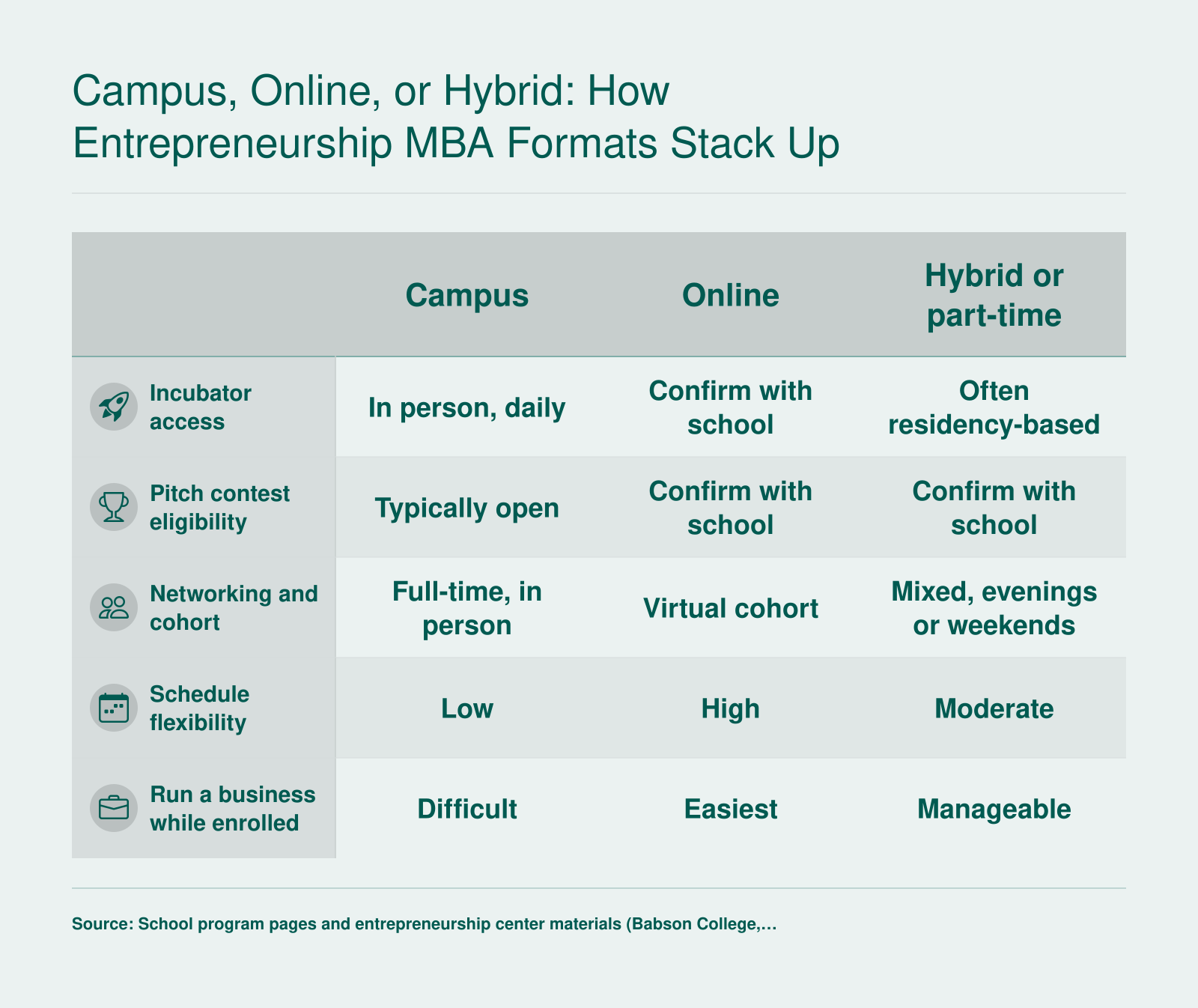
Campus, Online, or Hybrid: How Entrepreneurship MBA Formats Stack Up
Most programs on this list are campus-based. Illinois is the online option, and Syracuse is hybrid. Minnesota, Loyola Marymount, San Francisco, and Houston add part-time tracks. Babson says its accelerator support reaches students "even in virtual world," and Michigan Ross runs REAL.START with a $100,000 prize. Neither school publishes whether online or blended students get identical eligibility, funding, or in-person access, so confirm those terms with admissions before you enroll. Working founders who need to keep their company running should lean online or part-time. Founders who want daily access to incubators and investors should choose campus.
Entrepreneurship programs by state
MBA Entrepreneurship Programs: Your Questions Answered
These answers cover the questions founders ask most often when comparing entrepreneurship MBAs. Admissions policies and deadlines change each cycle, so confirm every date and requirement on the school's official admissions page before you apply.
Which business schools are strongest for startup founders?
What is the total price of an MBA with an entrepreneurship concentration?
How do you judge the return on an entrepreneurship MBA if you plan to launch a company?
Is an online MBA in entrepreneurship a smart choice for working founders?
Do top entrepreneurship MBA programs still require the GMAT or GRE?
When are application deadlines for entrepreneurship-focused MBA programs?
Do you need an MBA to raise venture capital?
Compare Entrepreneurship programs on the data that matters
Explore more MBA specializations or browse every graduate field.
All MBA programs