Best MBA in Entrepreneurship Programs in Minnesota
Compare 4 accredited MBA in Entrepreneurship programs in Minnesota at 3 schools, with graduate earnings, cost, debt, and completion data from IPEDS and the U.S. College Scorecard.

Few Minnesota schools publish a dedicated entrepreneurship MBA track, and the formats differ more than the curricula do. The University of Minnesota-Twin Cities offers a New Venture Track within its Carlson MBA, the University of St Thomas runs an entrepreneurship concentration through its Schulze School, and Augsburg University offers a hybrid, evening-based MBA with test-optional admission, a policy common to many MBA in Entrepreneurship programs with no GMAT or GRE required.
For a future founder, the tension is price against flexibility: the University of Minnesota-Twin Cities lists the lowest graduate tuition rate here, a metric central to the most affordable MBA in entrepreneurship programs, yet its full-time track is the most demanding to schedule around a startup.
Key Points
- Carlson's full-time MBA runs 24 months and 64 credits, on campus only.
- The University of St. Thomas is the most flexible on GMAT and GRE requirements.
- MN Cup drew 1,262 applications in 2026, with more than $400,000 in prizes and no equity taken.
Best MBA in Entrepreneurship Schools in Minnesota for 2027
Three Minnesota schools offer an MBA with an entrepreneurship focus: a large research university, a private university with a dedicated entrepreneurship school, and a Twin Cities university built around evening cohorts. They differ most in format and in how closely each ties coursework to real ventures, so match the program to your work schedule and goals. Graduation rates cited below are institution-wide, not specific to the MBA.
University of Minnesota-Twin Cities
#1Minneapolis, MN · ~$22,000/yr (est.)
Best for: Aspiring founders testing real ventures
Carlson School of Management at the University of Minnesota Twin Cities pairs its entrepreneurship and innovation specialization with hands-on venture work and a deep Minnesota startup network. Carlson's MBA portfolio is listed as AACSB-accredited across its full-time, executive, part-time, and online formats. Institution-wide, about 85 percent of students graduate within six years. Carlson plans to launch a redesigned Professional MBA in January 2027 that merges its online and part-time programs, with entrepreneurship staying available as a specialization.
- Built for students who want to identify opportunities and launch new businesses
- Foundational courses in entrepreneurship, innovation, and strategic management of technological change
- STARTUP course tests business models with mentor feedback
- Eligible STARTUP students may receive micro-grants of up to $3,000 for prototyping
- Work experience required; full-time students average about 5 years
- Three start dates per year: fall, spring, summer
- HyFlex format available for part-time students
- Alumni founders include Zipnosis, Bright Health, Sezzle, and Fulton Beer
- Aimed at students driving new ideas inside established organizations
- Ventures Enterprise: six-credit, multi-semester client projects with startups and nonprofits
- Full-time on campus; part-time online or HyFlex
- Two-year program with full-time and part-time options
- Interdisciplinary electives recommended
University of St Thomas
#2Saint Paul, MN · ~$21,000/yr (est.)
Best for: Career builders wanting startup internships
The University of St. Thomas runs its entrepreneurship MBA through the Schulze School of Entrepreneurship, with classes held on the Minneapolis campus in Schulze Hall. Its Entrepreneurial Fellowship places students as interns in early-stage companies, and many of those internships are paid. Institution-wide, about 76 percent of students graduate within six years. Current AACSB status for the Opus College of Business could not be confirmed in our research, so check with the school directly.
- Housed in the Schulze School of Entrepreneurship
- Classes meet on the Minneapolis campus in Schulze Hall
- Entrepreneurial Fellowship places student interns in early-stage companies
- Local startups and established firms recruit for internships, many paid
- Fowler Business Concept Challenge offers Business Concept and Social Venture tracks
- Competition scholarships go to the top four finishers and best presenter per track
- Scholarships available
Augsburg University
#3Minneapolis, MN · ~$14,000/yr (est.)
Best for: Working professionals needing evening classes
Augsburg University's MBA with an Entrepreneurship concentration is an accelerated evening program in a cohort model, designed for working professionals. The GRE and GMAT are optional, and math modules are available as an alternative. Institution-wide, about 52 percent of students graduate within six years. The program lists a $106,000 average post-graduation salary, which is a self-reported figure, so weigh it accordingly. Augsburg's Center for Innovation and Entrepreneurship adds support beyond the classroom.
- 26-month accelerated program with evening classes
- Cohort-based structure; hybrid delivery
- 14 courses: 12 core plus two entrepreneurship concentration courses
- Management Consulting Project capstone
- GRE and GMAT optional; math modules available instead
- Two years of professional experience and two recommendation letters required
- Augsburg Partnership Grant reduces graduate tuition by $80 per credit
- Center for Innovation and Entrepreneurship uses design thinking and lean-startup frameworks
Cost & outcomes by school
Federal data for the highest-earning Entrepreneurship programs, independent of the ranking above. Earnings are this field's master's graduates four years after completing, where the Scorecard reports them.
| School | Earnings | Tuition / yr | Debt | Grads/yr | Format |
|---|---|---|---|---|---|
| Augsburg University MN | — | $13,766 | — | — | Hybrid |
| University of Minnesota-Twin Cities MN | — | $22,017 | — | — | Campus |
| University of St Thomas MN | — | $21,151 | — | — | Campus |
Sources: U.S. Department of Education. Tuition and graduates: IPEDS. Earnings and debt: College Scorecard, this field's master's graduates; a dash means no figure is reported.
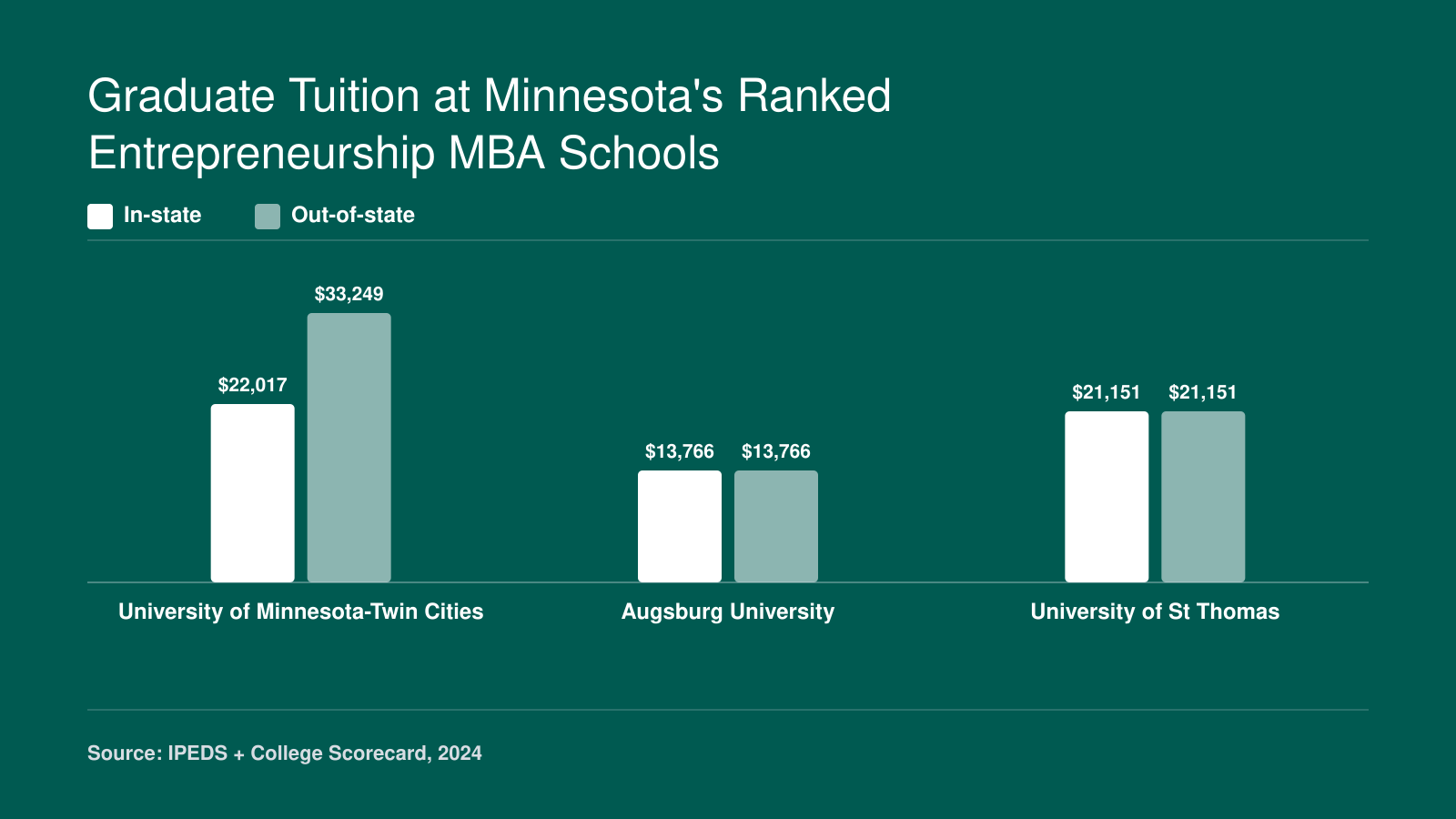
Graduate Tuition at Minnesota's Ranked Entrepreneurship MBA Schools
Public and private pricing differ sharply here, and the out-of-state gap matters most at the public school. The University of Minnesota-Twin Cities charges nonresidents noticeably more than residents, while Augsburg University and the University of St Thomas list one rate for everyone. These are annual graduate tuition and fees, not total program cost, so multiply by the time you will spend enrolled and check each program's credit requirements.
Cost and Minnesota Employer Demand for MBA Graduates
The real price of an MBA in Entrepreneurship is annual tuition multiplied by the length of the program, plus fees. Carlson at the University of Minnesota-Twin Cities publishes the clearest numbers for 2026-27.
What Carlson Costs by Format
- Full-time: 64 credits over four semesters. Tuition and fees total about $112,101 for Minnesota and reciprocity students and about $144,821 for non-residents. Global experience, housing and books are extra.
- Professional (part-time): $1,797 per credit across 52 credits, or $93,444 in tuition, before fees.
- Executive: $140,400 over four semesters, with fees, books and class-day meals included.
Totals for other Master's Programs in Minnesota, including the St. Thomas and Augsburg MBAs, could not be confirmed for 2026, so check each bursar page before comparing. Program-level earnings and debt for these concentrations are not published, so no payoff figure is quoted here.
Aid That Cuts Net Cost
Carlson considers every full-time applicant for scholarships, and a complete application by December 1, 2026 earns a guaranteed award, though the amount is not stated. Professional and Executive scholarships run 15 to 50 percent. St. Thomas lists an Entrepreneurial Fellowship that places students in startup internships, plus Fowler Business Concept Challenge scholarships.
Minnesota Demand
Minnesota's employment department counts about 270,320 management jobs, projected to reach 282,090 (4.4 percent growth, 11,770 added), with 224,266 openings.1 Twin Cities headquarters such as Target, UnitedHealth Group and 3M anchor that market. Weigh that demand against the totals above.
Related Articles
Online and Hybrid Entrepreneurship MBA Options in Minnesota
Can you earn an entrepreneurship MBA online in Minnesota? Partly, and the answer depends on the school and the track; see how programs compare in the Best Online MBA in Entrepreneurship Programs.
University of Minnesota-Twin Cities
The Carlson full-time MBA is on campus only, a format distinction among the Best MBA Programs. It runs 24 months and 64 credits, with no evening, weekend, or online option. The Professional MBA is the flexible route, with in-person, hybrid, and online coursework. Online classes are generally asynchronous, but students must attend three in-person residencies. The Entrepreneurship & Innovation specialization is fully online for Professional MBA students. Most finish in about three years, though completion can range from two to seven.
University of St Thomas and Augsburg University
St Thomas is listed as campus-based, with classes in Schulze Hall on its Minneapolis campus. A part-time flex MBA with an entrepreneurship concentration appears in search results, but its 2026 delivery format, completion time, and online availability of concentration courses were not confirmed. Check with admissions.
Augsburg's program is hybrid, with evening classes for working professionals, full-time and part-time options, and a cohort structure. It publishes a 26-month, 14-course format. How much of the entrepreneurship coursework is online is worth asking about directly.
The Trade-Off
Online and hybrid formats suit founders who cannot step away from a running business. Campus formats make incubators, pitch events, and venture competitions easier to join, such as the Fowler Business Concept Challenge at St Thomas or Carlson's Ventures Enterprise program.
GMAT and GRE Waiver Policies at Minnesota MBA Programs
Testing rules vary widely among the schools here, and the University of St. Thomas is the most flexible. Beyond test scores, the University of Minnesota-Twin Cities Full-Time MBA requires a personal statement, transcripts, two professional references, a current résumé, a video essay, and an invitation-only interview, while the St. Thomas STEM MBA asks for an essay and the St. Thomas Executive MBA expects at least 5 years of full-time professional experience. GPA thresholds appear only as waiver criteria, so confirm any stated minimum with each admissions office.
| School | GMAT/GRE Policy | Waiver Criteria | Next Application Deadline |
|---|---|---|---|
| University of Minnesota-Twin Cities (Full-Time MBA) | Required; GMAT or GRE General Test score should be less than five years old | Waiver possible with a four-year degree from a regionally accredited U.S. university (or international equivalent) and a GPA of 3.2 or higher, or 3.0 or higher for STEM majors | Rounds typically near October 1, December 1, February 1, and April 1 |
| University of St. Thomas (MBA and STEM MBA) | MBA: optional, but recommended if GPA is below 3.3. STEM MBA: not required | STEM MBA: no added testing or skills demonstration with a GPA above 3.0 and strong quantitative coursework, or a STEM/quantitative degree and a GPA above 2.8 | STEM MBA: priority June 15, international July 1, final August 30 |
| Augsburg University | No published policy | No published policy | No published policy |
Minnesota's statewide startup contest, MN Cup, drew 1,262 applications in 2026, and 92 companies advanced as semifinalists. Per the 2026 semifinalist announcement from the University of Minnesota, they competed for more than $400,000 in cash prizes, with no equity taken.
Entrepreneurship Resources: Incubators, Funding, and Mentors
Startup resources make the degree practical: mentors who read your financials, grant money for a prototype, pitch competitions with real checks, and funds that can invest in a student venture. Access rules vary more than the marketing suggests, so read them before you enroll.
Carlson's Holmes Center
The Holmes Center for Entrepreneurship anchors startup activity at the Carlson School. Its mentor network, about 260 advisors, works with students and alumni alike. Graduate students can apply for prototype and pilot grants in the $100 to $5,000 range, and full-time MBA students can join a two-semester venture enterprise course. A student-owned venture fund of more than $1 million exists, though it is run by 25 undergraduates and MBA investment access is not spelled out. MN Cup, hosted at the university, is open to any Minnesota-based business or idea under $1 million in revenue and awards $400,000 in non-dilutive capital, making it the piece an online or part-time student can reach most easily.
St. Thomas and the Schulze School
The Schulze Innovation Fund, established in 2017, requires at least one founder who is a current St. Thomas student or alumnus, so the door stays open after graduation. The Fowler Business Concept Challenge drew 67 submissions in 20261; five finalists competed for $10,000, and two teams advanced to global finals with a $75,000 seed pool.2 St. Thomas reports competition awards exceeding $500,000 annually3 across its programs, though several tracks are undergraduate-only.
Fit verdict
Founding now? St. Thomas puts capital and alumni-eligible funding closest to hand. Building skills first? Carlson's mentor depth and structured venture coursework suit you better.
Frequently Asked Questions About Minnesota Entrepreneurship MBAs
Which Minnesota MBA is best for entrepreneurship?
Which Minnesota MBA programs are AACSB accredited?
How much does the Carlson Executive MBA cost compared with the other options?
Can you start a business during an MBA program in Minnesota?
Compare Entrepreneurship programs on the data that matters
Explore more MBA specializations or browse every graduate field.
All MBA programs