Best Master's in Business Communication Programs
Compare 130+ accredited Communications programs at 120+ schools, with graduate earnings, cost, debt, and completion data from IPEDS and the U.S. College Scorecard.

A master's in business communication trains people to run an organization's internal and external messaging: crisis response, executive positioning, data-driven campaigns, and the strategy that ties them together. It is a narrower, more applied degree than the Best MBA Programs, which treat communication as one function among finance, operations, and marketing rather than the core skill.
Across the ranked programs, graduate tuition runs from roughly $7,000 to over $58,000 per year, and formats split across fully online, on-campus, and hybrid study, including the online master's in communication track. That spread matters because a stronger brand does not guarantee a stronger return.
Many of these degrees are built around weeknight classes and cohorts capped for working professionals, a signal that mid-career students, not recent graduates, are the intended audience.
Key Points
- Rankings weigh graduate tuition, net price, and verifiable outcomes, not prestige or advertising.
- Degree titles vary widely, from Rutgers' Master of Communication and Media to strategic communication degrees.
- Many programs offer online, on-campus, or hybrid study, so check whether classes are asynchronous.
Best Master's in Business Communication Programs: 2027 Rankings
These ten programs stand out for combining graduate communication training with real career outcomes, flexible formats, and strong institutional support. The rankings below highlight tuition, delivery mode, and concentrations to help you compare working-professional, research, and industry-focused options.
Rutgers University
#1New Brunswick, NJ · ~$23,000/yr (est.)
Best for: Working professionals balancing jobs and study
Rutgers University's School of Communication and Information offers a flexible Master of Communication and Media built around evening, online, and hybrid courses. Students can specialize in strategic and leadership communication or communication and media research within a 36-credit curriculum, with no entrance exam and rolling admissions. The program emphasizes applied projects and a network of more than 1,800 alumni, drawing working professionals from PR, marketing, journalism, and social media.
- 36 total credit hours
- No entrance exam required
- Rolling admissions
- Hybrid course options
- Fully online option available
- Designed for working professionals
- Weeknight classes at 6 to 9 p.m.
- Careers in PR, marketing, journalism, social media
- Capstone required
- Theory-informed, research-based study of organizational process
- Prepares for careers in leadership and corporate communication
- Special topics courses on emerging subjects
- 12 total courses
- 86% graduate in 24 months or less
- 60% of students work full- or part-time
- Alumni network of top professionals
University of Minnesota-Twin Cities
#2Minneapolis, MN · ~$22,000/yr (est.)
Best for: Mid-career communicators seeking strategic leadership roles
University of Minnesota-Twin Cities offers a cohort-based Professional M.A. in Strategic Communication designed for working communicators in advertising, PR, and corporate or nonprofit roles. Evening classes and a capstone tied to real workplace problems let students apply strategy directly. Small cohorts and an advisory board keep the program connected to Twin Cities agency practice.
- 33 total credit hours
- 2-Year program
- Full-time and part-time options
- Cohorts capped at 20 students
- Classes meet Tuesday and Thursday evenings
- Capstone can solve real workplace problems
- 90% of alumni report income increase
- GRE may be waived with graduate degree
Fairfield University
#3Fairfield, CT · ~$21,000/yr (est.)
Best for: Online learners seeking NYC media connections
Fairfield University's online M.A. in Communication offers specialized tracks in health communication, public relations, and organizational leadership. The flexible online format and rolling admissions suit working students, while proximity to the New York City media market supports networking. Recent graduates have landed roles at employers like Yale Medicine and WWE.
- 3 concentration options
- Complete in 2-3 years
- 36 total credit hours
- Rolling admissions
- 100% online program
- Focus in health communication
- Proximity to NYC media market
- Recent employers: Yale Medicine, WWE
Syracuse University
#4Syracuse, NY · $45,000 – $50,000/yr (est.)
Syracuse University's Newhouse School offers a fully online M.S. in Communications with tracks in journalism innovation, media management, and strategic communication. The 33-credit curriculum includes two residency experiences and a capstone, with topics spanning AI, crisis communications, and media law. It is geared toward media and communications professionals who need part-time study.
- Track courses in data-driven journalism
- Designed for media and communications backgrounds
- Core: digital systems, strategies, media law
- Two residency experiences required
- Variable topics include AI and crisis communications
- Cross-school electives from Whitman
- Advanced Social Media Strategy course
- Digital Communications Systems course
- Residency for leadership skills
- Track electives in digital branding and strategy
- Track elective in crisis communications
- Residency: Media Industry Leadership and Change
- Variable topics include AI and business analytics
Monmouth University
#5West Long Branch, NJ · $25,000 – $30,000/yr (est.)
Monmouth University's M.A. in Communication blends online, in-person, and hybrid coursework in a 30-credit curriculum. Students can choose thesis or non-thesis tracks and benefit from internship access between New York City and Philadelphia. The program suits students interested in crisis communication, digital marketing, and organizational communication.
- 30 total credit hours
- Full-time and part-time options
- Starts summer, fall, or spring
- 3.0 GPA minimum
- 2 letters of recommendation minimum
- Hybrid, online, and in-person courses
- Internship opportunities near NYC and Philly
- Careers in PR, marketing, journalism
Illinois State University
#6Normal, IL · ~$10,000/yr (est.)
Illinois State University's master's in communication combines communication theory and research methods with faculty expertise in organizational, instructional, and interpersonal communication. Awarded the National Communication Association Outstanding Master's Program Award, it prepares graduates for teaching, training, public relations, and media management. Graduate assistantships with tuition waivers and stipends support full-time study.
- 3.0 GPA minimum
- 3 letters of recommendation minimum
- Received Outstanding Master's Program Award
- Career paths include teaching, training, PR, media management
- Prepares for Ph.D. studies
- Full tuition waiver for teaching assistants
- Monthly stipend of approximately $1,300
- Graduate assistantships in various campus units
College of Charleston
#7Charleston, SC · $16,000 – $21,000/yr (est.)
College of Charleston's fully online M.A. in Communication is designed for working professionals and recent graduates, with an accelerated 12-month full-time option or a 24-month part-time path. The 30-credit curriculum covers communication theory, strategic marketing, leadership, and media. Students gain practical experience through internships and partnerships with employers like IBM and Forbes.
- 12-Month program
- 30 total credit hours
- Full-time and part-time options
- 3.0 GPA minimum
- Prerequisite courses required
- Independent study and internships
- Partnerships with IBM and Forbes
- Transfer up to 12 credits
Indiana University-Indianapolis
#8Indianapolis, IN · $11,000 – $29,000/yr (est.)
Indiana University-Indianapolis offers a campus-based M.A. in Applied Communication with concentrations in corporate communication, health communication, and media studies. The 30-credit program is test-optional and emphasizes applied projects, with a thesis or applied learning project option. An accelerated five-year bachelor's-to-master's path is available for qualified undergraduates.
- No entrance exam required
- Test optional
- 30 total credit hours
- Priority deadline January 15
- 5-year BA/MA option available
- Starts fall
- 3.0 GPA minimum
- GRE not required
- 3 letters of recommendation minimum
- Thesis or applied learning project
- Requires B+ average to graduate
- Interdisciplinary electives allowed
- 4 concentration options
University of South Dakota
#9Vermillion, SD · ~$7,000/yr (est.)
University of South Dakota's M.A. in Communication offers a customizable, interdisciplinary curriculum with thesis and non-thesis pathways. Students can draw on communication studies, media and journalism, and other departments, with graduate assistantships that provide stipends and tuition reduction. Eligible out-of-state students may receive in-state tuition through the WRGP program.
- Customizable plan of study
- Thesis and non-thesis tracks
- Graduate assistantships with stipend
- Small faculty-student ratio
- WRGP in-state tuition rates
- Blends multiple disciplines
- Foundation in research and theory
University of the Pacific
#10Stockton, CA · ~$55,000/yr (est.)
University of the Pacific's in-person M.A. in Communication is a two-year program on the Stockton campus. It offers concentrations in communication education, communication studies, and media and public relations, with training in theory, methodology, and practice. The program prepares graduates for doctoral study and communication-focused careers.
- 3 concentration options
- 2-Year program
- In-person course format
- Stockton campus location
- Prepares for doctoral programs
- Training in theory, methodology, practice
Cost & outcomes by school
Federal data for the highest-earning Communications programs, independent of the ranking above. Earnings are this field's master's graduates four years after completing, where the Scorecard reports them.
| School | Earnings | Tuition / yr | Debt | Grads/yr | Format |
|---|---|---|---|---|---|
| Georgetown University DC | $115,091 | $61,670 | $49,149 | 187 | Campus |
| George Washington University DC | $101,932 | $36,414 | $51,254 | 68 | Campus |
| Marist University NY | $90,060 | $17,200 | $20,656 | 40 | Online |
| California Baptist University CA | $89,265 | $15,562 | $23,171 | 13 | Online |
| Trinity Washington University DC | $86,961 | $15,660 | — | 4 | Online |
| DePaul University IL | $83,583 | $23,358 | $34,969 | 18 | Campus |
| The University of Texas at Austin TX | $83,467 | $12,006 | $47,657 | 35 | Campus |
| Texas Tech University TX | $81,195 | $9,518 | $22,489 | 46 | Online |
| University of Oregon OR | $79,716 | $19,474 | $29,606 | 21 | Hybrid |
| West Virginia University WV | $78,276 | $11,412 | $39,224 | 154 | Online |
| Florida State University FL | $77,547 | $10,553 | $31,020 | 62 | Online or campus |
| Southern New Hampshire University NH | $70,574 | $21,387 | $44,769 | 182 | Online |
Sources: U.S. Department of Education. Tuition and graduates: IPEDS. Earnings and debt: College Scorecard, this field's master's graduates; a dash means no figure is reported.
Cost, debt & payoff
Median earnings of this field's master's graduates (4 yrs after completing) vs. their median federal loan debt · U.S. College Scorecard
Across these programs the median graduate earns about $81,195 and finishes with roughly $44,464 in debt — a ratio that clears a common rule of thumb (keep debt below first-year salary). Tuition and debt vary widely school to school, so check the per-school figures in the table above before you shortlist.
How We Ranked Business Communication Master's Programs
Outcomes and cost, not prestige, decide where a healthcare management master's degree lands in these rankings. Each program is judged on what a student pays and what the institution delivers, using figures anyone can verify.
What We Measure
- Graduate tuition: the published in-state and out-of-state rates for the master's program itself.
- Net price: the institution-level average cost after grant aid.
- Graduation rate: the institution-wide share of students who finish.
- Earnings and debt: program-level College Scorecard figures, where they are published.
Where the Data Comes From
The numbers come from the U.S. Department of Education College Scorecard and IPEDS. Institution-level figures reflect the 2024 Scorecard snapshot. Details such as delivery format and credit hours come from each school's own program page.
What the Numbers Can't Tell You
The net price figure is a school-wide average after aid, not a quote for this degree. Your own cost depends on your aid package, your residency, and how many credits you take. Graduation rates are also institution-wide, so they say something about the school's overall completion record, not about a master's in communication cohort.
Small programs often have no published earnings or debt figures, and that is the case for many programs below. We say so rather than estimate. A missing figure is not a mark against a program, but it does mean you should ask the school for graduate outcomes directly.
Coverage
Every program covered here appears in the rankings dataset, and the ranking spans all delivery formats: online, hybrid, and on-campus. A strong online program competes against a strong campus program on the same measures, so you can compare cost and outcomes without filtering by format first.
Business Communication vs. Corporate Communication, Communication Management, and an MBA
The label on a communication master's has stopped telling you much about what is inside the degree. Titles among the programs here run from Master of Communication and Media at Rutgers to Professional Master of Arts in Strategic Communication at Minnesota, Applied Communication at IU Indianapolis, and plain "Communication" at Illinois State and South Dakota. Concentration labels are sparser still: Syracuse lists Journalism Innovation, and IU Indianapolis lists corporate communication. Few programs use "business communication" in the name, so read the course list rather than the title.
What the Degree Is
A master's in business communication teaches strategic, organizational, and leadership communication in a business setting, skills central to organizational leadership. The focus is how messages shape decisions, culture, and change inside and around companies.
How the Neighbors Differ
- Corporate communication: Often heavier on public relations and reputation, including media relations, crisis response, and stakeholder messaging.
- Communication management: Leans managerial, closer to master's in management thinking, with emphasis on leading communication teams, planning, and measuring results.
- Digital media: Production-focused, think online marketing skills, built around creating content, working with platforms, and using analytics tools.
- MBA with a communication concentration: Adds a broad business core such as finance, operations, and marketing, with communication as one strand rather than the center.
A Quick Fit Test
- Internal communications: Business communication or communication management fits best, since both stress employee engagement, change messaging, and team leadership.
- PR and reputation work: Choose a corporate communication or strategic communication track.
- Marketing leadership: An MBA concentration or a strategic communication degree gives you the budget and strategy vocabulary.
- Consulting: An MBA carries more recognition with employers. Business communication suits you if you want to specialize in organizational messaging and change.
Because naming is so loose, a program called "Communication" may be closer to business communication than one that uses the exact phrase. Check each curriculum for management, writing, and research coursework, and match it to the job you want in two or three years.
Online vs. On-Campus vs. Hybrid Business Communication Master's Programs
Most of the programs ranked here offer at least one flexible format, and several let you choose between online, on-campus, and hybrid study. The more useful distinction is how the program runs, not just where. Some online programs are asynchronous, while others, such as Columbia's part-time option, use scheduled live sessions and require short campus residencies.
| Factor | Online | On-Campus | Hybrid |
|---|---|---|---|
| Schedule | Asynchronous at University of Colorado Boulder (fully online) and Troy University, where students work on their own schedule. Columbia's part-time online format is synchronous. | Fixed class meetings. Columbia's full-time program is taught on its New York City campus, and the University of Oregon offers in-person options. | Mixes live and remote instruction. Georgetown, Lasell, and Oregon each offer hybrid or blended course options. |
| Typical time to completion | Colorado Boulder runs about 19 months (five semesters at two courses each). Lasell's online format ranges from 12 to 24 months. Troy lets students adjust their course load and does not state a fixed length. | Columbia full-time takes 16 months, with an accelerated 12-month option. Oregon's program typically takes 15 months, with one cohort starting each fall. | Columbia part-time is a 24-month curriculum that must be finished within three years. Georgetown students usually finish in two to five years, depending on course load. |
| Networking and residency | Colorado Boulder has no campus component, and Troy is entirely online. Networking depends on discussion boards, virtual events, and your own initiative. | Daily contact with faculty and a cohort, which helps most if you want local employer connections. | Columbia's part-time format is primarily online with three multi-day on-campus residencies. These offer concentrated in-person networking without relocating. |
| Cost considerations | Avoids relocation and commuting costs, and you can often keep working full time. Compare per-credit tuition, since it varies by school. | Usually adds housing and living costs, plus lost income during full-time study, especially in a city like New York. | Residency travel and lodging add to tuition, but total outlay is often lower than full relocation. |
| Best-fit student | Working professionals who need flexibility or live far from a campus. Asynchronous formats suit unpredictable schedules; synchronous ones suit those who want live discussion. | Career changers and recent graduates who want a short, immersive, cohort-based path. | Mid-career professionals who want a mix of flexibility and face-to-face connection. |
Related Articles
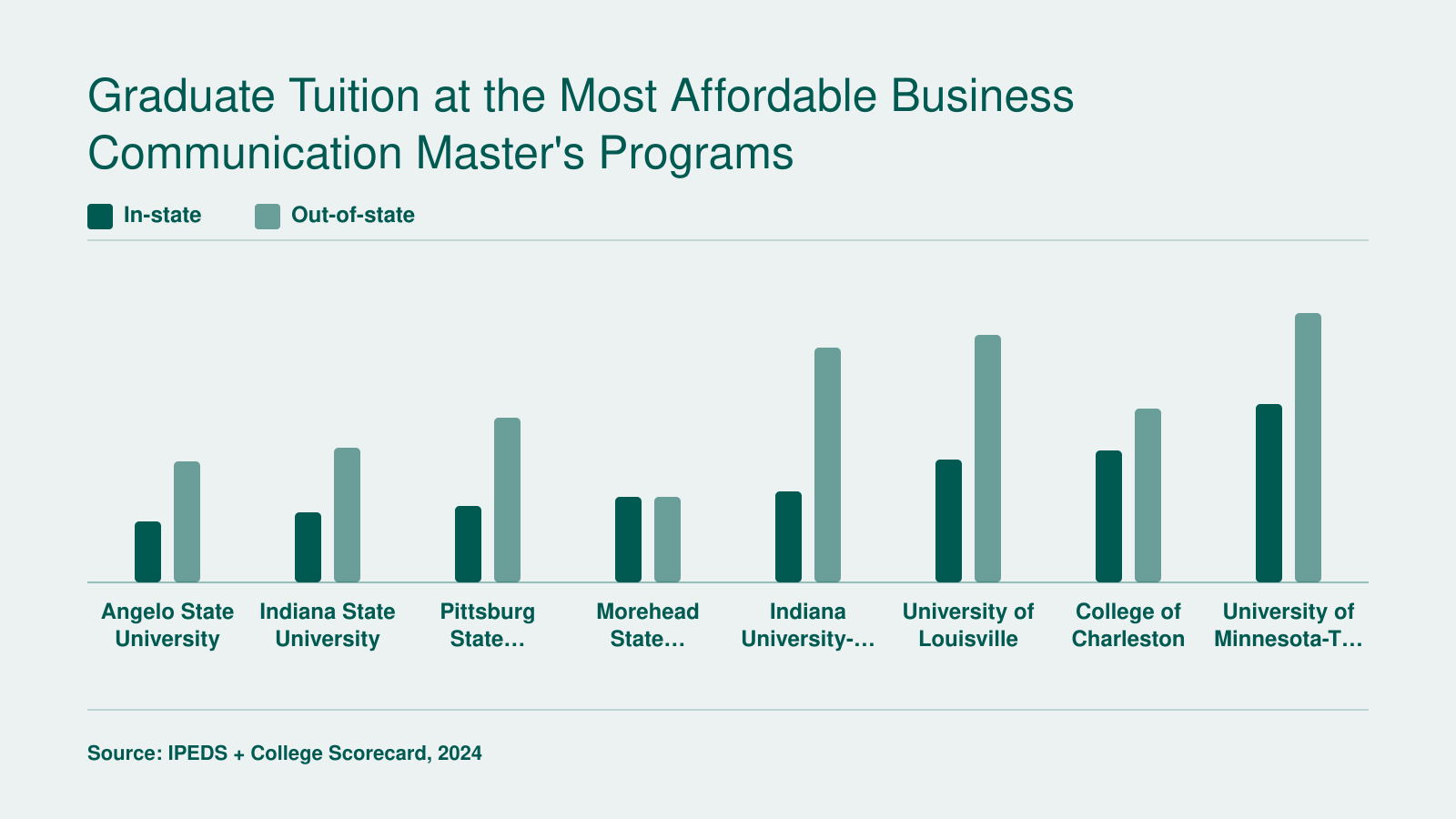
Graduate Tuition at the Most Affordable Business Communication Master's Programs
In-state and out-of-state graduate tuition plus fees are shown side by side for the lowest-cost schools here. Both figures are graduate tuition plus fees, while net price is an institution-wide average after aid and only an approximation of what a graduate student pays. The gap is widest at Indiana University-Indianapolis, where out-of-state tuition and fees run $17,784 above the in-state rate, followed by the University of Louisville at $15,418. Morehead State charges the same $10,512 to everyone in its online program, and online programs elsewhere sometimes use a flat rate too, so check the residency rules before assuming the higher price applies to you.
Accreditation, Admissions, and Application Requirements
Requirements vary by school, so treat the examples below as illustrations and confirm current terms with each admissions office before you apply.
- Institutional accreditationStart with the institution. It should be accredited by an accreditor recognized by the U.S. Department of Education (USDE) or the Council for Higher Education Accreditation (CHEA). Search the school in the USDE's DAPIP database or in CHEA's database, which covers roughly 8,200 institutions and 44,000 programs. Confirm the legal name, campus, accreditor, and status. A school saying it is 'accredited' doesn't tell you who accredited it or whether your program is covered.
- Business-school accreditation (AACSB)No single programmatic accreditor covers communication master's degrees. If the program sits in a business school, check for AACSB accreditation, which applies to the business school rather than each degree. Southeastern Oklahoma State University, home of a fully online MA in Business Communication, is AACSB accredited. Murray State's Organizational Communication program sits in the AACSB-accredited Bauernfeind College of Business. In neither case have we confirmed separate AACSB accreditation for the degree itself.
- Degree, GPA, and test requirementsExpect a bachelor's degree and a minimum GPA. Murray State asks for a 3.0 in the last two years of undergraduate study, plus at least a minor in communication, business, or a related field. It offers conditional admission at a 2.5, which may require prerequisite coursework and a review after the first nine credit hours. It requires no GRE. Many programs elsewhere are test-optional or will waive the GMAT or GRE, but policies differ, so verify each one.
- Supporting materialsMany programs request a resume, a statement of purpose or writing sample, and recommendations. Professional experience expectations range from preferred to not required. We could not confirm these details for the schools above, so check each program's application page. International applicants must show English proficiency. Murray State lists a TOEFL iBT minimum of 18 in each area for certain applicants and also accepts IELTS.
- Deadlines and start termsFall is the most common start, with spring entry at many schools. Online programs often use rolling admissions or several start dates per year. We could not verify current deadlines for the schools covered here, so confirm dates, and any earlier priority deadlines for funding, directly with each program.
Choose the program whose cost, format, and specialization line up with a specific career goal. A bigger name is not the better value if the numbers do not support it.
Communications programs by state
Frequently Asked Questions About Business Communication Master's Programs
These answers cover the questions prospective students ask most often about timing, value, careers, and eligibility. Details vary by school, so confirm requirements with each program before you apply.
How long does a master's in business communication take?
Is an online master's in business communication worth it?
What can you do with a master's in business communication?
Do you need a business undergraduate degree to apply to a business communication master's program?
Compare Communications programs on the data that matters
Explore more Business & Management specializations or browse every graduate field.
All Business & Management programs