Most Affordable Master's in Business Communication Programs
Compare 130+ accredited most affordable Communications programs at 120+ schools, with graduate earnings, cost, debt, and completion data from IPEDS and the U.S. College Scorecard.

Advertised tuition and the final bill rarely align. Among the ranked business communication programs, reported in-state tuition runs from $8,550 to $13,587 a year, but the effective net price after grant aid can land well below or above that headline figure. Business communication overlaps with communication management master's programs and related strategic and professional degrees, so the comparison includes programs under those names. A low sticker price matters less than the combination of net price, delivery format, and whether the program actually reports graduate earnings.
Key Points
- Flat online tuition means net price, not sticker price, decides affordability.
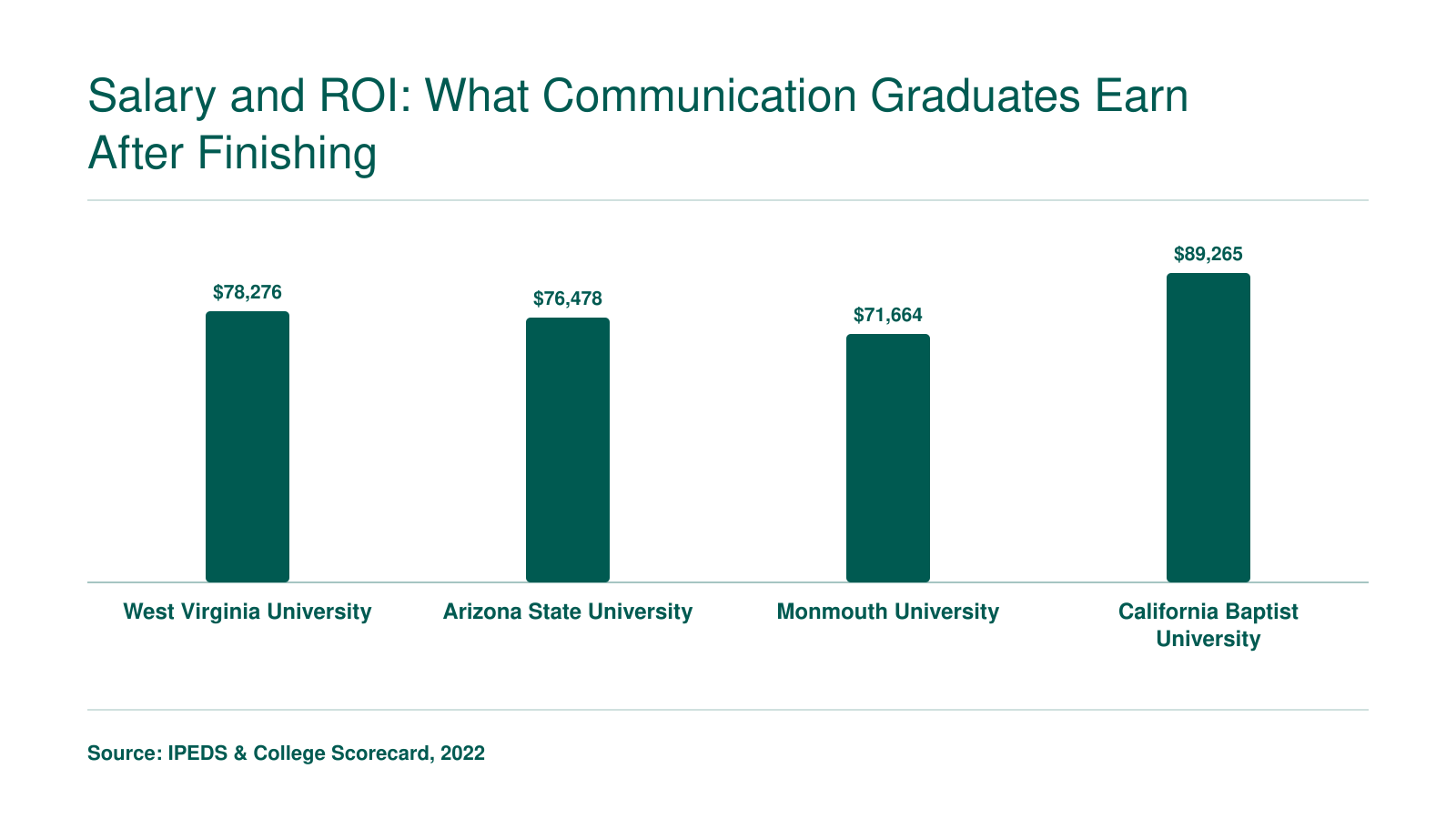
- Median earnings four years after finishing range from $71,664 to $89,265.
- PR and fundraising managers earned a median $136,470 in 2025.
Top 10 Most Affordable Business Communication Master's Programs
These ten master's programs in communication and strategic communication stand out for combining low net price with strong completion rates, but each approaches affordability differently. Use this list to compare format, cost structure, and career focus before you apply.
Arizona State University
#1Tempe, AZ · ~$14,000/yr (est.)
Best for: Out-of-state online learners
Arizona State University's Hugh Downs School offers a fully online master of arts in communication with a flat online tuition model that removes out-of-state pricing for remote learners. Three start dates per year and two sessions each term make it accessible for working professionals.
- Fully online program with no in-person requirement
- Three entry points per year, two sessions each term
- Faculty research spans health, intercultural, organizational, and interpersonal communication
Towson University
#2Towson, MD · ~$13,000/yr (est.)
Best for: Working professionals needing hybrid flexibility
Towson University's Master of Science in Communication Management is a 36-credit hybrid program that blends on-campus and online coursework, with at least half the degree available online. Required courses cover public relations, strategic communication, theory, research methods, and social media content strategy. Students can finish with comprehensive exams, a graduate project, or a thesis; the program also offers an accelerated bachelor's-to-master's track.
- 36 total credits with 15 required and electives
- At least 18 credits can be completed online
- Emphasis on public relations and strategic communication
- Capstone options include comprehensive exams, project, or thesis
- Accelerated bachelor's to master's pathway available
- Up to six graduate credits may transfer
Morehead State University
#3Morehead, KY · ~$11,000/yr (est.)
Best for: Busy professionals wanting fast online completion
Morehead State University's online Master of Arts in Communication is a 30-credit program that can be completed in as little as one year in a self-paced format. Core courses cover writing, research, and theory, while specialty options include organizational, intercultural, and small group communication. Admission offers multiple pathways, including a GRE alternative, making it accessible for working professionals.
- 30 total credits, complete in as little as one year
- Completely online with flexible, self-paced format
- Core courses in writing, research, and communication theory
- Specialty options in intercultural, organizational, and small group communication
- GRE alternative admission pathways available
- 2.5 GPA minimum for admission
- TOEFL required for non-native English speakers
Indiana University-Indianapolis
#4Indianapolis, IN · $11,000 – $29,000/yr (est.)
Indiana University Indianapolis offers a campus-based M.A. in Applied Communication with four concentration options, including corporate communication, health communication, and media studies. The program blends advanced theory with applied projects, preparing students for roles in public relations, corporate training, human resources, and management consulting. No GRE is required, and an optional 5-year BA/MA track lets undergraduates accelerate into the master's.
- Corporate communication concentration focuses on strategic messaging and stakeholder engagement
- Test optional: no entrance exam required
- Optional concentrations in four areas including corporate, health, and media
- Scholarships available with strong GRE scores
- Health communication concentration for public health and clinical settings
- Starts fall only
- GRE not required for admission
- Thesis or applied learning project capstone
- Media studies concentration explores media theory and digital media
- Requires B+ average to graduate
- Interdisciplinary electives allowed across programs
- Priority application deadline January 15
Southeastern Louisiana University
#5Hammond, LA · ~$9,000/yr (est.)
Southeastern Louisiana University offers a campus-based Master of Arts in Strategic Communication with a Strategic Sports Communication concentration. The 36-hour program includes a 15-hour core and flexible electives, and does not require an undergraduate degree in communication. Admission is open to students from any accredited bachelor's program, with provisional admission possible for GPAs below 3.0.
- 36 total credit hours, 15-hour strategic communication core
- Strategic Sports Communication concentration available
- No bachelor's degree in communication required
- Provisional admission for undergraduate GPA below 3.0
- Coursework covers media planning, digital content, and communication analytics
- Client strategic communication plan in final semester
Indiana State University
#6Terre Haute, IN · ~$9,000/yr (est.)
Indiana State University's campus-based Master of Arts in Communication offers four specializations: digital media, health communication, leadership, and public advocacy. The program typically takes two years and includes small-group learning with faculty who have award-winning professional experience. Graduates can complete a creative project, comprehensive exam, research project, or thesis, preparing them for careers in communications, public relations, and media.
- Four specializations: digital media, health, leadership, public advocacy
- 2-year on-campus program with small-group learning
- 2.8 GPA minimum and two recommendation letters required
- Accelerated master's option available
- Capstone choices include creative project or research project
State University of New York at Oswego
#7Oswego, NY · ~$13,000/yr (est.)
SUNY Oswego offers a campus-based Master of Arts in Strategic Communication through its Communication Studies department. The 33-credit program includes 18 core credits and 15 elective credits, covering persuasion, crisis communication, health campaigns, and integrated media. A strategic communication graduate internship is available, and the program serves both recent graduates and working professionals.
- 33 total credits: 18 core and 15 electives
- Choose five electives with an advisor
- Coursework includes crisis communication and health campaigns
- Integrated media and organizational life focus areas
- Graduate internship available
Illinois State University
#8Normal, IL · ~$10,000/yr (est.)
Illinois State University's Master's in Communication is a nationally recognized program that won the National Communication Association's Outstanding Master's Program Award. The campus-based program covers organizational, instructional, interpersonal, and mass communication, as well as public relations and rhetoric. Graduate assistantships provide tuition waivers and stipends, making it a strong value for full-time students.
- National Communication Association Outstanding Master's Program Award winner
- Graduate assistantships offer tuition waiver and monthly stipend around $1,300
- Faculty expertise spans organizational, instructional, and mass communication
- Prepares for teaching, training, PR, media management, or Ph.D.
- Research areas include organizational communication and rhetoric
- 3.0 GPA minimum and three letters of recommendation required
Troy University
#9Troy, AL · $5,000 – $10,000/yr (est.)
Troy University offers a fully online Master of Science in Strategic Communication that can be completed in under a year through nine-week terms with five start dates annually. The curriculum covers audience analysis, digital media strategy, crisis communication, and message development, and students build a portfolio of work. No application deadline and no campus visits make it flexible for working professionals.
- Complete in under one year with nine-week terms
- Five start dates per year, rolling admission
- Fully online, asynchronous classes
- Curriculum covers crisis management and digital media strategy
- Capstone project required
- Scholarships available; adjust course load each term
West Virginia University
#10Morgantown, WV · ~$11,000/yr (est.)
West Virginia University's online Master of Arts in Strategic Organizational Communication is a 30-credit program taught through 8-week asynchronous classes. No GRE or communication background is required, and students can finish in one year if they take a heavier load, though most finish in two. Provisional admission is available for GPAs below 2.75, and up to six transfer credits are accepted.
- 30 total credits, 8-week asynchronous online classes
- No GRE and no communication background required
- Complete in one year with accelerated pace, or two years typically
- Provisional admission available below 2.75 GPA
- Up to six transfer credits accepted
- No comprehensive exam; capstone optional
Cost & outcomes by school
Federal data for the highest-earning Communications programs, independent of the ranking above. Earnings are this field's master's graduates four years after completing, where the Scorecard reports them.
| School | Earnings | Tuition / yr | Debt | Grads/yr | Format |
|---|---|---|---|---|---|
| Georgetown University DC | $115,091 | $61,670 | $49,149 | 187 | Campus |
| George Washington University DC | $101,932 | $36,414 | $51,254 | 68 | Campus |
| Marist University NY | $90,060 | $17,200 | $20,656 | 40 | Online |
| California Baptist University CA | $89,265 | $15,562 | $23,171 | 13 | Online |
| Trinity Washington University DC | $86,961 | $15,660 | — | 4 | Online |
| DePaul University IL | $83,583 | $23,358 | $34,969 | 18 | Campus |
| The University of Texas at Austin TX | $83,467 | $12,006 | $47,657 | 35 | Campus |
| Texas Tech University TX | $81,195 | $9,518 | $22,489 | 46 | Online |
| University of Oregon OR | $79,716 | $19,474 | $29,606 | 21 | Hybrid |
| West Virginia University WV | $78,276 | $11,412 | $39,224 | 154 | Online |
| Florida State University FL | $77,547 | $10,553 | $31,020 | 62 | Online or campus |
| Southern New Hampshire University NH | $70,574 | $21,387 | $44,769 | 182 | Online |
Sources: U.S. Department of Education. Tuition and graduates: IPEDS. Earnings and debt: College Scorecard, this field's master's graduates; a dash means no figure is reported.
Cost, debt & payoff
Median earnings of this field's master's graduates (4 yrs after completing) vs. their median federal loan debt · U.S. College Scorecard
Across these programs the median graduate earns about $81,195 and finishes with roughly $44,464 in debt — a ratio that clears a common rule of thumb (keep debt below first-year salary). Tuition and debt vary widely school to school, so check the per-school figures in the table above before you shortlist.
What a Business Communication Master's Really Costs: Sticker Price vs. Net Price
Flat-rate online pricing has quietly weakened the old rule that residency decides what you pay for a Master's in Business Communication, so the published in-state figure is a less reliable guide than it once was.
Residency still moves the number at most schools
Morehead State charges the same program tuition to residents and nonresidents, at $10,512. Elsewhere the gap is severe: Angelo State lists $7,509 in-state against $14,889 out-of-state, and Troy University $8,550 against $17,100, both roughly double. Indiana State runs $8,596 versus $16,642. Check whether your target online Master's in Business Communication program offers a flat online rate before assuming you are priced out.
Fees and books are the hidden layer
Tuition rarely stands alone. Public universities commonly add technology fees in the range of $100 to $500 per term, distance-learning charges starting around $35 per credit, proctoring fees of $25 to $100 per exam, and a graduation fee of roughly $50 to $200. Books and course materials can run $1,000 to $3,000 across a degree. These are planning ranges, not quotes, and some schools waive or bundle them.
Build your own estimate
Multiply the per-credit rate by required credits (often 30 to 36), add per-term fees times the number of terms you will enroll, then add books and a graduation fee to estimate the total cost of a master's degree. Treat any published net price as an institution-wide average after aid, useful for comparison but never a figure to budget against.
Salary and ROI: What Communication Graduates Earn After Finishing
Program-level median earnings four years after finishing range from $71,664 at Monmouth University to $89,265 at California Baptist University. Published median program debt sits between $23,171 at California Baptist and $44,159 at Arizona State, with 10-year monthly payments from $264 to $502. That gap is the practical return-on-investment lens.
Related Articles
Online vs. Campus: Where the Cheapest Business Communication Degrees Are
Washington State University charges in-state tuition to every student in its fully online, 30-credit M.A. in Strategic Communication, no matter where they live. Arkansas State takes a similar approach: $350 per credit for all U.S. residents, about $10,500 total with fees included, though the rate can change from year to year. Morehead State lists the same $10,512 tuition for residents and nonresidents. Not every online program works this way. UMGC, for example, charges $555 per credit in-state and $659 out-of-state.
Check for Required Campus Visits
An "online" label does not always mean fully remote. Gonzaga requires a three-day campus immersion, and Syracuse builds in two weekend immersions. Towson's hybrid Communication Management M.S. lets you complete 18 units online, but its comprehensive exams are held on campus. Before you apply, confirm that the school is authorized to enroll online students in your state, especially if you're comparing No-GRE master's programs, because state authorization rules vary.
Which Format Fits You
Affordable online master's degree in communications programs at Arizona State, Morehead State, Troy, and West Virginia University suit working professionals and out-of-state students who want to avoid relocating and paying nonresident premiums. Campus programs at Illinois State, Indiana State, SUNY Oswego, and Southeastern Louisiana make more sense if you're hoping for a graduate assistantship, since those positions are usually tied to on-campus enrollment.
Public relations and fundraising managers, a path many business communication graduates follow, earned a median of $136,470 a year in 2025, according to the Bureau of Labor Statistics. BLS projects 6% job growth through 2035, faster than average.
Accreditation, Financial Aid, and Scholarships That Lower Your Cost
As communication degrees splinter into business, strategic, and corporate tracks, accreditation remains the one credential that determines whether your tuition qualifies for federal aid at all.
Start With Institutional Accreditation
Regional (institutional) accreditation is the baseline. Without it, you cannot access federal student aid, and most employers won't approve tuition reimbursement for the degree. No single programmatic accreditor covers business communication master's programs across the board, so don't expect a universal seal. AACSB accreditation shows up only when the degree lives inside an accredited business school: Southeastern Oklahoma State's business school is AACSB accredited.1 Arkansas State's business school is AACSB accredited, and Delaware's Lerner College is as well, though AACSB typically covers the business unit rather than automatically every communication degree. Verify the specific program before assuming its seal applies.
Aid Levers Worth Chasing
- Graduate assistantships: Some programs pair a stipend with a tuition waiver, though these are more common on campus than online.
- Military and veteran benefits: Regent University participates in the Yellow Ribbon Program and offers military discounts, as detailed on its scholarships and financial aid page.
- Employer programs: Regent's Corporate Partners Program extends tuition discounts, and schools like Florida encourage checking your employer's reimbursement policy.
- Institutional scholarships: Delaware's Lerner College lists a 20% scholarship for 2026-2027, though it cannot combine with other university funding.2
Match the Title to Your Search
Business communication, master's in strategic communication, and corporate communication are distinct degrees. Search all three titles to surface the lowest-cost option that fits your goals.
Communications programs by state
Frequently Asked Questions About Affordable Business Communication Master's Programs
What is the cheapest master's in business communication?
How long does a business communication master's take?
What are the most affordable master's in business communication programs for international students?
When are application deadlines, and do these programs require the GRE?
Compare Communications programs on the data that matters
Explore more Business & Management specializations or browse every graduate field.
All Business & Management programs